Sir Arthur Conan Doyle’s The Adventures of Sherlock Holmes collects 12 short stories featuring the world’s most famous detective — a master of deduction, disguise, and solving the impossible. Published in 1892, it established the template for all subsequent detective fiction.
🔍
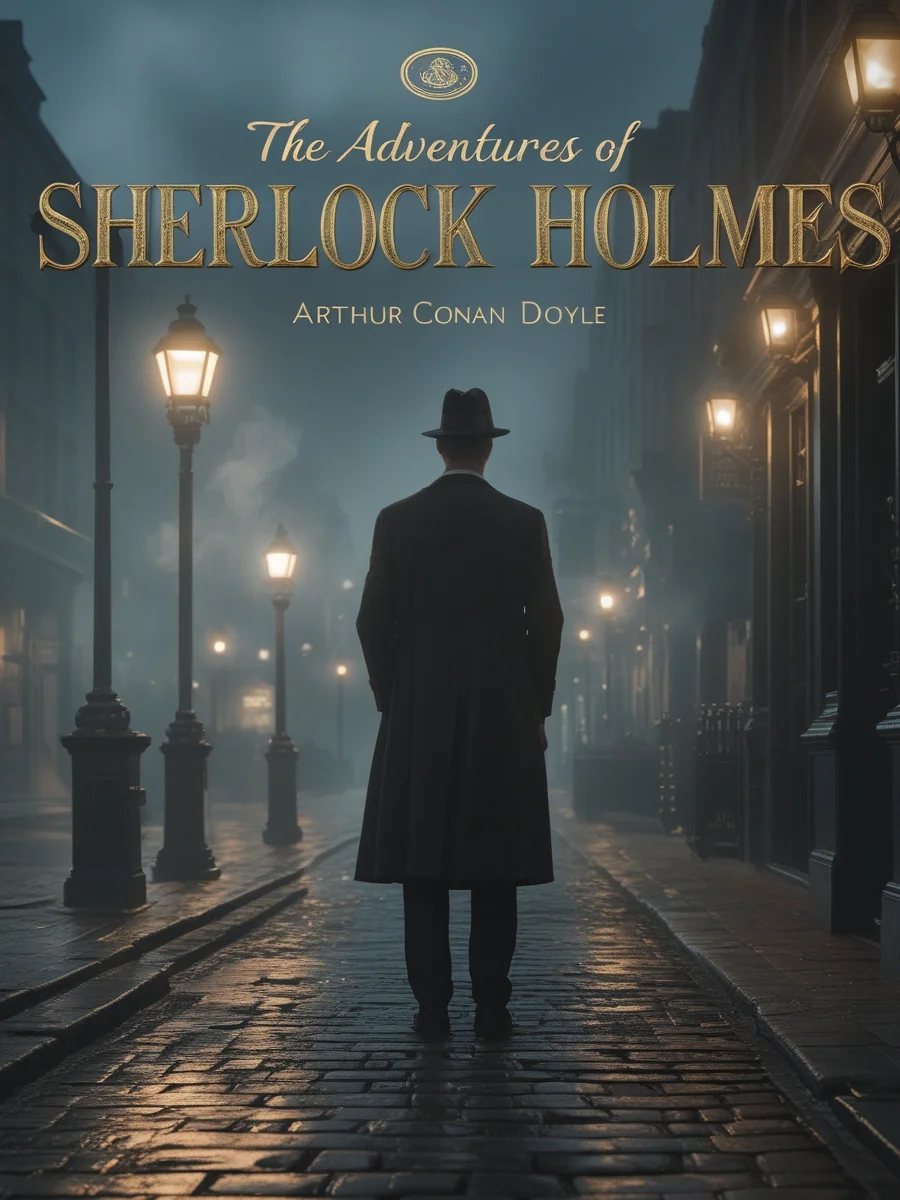
The Adventures of Sherlock Holmes
12 short stories featuring the world's most famous detective — a master of deduction, disguise, and solving the impossible. The collection that defined detective fiction.
| Author | Sir Arthur Conan Doyle |
| Published | 1892 |
| Genre | Detective fiction, mystery, short story collection |
| Chapters | 12 (12 short stories) |
| Setting | 1890s London — 221B Baker Street, country estates, and the foggy streets of Victorian England |
| Legacy | The most famous detective in literary history; established the template for all subsequent detective fiction |
🔍 The Stories
The collection opens with “A Scandal in Bohemia,” in which Holmes meets his match in the brilliant Irene Adler — the only woman ever to outwit him. In “The Red-Headed League,” a bizarre job posting conceals a clever bank robbery scheme. “The Adventure of the Speckled Band” sees Holmes racing to save a young woman from a sinister stepfather and a deadly snake.
“The Five Orange Pips” brings Holmes face-to-face with the Ku Klux Klan. “The Man with the Twisted Lip” involves an opium den and a mystery that resolves with unexpected simplicity. In “The Adventure of the Blue Carbuncle,” a stolen jewel turns up inside a Christmas goose, leading Holmes on a merry chase through London’s Christmas markets.
Each story follows a similar but never repetitive structure: a client arrives at Baker Street with a puzzling problem, Watson is intrigued, Holmes observes what no one else can see, and the mystery unravels through a combination of deduction, disguise, and daring. The stories are remarkably varied — some are cozy puzzles, others are genuinely frightening — but all showcase Holmes’s extraordinary mind.
🎭 Key Characters
Sherlock Holmes
The first and greatest fictional detective, Holmes combines scientific method with extraordinary observation. He notices the mud on a client’s boot, the calluses on a violinist’s fingers, the wear pattern on a walking stick — and from these details, he constructs entire biographies. He is brilliant, eccentric, arrogant, and utterly compelling.
Dr. John Watson
Holmes’s loyal companion, chronicler, and foil, Watson is the reader’s surrogate. He is intelligent and capable but lacks Holmes’s singular gifts, which allows the reader to experience Holmes’s deductions with fresh wonder. Watson’s warmth and decency balance Holmes’s cold intellectualism.
Irene Adler
Known as “The Woman,” Adler is the only person to outwit Holmes. She appears in only one story but made such an impression that she became a permanent part of the Holmes mythology. Her intelligence and independence made her a remarkable character for 1892.
Inspector Lestrade
The Scotland Yard detective who regularly calls on Holmes for help. Lestrade is capable but unimaginative — he sees the obvious but misses the extraordinary. He represents the gap between competent police work and Holmes’s genius.
📖 Literary Significance
The Adventures of Sherlock Holmes defined the detective fiction genre. Before Holmes, detective stories were rare and often crude. After Holmes, every fictional detective — from Hercule Poirot to Philip Marlowe to Monk — exists in the shadow of Doyle’s creation.
The stories established the conventions that the genre still follows: the brilliant detective, the loyal companion, the bumbling police, the locked-room mystery, the dramatic reveal. Doyle’s genius was not just in creating Holmes but in creating a framework that proved endlessly adaptable.
Holmes’s methods — observation, deduction, forensic science, disguise — were revolutionary. Doyle anticipated real investigative techniques by decades, and Holmes’s emphasis on evidence over intuition influenced actual police work. The stories remain not just entertaining but genuinely clever, with puzzles that reward careful reading.
✨ What Makes the DodaBooks Edition Special
This is the original 1892 text, carefully prepared for modern readers without distractions or clutter.
Zero Distractions
No ads, no license pages, no project boilerplate — just the original stories, clean and uninterrupted.
Smart Typography
Curly quotes, em-dashes, proper ellipsis — typeset with care for a premium reading experience.
Chapter Navigation
Full table of contents with back-to-story links in every section — jump between all 12 stories effortlessly.
Cleaned & Polished
All Gutenberg boilerplate stripped, consistent formatting throughout the text.
No DRM
You own your copy — read on any device, anytime, forever.
Instant Download
EPUB + PDF + AZW3 formats included, delivered instantly after purchase.
🏛️ Historical Context: London in 1892
The Adventures of Sherlock Holmes appeared at the perfect moment for detective fiction. Published in book form in 1892, the stories had first run in The Strand Magazine between 1891 and 1892, where they became a phenomenon — readers queued to buy each issue and gossiped about the cases as if Holmes were a real man. The illustrated format, with Sidney Paget’s now-iconic drawings of Holmes in his deerstalker and cape, fixed the detective’s image in the public imagination forever.
The 1890s were a decade of rapid change in England — the growth of a literate middle class, the rise of mass-market magazines, and a new faith in science and rational inquiry. Holmes embodied that faith. Where earlier detectives relied on luck or confession, Holmes applied systematic observation and forensic reasoning, and Victorian readers, newly enthusiastic about what science could achieve, found him irresistible. Understanding this context helps you see why the stories caught on so quickly: they made the modern world feel readable, ordered, and ultimately knowable.
🔮 Why Holmes Still Captures Us
More than 130 years later, Holmes remains the most recognisable detective in any medium. Part of his staying power is simply the brilliance of the puzzles, but a larger part is the character himself. Holmes is the fantasy of pure reason — a mind that never misses a detail, that reads an entire life from a cuff or a hat. In a messy world, his ordered deductions offer a satisfying sense of control.
The partnership with Watson is equally important to the appeal. Holmes sees everything and knows everything, but he is cold and strange; Watson is warm, ordinary, and lets us follow along. Their friendship — brilliant loneliness balanced by steady loyalty — is as much the reason these stories endure as the mysteries themselves. This is the volume where that relationship is at its most joyful.
🧭 How to Read This Collection
Because each of the twelve stories is self-contained, there is no wrong way to begin. Still, a few approaches reward new readers. Start with “A Scandal in Bohemia” and “The Red-Headed League,” the two most famous entries, to meet Holmes and Watson when they are at their best. Then let the volume run in order and note how Doyle plays with the formula — a locked-room murder in one story, a domestic puzzle in the next.
It is worth slowing down to watch Holmes’s method as it develops across the collection. On a first read you will be swept along by the cases; on a second, pay attention to his opening monologues, which are miniature lessons in observation. Each story is short enough to finish in a single sitting, which makes the volume ideal for reading one case at a time. To see where this detective’s story began, our guide to A Study in Scarlet covers the first Holmes novel, while The Sign of the Four follows it as the second novel in the series.
📖 The Stories Behind the Stories
Several Adventures grew from real events and everyday oddities, which lends them a documentary feel. “The Adventure of the Engineer’s Thumb,” with its hidden machinery and mutilated victim, was inspired by a contemporary Swiss story Doyle had heard; “The Blue Carbuncle,” set at Christmas, reflects the holiday boom in contemporary London. Even the more gothic entries, like “The Speckled Band” with its death-dealing snake, were grounded in newspaper reports and Doyle’s medical training.
If you enjoy tracing these connections, the later collection The Memoirs of Sherlock Holmes continues the same blend, and The Hound of the Baskervilles shows Doyle at the height of his powers in novel form.
❓ Frequently Asked Questions
Which stories are in this collection?
The 12 stories are: “A Scandal in Bohemia,” “The Red-Headed League,” “A Case of Identity,” “The Boscombe Valley Mystery,” “The Five Orange Pips,” “The Man with the Twisted Lip,” “The Adventure of the Blue Carbuncle,” “The Adventure of the Speckled Band,” “The Adventure of the Engineer’s Thumb,” “The Adventure of the Noble Bachelor,” “The Adventure of the Beryl Coronet,” and “The Adventure of the Copper Beeches.”
Do I need to read the stories in order?
No. Each story is self-contained, and you can read them in any order. However, Watson’s relationship with Holmes develops gradually, and some readers prefer to start with “A Scandal in Bohemia” for the strongest introduction to both characters.
How long does it take to read?
At 193 pages in the DodaBooks edition, most readers finish the collection in 4-6 hours. The stories are ideal for reading one or two at a time, making it perfect for short reading sessions.
Is Irene Adler in this collection?
Yes — she appears in the first story, “A Scandal in Bohemia.” Despite appearing in only one story, she became known as “The Woman” — the only person ever to outwit Holmes — and remains one of the most iconic figures in the Holmes canon.
What's the best starting point for Holmes?
This collection is the ideal starting point. It contains the most famous and representative stories, introduces Holmes and Watson at the height of their powers, and showcases the full range of Doyle’s storytelling. From here, you can explore the later novels and story collections.
Is this collection different from the other Sherlock Holmes books?
Yes. The Adventures is the first of the five short-story collections, gathering twelve tales originally published in The Strand Magazine. It differs from the novels like A Study in Scarlet or The Hound of the Baskervilles in that each chapter is a complete, self-contained mystery rather than one long storyline. It also showcases Holmes and Watson at their most energetic, before the darker tone of the later collections.
Are there any supernatural elements in these stories?
No — and that is precisely the point. Doyle wrote ordinary, solvable mysteries, and any apparently ghostly or impossible detail always turns out to have a rational explanation. This grounded, evidence-based approach was central to the appeal and helped establish the realistic tradition of detective fiction that followed.
📚 Related Articles
🔍 Read the Original Detective Stories
The Adventures of Sherlock Holmes is the collection that defined detective fiction. The DodaBooks edition preserves all 12 original stories in a clean, distraction-free format:
- ✅ Complete 12-story collection — every word of the 1892 edition
- ✒️ Smart typography — curly quotes, em-dashes, proper ellipsis
- 📜 Full table of contents with story navigation
- 🔒 DRM-free — read on any device, anytime
- 📥 Instant download — EPUB + PDF + AZW3 formats