Teaching the Declaration of Independence to high school students? This guide breaks down the document’s historical context, the 56 signers’ stories, and key classroom activities for grades 9-12 American history.
Teaching Declaration of Independence: Complete Guide
A complete guide to teaching the Declaration of Independence — historical context, the five-part structure, signer biographies, visual resources, and ready-to-use classroom activities.
👉 Get the Annotated Edition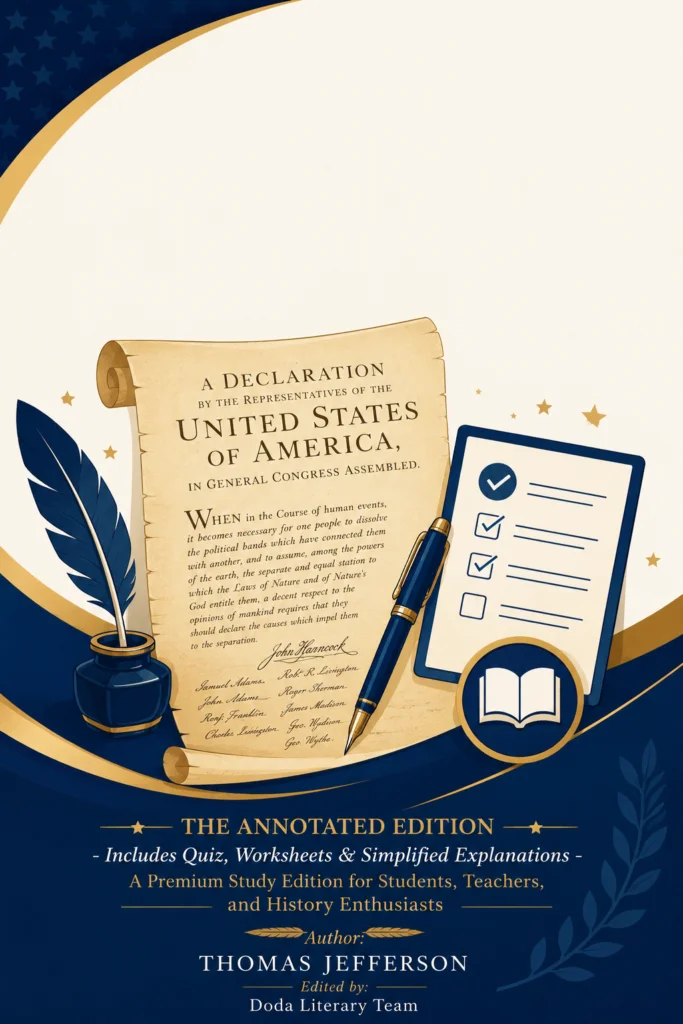
| Document | Declaration of Independence |
| Adopted | July 4, 1776 |
| Signers | 56 delegates |
| Principal Author | Thomas Jefferson |
| Structure | 5 sections: Introduction, Preamble, Grievances, Conclusion, Signatures |
📚 Why the Declaration Matters in Your Classroom
The Declaration of Independence is more than a founding document — it’s a revolutionary argument about human rights, government legitimacy, and the right to challenge unjust authority. Students encounter it in nearly every American history course, but many never move beyond the famous opening lines to understand its full structure, the grievances against King George III, or the human stories behind the 56 signatures.
The challenge is that the Declaration’s language is dense, its historical context is unfamiliar to modern students, and the document itself is often taught as a static artifact rather than a living argument.
Teaching it well means making the stakes feel real.
📖 What the Declaration Actually Says
Before diving into the signers and the Revolution, students need to understand the document’s five-part structure:
Introduction: Why the colonies are explaining themselves to the world Preamble: The philosophical foundation — natural rights, consent of the governed, right of revolution Grievances: 27 specific complaints against King George III Conclusion: The colonies’ declaration of independence Signatures: 56 men who put their names — and their lives — on the line
The preamble gets most of the attention, but the grievances section is where students can see exactly what pushed the colonies to revolt: unfair taxes, lack of representation, dissolved legislatures, quartered troops, and more.
👤 The 56 Signers: Stories Your Students Need to Know
The signers weren’t a unified block of wealthy landowners. They were merchants, farmers, lawyers, and doctors from every colony. Some were rich, others were in debt. Some owned slaves, others opposed the practice.
Here are a few stories that resonate with students:
John Hancock (Massachusetts): President of the Continental Congress — his famously large signature was a statement of defiance. He told Congress they needed to “hang together” or they’d “hang separately.”
Benjamin Franklin (Pennsylvania): At 70, the oldest signer. Already world-famous as a scientist, inventor, and diplomat. His wit and wisdom kept the Congress together during tense debates — and his own memoir, covered in our guide to Franklin’s Autobiography, tells the story in his own words.
Robert Morris (Pennsylvania): “The Financier of the Revolution” — he personally funded the Continental Army when the government couldn’t. He spent his personal fortune on the war and died in debt.
Charles Carroll (Maryland): The wealthiest man in America at the time. He signed knowing the British would specifically target him for his wealth and influence.
John Adams (Massachusetts): The leading advocate for independence on the Congress floor. He later said July 2nd (the vote for independence) would be celebrated, not July 4th.
Thomas Jefferson (Virginia): The principal author — chosen because he was a skilled writer from Virginia and Adams trusted him. Jefferson wrote the draft in 17 days.
🖼️ Teaching the Signers with Visuals
The DOI Annotated Edition includes 45 signer portraits extracted from a 1973 National Parks Service publication, each with expanded biographical sketches. Students can see the faces behind the signatures — a reminder that these were real people making an extraordinary choice.
🏛️ Historic Sites and Visual Context
Independence Hall in Philadelphia — then called the Pennsylvania State House — is where the signing happened. The Assembly Room has been restored to its 1776 appearance, and photographs help students imagine the cramped, contentious space where history was made.
🎯 Classroom Activity Ideas
Founding Document Jigsaw: Split the class into five groups, assign each group one section of the Declaration (introduction, preamble, grievances, conclusion, signatures). Each group becomes the expert on their section, then teaches the rest of the class.
Rewrite the Grievances: Have students translate each grievance into modern English. Which ones would still apply today?
Signer Resume: Students pick one signer and create a resume or LinkedIn-style profile for them.
Declaration vs. Modern Government: Compare the grievances about quartered troops and dissolved legislatures to modern debates about government power.
Silent Debate: Post four interpretations of a key line from the preamble around the room. Students move to the one they agree with most, then defend their choice in writing.
📚 Get the complete annotated edition with classroom-ready resources
👉 Get the Annotated Edition🎓 What the Annotated Edition Unlocks for Teachers
Full Annotated Text
The complete Declaration with historical annotations, modern translations, and vocabulary definitions for every section.
45 Signer Portraits
Biographical sketches and portraits of every signer — use for gallery walks, profiles, and discussions.
Historic Photographs
Images of Independence Hall, Carpenters' Hall, and the National Archives to provide visual context.
Classroom Worksheets
Ready-to-print worksheets, quiz questions, and a complete answer key — no prep time needed.
Modern Translations
Every section of the Declaration translated into modern English so students understand the arguments.
Digital Format
Works on all devices — project in class, share with students, or use for remote learning.
🕰️ The Road to July 4, 1776
The Declaration did not come out of nowhere. British taxes and laws after 1763 — the Stamp Act, the Townshend duties, the Coercive Acts — pushed the colonies toward rebellion over more than a decade of protest. By 1774 the First Continental Congress had met to organize resistance, and by 1775 the first shots of the Revolution had been fired at Lexington and Concord. When Richard Henry Lee proposed independence in June 1776, a committee of five — Jefferson, Adams, Franklin, Sherman, and Livingston — was appointed to draft the case. Jefferson wrote the draft in seventeen days. Congress debated it for three, trimmed the text, and adopted it on July 4.
⚖️ The Grievances: The Case Against a King
The famous preamble gets most of the classroom attention, but the grievances are the heart of the argument — 27 specific charges against George III, from unfair taxation to dissolved legislatures to standing armies warehoused in peacetime. Encourage students to read the grievances as a legal brief. Each one names a concrete abuse the colonies had actually lived through. When students realize the Declaration is a court case and not just a slogan, the document snaps into focus. Have them practice by pairing each grievance with a small-group “case file” reconstruction of the real events behind it.
📰 How Americans First Heard About It
The Declaration was announced, not emailed. Printers raced to set type, copies were read aloud in town squares, and on the evening of July 9 a crowd in New York tore down the gilded lead statue of George III, melting it into bullets. Localities responded at their own pace — some ratified the text the same week it reached them, others took months. Newspapers and broadsides spread the words across the colonies and then across Europe. Teaching this circulation turns the document from a text into an event, and it helps students understand why the Declaration’s language reached so many people so fast.
🗓️ A One-Week Teaching Arc
- Day 1 — Set up the road to independence with the historical context, read the Introduction, and present the five-part structure.
- Day 2 — The Preamble. Pair the original with the modern translation, then run a Silent Debate on “all men are created equal.”
- Day 3 — The Grievances. Use the Rewrite the Grievances activity and the case-file approach above.
- Day 4 — The Signers. Use the 45 portraits and biographies for a gallery walk or a Signer Resume.
- Day 5 — The contradictions and legacy. Use the anti-slavery clause materials to open discussion, then the included quiz to check understanding.
🔥 Teaching the Contradictions Honestly
The Declaration’s ideals stand in tension with its own time — Jefferson’s draft included a clause condemning the slave trade, which Congress removed at the insistence of South Carolina and Georgia. Rather than hiding that, teach it. Students respect a document they can argue with, and the chain that runs from “all men are created equal” to the long fight against slavery is one of the most powerful through-lines in American history. Our guide to Frederick Douglass’s Narrative shows how an enslaved man turned the founders’ own language back on them.
❓ Frequently Asked Questions
What happened to the signers after independence?
The stories vary enormously. Five were captured by the British and tortured before dying. Twelve had their homes ransacked and burned. Nine died during the war from wounds or hardship. Several became US presidents, governors, and senators.
How long does it take to teach the Declaration?
A thorough unit takes 1–2 weeks. The annotated edition’s structure allows you to cover the full document in 3–4 class periods or dive deeper into specific sections.
What grade level is this appropriate for?
Grades 9–12. The language and concepts are suitable for high school American history, civics, and government classes.
Do I need to prep materials before class?
No. The annotated edition includes everything — annotated text, worksheets, quiz, answer key, and visual resources. Open and teach.
How do I handle the contradictions in the Declaration (e.g., slavery)?
The annotated edition includes context about Jefferson’s original anti-slavery clause that was removed from the final draft. Use this as a discussion point about the document’s moral complexities.
Can I use this for AP US History?
Yes. The historical annotations, context sections, and primary source analysis support APUSH curriculum requirements for document analysis.
Why does the Declaration list 27 grievances?
The grievances are the evidence in the case for separation — specific, documented abuses that justified the leap from protest to independence. They let the colonists address “a candid world” as reasonable men presenting a legal brief, not a tantrum.
How can I use the 45 signer portraits in class?
Use them for a gallery walk, signer profiles, mock interviews, or a “which signer would you want on your team?” discussion. Each portrait comes with a biographical sketch, so students can build a full character study without extra research.
📚 Related Articles
Everything you need to teach the Declaration with confidence
Declaration of Independence Annotated Edition
Full annotated text with modern translations, 45 signer portraits, historic photographs, worksheets, quiz, and answer key.
👉 Get the Annotated Edition{ .cta-button }