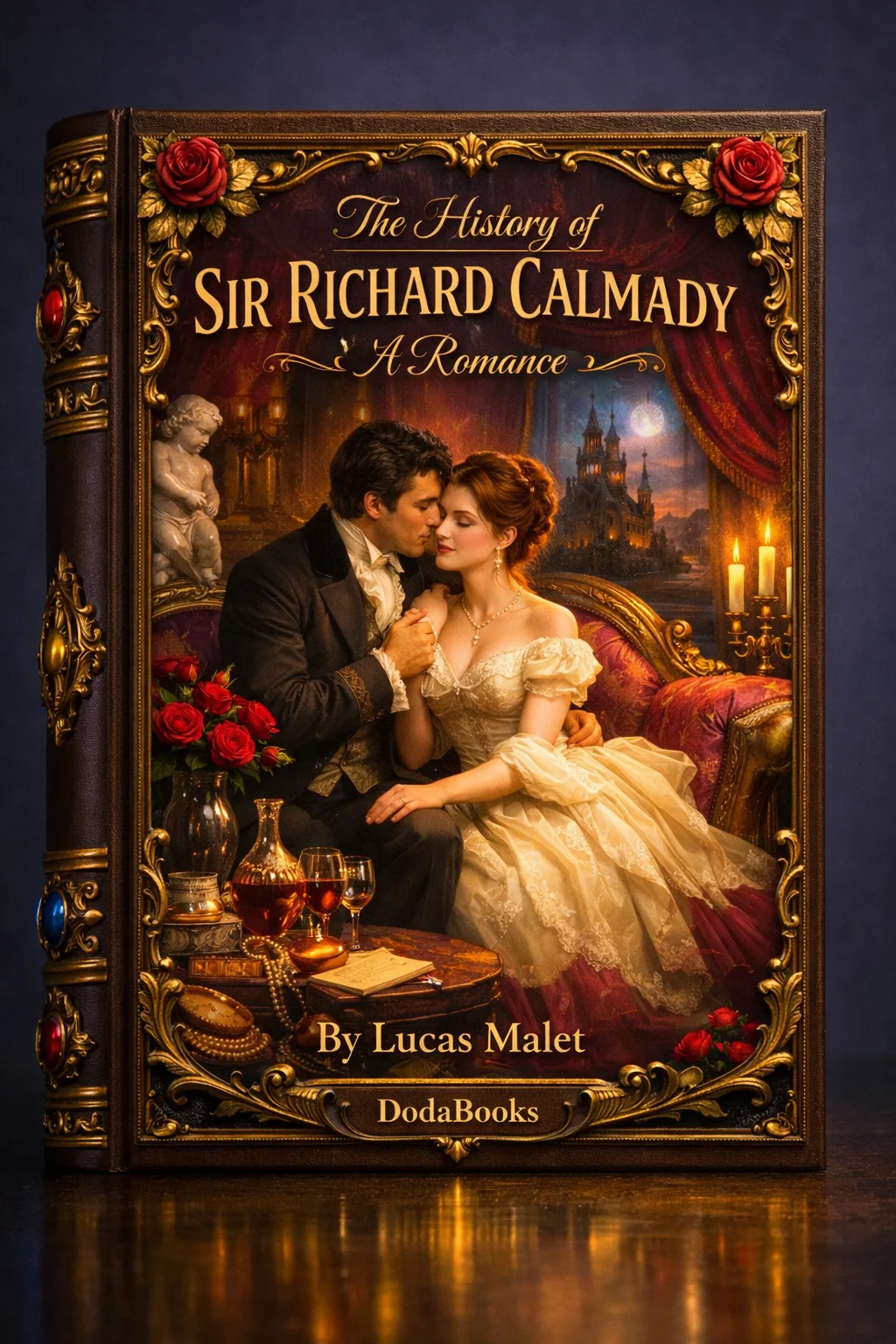
The History of Sir Richard Calmady: A Romance tells the story of a young heir whose life is irrevocably altered by a tragic accident. Born into wealth and privilege, Richard Calmady faces not only physical limitation but the cruel judgments of a society obsessed with appearance.
💕
The History of Sir Richard Calmady
A sweeping Victorian romance of love, deformity, and redemption — when a shocking accident leaves young Sir Richard Calmady physically disabled, he must navigate a world that judges him by his appearance whilst yearning for love and purpose.
| Author | Lucas Malet (Mary St. Leger Kingsley) |
| Published | 1901 |
| Genre | Victorian romance, psychological novel |
| Books | 6 (60 chapters) |
| Pages | 868 |
| Legacy | Nietzsche owned a copy; a rediscovered masterpiece of late Victorian fiction |
💕 The Story
Born into wealth and privilege at the majestic Calmady estate, young Richard is a golden child — beautiful, adored, and destined for greatness. But a tragic accident leaves him physically disabled, and his world transforms overnight. He must navigate a society that judges him by his appearance, a society that sees his deformity before it sees him.
As he grows to manhood, Richard’s journey becomes one of profound self-discovery. His relationships with the women who love him — his beautiful mother Katherine, the spirited Honoria St. Quentin, and the dangerously alluring Helen de Vallorbes — chart a path through passion, betrayal, and ultimately transcendence. His is a story of what it means to be human when the body fails but the spirit endures.
📖 Literary Significance
Lucas Malet was one of the most daring and psychologically astute novelists of the late Victorian era. The History of Sir Richard Calmady (1901) was considered scandalous for its frank treatment of physical disability and sexual desire — topics that polite society preferred to ignore. Nietzsche himself owned a copy, recognizing in its pages the kind of existential struggle that defined his own philosophy.
The novel is a masterwork of psychological realism. Malet’s prose is rich and immersive, her characterisation deep and sympathetic. Richard’s inner life — his rage, his longing, his eventual acceptance — is rendered with a sensitivity that was decades ahead of its time. The novel anticipates modern discussions of disability, body image, and the social construction of normalcy.
✨ What Makes the DodaBooks Edition Special
This edition brings Malet’s rediscovered masterpiece to modern readers in a clean, distraction-free format.
Zero Distractions
No ads, no license pages — just the complete text, clean and uninterrupted.
Smart Typography
Curly quotes, em-dashes, proper ellipsis — typeset with care for a premium reading experience.
Book Navigation
Full table of contents with navigation to each of the 6 books and 60 chapters — easily jump between them.
Cleaned & Polished
All Gutenberg boilerplate stripped, consistent formatting throughout the text.
No DRM
You own your copy — read on any device, anytime, forever.
Instant Download
EPUB format included, delivered instantly after purchase.
🏛️ Historical & Cultural Context
To appreciate why The History of Sir Richard Calmady caused such a stir, it helps to know how bold Malet was being for her time. The novel appeared in 1901, at the very end of the Victorian era, when respectable fiction was expected to avoid any frank treatment of physical desire — especially desire felt by someone society regarded as deformed. Public discussion of disability was rare, and when it did occur it usually leaned heavily on sentiment or pity. Malet refused both. She gave Richard a full inner life of longing and frustration, sexual as well as emotional, and treated his disability as a fact of his experience rather than a moral lesson for the reader.
This made her novel genuinely daring. That a woman writer — writing under the pseudonym Lucas Malet to keep her critical independence — would publish such a psychologically honest portrait was enough to mark the book as scandalous in some circles and important in others. The fact that Friedrich Nietzsche is said to have owned a copy speaks to the novel’s reach: here was a work of fiction engaging, from within, with the same questions of will, suffering, and the human refusal to be defined by the body that obsessed European philosophy at the turn of the century.
🔥 Themes: Desire, Disability, and Redemption
At its heart, the novel asks what it means to live a full life when the body fails. Desire is Malet’s great subject — she refuses to pretend that Richard’s physical limitation erases his longing for love and connection, and she follows honestly wherever that longing leads him, including into destructive choices (the allure of the dangerous Helen de Vallorbes) before he finds his way back. Social judgment is the relentless pressure throughout: a society obsessed with appearance sees Richard’s body before it sees him, and Malet shows how that external gaze shapes his internal sense of self. And underlying everything is redemption — the slow, hard-won movement from rage and self-pity toward acceptance and genuine love.
Readers who enjoy rich psychological portraiture in a Victorian setting will find this a rewarding novel to pair with other works in the period. Its interrogation of society’s expectations echoes the spirit of Elizabeth Gaskell’s portrait of a quietly defiant village community in our guide to Cranford, while its focus on constraint and inner life connects it to the great Victorian governess novel Jane Eyre, covered in our guide to Jane Eyre.
💡 What to Pay Attention To
Because the novel is long — six books and roughly sixty chapters — a little preparation makes the reading far more rewarding. Pay close attention to the three women who shape Richard’s life, since each represents a different path: his mother Katherine, whose love complicates his independence; the spirited Honoria St. Quentin, who offers a genuine chance at connection; and the dangerously alluring Helen de Vallorbes, who tempts him toward self-destruction. Tracking how Richard’s feeling toward each woman shifts is the surest way to follow his inner arc.
It is also worth noting how Malet uses the world around Richard to mirror his state of mind. The majestic Calmady estate, the social rituals of the landed gentry, and the weight of inheritance all act as a backdrop against which his personal struggle plays out. Reading in the six-book structure the edition provides — rather than trying to absorb the novel all at once — helps the psychological development land as it should.
📖 Why It Still Matters
The History of Sir Richard Calmady matters today because it was decades ahead of its time. Long before modern conversations about disability, body image, and the social construction of normalcy, Malet was writing about them with empathy and psychological depth. Her novel refuses to sentimentalise disability, insists on the legitimacy of desire in a body society calls imperfect, and grants her hero a full, complicated humanity. For those reasons it has been rediscovered and celebrated as a hidden masterpiece of late Victorian fiction.
It is also simply a compelling story — a sweeping romance with real emotional stakes, told in prose of unusual richness. For readers who came to Victorian fiction through the gentler social novels of the period, Malet offers something bolder while staying firmly rooted in what makes the era’s fiction so beloved. The DodaBooks edition brings the complete six-book text to modern readers in a clean, distraction-free format, with full chapter navigation so you can pace the long narrative comfortably.
❓ Frequently Asked Questions
Is this a romance novel or something more?
It is both. At its surface, it is a sweeping Victorian romance. But Malet uses the romance to explore deeper themes: disability, desire, social judgment, and the human capacity for transcendence. It is as much a philosophical novel as a love story.
Who was Lucas Malet?
The pseudonym of Mary St. Leger Kingsley (1852–1931), daughter of the novelist Charles Kingsley. She was one of the most intellectually daring novelists of her era, and Sir Richard Calmady was her masterpiece — praised by critics and readers alike.
Why did Nietzsche own a copy?
The novel’s themes — the struggle against adversity, the will to transcend physical limitation, the questioning of conventional morality — resonated with Nietzsche’s philosophy. His ownership of the book is a testament to its intellectual ambition.
How long does it take to read?
At 868 pages across 60 chapters, most readers take 14-20 hours. The novel is structured in six books, making it easy to read in sections.
Is the novel difficult to read?
It is long and psychologically rich, but Malet’s prose is clear and immersive. Reading it in the six-book structure rather than all at once makes it approachable, and the psychological depth rewards the time spent.
Why is it described as "a romance"?
The subtitle, “A Romance,” signals its sweeping, emotionally intense love story. It is not a genre romance but a literary romance — one that uses the love story as a vehicle for profound questions about desire, disability, and self-acceptance.
Are there other Victorian novels like this?
Fans of Malet’s psychological depth often enjoy Bronte’s Jane Eyre and the social portraiture of Elizabeth Gaskell’s Cranford. John Oliver Hobbes’s Robert Orange is another late-Victorian novel exploring similar themes of passion and moral struggle.
📚 Related Articles
💕 Read the Rediscovered Victorian Masterpiece
The History of Sir Richard Calmady is a sweeping romance and a profound exploration of love, disability, and the human spirit — a hidden gem of late Victorian fiction. The DodaBooks edition presents Malet’s masterpiece in a clean, distraction-free format:
- ✅ Complete 6-book / 60-chapter text — every word of the classic
- ✒️ Smart typography — curly quotes, em-dashes, proper ellipsis
- 📜 Full table of contents with book and chapter navigation
- 🔒 DRM-free — read on any device, anytime
- 📥 Instant download — EPUB format
To step inside the authentic studios and bohemia of Victorian England’s greatest artistic revolt, explore our companion to Præraphaelite Diaries and Letters Guide.