Romeo and Juliet Summary Act by Act: Complete Scene-by-Scene Study Breakdown
William Shakespeare’s Romeo and Juliet (c. 1595–1596) is the most celebrated romantic tragedy in world literature. Set against the violent factional blood feud between the Montagues and Capulets in Renaissance Verona, the play dramatizes the intoxicating passion, secret marriage, and catastrophic demise of two “star-cross’d lovers.”
Shakespeare’s brilliance lies in compressing the narrative into roughly four days of relentless kinetic momentum. From the opening street brawl in the sweltering heat of Verona to the midnight double suicide inside the Capulet ancestral tomb, every scene propels the lovers closer to their tragic destiny. Whether preparing for literature exams or directing a stage performance, this scene-by-scene guide provides comprehensive narrative recaps, key quote analyses, and thematic breakdowns for all twenty-four scenes.
| Feature | Key Details |
|---|---|
| Playwright | William Shakespeare |
| Composition Date | Circa 1594–1596 (First Quarto published 1597) |
| Structure | 5 Acts, 24 Scenes + 2 Choral Prologues (approx. 3,007 lines) |
| Setting | Verona and Mantua, Northern Italy (14th / 16th Century) |
| Source Material | Arthur Brooke’s narrative poem The Tragical History of Romeus and Juliet (1562) |
| Timeline | Sunday morning to Thursday night / Friday dawn (less than five days) |
| Canonical Edition | DodaBooks Fully Annotated & Illustrated Edition of Romeo and Juliet |
☀️ Act I: Ancient Grudges, Masked Feasts, and Love at First Sight
Prologue: The Star-Cross’d Lovers
The Chorus delivers an iconic fourteen-line Shakespearean sonnet establishing the tragic premise: two noble families in fair Verona, equal in social dignity, renew an ancient civil grudge with fresh bloodshed. Caught in the crossfire of this ancestral hatred, two lovers take their lives, their death burying their parents’ strife. The Chorus asks the audience to lend two hours of patient hearing to their stage.
Act I, Scene 1: The Verona Street Brawl
On a sun-drenched Sunday morning in a public square in Verona, Capulet servants Sampson and Gregory banter about their hatred for the house of Montague. Sampson boasts of his aggression, declaring he will bite his thumb at the passing Montague servants Abram and Balthasar—an insulting gesture equivalent to an explicit challenge to violence. A sword fight erupts.
Benvolio, Romeo’s peaceful cousin, draws his sword to part the combatants (“Part, fools! Put up your swords; you know not what you do”). Immediately, Tybalt, Juliet’s fiery Capulet cousin, arrives with drawn blade, mocking Benvolio’s peaceful intentions: “What, drawn, and talk of peace? I hate the word, / As I hate hell, all Montagues, and thee.”
The brawl escalates as citizens and aging patriarchs Lord Capulet and Lord Montague join the fray. Prince Escalus arrives with his armed guard, halting the riot. Infuriated that three civil brawls have recently disturbed Verona’s quiet streets, Escalus decrees that any person disturbing the peace again will pay with their life (“If ever you disturb our streets again, / Your lives shall pay the forfeit of the peace”).
Once the crowd disperses, Montague and Lady Montague question Benvolio about Romeo’s whereabouts. Benvolio reports that he saw Romeo wandering alone at dawn through a sycamore grove, weeping and avoiding human contact. Romeo enters, confessing to Benvolio that he is hopelessly lovesick for a woman named Rosaline, who has sworn a vow of chastity. Romeo delivers a barrage of Petrarchan oxymorons (“O brawling love! O loving hate! / O heavy lightness! serious vanity!”). Benvolio urges Romeo to cure his obsession by examining other beauties, but Romeo insists his eyes can never forget her.
Act I, Scene 2: Paris’s Suit and the Servant’s List
Count Paris, a handsome young nobleman and kinsman of Prince Escalus, asks Lord Capulet for permission to marry his daughter Juliet. Capulet hesitates, pointing out that Juliet is not yet fourteen years old and urging Paris to wait two more summers (“My child is yet a stranger in the world; / She hath not seen the change of fourteen years”). However, Capulet invites Paris to his annual masquerade feast that evening to woo her.
Capulet sends an illiterate servant, Peter, into Verona with a guest list. Unable to read the names, Peter encounters Romeo and Benvolio on the street and asks for their assistance. Reading the list, Romeo discovers that Rosaline will be attending the Capulet banquet. Benvolio urges Romeo to crash the masked ball so he can compare Rosaline with Verona’s most radiant maidens and realize she is merely a crow compared to a swan. Romeo agrees to go, not to look at other women, but to gaze upon Rosaline.
Act I, Scene 3: Juliet, Lady Capulet, and the Nurse
In the Capulet mansion, Lady Capulet calls for her daughter Juliet. The bawdy, affectionate Nurse provides comic relief with an extended, rambling monologue recalling Juliet’s infancy, weaning, and her late husband’s coarse joke when toddler Juliet fell backward.
Lady Capulet introduces the subject of marriage, asking Juliet her thoughts on wedlock. Juliet replies demurely: “It is an honour that I dream not of.” Lady Capulet passionately promotes Count Paris, describing him as a glorious book of love lacking only a cover. Juliet obediently agrees to observe Paris at the feast: “I’ll look to like, if looking liking move; / But no more deep will I endart mine eye / Than your consent gives strength to make it fly.”
Act I, Scene 4: Mercutio’s Queen Mab Speech
Sunday evening. Romeo, Benvolio, and their charismatic, sharp-tongued friend Mercutio approach the Capulet mansion wearing festive masks and carrying torches. Romeo is weighed down by heavy foreboding, refusing to dance because of a warning dream.
Mercutio mocks Romeo’s romantic superstition with his legendary Queen Mab speech, describing the miniature fairy midwife who gallops through lovers’ brains, courtiers’ knees, and soldiers’ necks, delivering dreams tailored to human vanity and appetite (“True, I talk of dreams, / Which are the children of an idle brain, / Begot of nothing but vain fantasy”).
As they prepare to enter the feast, Romeo experiences a sudden, prophetic shiver of doom:
“My mind misgives / Some consequence yet hanging in the stars / Shall bitterly begin his fearful date / With this night’s revels and expire the term / Of a despised life closed in my breast / By some vile forfeit of untimely death.”
Act I, Scene 5: The Masquerade Ball and Love’s Shared Sonnet
Inside the candlelit great hall, Capulet warmly welcomes the masked guests. Across the ballroom, Romeo catches sight of Juliet dancing. In an instant, his infatuation with Rosaline vanishes like smoke:
“O, she doth teach the torches to burn bright! / It seems she hangs upon the cheek of night / Like a rich jewel in an Ethiop’s ear; / Beauty too rich for use, for earth too dear! … / Did my heart love till now? forswear it, sight! / For I ne’er saw true beauty till this night.”
Tybalt overhears Romeo’s voice and recognizes him as a Montague. Enraged by the intrusion, Tybalt calls for his rapier to strike the trespasser dead. Capulet sternly intervenes, forbidding Tybalt from creating a disturbance in his house and praising Romeo as a virtuous and well-governed youth. Humiliated, Tybalt retreats, swearing that Romeo’s intrusion will turn to bitter gall.
Approaching Juliet, Romeo takes her hand. Their very first exchange forms a shared fourteen-line holy sonnet, using religious metaphors of pilgrims, holy shrines, and saints to sanctify their romantic attraction:
ROMEO: “If I profane with my unworthiest hand / This holy shrine, the gentle fine is this: / My lips, two blushing pilgrims, ready stand / To smooth that rough touch with a tender kiss.”
JULIET: “Good pilgrim, you do wrong your hand too much, / Which mannerly devotion shows in this; / For saints have hands that pilgrims’ hands do touch, / And palm to palm is holy palmers’ kiss.”
They kiss twice before the Nurse interrupts to summon Juliet to her mother. Inquiring with the Nurse, Romeo is horrified to discover that the girl who has captured his soul is Lord Capulet’s daughter: “Is she a Capulet? / O dear account! my life is my foe’s debt.” Moments later, Juliet discovers Romeo’s identity from the Nurse, delivering her famous cry: “My only love sprung from my only hate! / Too early seen unknown, and known too late!”
🌙 Act II: The Balcony, The Herbalist Friar, and The Secret Vow
Prologue & Act II, Scene 1: Leaping the Garden Wall
The Chorus delivers another sonnet describing how old desire lies dead as new affection blossoms. In Scene 1, leaving the banquet at midnight, Romeo ditches his companions and leaps over the high orchard wall into Capulet’s garden. Outside the wall, Benvolio and Mercutio search for him. Mercutio loudly conjures Romeo using satirical references to Rosaline’s bright eyes and scarlet lip. Realizing Romeo wishes to remain hidden, Benvolio leads Mercutio away into the night.
Act II, Scene 2: The Balcony Scene
Standing beneath Juliet’s bedroom window, Romeo watches her step onto the balcony in the moonlight:
“But, soft! what light through yonder window breaks? / It is the east, and Juliet is the sun… / Arise, fair sun, and kill the envious moon.”
Unaware that Romeo is concealed in the fruit trees below, Juliet speaks into the night air, addressing the philosophical arbitrariness of family names:
“O Romeo, Romeo! wherefore art thou Romeo? / Deny thy father and refuse thy name; / Or, if thou wilt not, be but sworn my love, / And I’ll no longer be a Capulet… / What’s in a name? that which we call a rose / By any other name would smell as sweet.”
Romeo steps out from the shadows: “I take thee at thy word: / Call me but love, and I will be new baptized; / Henceforth I never will be Romeo.”
Juliet is startled, warning him that her kinsmen will murder him if they discover him in the garden. Romeo replies that love’s light wings carried him over the stony walls, and twenty of their swords cannot harm him compared to one angry look from her eyes.
Juliet confesses her love with radiant honesty, bypassing coyness while cautioning against swearing by the inconstant moon. As the Nurse calls from within the bedchamber, Juliet makes a decisive, daring proposal: if Romeo’s love is honorable and his intention is marriage, he must send word the following morning by nine o’clock naming the time and place of the ceremony. They part with bittersweet reluctance: “Parting is such sweet sorrow / That I shall say good night till it be morrow.”
Act II, Scene 3: Friar Laurence’s Cell
At dawn on Monday, Franciscan friar Laurence gathers medicinal herbs and poisonous weeds in a wicker basket, delivering a philosophical monologue on the dual nature of all living things:
“Within the infant rind of this small flower / Poison hath residence and medicine power: / For this, being smelt, with that part cheers each part; / Being tasted, slays all senses with the heart.”
Romeo enters, confessing that he has spent the night in bliss and begs the Friar to marry him to Capulet’s daughter Juliet that very day. Friar Laurence chides Romeo for his fickle nature, noting that tears for Rosaline are barely dry on his cheeks. However, seeing an opportunity for civic reconciliation, the Friar agrees to perform the marriage: “For this alliance may so happy prove, / To turn your households’ rancour to pure love.”
Act II, Scenes 4–6: The Secret Wedding
In Scene 4, Benvolio reveals to Mercutio that Tybalt has sent a formal challenge letter to Romeo’s house. Mercutio describes Tybalt as the “Prince of Cats”—a punctilious, fashionable duelist obsessed with fencing geometry. Romeo arrives, engaging Mercutio in a brilliant, lightning-fast duel of puns. Mercutio rejoices that Romeo has abandoned lovesick moping and returned to his witty self.
The Nurse arrives with her servant Peter, seeking Romeo. Mercutio mercilessly teases the Nurse with bawdy songs before leaving. Romeo instructs the Nurse to tell Juliet to devise an excuse to attend confession at Friar Laurence’s cell that afternoon, where they will be married. Furthermore, Romeo arranges for his servant to deliver a rope ladder so he can climb to Juliet’s chamber for their wedding night.
In Scene 5, Juliet waits in agony in the orchard, noting that the Nurse has been gone for three hours. The Nurse returns, theatrically complaining of aching bones, breathlessness, and weary joints before finally delivering the joyful news: Juliet must hasten to Friar Laurence’s cell.
In Scene 6, Romeo and Juliet reunite in Friar Laurence’s cell. Sensing the lovers’ feverish intensity, the Friar offers a prophetic caution against emotional extremism:
“These violent delights have violent ends / And in their triumph die, like fire and powder, / Which as they kiss consume… Therefore love moderately; long love doth so; / Too swift arrives as tardy as too slow.”
The Friar leads them into the chapel to unite them in holy matrimony.
⚡ Act III: The Blood in the Street, Exile, and The Ultimatum
Act III, Scene 1: The Fatal Duel and the Prince’s Sentence
Monday afternoon. The heat in Verona’s streets is scorching, which Benvolio warns stirs the mad blood. Mercutio and Benvolio encounter Tybalt and Capulet partisans. Tybalt seeks Romeo.
When Romeo enters, fresh from his secret marriage to Juliet, Tybalt insults him: “Romeo, the hate I bear thee can afford / No better term than this,—thou art a villain.” Now regarding Tybalt as his kinsman by marriage, Romeo refuses to fight, answering with gentle restraint: “I do protest, I never injured thee, / But love thee better than thou canst devise, / Till thou shalt know the reason of my love.”
Scandalized by Romeo’s calm submission, Mercutio draws his rapier to defend the Montague honor: “O calm, dishonourable, vile submission!” Mercutio and Tybalt duel. Attempting to restore order, Romeo steps between them, holding Mercutio back. Under Romeo’s outstretched arm, Tybalt thrusts his blade into Mercutio and flees.
Mortally wounded, Mercutio curses both feuding houses with his dying breath:
“A plague o’ both your houses! They have made worms’ meat of me… Why the devil came you between us? I was hurt under your arm.”
Mercutio is carried away and dies. Consumed by grief and shame that his love for Juliet made him effeminate, Romeo abandons peaceful restraint as Tybalt returns. They fight furiously; Romeo runs Tybalt through, and Tybalt falls dead in the street. Stunned by what he has done, Romeo cries: “O, I am fortune’s fool!” and flees.
Prince Escalus arrives with the citizens. Benvolio recounts the duel truthfully. Lady Capulet weeps over Tybalt’s body, demanding Romeo’s execution. However, because Tybalt initiated the violence by killing Mercutio, Prince Escalus commutes the death sentence to permanent banishment from Verona, warning that if Romeo is found within the city walls, “that hour is his last.”
Act III, Scene 2: Juliet’s Epithalamium and Grief
At the Capulet orchard, Juliet awaits the coming of night in an ecstatic epithalamium (wedding song), yearning for Romeo to arrive:
“Gallop apace, you fiery-footed steeds, / Towards Phoebus’ lodging… / Come, civil night, / Thou sober-suited matron, all in black, / And learn me how to lose a winning match, / Play’d for a pair of stainless maidenhoods.”
The Nurse bursts in, wringing her hands and crying out that “he is dead!” Juliet mistakenly assumes Romeo has been killed. When the Nurse clarifies that Tybalt is slain and Romeo is banished, Juliet undergoes a storm of conflicting emotions: she momentarily curses Romeo as a beautiful tyrant and a serpent hidden beneath a flowering face, but instantly rebukes herself for speaking ill of her three-hour husband. Realizing that “banished” is a word more terrible than ten thousand dead Tybalts, Juliet weeps inconsolably. Pitying her grief, the Nurse promises to find Romeo at Friar Laurence’s cell.
Act III, Scenes 3–4: The Despair in the Cell and the Thursday Mandate
In Scene 3, Romeo hides in Friar Laurence’s cell, collapsing into suicidal despair upon learning of his banishment. For Romeo, exile from Verona is exile from Juliet, which is worse than death (“There is no world without Verona walls, / But purgatory, torture, hell itself”). When the Nurse arrives and reports that Juliet is weeping continuously, Romeo draws his dagger to stab himself.
Friar Laurence sharply disarms him, delivering a blistering rebuke against unmanly cowardice (“Hold thy desperate hand: / Art thou a man? thy form cries out thou art: / Thy tears are womanish”). The Friar reminds Romeo of his blessings: Juliet is alive, Tybalt did not kill him, and the Prince granted exile rather than execution. The Friar outlines a survival plan: Romeo will spend the wedding night in Juliet’s chamber, flee to Mantua before dawn, and remain there until the Friar can announce their marriage, reconcile the families, and beg the Prince’s pardon.
In Scene 4, late Monday night, Lord Capulet, Lady Capulet, and Count Paris discuss Juliet’s grief. Assuming Juliet is mourning Tybalt’s death, Capulet makes a sudden, catastrophic decision: to cheer her up, Juliet will marry Count Paris on Thursday morning.
Act III, Scene 5: The Lark and the Nightingale
Tuesday dawn. In Juliet’s bedchamber, the lovers linger after their wedding night. Juliet insists the birdsong outside belongs to the nightingale, wanting the night to last, but Romeo realistically points out that it is the herald of the day, the lark. Knowing his life is forfeit if he stays, Romeo descends the rope ladder into the courtyard. Looking down at him, Juliet experiences a chilling premonition:
“O God, I have an ill-divining soul! / Methinks I see thee, now thou art below, / As one dead in the bottom of a tomb: / Either my eyesight fails, or thou look’st pale.”
Lady Capulet enters, announcing the joyful news that Juliet is to marry Count Paris at Saint Peter’s Church on Thursday. Juliet boldly refuses, stating she will not marry Paris, and that if she ever marries, it will be Romeo, whom her mother knows she hates.
Lord Capulet enters, expecting gratitude. When Juliet kneels and refuses, Capulet erupts into terrifying verbal abuse, calling her a worthless wretch, a green-sickness carrion, and a baggage. He vows that if she refuses to marry Paris on Thursday, he will drag her to church on a hurdle, disown her, and leave her to beg, starve, and die in the streets (“Hang thee, young baggage! disobedient wretch! … An you be mine, I’ll give you to my friend; / An you be not, hang, beg, starve, die in the streets”).
After her parents storm out, Juliet turns to her Nurse for comfort. The Nurse betrays her, advising Juliet to forget the banished Romeo and marry Paris, whom she calls an eagle compared to Romeo the dishclout. Stunned by the Nurse’s treachery, Juliet cuts her off forever (“Ancient damnation! O most wicked fiend!”). Juliet resolves to visit Friar Laurence for a remedy, whispering that if all else fails, she has the power to die.
🧪 Act IV: The Sleeping Potion and The Fake Death
Act IV, Scenes 1–3: The Desperate Remedy and the Phial
On Tuesday morning in Friar Laurence’s cell, Paris is discussing the Thursday wedding when Juliet arrives. Juliet speaks to Paris with icy, double-edged politeness. Once Paris departs, Juliet weeps desperately, drawing a knife and threatening to kill herself rather than betray her marriage vows to Romeo.
Seeing her resolve, Friar Laurence offers a daring, dangerous alternative: he possesses a distilled herbal draught that, when swallowed, produces a state resembling death for forty-two hours—cooling the pulse, stiffening the limbs, and turning the face ashen pale. Her family will assume she is dead and bear her in an open bier to the ancient Capulet vault. Meanwhile, the Friar will send an urgent letter to Romeo in Mantua; Romeo will return secretly, watch her awaken in the vault, and carry her off to Mantua to live in safety. Juliet instantly accepts: “Love give me strength! and strength shall help afford.”
In Scene 2, Juliet returns home, kneels before her father, and falsely begs his forgiveness, claiming Friar Laurence taught her repentance. Delighted, Capulet impulsively moves the wedding up by one day, from Thursday to Wednesday morning, throwing the timeline into dangerous disarray.
In Scene 3, Tuesday night, Juliet dismisses the Nurse and Lady Capulet from her bedchamber. Holding the phial of potion, Juliet delivers her magnificent soliloquy of terror. She wrestles with four agonizing fears:
- What if the mixture fails to work, forcing her to marry Paris in the morning? (She lays a dagger by her bed).
- What if the Friar secretly gave her real poison to hide his dishonor in marrying her to Romeo?
- What if she awakens in the vault before Romeo arrives, suffocating in the foul, airless tomb?
- What if she goes mad from terror among the rotting bones of her ancestors and Tybalt’s bloody corpse, dashing out her brains with an ancestor’s bone?
Overcoming her horror through the sheer power of love, she raises the phial: “Romeo, Romeo, Romeo! Here’s drink—I drink to thee.” She swallows the draught and collapses unconscious across her bed.
Act IV, Scenes 4–5: Lamentation in the House of Feasting
At dawn on Wednesday, the Capulet mansion bustles with wedding cooks, musicians, and servants. Lord Capulet commands the Nurse to awaken Juliet and dress her for the bridegroom.
Entering the bedroom, the Nurse playfully calls to Juliet, then pulls back the bed curtains to discover her cold, stiff, and lifeless. The house erupts in wailing lamentations. Lady Capulet, Lord Capulet, and Count Paris weep inconsolably over the bride claimed by Death.
Friar Laurence enters, comforting the family with Christian stoicism, reminding them that Juliet is now in heaven where she will never age or suffer. The Friar instructs Capulet to turn all wedding preparations into funeral rites: the bridal flowers will serve for a buried corpse, the wedding feast will become a burial banquet, and the cheerful wedding hymns will change to sullen dirges.
⚰️ Act V: The Mantua Apothecary, The Tomb, and Reconciliation
Act V, Scene 1: Mantua and the Desperate Purchase
Wednesday afternoon in Mantua. Romeo wakes feeling strangely joyful from a dream where Juliet found him dead and revived him with kisses, making him an emperor.
His servant Balthasar arrives on horseback from Verona, bearing catastrophic news: he personally witnessed Juliet being laid in the Capulet family monument and rode immediately to tell his master. Shattered, Romeo looks up at the sky in defiant anguish: “Is it even so? then I defy you, stars!”
Romeo commands Balthasar to hire horses and purchase ink and paper. Once Balthasar leaves, Romeo remembers a poor, emaciated apothecary whose shop was lined with empty boxes, stuffed alligators, and dusty seeds. Romeo visits the apothecary, offering forty gold ducats for a swift, lethal poison that will violently disperse through the veins and strike him dead instantly. The starving apothecary hesitates, noting that selling poison carries the death penalty in Mantua, but Romeo appeals to his poverty: “My poverty, but not my will, consents.” Clutching the lethal phial, Romeo mounts his horse and rides toward Verona: “Come, cordial and not poison, go with me / To Juliet’s grave; for there must I use thee.”
Act V, Scene 2: The Quarantined Letter
Back in Verona, Friar John returns to Friar Laurence’s cell. Friar Laurence asks eagerly if he delivered the letter to Romeo in Mantua.
Friar John reveals a devastating administrative failure: while searching for a fellow Franciscan friar to accompany him, the city health officers suspected they were visiting a house infected by the deadly infectious plague and locked the doors, placing them in strict quarantine. Friar John was unable to deliver the letter, nor could he find a messenger to return it.
Realizing that Romeo has received no word of the potion plot, Friar Laurence grabs an iron crowbar and rushes toward the Capulet monument, intending to break open the tomb, rescue Juliet when she awakens in three hours, and keep her hidden in his cell until Romeo can be summoned.
Act V, Scene 3: The Capulet Tomb and “All Are Punish’d”
Wednesday midnight. In the churchyard, Count Paris and his page arrive at the Capulet monument with sweet water and flowers to strew upon Juliet’s grave. Hearing footsteps, Paris conceals himself in the yew trees.
Romeo and Balthasar arrive with an iron crowbar and mattock. Romeo commands Balthasar to leave on pain of death, claiming he is entering the tomb to look upon his lady’s face and take a precious ring from her finger. Balthasar retreats but hides nearby.
Romeo begins prying open the tomb doors (“Thou detestable maw, thou womb of death”). Paris steps forward, believing Romeo has come to desecrate the bodies of Tybalt and Juliet. Paris attempts a citizen’s arrest: “Stop thy unhallowed toil, vile Montague!” Romeo pleads with Paris to flee and not tempt a desperate man: “Put not another sin upon my head / By urging me to fury: O, be gone!” Paris refuses, and they duel. Romeo mortally wounds Paris. Dying, Paris begs to be laid in the tomb with Juliet. Romeo recognizes Paris as Mercutio’s kinsman and honors his dying wish, gently carrying his body into the vault.
Inside the tomb, Romeo gazes upon Juliet’s radiant form. He wonders why death has not drained the beauty from her face:
“O my love! my wife! / Death, that hath suck’d the honey of thy breath, / Hath had no power yet upon thy beauty: / Thou art not conquer’d; beauty’s ensign yet / Is crimson in thy lips and in thy cheeks, / And death’s pale flag is not advanced there.”
Not realizing that her cheeks are flushing crimson because the potion is wearing off, Romeo bids his final farewell to the world, embracing Juliet:
“Here’s to my love! [Drinks] O true apothecary! / Thy drugs are quick. Thus with a kiss I die.”
Romeo falls dead beside her bier.
Moments later, Friar Laurence arrives with lantern and crowbar, entering the bloody tomb to find Paris dead and Romeo lifeless. Juliet awakens from her forty-two-hour sleep, seeing the Friar: “O comfortable friar! where is my lord? / I do remember well where I should be, / And there I am. Where is my Romeo?”
Hearing the approaching voices of the city watchmen, the terrified Friar urges Juliet to flee with him, promising to place her in a sisterhood of holy nuns. Juliet refuses to leave. The Friar panics and flees the tomb alone.
Left alone with her dead husband, Juliet sees the cup clutched in Romeo’s hand, realizing he has poisoned himself. She kisses his lips, hoping some poison still lingers: “Thy lips are warm.” Hearing the watchmen outside, Juliet seizes Romeo’s dagger:
“Yea, noise? then I’ll be brief. O happy dagger! [Snatching Romeo’s dagger] / This is thy sheath; [Stabs herself] there rust, and let me die.”
Juliet stabs herself in the heart and falls dead across Romeo’s body.
The watchmen arrive, discovering the bloody carnage. They detain Balthasar and Friar Laurence. Prince Escalus arrives, followed by Lord and Lady Capulet, and Lord Montague (who reveals that Lady Montague died of grief that very night over Romeo’s exile).
Before the assembled citizens, Friar Laurence confesses the entire story: the secret marriage, Tybalt’s death, Romeo’s banishment, the sleeping potion, the quarantined letter, and the double suicide. Balthasar delivers Romeo’s final letter to his father, confirming the Friar’s testimony and describing his purchase of poison.
Prince Escalus turns to Capulet and Montague, delivering a blistering moral verdict:
“Where be these enemies? Capulet! Montague! / See, what a scourge is laid upon your hate, / That heaven finds means to kill your joys with love. / And I for winking at your discords too / Have lost a brace of kinsmen: all are punish’d.”
Shattered by grief and remorse, Lord Capulet extends his hand to Montague: “O brother Montague, give me thy hand: / This is my daughter’s jointure, for no more / Can I demand.” Montague clasps his hand, vowing to erect a statue of pure gold in Verona in honor of true and faithful Juliet, while Capulet promises a matching golden statue for Romeo.
The Prince brings the tragedy to a close with its immortal final rhyming couplet:
“A glooming peace this morning with it brings; / The sun, for sorrow, will not show his head: / Go hence, to have more talk of these sad things; / Some shall be pardon’d, and some punished: / For never was a story of more woe / Than this of Juliet and her Romeo.”
🧭 Visual Dramatic Architecture of Romeo and Juliet
[Sunday: Ancient Hatred & Love's Spark]
  - Act I, Sc. 1: Street brawl; Prince Escalus's decree; Romeo lovesick for Rosaline
  - Act I, Sc. 2–4: Paris woos Capulet; Queen Mab speech; Romeo's foreboding dream
  - Act I, Sc. 5: Masquerade ball; Tybalt enraged; Romeo & Juliet shared sonnet
            │
            ▼
[Monday: The Sacred Vow & The Fatal Duel]
  - Act II, Sc. 1–3: The Balcony Scene ("What's in a name?"); Friar Laurence's herbs
  - Act II, Sc. 4–6: Tybalt's challenge letter; Secret wedding in Friar's cell
  - Act III, Sc. 1: Hot streets; Mercutio slain ("A plague o' both your houses!");
                    Romeo kills Tybalt; Prince banishes Romeo
  - Act III, Sc. 2–4: Juliet's grief; Romeo despairs; Capulet promises Thursday wedding
            │
            ▼
[Tuesday: The Lark, The Ultimatum, & The Phial]
  - Act III, Sc. 5: Morning lark vs. nightingale; Capulet threatens disownment; Nurse betrays
  - Act IV, Sc. 1–3: Friar gives 42-hour potion; Wedding moved to Wednesday;
                     Juliet drinks the potion soliloquy
            │
            ▼
[Wednesday: The Dead Bride & The Mantua Error]
  - Act IV, Sc. 4–5: Juliet discovered "dead"; Funeral lamentations
  - Act V, Sc. 1–2: Balthasar brings news to Mantua; Romeo buys poison;
                    Friar John quarantined (letter undelivered)
            │
            ▼
[Thursday / Friday Dawn: The Tomb & Golden Reconciliation]
  - Act V, Sc. 3: Paris slain at tomb; Romeo drinks poison; Juliet stabs herself;
                  Prince's verdict ("All are punish'd"); Feud ends; Golden statues erected
❓ Frequently Asked Questions
How long does the entire plot of Romeo and Juliet take?
Shakespeare remarkably compresses the timeline into less than five full days. The play begins on a Sunday morning with the Verona street brawl and the masked feast, progresses through their secret marriage on Monday and banishment on Tuesday, and concludes with their deaths in the Capulet tomb late Thursday night or early Friday morning.
Why did Friar John fail to deliver the letter to Romeo in Mantua?
In Act V, Scene 2, Friar John explains that while seeking another Franciscan friar in Verona to accompany him, health officials suspected they had been in a house infected with the infectious plague (Black Death). The officials locked them inside and placed the house under quarantine, preventing Friar John from leaving or finding a courier to carry the message.
Why does Mercutio curse both houses before he dies?
Mercutio is not a member of either family; he is a neutral kinsman of Prince Escalus. His violent death in Act III, Scene 1 is the direct result of their pointless, tribal feud. Crying "A plague o' both your houses!" three times, his dying curse exposes the senselessness of their hatred and foreshadows the impending destruction of both families.
How difficult is the language of Romeo and Juliet for students?
Romeo and Juliet has an accessible reading level compared to Shakespeare's later tragedies (difficulty rating 6.5/10, Lexile 1040L). While the play contains complex Petrarchan sonnets, bawdy puns, and rhyming couplets, its linear plot and relatable teenage emotions make it Shakespeare's most widely taught play. Read our complete analysis in Is Romeo and Juliet Hard to Read?.
Which edition of Romeo and Juliet has the best vocabulary explanations?
The best edition of Romeo and Juliet is the DodaBooks Fully Annotated & Illustrated Edition, featuring 242 archaic vocabulary cards, 10 full-page artworks, scene-by-scene notes, and complete DRM-free formatting.
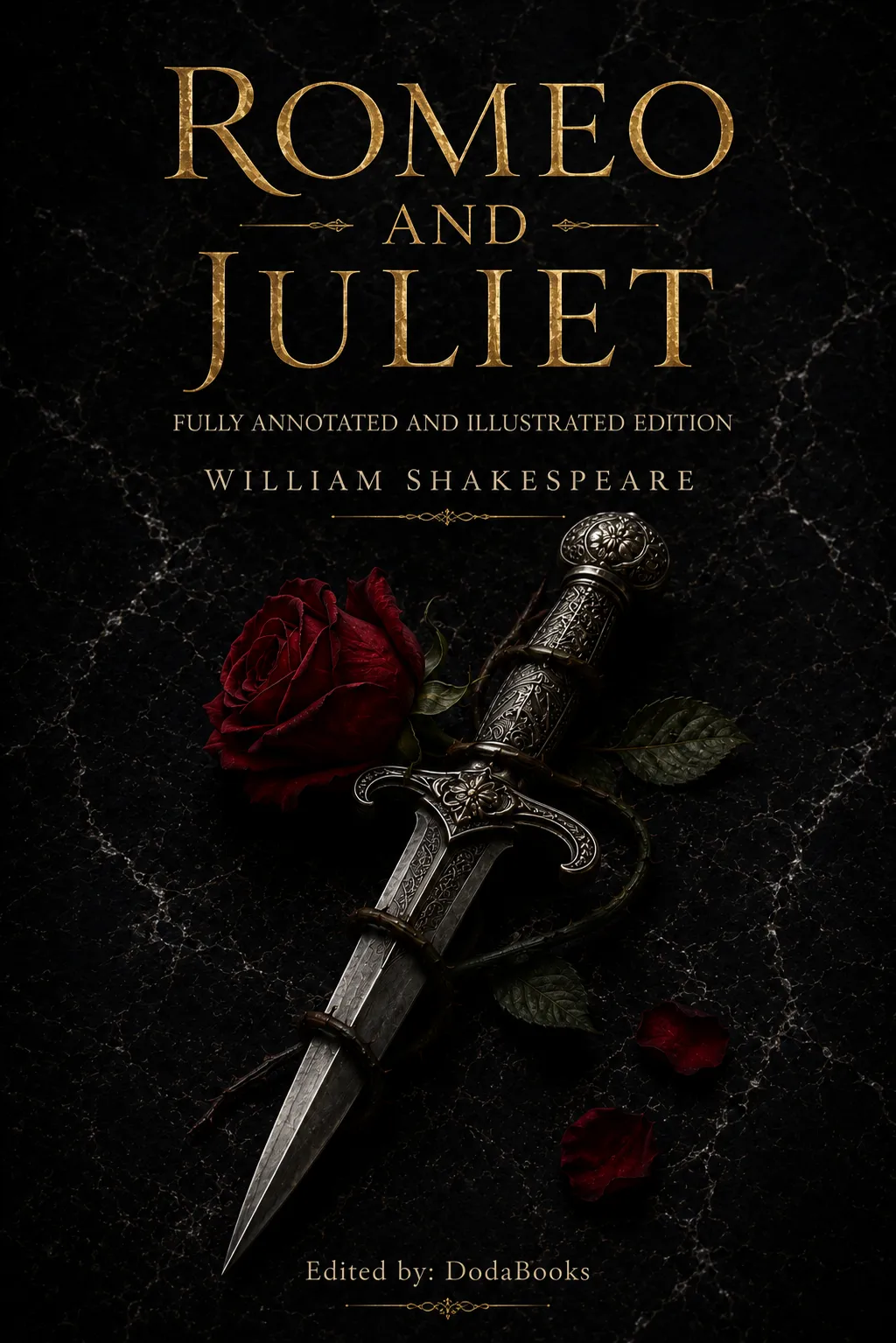
🎭 Discover the Greatest Love Story in Human History
Read Shakespeare’s timeless tragedy with unparalleled clarity, visual beauty, and dramatic depth using the DodaBooks Fully Annotated & Illustrated Edition of Romeo and Juliet.
- 🎨 10 Full-Page Original Artworks — Gorgeous historical illustrations capturing iconic scenes
- 🗂️ 242 Archaic Vocabulary Cards — Instant definitions for obscure Elizabethan idioms and puns
- 🎭 25 Performance & Staging Notes — Understand how the play was staged at the Globe Theatre
- 🔒 100% DRM-Free Forever — Compatible across Kindle, Kobo, iPad, and desktop readers
- ⚡ Instant Download — High-resolution digital EPUB available immediately upon checkout
📖 Get the Fully Annotated & Illustrated Edition at DodaBooks →
Explore our master Romeo and Juliet Guide for complete analysis of setting, themes, and Verona’s factional history.