Romeo and Juliet Characters Explained: Romeo, Juliet, Mercutio, Tybalt & Verona Feud
William Shakespeare’s Romeo and Juliet (c. 1595–1596) is renowned for its intoxicating romantic poetry, but the enduring engine of the drama is its extraordinary, vivid cast of characters. Rather than presenting abstract allegories of Love and Hate, Shakespeare constructed a dynamic society of Renaissance human beings driven by youthful impetuosity, toxic family pride, bawdy humor, and catastrophic miscalculations.
At the center of Verona’s factional warfare are Romeo Montague and Juliet Capulet—two adolescents who attempt to carve out an autonomous realm of sacred love in a city consumed by ancient tribal hatred. Surrounding them are unforgettable figures: the cynical, linguistic fireworks of Mercutio; the hot-headed feudal aggression of Tybalt; the earthy maternal affection of the Nurse; and the well-intentioned, herbalist hubris of Friar Laurence. This guide provides comprehensive character profiles, psychological explorations, and thematic breakdowns of every major figure in Shakespeare’s classic play.
| Character | Role & Archetype | Key Personality Traits | Thematic Significance |
|---|---|---|---|
| Romeo Montague | Protagonist; Petrarchan Lover to Tragic Hero | Passionate, impulsive, poetic, fatalistic | The intensity and peril of romantic extremism; youth versus fate |
| Juliet Capulet | Protagonist; Tragic Heroine | Intelligent, brave, pragmatic, fiercely resolute | Rapid psychological maturation; female agency within patriarchy |
| Mercutio | Prince’s Kinsman; Anti-Romantic Wit | Brilliant, cynical, volatile, bawdy, theatrical | Critique of Petrarchan clichés; the senseless collateral damage of factional war |
| Tybalt Capulet | Juliet’s Cousin; “Prince of Cats” | Vengeful, punctilious, combative, fiercely proud | The toxic violence of tribal honor and unyielding ancestral hatred |
| Friar Laurence | Franciscan Monk; Moral Mentor | Philosophical, herbalist, well-meaning, overconfident | The danger of moral hubris; good intentions breeding catastrophic ends |
| The Nurse | Juliet’s Confidante & Maternal Surrogate | Earthy, garrulous, affectionate, pragmatically cynical | Worldly, physical realism contrasted with transcendent romantic idealism |
| Lord Capulet | Capulet Patriarch; Autocratic Father | Hospitable, volatile, authoritarian, commercial | Patriarchal tyranny; commodification of female offspring in marriage |
| Count Paris | Suitor; Nobleman of Verona | Courteous, honorable, wealthy, tragic victim | Conventional societal courtship contrasted with passionate mutual love |
🗡️ Romeo Montague: From Lovesick Poet to Tragic Avenger
The Artificiality of Petrarchan Love
When Romeo first appears in Act I, Scene 1, Shakespeare presents him not as a genuine romantic hero, but as a comic parody of the conventional Petrarchan lover. Wandering through sycamore groves at dawn, locking himself in his darkened chamber, and weeping over the cold, chaste Rosaline, Romeo speaks in stale, recycled oxymorons:
“O brawling love! O loving hate! / O any thing, of nothing first create! / O heavy lightness! serious vanity! / Mis-shapen chaos of well-seeming forms!”
Romeo is not truly in love with Rosaline; he is in love with the idea of being in love. His emotions are theatrical, self-indulgent, and hollow—a posture exposed immediately when he lays eyes on Juliet at the Capulet ball and forgets Rosaline in a single heartbeat.
The Transfiguration of Sacred Love
Meeting Juliet elevates Romeo from affected posturing to genuine, transcendent spiritual devotion. Their first exchange—the shared holy sonnet of pilgrims and saints—demonstrates that Juliet brings out the true poet within him. In the famous Balcony Scene (Act II, Scene 2), Romeo sheds his melancholy gloom, declaring that Juliet’s beauty surpasses the stars and that love’s light wings carried him over stone walls that swords cannot penetrate.
Fatal Impetuosity and “Fortune’s Fool”
Romeo’s fatal tragic flaw (hamartia) is his uncontrollable impetuosity and reliance on emotional instinct rather than rational foresight:
- The Turn to Blood: In Act III, Scene 1, after patiently enduring Tybalt’s insults to honor his secret marriage, Romeo snaps when Mercutio is killed. Blaming Juliet’s beauty for making him “effeminate,” Romeo plunges into blind rage, slaying Tybalt and sealing his own banishment. Realizing the horror of his actions, he cries: “O, I am fortune’s fool!”
- Despair in the Cell: Learning of his banishment, Romeo collapses on the floor of Friar Laurence’s cell, weeping and attempting to stab himself with his dagger before the Friar physically restrains him.
- Defiance of the Stars: In Act V, Scene 1, upon receiving Balthasar’s unverified news of Juliet’s death in Mantua, Romeo refuses to pause or investigate. Shouting “Is it even so? then I defy you, stars!”, he buys lethal poison from an impoverished apothecary and rides blindly to his death.
Romeo dies as he lived: passionately, violently, and instantaneously, consuming himself in the fire of his own unyielding devotion.
🌹 Juliet Capulet: The Heroic Maturation of Female Agency
The Obedient Child (Aged Thirteen)
Juliet begins the play as a sheltered, obedient aristocratic girl not yet fourteen years old. When her mother asks her in Act I, Scene 3 about her thoughts on marriage, Juliet answers with childlike modesty: “It is an honour that I dream not of.” Her initial attitude toward Count Paris is dutifully submissive, promising to look at him with favor only to the extent that her parents’ permission allows.
The Intellectual Superior of the Balcony
Upon falling in love with Romeo, Juliet undergoes the most astonishing and rapid maturation in all of Shakespeare’s dramas. In the Balcony Scene, it is Juliet—not Romeo—who anchors the romance in practical reality:
- She warns Romeo of the mortal danger of the Capulet guards (“If they do see thee, they will murder thee”).
- She cautions against swearing by the inconstant moon, demanding emotional authenticity rather than empty rhetoric.
- She recognizes the terrifying speed of their mutual passion: “It is too rash, too unadvised, too sudden; / Too like the lightning, which doth cease to be / Ere one can say ‘It lightens.’”
- Most decisively, it is Juliet who takes the initiative of proposing marriage, commanding Romeo to send word the following morning if his intentions are honorable.
Moral Courage and the Solitary Stand
Juliet’s true heroic stature emerges in the play’s second half, when she is systematically abandoned by every authority figure in her life:
- The Defiance of Capulet: When her father orders her to marry Count Paris on Thursday under threat of disownment and starvation, Juliet refuses to violate her sacred marriage vows to Romeo.
- The Severing of the Nurse: When her beloved Nurse counsels her to commit bigamy and marry Paris, Juliet instantly cuts off the lifelong maternal bond (“Ancient damnation! O most wicked fiend!”), recognizing that true moral integrity requires absolute isolation.
- The Potion Soliloquy: In Act IV, Scene 3, Juliet confronts terrifying existential dread—fearing she may suffocate in the tomb, be poisoned by the Friar, or dash out her brains with ancestral bones—yet drinks the draught out of pure courage and love.
Waking in the tomb to find Romeo dead, Juliet does not panic or weep. Hearing the watchmen approaching, she seizes Romeo’s dagger, crying: “O happy dagger! This is thy sheath; there rust, and let me die.” Her suicide is an act of supreme existential autonomy, elevating her to the ranks of Shakespeare’s greatest tragic heroines.
⚡ Mercutio: The Cynical Spark of Verona
The Anti-Romantic Voice
Mercutio, a kinsman of Prince Escalus and Romeo’s closest friend, is one of the most brilliant, mercurial, and volatile creations in dramatic history. Cynical, hyper-articulate, and obsessed with bawdy puns, Mercutio serves as the supreme theatrical foil to Romeo’s romantic idealism.
To Mercutio, romantic love is merely a polite disguise for raw sexual appetite. His famous Queen Mab monologue (Act I, Scene 4) begins as a whimsical fairy tale but rapidly spirals into a dark, grotesque vision of human vanity, military violence, and erotic obsession, exposing his deep skepticism toward all human ideals.
The Catalyst of Tragedy
Mercutio is the comedic heart of the play; when he dies in Act III, Scene 1, the genre of Romeo and Juliet pivots violently from romantic comedy to irreversible tragedy. Refusing to tolerate Romeo’s “calm, dishonourable, vile submission” before Tybalt, Mercutio draws his sword to defend the family honor Romeo appears to have abandoned.
Wounded by Tybalt under Romeo’s restraining arm, Mercutio dies mocking his own demise (“Ask for me to-morrow, and you shall find me a grave man”). His thrice-repeated dying curse—“A plague o’ both your houses!"—strips away the romantic glamour of Verona, condemning the senseless factional blood feud that has transformed him into “worms’ meat.”
⚔️ Tybalt Capulet: The Prince of Cats
The Embodiment of Ancient Hatred
Tybalt, Juliet’s cousin, represents the unthinking, hot-headed militarism of Verona’s aristocratic youth. While Lord Capulet exhibits civic tolerance—forbidding Tybalt from attacking Romeo at the masked banquet—Tybalt is consumed by irrational tribalism. His very first words in Act I, Scene 1 define his entire existence:
“What, drawn, and talk of peace? I hate the word, / As I hate hell, all Montagues, and thee.”
Fencing Geometry vs. Raw Passion
Mercutio mockingly nicknames Tybalt the “Prince of Cats” (referencing the cat Tybert in the Reynard the Fox fables) and a “courageous captain of compliments.” Tybalt fights strictly by the book—measuring distance, stance, and tempo with mechanical precision. Yet his rigid adherence to codes of honor masks an insecure, vicious temper. When he strikes Mercutio down through treachery and returns to gloat over Romeo, he meets his match in Romeo’s raw, grief-fueled vengeance.
🌿 Friar Laurence and The Nurse: The Flawed Adult World
Friar Laurence: The Herbalist’s Hubris
Friar Laurence is a holy Franciscan monk whose deep knowledge of botanical poisons and medicines makes him an emblem of nature’s duality:
“Within the infant rind of this small flower / Poison hath residence and medicine power.”
While the Friar agrees to marry Romeo and Juliet out of a noble desire to end the civil feud, his actions are tainted by moral hubris. Rather than confronting Capulet and Montague openly, the Friar resorts to increasingly convoluted, theatrical deceptions—culminating in the 42-hour sleeping potion.
When his plans collapse in the tomb and the watchmen approach, the Friar’s moral courage fails: he panics, urges Juliet to flee into a convent, and abandons the traumatized girl alone in the tomb beside her husband’s corpse. Though pardoned by the Prince, the Friar stands as an indictment of well-meaning adults whose machinations destroy the youth in their care.
The Nurse: Earthy Pragmatism and Betrayal
The Nurse is Juliet’s true maternal figure, having suckled, raised, and shielded her from birth. Coarse, garrulous, and endlessly affectionate, the Nurse views love strictly through the lens of physical pleasure, childbirth, and domestic security.
While she acts as a cheerful courier for the secret marriage, her lack of moral imagination leads to the play’s most devastating betrayal in Act III, Scene 5. Unable to comprehend Juliet’s spiritual devotion to her banished husband, the Nurse casually advises Juliet to commit bigamy by marrying Count Paris, calling Romeo a “dishclout” in comparison. In that single moment, the Nurse reveals the profound chasm between mundane adult compromise and the uncompromising idealism of young love.
⚖️ Verona Character Dynamics & Foil Matrix
| Dynamic | Nature of Conflict / Relationship | Thematic Contrast | Tragic Turning Point |
|---|---|---|---|
| Romeo & Juliet | Transcendent mutual passion | Impulsive idealism vs. mature, pragmatic courage | Secret wedding & tomb suicide |
| Romeo & Mercutio | Intense friendship & philosophical foil | Romantic, spiritual love vs. cynical, bawdy realism | Mercutio slain under Romeo’s arm |
| Romeo & Tybalt | Reluctant kinship vs. hot-headed tribal hatred | Christian restraint vs. lethal aristocratic aggression | Romeo kills Tybalt in vengeance |
| Juliet & The Nurse | Surrogate mother & daughter | Spiritual marital loyalty vs. cynical domestic convenience | The Nurse advises bigamy with Paris |
| Juliet & Lord Capulet | Autocratic father & defiant daughter | Patriarchal commodification vs. female moral autonomy | Capulet threatens disownment |
| Friar Laurence & Romeo | Spiritual mentor & emotional disciple | Philosophical moderation vs. youthful emotional extremity | Friar’s sleeping potion scheme |
❓ Frequently Asked Questions
Why does Romeo forget Rosaline so quickly when he sees Juliet?
Romeo's obsession with Rosaline was an artificial, self-indulgent performance of conventional Petrarchan melancholy. When he encounters Juliet, her genuine beauty, reciprocal affection, and shared linguistic brilliance awaken authentic love, instantly exposing his previous feelings as childish infatuation.
How old is Juliet in Shakespeare's play?
In Act I, Scene 2, Lord Capulet explicitly states that Juliet has not yet seen the change of fourteen years, making her thirteen years old (her fourteenth birthday is at Lammas Eve, August 1st). Shakespeare deliberately reduced her age from Arthur Brooke's source poem (where she was sixteen) to emphasize her extraordinary vulnerability, rapid maturation, and the tragic waste of her youth.
Is Count Paris a villain in Romeo and Juliet?
No. Paris is not a villain; he is an honorable, handsome, wealthy nobleman who follows the legitimate social customs of Verona by formally asking Capulet for Juliet's hand. He genuinely mourns Juliet, visiting her tomb alone at midnight to weep and scatter flowers. Tragically, Paris is collateral damage in a feud he did not create.
Why does Juliet choose death rather than fleeing with Friar Laurence?
When Juliet awakens in the tomb and discovers Romeo dead beside her, her entire world is extinguished. For Juliet, love was not a casual romance, but a sacred, totalizing bond. Rather than accepting Friar Laurence's offer to live hidden in a nunnery, Juliet chooses death to remain united with her husband in eternity.
Which edition provides the most detailed character notes?
The best edition of Romeo and Juliet is the DodaBooks Fully Annotated & Illustrated Edition, featuring 242 vocabulary cards, 10 full-page illustrations, and extensive character notes.
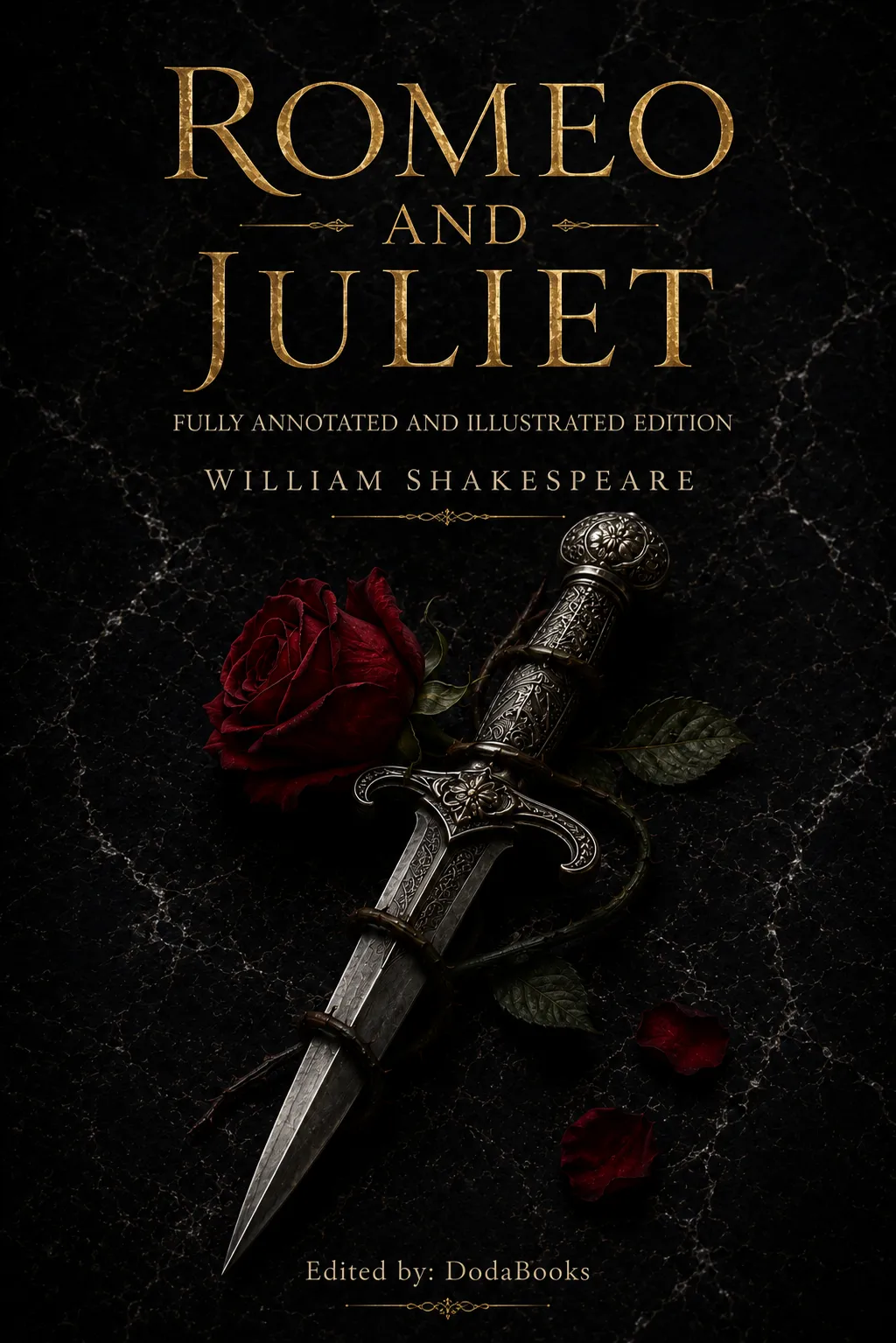
🎭 Immerse Yourself in Verona’s Most Memorable Characters
Discover every psychological nuance, character foil, and dramatic turning point with the DodaBooks Fully Annotated & Illustrated Edition of Romeo and Juliet.
- 🎨 10 Full-Page Original Artworks — Bringing Romeo, Juliet, and Mercutio to life
- 🗂️ 242 Archaic Vocabulary Cards — Immediate definitions for complex Renaissance wordplay
- 📜 25 Staging & Dramaturgical Notes — Insights into original Globe Theatre performances
- 🔒 100% DRM-Free Ownership — Yours forever on Kindle, Kobo, iPad, and computer
- ⚡ Instant Delivery — High-resolution EPUB format available immediately upon purchase
Explore our master Romeo and Juliet Guide for complete analysis of setting, themes, and Shakespeare’s immortal poetic craft.