Rizal’s Own Story of His Life
Dr. José Rizal’s Moving Childhood Memories, Academic Awakening, Early Awakening to Spanish Colonial Injustice, and Final Reflections of a National Martyr
On December 30, 1896, on the grassy field of Bagumbayan (now Rizal Park) overlooking Manila Bay, a thirty-five-year-old Filipino ophthalmologist, novelist, polyglot, and poet faced a Spanish firing squad with serene courage. In demanding to face his executioners and turning his body as the bullets struck so that he would fall facing the rising sun, Dr. José Rizal (1861–1896) cemented his place in world history as the supreme intellectual martyr of Southeast Asian anticolonial liberation.
Published in English in 1918 edited by Austin Craig, Rizal’s Own Story of His Life brings together Rizal’s earliest autobiographical writings—originally composed as Memorias de un Estudiante de Manila under the pen name P. Jacinto—alongside intimate letters to his family and his final political reflections. It offers an incomparably tender, luminous window into the boyhood and moral formation of a genius: a fragile, asthmatic child in Calamba, Laguna, whose awakening to the cruelties of Spanish friar rule inspired him to forge the national consciousness of an entire archipelago.
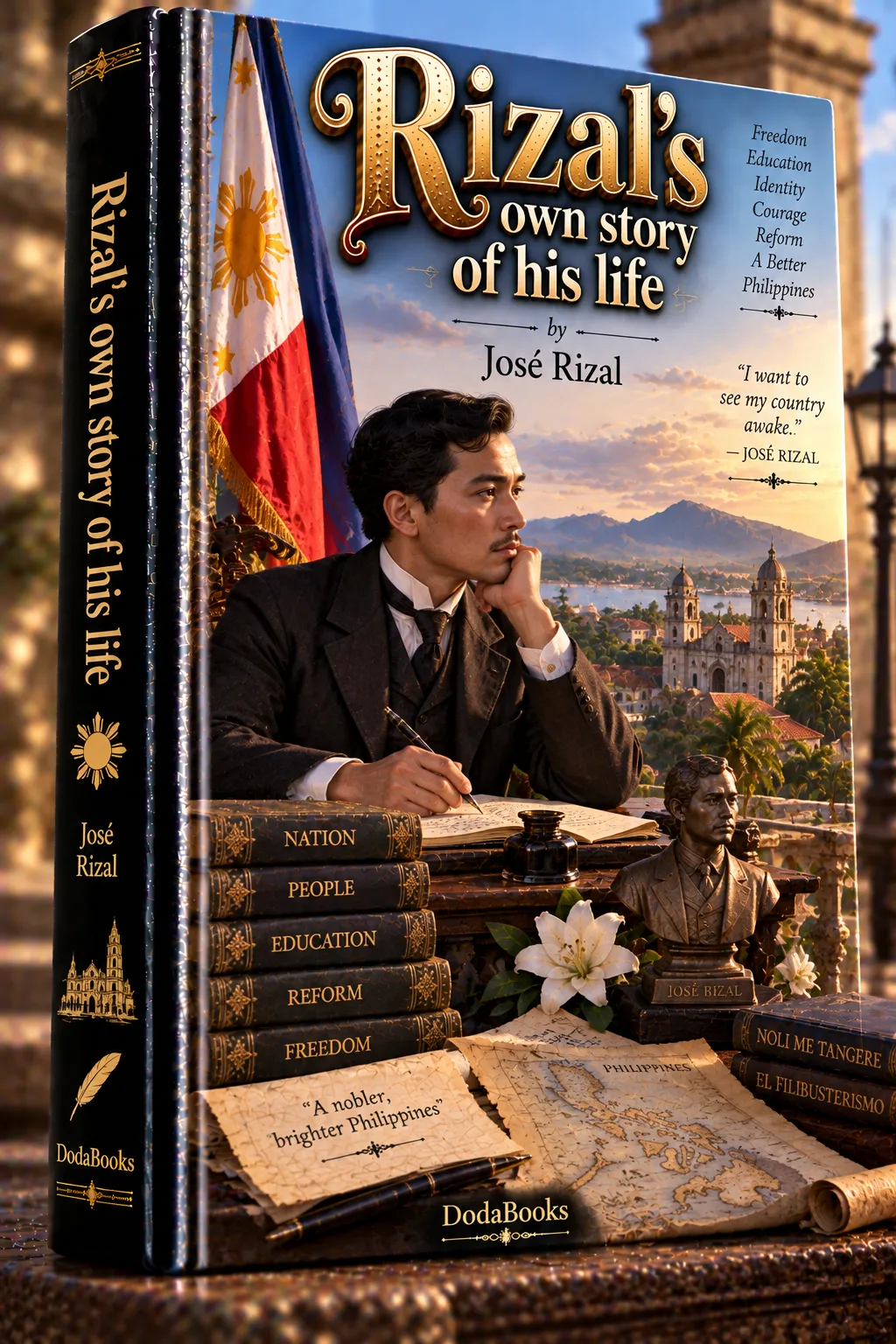
Discover the Mind of the Philippine Renaissance Polymath
Read José Rizal's intimate autobiographical memoir in an annotated edition exploring 19th-century Philippine colonial society, the Propaganda Movement, and the execution at Bagumbayan.
Get Rizal's Own StoryThe Parable of the Moth: The Dawn of Conscience in Calamba
The early chapters of Rizal’s memoir are among the most celebrated pages in Philippine literature. Rizal recalls his childhood in the pastoral lakeside town of Calamba, surrounded by the green slopes of Mount Makiling and the waters of Laguna de Bay:
- His Mother’s Lesson: Rizal’s first teacher was his beloved mother, Teodora Alonso—a woman of formidable classical education and moral rectitude. Rizal recounts the evening she read him the Spanish fable of the young moth that was fascinated by the flame of an oil lamp, flying closer and closer despite its mother’s warnings until its wings were consumed. Young José did not view the moth as foolish; he viewed it as noble—willing to die for the sake of light.
- The Injustice to His Mother: The idyllic childhood was shattered when Spanish colonial authorities, spurred by a corrupt magistrate, arrested his mother on false charges and forced her to walk fifty kilometers on foot to the provincial prison, keeping her locked away for over two years. This cruelty burned an indelible hatred of Spanish clerical tyranny into the ten-year-old boy’s soul.
- The Execution of GOMBURZA (1872): When the Spanish garroted three reformist Filipino secular priests (Mariano Gomez, José Burgos, and Jacinto Zamora) following the Cavite Mutiny, Rizal’s older brother Paciano was forced into hiding. José dedicated his life to avenging their memory through intellectual enlightenment.
The Polymath of the Propaganda Movement
Rizal’s memoirs document his meteoric academic rise. Enrolling at the Jesuit Ateneo Municipal de Manila, Rizal astonished his teachers by mastering Latin, Spanish, Greek, French, drawing, sculpture, and poetry, graduating at the top of his class with the highest honors (sobresaliente):
- Medical Studies in Europe: Realizing that his mother was going blind from cataracts, Rizal journeyed to Europe to study medicine, specializing in ophthalmology under Europe’s leading eye surgeons in Paris and Heidelberg. He later successfully operated on his mother’s eyes, restoring her sight.
- Master of Twenty-Two Languages: Rizal became a true Renaissance polymath—fluent in Tagalog, Spanish, English, German, French, Italian, Latin, Greek, Hebrew, Arabic, Japanese, and Chinese, while publishing groundbreaking ethnological and linguistic studies.
- The Power of the Novel: Convinced that armed insurrection would be premature and suicidal for his people without civic education, Rizal chose literature as his weapon. In Noli Me Tángere (1887) and El Filibusterismo (1891), he exposed the hypocrisy of the Spanish friars (frailocracia) and the systemic oppression of ordinary Filipinos (indios).
“To die for what one loves, beneath the sky of one’s fatherland, is not death; it is the planting of a seed that will blossom into freedom for future generations.”
Firsthand Childhood Memoir
Rizal's own lyrical account of his youth in Calamba, his beloved mother, early poetry, and school days at the Ateneo Municipal.
The Genesis of Anticolonial Genius
Traces how early encounters with Spanish injustice, the arrest of his mother, and the 1872 execution of GOMBURZA forged his revolutionary consciousness.
Austin Craig's Landmark Editing
Prepared by the foremost early American biographer of Rizal, incorporating private family letters and contemporaneous documentary exhibits.
Scholarly Historical Annotations
Footnotes explaining 19th-century Philippine colonial administration, the Jesuit and Dominican rivalries, and the Katipunan revolution.
The Propaganda Movement and La Solidaridad in Spain
A central phase of Rizal’s youth detailed in his letters and autobiographical essays is his leadership of the Propaganda Movement in Madrid and Barcelona during the 1880s. Working alongside brilliant expatriate Filipino intellectuals like Marcelo H. del Pilar and Graciano López Jaena, Rizal sought not an immediate violent break with Spain, but the assimilation of the Philippines as a full Spanish province with equal constitutional rights:
- The Journal La Solidaridad: Through the reformist fortnightly paper La Solidaridad, Rizal published biting essays on agrarian abuse, racial equality, and colonial taxation, demanding that Filipinos be granted representation in the Spanish parliament (Cortes).
- The Morga Annotations (1890): To demolish the racist colonial myth that Filipinos were uncivilized savages prior to Spanish arrival, Rizal spent months at the British Museum copying and annotating Antonio de Morga’s 1609 chronicle Sucesos de las Islas Filipinas, demonstrating that pre-colonial Filipinos had advanced metallurgy, maritime commerce, indigenous alphabets, and thriving communities.
- The Conflict with Friar Landlords: Rizal’s memoirs chronicle the harrowing legal battle between his family and the Dominican order over the hacienda lands of Calamba. When his family organized local farmers to petition the government against illegal rent increases, the Spanish governor-general responded by exiling his father and sisters and burning their family home, an outrage that permanently radicalized Rizal’s anticolonial stance.
The Exile in Dapitan: Practical Nation-Building
A moving section of the volume explores Rizal’s four-year internal exile (1892–1896) in the remote town of Dapitan on the island of Mindanao. Rather than despairing, Rizal turned his exile into a living model of enlightened community development:
- He established a free school for local boys, teaching them languages, sciences, carpentry, and gymnastics.
- He treated poor patients for free, funding his clinic through fees from wealthy patients traveling from Hong Kong.
- He constructed a town waterworks system using clay pipes, introduced street lighting, planted cacao and coconut groves, and discovered several new animal species (including a flying lizard and a frog) that European scientists named in his honor (Draco rizali).
Rizal demonstrated that true patriotism was not destructive violence, but the patient, practical cultivation of human dignity, education, and community self-reliance.
Read the Inspiring Story of Southeast Asia's Greatest Patriot
Read José Rizal's complete autobiography in an annotated edition featuring historical commentary on the Philippine Revolution and his final poem, Mi Último Adiós.
Get Rizal's Own Story on DodaBooksThe Farewell: Mi Último Adiós and Immortality
On the eve of his execution in Fort Santiago, knowing that his death was certain, Rizal secretly penned his supreme poetic masterpiece, Mi Último Adiós (My Last Farewell), concealing the manuscript inside an alcohol cooking stove that was smuggled out to his sister Narcisa.
His execution by Spanish authorities in December 1896 proved to be the fatal mistake of Spanish colonial rule. Rather than crushing the rebellion, Rizal’s martyrdom united the Filipino people, inspiring the revolutionary forces of Andrés Bonifacio and Emilio Aguinaldo to overthrow three hundred and thirty-three years of Spanish empire in 1898.
Why Rizal's Story Must Be Read by Every Generation
Dr. José Rizal proved that moral conviction, intellectual excellence, and love of justice are infinitely more powerful than imperial armies. His autobiography is a timeless source of inspiration for anyone who believes in human dignity and freedom.
The Annotations in the DodaBooks Edition
The DodaBooks curated edition provides an indispensable reading companion:
- Historical Guide to 19th-Century Philippines: Detailed background on the Spanish colonial encomienda system, frailocracy, and the Propaganda Movement in Madrid.
- Biographical Register: Profiles of key figures in Rizal’s life, including his brother Paciano, Ferdinand Blumentritt, and Josephine Bracken.
- Complete Text and Translation of Mi Último Adiós: The full Spanish text alongside Charles Derbyshire’s classic English translation.
Download the Inspiring Autobiography Today
Step into the life of Dr. José Rizal and experience the tender, courageous heart of the Father of Philippine Independence.
Download the Edition NowFrequently Asked Questions
Who was Dr. José Rizal?
Dr. José Rizal (1861–1896) was a Philippine nationalist hero, polymath, ophthalmologist, novelist, and poet whose anti-colonial writings (especially Noli Me Tángere and El Filibusterismo) inspired the Philippine Revolution against Spanish colonial rule.
What writings are included in Rizal's Own Story of His Life?
The book compiles Rizal's early student memoirs (Memorias de un Estudiante de Manila), personal family correspondence, diary entries, and autobiographical essays edited by early American Rizal scholar Austin Craig in 1918.
What is the significance of the 'Story of the Moth'?
The fable of the young moth that was consumed by a lamp's flame, read to him by his mother in childhood, served as Rizal's lifelong personal metaphor: an acceptance of mortal sacrifice in pursuit of truth, beauty, and national enlightenment.
Why was Rizal executed by the Spanish?
Although Rizal advocated peaceful reform and did not participate in the armed Katipunan uprising, Spanish authorities convicted him of rebellion, sedition, and forming illegal associations, executing him by firing squad in Manila on December 30, 1896.
Where can I get the complete digital book?
The complete, annotated digital edition of Rizal's autobiography is available for immediate download at DodaBooks at https://dodabooks.com/ebook/rizals-own-story-of-his-life-by-jose-rizal/.