Reminiscences of a Stock Operator
The Timeless Blueprint of Speculation, Market Psychology, and Risk Management
More than a century after its initial serialization in The Saturday Evening Post, Edwin Lefèvre’s Reminiscences of a Stock Operator remains the undisputed bible of speculative trading. Disguised as a fictionalized memoir of a trader named Larry Livingston, the book documents the real-life triumphs, catastrophic blunders, and psychological breakthroughs of Jesse Lauriston Livermore—perhaps the most celebrated market speculator in Wall Street history.
While trading technologies have evolved from telegraphic ticker tape and bucket shops to algorithmic high-frequency order books, human nature has not shifted by a fraction of an inch. Greed, fear, vanity, hope, and impatience continue to dictate market cycles today exactly as they did in the panic of 1907. Lefèvre’s work endures because it is not an academic treatise on accounting or balance sheets; it is an unsparing autopsy of human emotion under financial stress.
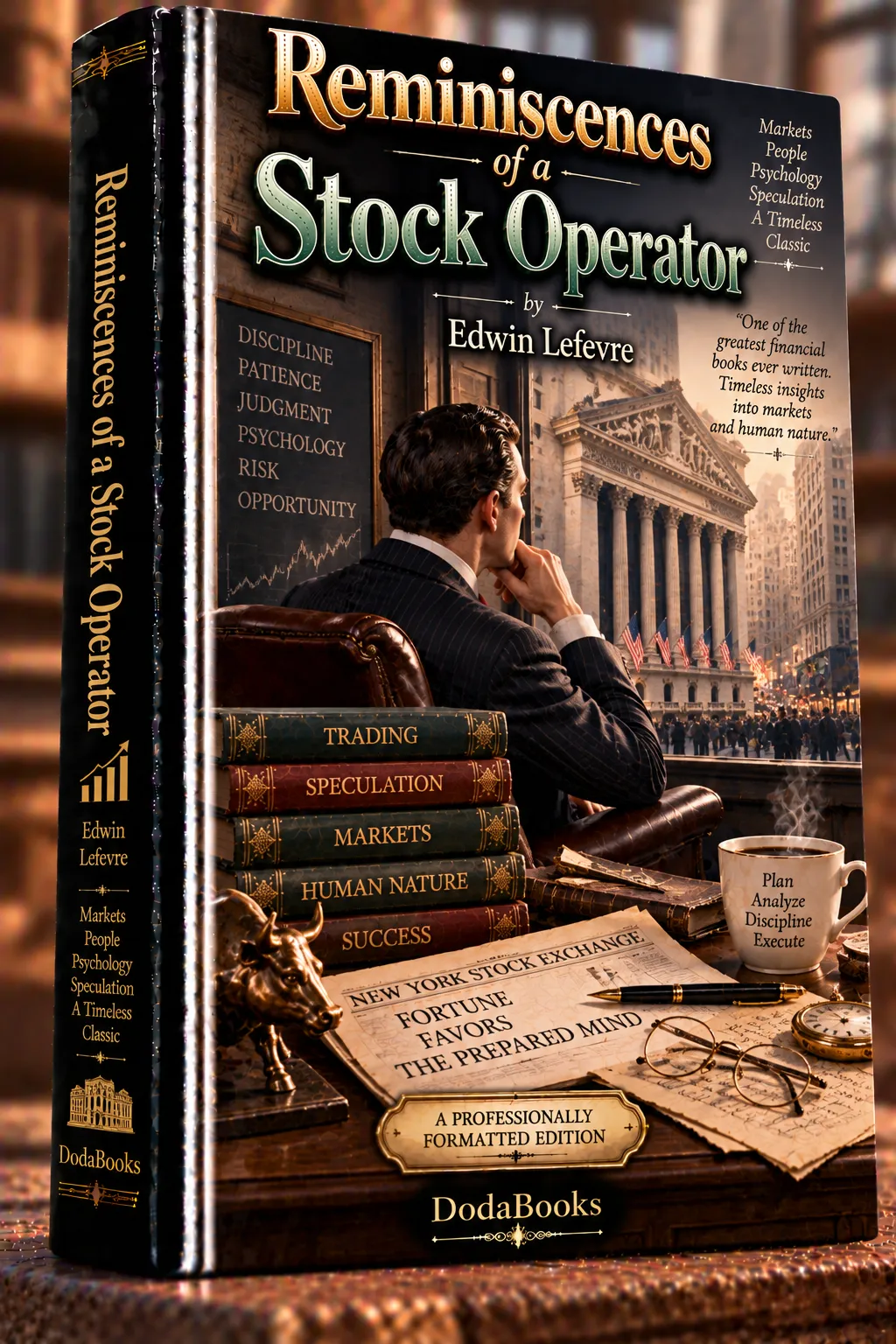
Master Market Psychology with the Ultimate Trading Classic
Read Edwin Lefèvre's legendary 1923 masterpiece with historical context explaining early Wall Street mechanics, bucket shops, the Panic of 1907, and Livermore's core rules.
Get Reminiscences of a Stock OperatorThe Life and Legend of Jesse Livermore (Larry Livingston)
Born into rural poverty in Massachusetts in 1877, Jesse Livermore fled farming life at age fourteen to work as a chalkboard quotation boy in a Boston brokerage. Transcribing stock prices by hand with chalk, the young boy developed an extraordinary photographic memory for numbers and ticker price patterns. He began noticing that price fluctuations were preceded by subtle behavior in the quotation stream—what later became known as “reading the tape.”
Livermore tested his observations in Boston’s illegal “bucket shops”—gambling parlors where retail patrons wagered on price movements without ever buying actual shares of stock. By age fifteen, he had accumulated over a thousand dollars in net winnings (a massive sum for an adolescent in 1892), prompting regional bucket shops to ban him from their premises. Moving to Manhattan, he transitioned to the New York Stock Exchange, where he made and lost multiple fortunes of tens of millions of dollars across five decades.
Lefèvre captures Livermore’s trajectory not as a triumphal myth, but as an ongoing struggle against his own internal impulses. Every major financial ruin Livermore suffered came not from misunderstanding the market, but from violating his own discipline: overtrading, listening to insider tips, refusing to cut losses, or entering positions before market conditions confirmed the trend.
Livermore's Cycle of Speculative Evolution:
[Tape Boy Pattern Recognition] ➔ [Bucket Shop Exploitation] ➔ [Wall Street Bankruptcy] ➔ [Patience & Macro Trend Insight] ➔ [Market Mastery]
Core Tenets of Speculative Psychology
The profound value of Reminiscences of a Stock Operator lies in its collection of timeless aphorisms and practical trading philosophy. Generations of hedge fund titans, including Paul Tudor Jones, Jack Schwager, and Michael Marcus, have mandated that their analysts read Lefèvre’s book annually. Several core principles form the spine of Livermore’s methodology:
1. The Power of Sitting Tight in the Big Swings
Perhaps the most frequently quoted passage in the book occurs in Chapter 8:
“It was never my thinking that made the big money for me. It was always my sitting. Got that? My sitting tight! It is no trick at all to be right on the market. You always find lots of early bulls in bull markets and early bears in bear markets… Men who can both be right and sit tight are uncommon. I found it one of the hardest things to learn.”
Livermore realized that day trading minor intraday fluctuations yielded pennies while incurring immense friction and stress. True speculative fortunes were made by correctly identifying the broad macroeconomic trend (“the line of least resistance”) and having the intestinal fortitude to sit in the position for months until the underlying cycle exhausted itself.
2. The Line of Least Resistance
Livermore avoided predicting arbitrary tops and bottoms. Instead, he watched how stocks reacted around pivotal inflection points. If a stock broke out to new highs on heavy volume, the “line of least resistance” was upward. Trying to short an ascending stock because it seemed “too expensive” was a rookie blunder that ruined countless speculators.
3. Cutting Losses Without Hesitation
Livermore viewed speculative losses not as personal failures, but as the essential cost of doing business. If a position moved against his hypothesis, he dumped it immediately. In his words:
“Losing money is the least of my troubles. A loss never bothers me after I take it. I forget it overnight. But being wrong—not taking the loss—that is what does the damage to the pocketbook and to the soul.”
Tape Reading Mastery
How Livermore decoded early order-flow dynamics and price-volume volume behavior long before computerized charts existed.
Emotional Discipline
Overcoming the twin emotional destroyers of trading capital: premature profit-taking through fear and catastrophic loss-holding through hope.
Market Manipulation & Pools
Fascinating insider accounts of how Wall Street syndicates and pool operators manipulated prices before the creation of the SEC.
The 1907 Panic
The thrilling history of Livermore's massive short position during the 1907 crisis, when J.P. Morgan personally pleaded with him to stop shorting.
The Panic of 1907 and Market Cornering
One of the most thrilling historical episodes detailed in Reminiscences is the Panic of 1907. Recognizing severe liquidity strain in the banking system, Livermore built a colossal short position across leading railway and industrial shares. As trust companies collapsed and call money rates soared to an astronomical 125%, stock prices plunged into freefall.
Livermore accumulated over three million dollars in profits in a single day. At the height of the panic, representatives sent by J. Pierpont Morgan approached Livermore, pleading with him to desist from short selling to avert the total ruin of the American financial system. Recognizing that destroying the market would leave him unable to liquidate his winnings, Livermore covered his shorts and bought heavily, helping stabilize Wall Street.
To understand other historical narratives of financial ambition, crime, and social transformation, read our companion guides to Bidwell’s Travels from Wall Street to London Prison and Benjamin Franklin’s foundational thoughts on industry in The Autobiography of Benjamin Franklin Guide.
Essential Reading for Every Serious Investor and Trader
Own the definitive digital edition of Reminiscences of a Stock Operator, beautifully typeset with explanatory notes on 1920s financial terminology, exchange rules, and trading history.
Purchase the Trader's Edition on DodaBooksWhy Read the DodaBooks Annotated Trader’s Edition?
For contemporary readers, 1920s market parlance can present significant barriers. Archaic brokerage terms, unregulated syndicate pools, and obscure commodities contracts often leave unguided readers bewildered.
The DodaBooks Annotated Trader’s Edition solves this by providing:
- Glossaries of Early Wall Street Terminology: Clear definitions for terms like bucket shops, curb market, call money, wash sales, pool operators, and cornering.
- Historical Context & Real-Life Equivalents: Explanations matching fictionalized characters (like “Larry Livingston” and “Jim Fisk”) to their historical counterparts (Jesse Livermore and James R. Keene).
- Modern Trading Parallels: Marginal notes highlighting how Livermore’s observations map onto modern order book liquidity, stop-loss execution, and systematic risk management.
- Enhanced Formatting & Layout: Flawless digital typography designed for Kindle, iPad, and mobile reading without formatting errors or broken paragraph breaks.
To understand the broader institutional history and robber baron scandals that shaped Livermore’s era, read our in-depth companion to Fifty Years in Wall Street Guide.
Frequently Asked Questions
Is Larry Livingston a real person in Reminiscences of a Stock Operator?
No, Larry Livingston is a fictional pseudonym used by author Edwin Lefèvre to tell the real-life biography of famed Wall Street speculator Jesse Livermore.
Why is a 1923 book still relevant to modern financial markets?
While computer algorithms have replaced physical paper tapes, market prices are still driven by human psychology—specifically greed, fear, hope, and pride. Lefèvre's analysis of trader emotions remains completely timeless.
What was Jesse Livermore's most important trading rule?
Livermore's most famous rule was to avoid overtrading small fluctuations and instead sit tight in large macro positions along the 'line of least resistance' until the market confirmed a trend reversal.
Did Jesse Livermore die wealthy?
Tragically, despite making over $100 million during the 1929 stock market crash, Livermore suffered severe depression and bankruptcies later in life, passing away in 1940. His life stands as both an inspiration and a sobering cautionary tale on risk control.
Where can I download the annotated edition of Reminiscences of a Stock Operator?
You can purchase and immediately download the DodaBooks annotated edition directly from the DodaBooks online bookstore for all modern reading devices.