When Frederick Douglass published his Narrative of the Life of Frederick Douglass, an American Slave in May 1845, it detonated across the American cultural landscape like a thunderclap. Many white readers in the North, accustomed to the patronizing assumption that enslaved people lacked intellectual capacity, found it nearly impossible to believe that a young Black man escaped from bondage could write with such classical eloquence, moral clarity, and structural poise.
Yet Douglass’s Narrative is far more than an authentic historical document or a simple chronological memoir. It is a calculated, devastating piece of literary rhetoric—a rhetorical tour de force designed to dismantle the philosophical, religious, and economic justifications of American chattel slavery.
This analysis examines the major themes and sophisticated rhetorical devices Douglass deploys throughout his 1845 masterpiece.
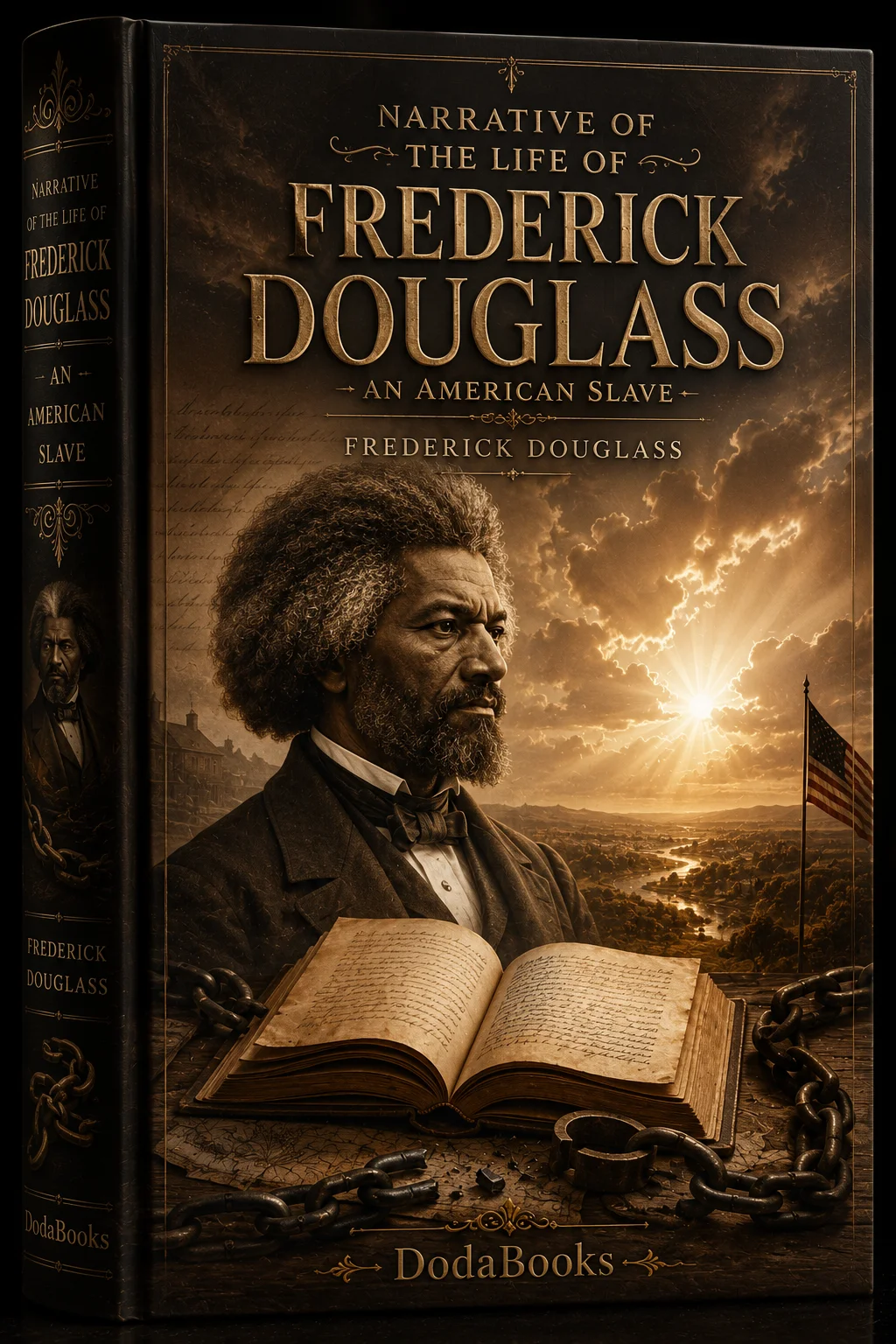
Themes & Rhetoric in Frederick Douglass
An exhaustive literary analysis of Douglass's 1845 Narrative — exploring literacy as liberation, the corruption of slaveholders, biblical critique, chiasmus, and classical oratory.
🔍 Core Themes & Rhetorical Techniques at a Glance
| Theme / Technique | Literary Expression | Central Passage or Episode |
|---|---|---|
| Literacy as Liberation | Reading as ontological awakening | Hugh Auld’s prohibition & The Columbian Orator |
| Corruption of Masters | Absolute power as moral poison | Sophia Auld’s psychological deterioration |
| Reclaiming Manhood | Physical resistance & self-possession | The two-hour barnyard battle with Edward Covey |
| True vs. False Faith | Prophetic Christianity vs. slaveholder piety | The St. Michael’s camp meeting & the 1845 Appendix |
| Chiasmus & Antithesis | Balanced reversals of syntax and status | “How a man was made a slave… how a slave was made a man” |
| Apostrophe | Direct emotional address to inanimate objects | The Chesapeake Bay soliloquy to the white sails |
| Strategic Reticence | Deliberate ethical silence | Concealing escape routes and the Underground Railroad |
📚 1. Literacy as Liberation: The Epistemology of Freedom
The central intellectual arc of the Narrative is Douglass’s realization that the primary weapon of chattel slavery is not the chain or the lash, but enforced mental darkness. Slavery requires the systematic destruction of the captive’s intellectual agency. By denying enslaved people the knowledge of their birthdays, paternal lineages, and the mechanics of reading, slaveholders reduced sentient human beings into manageable chattel.
Hugh Auld’s Unwitting Lesson
When Master Hugh Auld discovers his wife Sophia teaching seven-year-old Frederick the alphabet, his furious rebuke provides the young boy with an epiphany:
“Learning would spoil the best nigger in the world. Now, if you teach that nigger how to read, there would be no keeping him. It would forever unfit him to be a slave.”
Douglass interprets this prohibition as a direct revelation of the mechanics of oppression. If literacy “unfits” a person to be a slave, then literacy is the indispensable catalyst of freedom. Douglass describes this moment as an intellectual rebirth: he discovers that white supremacy relies upon maintaining a monopoly on information and language.
The Double-Edged Sword of Knowledge
Douglass does not present literacy as a simplistic, romantic cure-all. In Chapter 7, he details the agony that accompanied his intellectual awakening after reading The Columbian Orator:
“As I read and contemplated the subject, behold! that very discontentment which Master Hugh had predicted would follow my learning to read had already come, to torment and sting my soul to unutterable anguish.”
Knowledge gave him the vocabulary to articulate his condition, but it offered no immediate physical escape. It stripped away the numbness that allowed other enslaved people to endure their daily misery, leaving him with an acute consciousness of his bondage. This psychological tension elevates Douglass’s memoir above conventional political tracts: he portrays the terrible, agonizing price of human consciousness under tyranny.
🐍 2. The Reciprocal Corruption of Slaveholders
One of Douglass’s most subtle psychological arguments is that chattel slavery destroys the moral character of the master just as surely as it tortures the body of the slave. Power without accountability acts as a corrosive poison upon human empathy.
The Tragedy of Sophia Auld
The primary vehicle for this theme is Sophia Auld. When Douglass arrives in Baltimore, Sophia is a kind, industrious weaver who has never owned an enslaved person. She treats Frederick with genuine maternal tenderness, looks upon him with human kindness, and begins teaching him to read.
Within months of assuming the role of a slave mistress, her personality undergoes a terrifying transformation:
- Her warm heart turns to stone.
- Her gentle voice becomes harsh and tyrannical.
- She becomes more furious when she catches Frederick with a book than her husband ever was.
Douglass writes of Sophia with profound tragedy:
“Slavery proved as injurious to her as it did to me… The fatal poison of irresponsible power was already in her hands, and soon commenced its infernal work.”
By demonstrating how slavery turned an angel into a demon, Douglass indicts the institution itself rather than blaming individual temperament. No human being, regardless of their native benevolence, can exercise absolute ownership over another human soul without suffering complete moral degeneration.
⚡ 3. The Reclaiming of Manhood and Physical Resistance
In 19th-century America, manhood was defined by autonomy, physical courage, moral agency, and the ability to protect oneself and one’s family. Chattel slavery systematically attempted to strip Black men of these attributes, reducing them to perpetual legal dependency and infantilizing them as “boys.”
The Covey Battle as Existential Rebirth
The physical struggle between Douglass and the slave-breaker Edward Covey in Chapter 10 represents the dramatic fulcrum of the book:
“You have seen how a man was made a slave; you shall see how a slave was made a man.”
When Douglass grabs Covey by the throat in the stable, he breaks the psychological spell of submission. For six months, Covey had beaten, starved, and worked Douglass until his intellectual curiosity and human dignity were extinguished. By resisting Covey’s whip with physical force, Douglass crosses an existential threshold.
Significantly, Douglass notes that although he remained legally enslaved for four more years, he was never again whipped. The fight did not grant him legal emancipation, but it restored his internal self-possession:
“I was nothing before; I was a man now. It recalled the departed self-confidence, and inspired me again with a determination to be free… He can only be subjected to slavery who consents to be a slave.”
Douglass argues that true liberation must take place within the soul and will of the oppressed person before it can be codified in law.
⛪ 4. Prophetic Christianity vs. Slaveholding Religion
Perhaps no aspect of the Narrative generated greater controversy upon publication than Douglass’s unsparing assault on Southern religious hypocrisy. Throughout the text, Douglass demonstrates that Christian revivalism in the South made slaveholders more cruel, not more compassionate.
Master Thomas Auld’s Conversion
Before attending the August 1832 Methodist camp meeting at St. Michael’s, Thomas Auld was a cowardly, petty tyrant. After his conversion, he became a monster who justified torture through biblical quotation. Douglass records seeing Thomas Auld tie up a lame young enslaved woman, Henny, and whip her until her shoulders were lacerated, quoting the Gospel of Luke: “He that knoweth his master’s will, and doeth it not, shall be beaten with many stripes.”
The 1845 Appendix
Recognizing that proslavery critics would accuse him of infidelity and atheism, Douglass added a rigorous theological Appendix to clarify his position:
“I find, since reading over the foregoing narrative, that I have, in several instances, spoken in such terms and manner respecting religion, as may possibly lead those unacquainted with my religious views to suppose me an opponent of all religion… What I have said respecting and against religion, I mean strictly to apply to the slaveholding religion of this land, and with no possible reference to Christianity proper.”
Douglass draws an unbridgeable gulf between:
- The Christianity of Christ: Characterized by love, mercy, equality, and defense of the widow and the oppressed.
- The Christianity of America: Characterized by slave auctions, bloodhounds, hypocritical revivals, and pastors who defend human bondage while missionary societies send Bibles to foreign lands.
Douglass uses the prophetic tradition of Isaiah, Jeremiah, and Jesus Christ cleansing the Temple to judge American society by the very scriptures it claimed to revere.
🎭 5. The Deconstruction of Pro-Slavery Myths
Pro-slavery theorists in the 1840s (such as George Fitzhugh and John C. Calhoun) argued that chattel slavery was a “positive good”—a paternalistic institution that provided joyful, singing laborers with security and moral guidance superior to the condition of northern industrial factory workers. Douglass systematically dismantles these myths.
The Reality of the Slave Songs
Douglass addresses the northern misconception that singing slaves were happy slaves:
“Slaves sing most when they are most unhappy. The songs of the slave represent the sorrows of his heart; and he is relieved by them, only as an aching heart is relieved by its tears.”
By analyzing the sorrow songs, Douglass offers the first serious ethnomusicological critique in American literature, teaching white readers how to interpret Black cultural expression not as clownish contentment, but as profound metaphysical lamentation.
The Function of Holidays and Alcohol
In Chapter 10, Douglass reveals that the Christmas holidays granted to enslaved workers were not acts of benevolent generosity, but safety valves calculated to prevent revolt. Masters systematically encouraged slaves to engage in drunken brawls and drinking contests:
“So when the holidays ended, we staggered up from the filth of our wallowing, took a long breath, and marched to the field, feeling, upon the whole, rather glad to go, from what our master had deceived us into a belief was freedom, back to the arms of our slavery.”
By poisoning the very idea of freedom with drunkenness and degradation, masters manipulated the psychology of their captives, ensuring stability through calculated indulgence.
✒️ 6. Rhetorical Craft: Syntax, Style, and Classical Figures
Douglass was a self-taught master of 19th-century English prose. Having studied Caleb Bingham’s The Columbian Orator, he absorbed the rhythms of the King James Bible, John Milton, and classical Roman orators like Cicero.
Mastery of Chiasmus and Inverted Parallelism
The most famous stylistic hallmark of Douglass’s writing is chiasmus—a rhetorical device in which two or more clauses are balanced against each other by the reversal of their grammatical structures.
Consider his signature declarations:
- “You have seen how a man was made a slave; you shall see how a slave was made a man.”
- “I have found that, to make a contented slave, it is necessary to make a thoughtless one.”
- “In learning to read, I owe almost as much to the bitter opposition of my master, as to the kindly aid of my mistress.”
Chiasmus is not merely an ornamental flourish in Douglass’s hands; it mirrors the dialectical struggle of his life. By inverting the sentence, Douglass inverts the power relationship between master and slave, demonstrating his intellectual superiority over those who claimed ownership of his body.
Apostrophe and the Chesapeake Bay Soliloquy
In Chapter 10, Douglass employs the classical figure of apostrophe—an address to an absent entity or personified object—when gazing at the ships on the Chesapeake Bay:
“O that I were free! O, that I were on one of your gallant decks, and under your protecting wing! Alas! betwixt me and you, the turbid waters roll. Go on, go on. O that I could also go! Could I but swim! If I could fly! O, why was I born a man, of whom to make a brute!”
This passage lifts the narrative from realistic documentary into high tragic poetry. The ships become symbols of cosmic freedom, while the turbid water represents the arbitrary legal barrier separating slavery from liberty.
Strategic Reticence and the Ethics of Silence
In Chapter 11, Douglass makes a profound rhetorical choice: he refuses to describe the exact details of how he escaped to New York.
While sensational autobiographers might satisfy reader curiosity with thrilling tales of train disguises and secret compartments, Douglass asserts a higher moral principle:
“I have never approved of the very public manner in which some of our western friends have conducted what they call the underground railroad… they do nothing towards enlightening the slave, whilst they do much towards enlightening the master.”
By maintaining strict silence about the mechanics of escape, Douglass demonstrates ethical responsibility toward those still in chains and denies slaveholders the intelligence they needed to capture other fugitives.
🏛️ 7. Douglass’s Legacy in the Canon of American Liberty
Frederick Douglass’s 1845 Narrative occupies an unassailable position in American literature. Written in the tradition of Benjamin Franklin’s Autobiography, it redefines the quintessential American myth of the “self-made man.”
While Franklin rose from poverty to prosperity through industrious printmaking and civic engagement, Douglass had to steal himself before he could earn his own bread. He took an alphabet forbidden by law and transformed it into a weapon of universal human liberation.
Key Analytical Takeaways
- Language as Power: Enforced illiteracy is the cornerstone of oppression; acquiring words is the foundation of self-defense.
- The Corrosive Nature of Power: Tyranny dehumanizes the oppressor as thoroughly as the oppressed.
- Internal vs. External Emancipation: Physical freedom begins with the refusal of the mind and spirit to accept subjugation.
- Prophetic Moral Vision: True faith is active justice, not institutional dogmatism or pious hypocrisy.
📖 Experience the Complete Text with DodaBooks
To read Frederick Douglass’s transformative rhetoric in its authentic, complete 1845 edition—with full annotations, historical commentary, and enhanced typography—visit the DodaBooks Annotated Edition of Narrative of the Life of Frederick Douglass.