Frederick Douglass’s Narrative of the Life of Frederick Douglass, an American Slave (1845) stands as one of the towering achievements of American literature, historical testimony, and abolitionist advocacy. Written when Douglass was in his late twenties and still legally the property of Thomas Auld, this electrifying memoir unmasks the systemic horrors of American chattel slavery while chronicling an extraordinary personal journey from enforced ignorance and terror to intellectual self-possession and political leadership.
This comprehensive chapter-by-chapter summary and literary breakdown guides students, educators, and general readers through each section of Douglass’s masterwork, from William Lloyd Garrison’s stirring preface to the scathing theological Appendix.
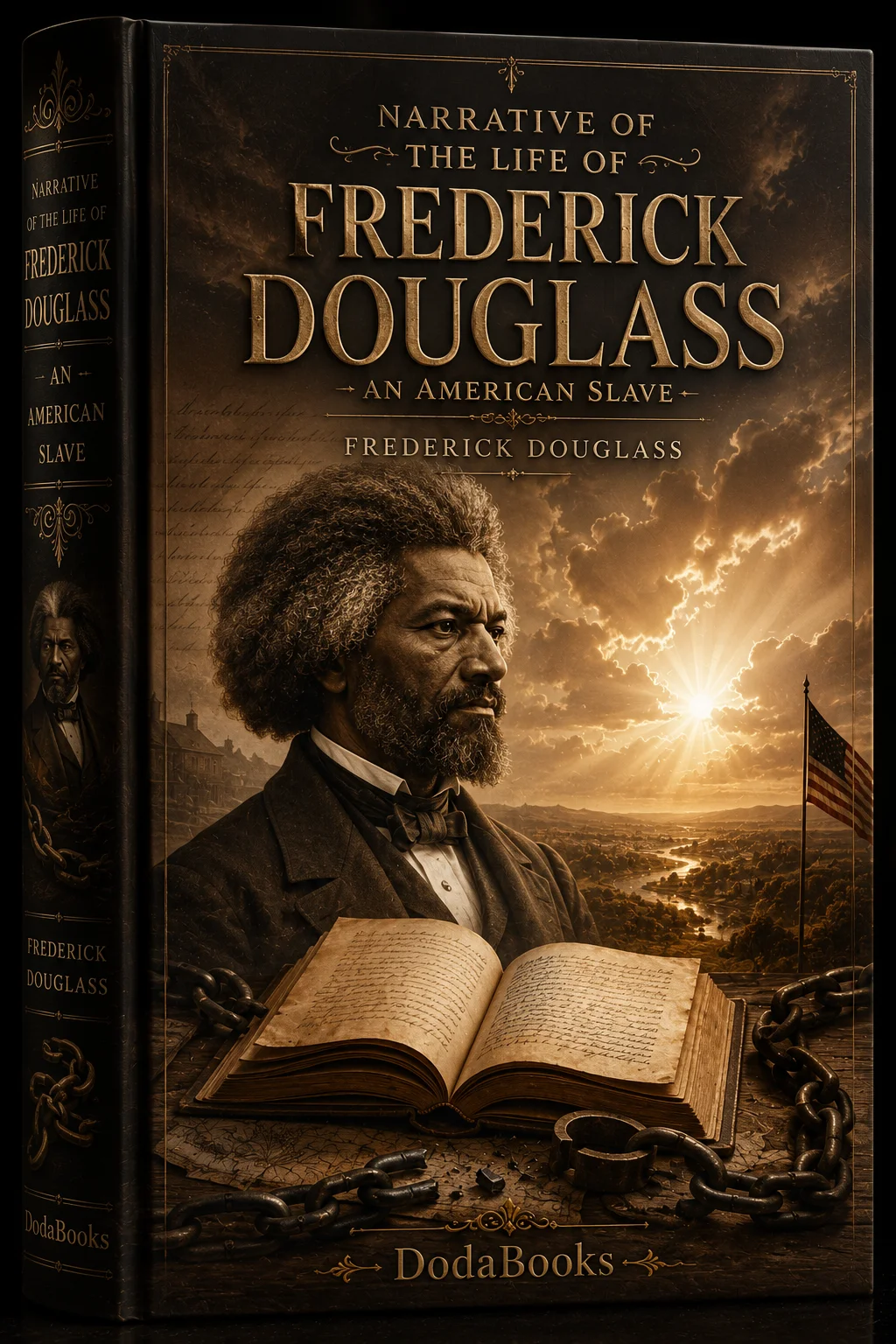
Narrative of the Life of Frederick Douglass
A definitive chapter-by-chapter breakdown of America's most influential slave narrative — examining Douglass's boyhood, his fight for literacy, the battle with Covey, and his perilous escape to freedom.
📖 Structure of the Narrative at a Glance
| Section | Focus & Setting | Key Turning Points |
|---|---|---|
| Prefaces | Garrison & Phillips (Boston, 1845) | Authentication of Douglass’s authorship and oratorical power |
| Chapters 1–4 | Tuckahoe & Colonel Lloyd’s Plantation | Loss of birthdate, separation from mother, songs of sorrow, overseer brutality |
| Chapters 5–7 | Baltimore (The Auld Household) | Sophia Auld’s kindness and corruption; Hugh Auld’s prohibition; learning to read |
| Chapters 8–9 | Property Division & St. Michael’s | Valuation of slaves as livestock; religious hypocrisy of Master Thomas Auld |
| Chapter 10 | Covey’s Farm & Baltimore Shipyards | The two-hour fight with Covey; Sabbath school; failed escape; caulking trade |
| Chapter 11 | Escape to New York & New Bedford | Flight to the North; marriage to Anna Murray; speaking at Nantucket |
| Appendix | Theological Defense | Distinction between pure Christianity and slaveholding hypocrisy |
📜 Front Matter: The Prefaces by Garrison and Phillips
Before Douglass’s own voice begins, the 1845 edition opens with two authenticating texts written by prominent white abolitionist leaders: a formal preface by William Lloyd Garrison, founder of the American Anti-Slavery Society and editor of The Liberator, and a supportive letter from the Boston orator and lawyer Wendell Phillips.
Garrison’s Preface
Garrison recalls his first encounter with Frederick Douglass at the August 1841 Nantucket Anti-Slavery Convention. Garrison describes the electric shock that ran through the audience when Douglass arose to speak: a man whose commanding physique, moral dignity, and eloquence shattered the racist stereotype of the intellectually inferior slave.
Garrison emphasizes that Douglass’s testimony is entirely authentic, written by his own hand without ghostwriters or editorial embellishment. Garrison uses Douglass’s life to issue a blistering challenge to the conscience of the North, asking how any Christian republic can tolerate an institution that reduces human beings bearing the image of God into cattle and beasts of burden.
Wendell Phillips’s Letter
Wendell Phillips follows Garrison with an affectionate and urgent letter addressed directly to Douglass. Phillips acknowledges the profound physical and legal danger Douglass faces by publishing this book. Unlike white authors, Douglass cannot reveal his name, former masters, and exact locations without risking kidnapping, extradition, and re-enslavement under federal fugitive laws. Phillips invokes the classic New England heritage of the Mayflower, noting with bitter irony that while Pilgrim fathers fled tyranny across the Atlantic, Black fugitives must flee tyranny within the borders of their own homeland.
🌾 Chapter 1: The Darkness of Origins & Plantation Childhood
“By far the larger part of the slaves know as little of their ages as horses know of theirs, and it is the wish of most masters within my knowledge to keep their slaves thus ignorant.”
Douglass begins his story with a profound absence: he does not know his exact date of birth, an ignorance systematically imposed on enslaved people to strip them of basic human identity. Born in Tuckahoe, near Hillsborough, in Talbot County, Maryland, he estimates his birth around 1818 based on overhearing his master say he was around seventeen in 1835.
Key Events & Developments
- Maternal Separation: Douglass recounts that he was separated from his mother, Harriet Bailey, when he was a tiny infant, a standard plantation practice designed to blunt the natural bond between mother and child. He saw her only four or five times in his entire life, always at night after she had walked twelve miles on foot from her hired plantation to lie beside him until he slept. When she died around his seventh year, he was forbidden to visit her illness or attend her burial, experiencing her death with the detachment one might feel for a stranger.
- Paternity & Rumor: His father was white and widely rumored to be his own master, Aaron Anthony. Douglass reflects on the peculiar misery of enslaved children fathered by their masters: they are subject to the constant hatred of the master’s white wife, frequently whipped to satisfy domestic jealousy, and sold away down south to avoid family discord.
- The First Witnessed Horror: The chapter closes with young Frederick witnessing his first brutal flogging: his Aunt Hester tied to a joist in the kitchen and stripped to the waist, whipped mercilessly by overseer Aaron Anthony until the blood dripped on the floor, while young Frederick huddled terrified in a closet. This event serves as Douglass’s “blood-stained gate, the entrance to the hell of slavery.”
🏛️ Chapter 2: The Great House Farm & The Slave Songs
Douglass describes the agricultural empire of Colonel Edward Lloyd, one of Maryland’s wealthiest planters, whose home plantation functioned like a self-contained baronial feudal estate known as the “Great House Farm.”
Daily Subsistence & Living Conditions
Enslaved field hands received bare minimum monthly allowances: eight pounds of pork or fish and one bushel of cornmeal, along with two coarse linen shirts, one pair of trousers, one jacket, and one pair of shoes per year. Children too young to work went practically naked year-round, sleeping on cold dirt floors with single coarse blankets and eating boiled cornmeal “mush” out of a communal wooden trough like pigs.
The Overseers: Severe vs. Hopkins
Douglass contrasts two overseers:
- Mr. Severe: A foul-mouthed sadist who took pleasure in flogging women and men alike at dawn.
- Mr. Hopkins: A less overtly cruel overseer who took no apparent pleasure in punishment, regarded by the enslaved as a relatively good man, though still an agent of an evil system.
The Truth About the Slave Songs
One of the most celebrated and philosophically profound passages in American autobiography occurs in this chapter. Douglass analyzes the sorrow songs sung by enslaved people as they traveled through the dense pine woods between outlying farms and the Great House Farm. White observers frequently misconstrued these wild, mournful songs as evidence of slave contentment and happiness.
Douglass corrects this falsehood with absolute clarity:
“The songs of the slave represent the sorrows of his heart; and he is relieved by them, only as an aching heart is relieved by its tears.”
To sing of freedom in melodies heavy with sorrow was not an expression of joy, but a lamentation that revealed the agonizing despair of human souls in bondage.
🐎 Chapter 3: The Power of Colonel Lloyd & The Peril of Truth
Chapter 3 explores the immense wealth of Colonel Lloyd and the atmosphere of paranoid terror that surrounded his plantation.
The Garden and the Horses
Colonel Lloyd maintained a fabulous fruit garden that tempted hungry slaves from miles around; to prevent theft, the colonel tarred the garden fence and declared that any slave found with tar on their clothes would be whipped without trial.
Lloyd also obsessed over his stable of fine riding horses. Two elderly slaves, Old Barney and Young Barney, had the impossible task of attending to these delicate animals. If a horse moved too slowly, held its head too low, or if the water was not at the exact temperature, Barney was forced to kneel in the dust and receive thirty or forty lashes from Lloyd or his sons.
The Cost of Speaking the Truth
Douglass demonstrates how slavery compelled enslaved people to suppress the truth. Colonel Lloyd once rode along the road in disguise and encountered an enslaved man, asking him if his master treated him well and gave him enough food. Not knowing he was speaking to Lloyd himself, the man honestly answered that his master overworked and underfed him.
A few weeks later, the honest man was chained, separated from his wife and children, and sold down the river to a Georgia trader as punishment for telling the truth. From that day forward, slaves universally learned that survival demanded saying their masters were kind and wealthy, even when they were despots.
⚖️ Chapter 4: Gore, Demby, and Murder Without Penalty
Mr. Hopkins was replaced as overseer by Mr. Austin Gore, a man who personified the cold, mechanical cruelty of the slave system. Gore never smiled, never bantered, and adhered to a terrifying maxim: it is better that a dozen slaves suffer under undeserved punishment than that the overseer’s authority be questioned for an instant.
The Murder of Demby
The climax of Chapter 4 is Gore’s cold-blooded murder of an enslaved man named Demby. During a severe whipping, Demby broke away and plunged into a creek up to his neck, refusing to come out. Gore coolly gave Demby three calls: if he did not come out on the third call, he would be shot. Demby stood his ground; on the third count, Gore raised his musket and shot Demby through the head, sending his blood and brains drifting down the creek.
When Colonel Lloyd demanded an explanation, Gore claimed that Demby had become unmanageable and that if one slave was allowed to set an example of defiance, every slave on the Eastern Shore would revolt and white men would lose control of their plantations. Gore’s defense was accepted immediately; he retained his post and his reputation as a first-rate overseer.
Douglass documents additional murders of enslaved people by white masters in Talbot County—including Mrs. Giles Hick, who murdered Douglass’s young cousin for falling asleep while tending a crying infant—proving that under Maryland law, the killing of a Black person by a white person was practically legal and never prosecuted.
⛵ Chapter 5: Leaving the Plantation & The Move to Baltimore
At approximately seven or eight years of age, Frederick Douglass received the news that changed the entire trajectory of his life: he was selected to go to Baltimore to live with Mr. Hugh Auld, the brother of his master’s son-in-law (Thomas Auld).
Leaving the Lloyd Plantation
Before departing, Douglass was given his first pair of trousers, scrubbed clean in the creek to remove plantation filth, and sent aboard a sloop sailing up the Chesapeake Bay to Baltimore. Looking back, Douglass views this departure as the providential turning point of his existence:
“Going to live at Baltimore laid the foundation, and opened the gateway, to all my subsequent prosperity.”
Meeting Sophia Auld
Upon arriving at the Auld home on Philpot Street in Baltimore, Douglass met his new mistress, Mrs. Sophia Auld. Unlike plantation mistresses, Sophia had never owned slaves before; she was a weaver by trade and greeted little Frederick with an open, beaming countenance of human warmth. For the first time in his life, white eyes looked upon him with affection rather than contempt.
🔤 Chapter 6: The Key to Freedom & The Power of Literacy
Chapter 6 forms the intellectual turning point of the entire Narrative.
The Forbidden Alphabet
Moved by young Frederick’s intelligence, Sophia Auld began teaching him the alphabet, syllable combinations, and how to spell simple three- and four-letter words. However, when her husband Hugh discovered what was happening, he was outraged and forbade her immediately, delivering a speech that Douglass etched forever into his memory:
“If you give a nigger an inch, he will take an ell. A nigger should know nothing but to obey his master—to do as he is told to do. Learning would spoil the best nigger in the world. Now, if you teach that nigger how to read, there would be no keeping him. It would forever unfit him to be a slave.”
Douglass’s Epiphany
Rather than crushing his spirits, Hugh Auld’s lecture was an explosive revelation. Douglass suddenly grasped what had previously been a dark mystery: the white man’s power to enslave the Black man lay in enforced mental darkness. If literacy unfitted a man to be a slave, then literacy was the royal road to freedom:
“From that moment, I understood the pathway from slavery to freedom… In learning to read, I owe almost as much to the bitter opposition of my master, as to the kindly aid of my mistress.”
City Slavery vs. Plantation Slavery
Douglass observes that slavery in Baltimore was markedly different from plantation life. In the city, public opinion and the close proximity of neighbors exerted a restraining influence on masters; white men were ashamed to have their cruelty known on the street. However, Douglass notes exceptions, such as the monstrous treatment of two enslaved women, Henrietta and Mary, by Mrs. Hamilton across the street.
📖 Chapter 7: The Columbian Orator & The Bread of Knowledge
Following her husband’s rebuke, Sophia Auld underwent a dramatic psychological deterioration. The venom of absolute power poisoned her native goodness, turning her into a ferocious overseer who seized newspapers from Douglass’s hands whenever she caught him looking at them.
Outsmarting the Prohibition
Douglass adopted innovative strategies to continue his education:
- Trading Bread for Lessons: Whenever sent on errands, he carried bread in his pockets to trade with hungry, poor white boys in the Baltimore shipyards in exchange for reading lessons on street corners.
- Copying Ship Timber Markings: While working in Durgin and Bailey’s shipyard, he observed carpenters marking timbers with letters representing ship sections: L (Larboard), S (Starboard), LF (Larboard Forward), and A (Aft). He copied these letters on fences and pavements with chalk, challenging neighborhood boys to spelling contests to learn new letters.
- Webster’s Spelling Book: When the Aulds were away, he used little Master Thomas’s discarded copybooks to practice writing between the lines until he had mastered a legible hand.
The Columbian Orator
Around age twelve, Douglass obtained a copy of Caleb Bingham’s The Columbian Orator, a popular school reader containing dialogues on liberty and speeches by British parliamentarians like Richard Brinsley Sheridan. One dialogue between a master and a slave, in which the slave convincingly argues for his natural right to liberty, electrified Douglass.
Reading these arguments gave him words for the anguish that burned within his soul. Yet literacy also brought acute mental torment: he could see the wretchedness of his condition without seeing any immediate way out. He envied the stupidest brute on the farm, confessing that freedom often appeared before him like an unapproachable torment. It was during this period that he first heard the word “abolition” in connection with the North, igniting a permanent flame of hope.
⚖️ Chapter 8: The Property Valuation & The Loneliness of Grandma
Tragedy struck Douglass’s life through the death of Captain Aaron Anthony and his heir Richard Anthony. Because Anthony died without a will, all his human property had to be appraised and divided between his two surviving children, Andrew and Lucretia.
Ranked Alongside the Beasts
Douglass was recalled from Baltimore to the Eastern Shore for the valuation. He describes the utter humiliation of standing in the yard alongside horses, sheep, swine, and cattle:
“There were horses and men, cattle and women, pigs and children, all holding the same rank in the scale of being, and were all subjected to the same narrow examination… A single word from the white men was enough to sever forever the dearest ties of affection.”
Douglass was assigned to Mrs. Lucretia, who sent him back to Baltimore to live with Master Hugh.
The Abandonment of His Grandmother
Following the premature deaths of both Lucretia and her brother Andrew, the Anthony estate fell into the hands of strangers. Douglass’s beloved grandmother, Betsy Bailey—who had cared for generations of children, built the master’s cabin, and served him faithfully from youth to old age—was considered too old and frail to be useful on the auction block.
Instead of being granted freedom, she was turned out into a desolate hut in the woods to live alone and die like an abandoned dog. Douglass’s furious poetic denunciation of this cruelty ranks among the most moving indictments of slavery in the English language.
⛪ Chapter 9: St. Michael’s & The Hypocrisy of Religious Masters
In 1832, following a quarrel between Hugh Auld and his brother Thomas Auld, Douglass was taken away from Baltimore and brought to live with Thomas at St. Michael’s on the Eastern Shore.
The Mean Despotism of Master Thomas
Thomas Auld was incapable of managing slaves effectively. Having acquired his human property by marriage, he was an awkward, petty tyrant who starved his house servants, giving them less than half a bushel of cornmeal a week and forcing them to beg or steal food from neighbors to survive.
The August 1832 Methodist Camp Meeting
In August 1832, Master Thomas attended a Methodist camp meeting in Talbot County, experienced a profound religious conversion, and joined the church. Douglass harbored a faint hope that religion might make his master more humane and liberate his captives.
Instead, religion made Thomas Auld vastly more cruel:
“Prior to his conversion, he relied upon his own depravity to shield and sustain him in his savage barbarity; but after his conversion, he found religious sanction and support for his slaveholding cruelty.”
Auld regularly whipped a young, disabled enslaved girl named Henny while quoting Scripture: “He that knoweth his master’s will, and doeth it not, shall be beaten with many stripes.” Finding Douglass intellectually unmanageable, Thomas Auld resolved to send him on a one-year contract to Edward Covey, a notorious local farmer known as a “slave-breaker.”
⚡ Chapter 10: The Turning Point, Edward Covey, and the Shipyards
Chapter 10 is the longest, most dramatic, and thematic climax of the entire Narrative. Running over eighty pages in the original edition, it chronicles Douglass’s fall into despair and his heroic physical and spiritual resurrection.
The Ordeal with Edward Covey
On January 1, 1833, Douglass arrived at Covey’s farm. Covey was a religious fanatic, a class leader in the Methodist church, and a master of psychological warfare. He worked his laborers from dawn until late into the night, hiding behind bushes and creeping through ditches to pounce on unsuspecting workers. He earned the nickname “the Snake.”
Within six months, Covey achieved what no master had done before: he broke Douglass’s spirit:
“Mr. Covey succeeded in breaking me. I was broken in body, soul, and spirit. My natural elasticity was crushed, my intellect languished, the disposition to read departed, the cheerful spark that lingered about my eye died; the dark night of slavery closed in upon me; and behold a man transformed into a brute!”
The Chesapeake Soliloquy
During his Sunday respites, Douglass stood on the banks of the Chesapeake Bay, gazing at the beautiful white sails of passing ships moving toward the ocean. In an unforgettable apostrophe, he compared their freedom to his own chains:
“You are loosed from your moorings, and are free; I am fast in my chains, and am a slave! You move merrily before the gentle gale, and I sadly before the bloody whip! You are freedom’s swift-winged angels, that fly round the world; I am confined in bands of iron! O that I were free! O, that I were on one of your gallant decks!”
The Collapse and the Battle with Covey
In August 1833, while fanning wheat in the sweltering heat, Douglass collapsed from heat exhaustion. Covey rushed up and kicked him violently in the side, striking his head with a hickory slat until blood flowed. Douglass staggered seven miles to Master Thomas’s house to seek protection, but Thomas dismissed his complaints and ordered him back to Covey the next morning.
Returning to the woods, Douglass met an older enslaved man named Sandy Jenkins, who advised him to carry a certain root in his right pocket to protect him from whippings.
On Monday morning, when Covey attempted to tie Douglass’s legs in the barn, something snapped inside Frederick:
“You have seen how a man was made a slave; you shall see how a slave was made a man.”
Douglass seized Covey by the throat and fought him for two full hours in the stable dung. Covey called for help from his cousin Hughes, but Douglass kicked Hughes to the ground. When Covey asked an enslaved hired man named Bill to help tie Douglass down, Bill flatly refused, saying he was hired to work, not to whip men.
Covey finally abandoned the fight, gasping for breath, and never raised a hand against Douglass again for the remaining six months of his contract. The battle restored Douglass’s sense of manhood, his self-respect, and his determination to be free or die trying.
William Freeland and the Secret Sabbath School
On January 1, 1834, Douglass was hired out to Mr. William Freeland, an open, fair-minded planter without religious hypocrisy. Here, Douglass established a secret Sabbath school in the woods, teaching up to forty fellow slaves how to read the New Testament. Douglass loved these men with fierce devotion, resolved to share whatever intellectual light he possessed.
The Failed Escape of 1835
In 1835, Douglass and five companions (Henry and John Harris, Sandy Jenkins, Charles Roberts, and Henry Bailey) plotted an escape by stealing a large canoe and paddling up the Chesapeake Bay to the head of the bay, posing as fishermen carrying false travel passes written by Douglass.
On the morning of their intended departure, the plot was betrayed by an unknown party. Constables arrived, tied the conspirators, and dragged them fifteen miles to the county jail in Easton. Douglass expected to be sold to a Georgia trader, but Thomas Auld unexpectedly decided to send him back to Baltimore to Master Hugh to learn a trade.
The Caulking Trade & The Apprentice Riot
In Baltimore, Douglass was apprenticed to William Gardner at Fell’s Point to learn the trade of ship-caulking. In Gardner’s busy shipyard, fifty white carpenters launched a strike against free and enslaved Black mechanics. Four white apprentices attacked Douglass with brickbats, spikes, and handspikes, nearly blinding him in his left eye. Hugh Auld was outraged—not out of affection for Frederick, but out of anger that white ruffians had damaged his property—and pulled him out of Gardner’s yard.
Douglass was placed in the shipyard of Master Walter Price, where he rapidly mastered caulking, earning six to nine dollars a week. However, under the law of slavery, every Saturday evening he was forced to turn over every penny of his wages to Hugh Auld. This robbery reignited his fury: why should a man work six days a week only to hand the fruits of his sweat to another who had done nothing?
🗽 Chapter 11: The Escape to Freedom & The Nantucket Speech
In Chapter 11, Douglass recounts his escape to the free states and his entry into public abolitionist life.
The Prudence of Silence
Douglass deliberately withholds the exact dates, names, railroad lines, and methods of his escape. He writes that while publishing these details might satisfy public curiosity, it would endanger the brave free Black men and women who assisted him and alert slaveholders to plug the gaps in the Underground Railroad.
Arrival in New York & The Fugitive’s Terror
On September 3, 1838, Douglass succeeded in reaching New York City. His initial ecstasy at standing on free soil was soon tempered by the chilling realization that he was an unprotected fugitive in a city teeming with Southern slave-catchers and corrupt northern kidnappers.
Fortunately, he met Mr. David Ruggles, an African American journalist and leader of the New York Vigilance Committee. Ruggles took Douglass into his boarding house, provided him with safe harbor, and sent for Douglass’s fiancée, Anna Murray, a free Black woman from Baltimore who had helped finance his escape.
The couple was married by the Reverend J.W.C. Pennington on September 15, 1838, and departed immediately for New Bedford, Massachusetts, where the whaling industry offered plentiful work for skilled ship-caulkers.
The Transformation in New Bedford
In New Bedford, they were welcomed by a prosperous Black couple, Mr. and Mrs. Nathan Johnson. Because Frederick had gone by several names (Frederick Augustus Washington Bailey, Frederick Stanley, Frederick Johnson) to evade pursuers, Mr. Johnson suggested the surname Douglass, inspired by the heroic Scottish chieftain in Sir Walter Scott’s poem The Lady of the Lake.
Douglass was astonished by New Bedford:
- Clean streets, prosperous homes, well-fed workers, and no whip-wielding overseers.
- Free Black families living in elegant houses with extensive libraries, possessing civil rights, and defending fugitives with unified armed resolve against any slave-catcher bold enough to enter the town.
Douglass found work loading oil casks and shoveling coal on the wharves, savoring the joy of earning his own bread with his own hands.
The Liberator & The Nantucket Convention
Douglass subscribed to William Lloyd Garrison’s abolitionist newspaper, The Liberator. The paper became his meat and drink, setting his soul on fire with the holy cause of human freedom.
In August 1841, Douglass attended an anti-slavery convention on the island of Nantucket. At the urging of Mr. William C. Coffin, Douglass rose before a white audience to speak publicly about his experiences in slavery for the very first time. Despite trembling knees and profound hesitation, his voice carried the authentic weight of suffering and truth. From that day onward, Frederick Douglass dedicated his voice, his intellect, and his entire life to the abolition of slavery.
🕊️ Appendix: The Distinction Between True and False Christianity
Douglass concludes his book with an impassioned, theological Appendix designed to prevent pro-slavery critics from claiming that his memoir was an attack on religion.
Douglass draws a sharp and uncompromising distinction between two diametrically opposed faiths:
- The Christianity of Christ: Pure, peaceable, loving, impartial, and merciful—a faith that defends the poor, comforts the brokenhearted, and demands justice for the oppressed.
- The Christianity of This Land (Slaveholding Religion): Corrupt, hypocritical, violent, and arrogant—a monstrous distortion that uses the Bible to justify the whip, the chain, and the slave market.
Douglass writes witheringly of the southern revivals where masters prayed loudly on Sunday and sold their brothers on Monday, showing that the most religious slaveholder was consistently the most cruel and unfeeling. The Appendix concludes with a biting parody of a popular religious hymn, exposing the grotesque alliance between the auction block and the pulpit.
📚 Study Questions & Key Takeaways
- Why does Douglass emphasize his lack of a birthdate in Chapter 1?
To demonstrate that chattel slavery was an assault on time, family memory, and personal identity. - What does the battle with Covey represent in American literature?
It marks the rebirth of self-respect, moral agency, and physical courage—the symbolic moment when Frederick stops being property and becomes a free man in spirit. - How does Sophia Auld’s transformation illustrate the effect of slavery on masters?
She proves that tyrannical power corrupts the naturally kind human soul, destroying empathy and morality in the oppressor as well as the oppressed.
📖 Deepen Your Study with DodaBooks
To experience Frederick Douglass’s masterwork in its pure, unabridged form—accompanied by historical context notes, plantation maps, and clear typography—explore the DodaBooks Annotated Edition of Narrative of the Life of Frederick Douglass.