Napoleon’s Letters to Josephine: Passion, Power, and the Price of Empire
From the Feverish Battlefield Despatches of the 1796 Italian Campaign to the Sombre Farewell of Imperial Divorce: A Conqueror’s Most Vulnerable Correspondence
Across the sweeping panorama of modern European history, no personal correspondence presents so startling an emotional trajectory as Napoleon’s Letters to Josephine (1796–1812). Written by Napoleon Bonaparte to Marie Josèphe Rose Tascher de La Pagerie—the enchanting Martinique-born widow who became Empress of the French—these missives span sixteen fateful years. They trace the meteoric ascension of a fiery, penniless Corsican general into the supreme master of continental Europe, concluding amidst the icy catastrophe of the 1812 Russian campaign and the private wreckage of dynastic sacrifice.
While official imperial bulletins recorded military triumph at Austerlitz, Marengo, and Jena with classical pomp, Napoleon’s private letters capture the chaotic human engine beneath the myth. In these pages, we encounter not an unfeeling bronze statue or an infallible strategist, but an exhausted warrior writing on horseback or by the dim light of campaign candles: pleading for news, agonizing over rumors of infidelity, scolding domestic expenditures, and ultimately mourning the companion who remained his closest emotional confidante long after reasons of state forced their painful separation.
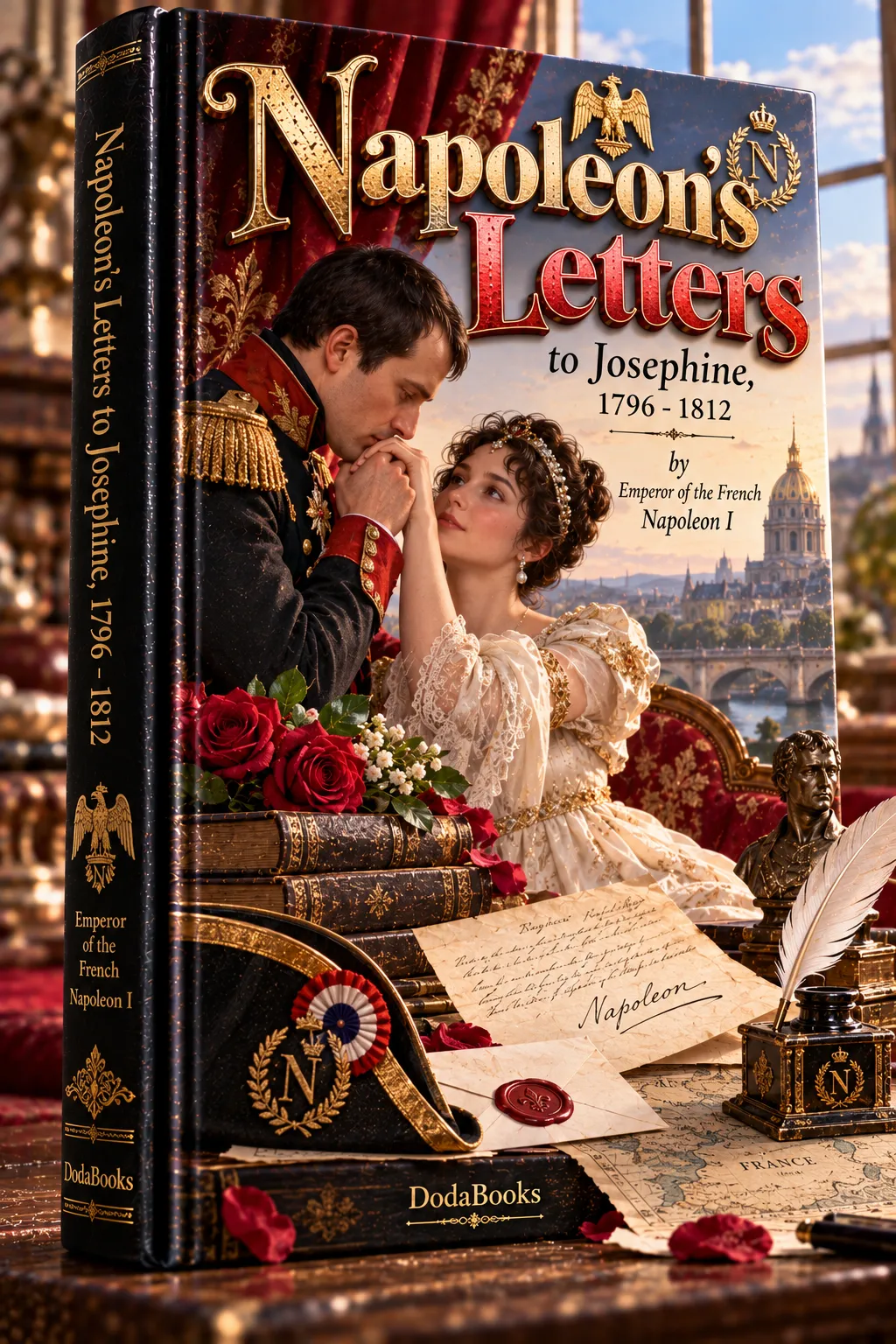
Discover the Intimate Voice of Europe's Conqueror
Read Napoleon Bonaparte's complete uncensored correspondence to Empress Josephine, annotated with military context, historical background, and personal commentary.
Read Napoleon's Letters TodayThe 1796 Italian Campaign: Feverish Passion on the Edge of Genius
The opening sequence of letters, penned during the whirlwind Italian Campaign of 1796–1797, constitutes some of the most extraordinary romantic literature ever produced by a military commander. Married to Josephine in Paris on March 9, 1796, the twenty-six-year-old Bonaparte departed just two days later to assume command of the ragged, demoralized Army of Italy. As he shattered Austrian and Sardinian forces across Montenotte, Lodi, and Castiglione, his nocturnal hours were consumed not by tactical complacency, but by an overwhelming, almost pathological romantic obsession.
Napoleon’s early letters from Nice, Verona, and Milan reveal an intense psychological turbulence that startled even his closest aides:
- Desperate Pleading for Letters: While maneuvering tens of thousands of bayonets against veteran Austrian field marshals, Bonaparte bombarded Josephine with frantic couriers, begging for a single line in return: “I have not spent a day without loving you; I have not spent a night without clasping you in my arms.”
- Jealousy and Paris Distractions: While Napoleon endured dysentery, battlefield mud, and artillery duels, Josephine lingered in Paris, attending salons and flirting with dashing cavalry officers like Hippolyte Charles. Napoleon’s missives veer wildly between breathless adoration and violent jealousy: “You do not write to me; you are wicked, very wicked! You no longer love your poor husband!”
- Physical Devotion and Miniature Portraits: Bonaparte carried Josephine’s miniature portrait inside his coat pocket, kissing it dozens of times each day. During one cavalry skirmish, when the glass covering the miniature cracked, Napoleon turned white with horror, convinced it was an omen that Josephine had fallen gravely ill or died in Paris.
These campaign letters demolish the stereotype of Bonaparte as a purely calculating, stoic machine. They demonstrate that his initial military genius was fueled by a fierce, nervous energy wherein martial conquest and romantic longing were inextricably entwined.
The Evolution of Tone: From Ardent Suitor to Imperial Ruler
As Napoleon’s political destiny transformed—progressing from revolutionary general to First Consul of the French Republic in 1799, and finally to Emperor of the French at Notre-Dame in 1804—the emotional temperature of the correspondence underwent a profound mutation. The desperate suitor of 1796 gradually morphed into a commanding patriarch and statesman, though the underlying bond of deep affection never extinguished.
Scholars divide this epistolary transformation into three distinct historical phases:
In the imperial years following the 1805 victories at Ulm and Austerlitz, Napoleon’s notes become laconic bulletins. He writes brief summaries of his health (“My health is good, the weather bad, the enemy beaten”), reassures Josephine that he has escaped enemy cannon fire, and inquires gently after her gardens and dogs at her beloved estate of Château de Malmaison. The wild romantic fever had yielded to an unshakeable domestic familiarity.
The Agony of Dynastic Divorce: Empire Versus Heart
The emotional crux of the collection arrives in late 1809, when the fundamental tragedy of Napoleon’s reign asserted itself: the necessity of an imperial heir. Josephine, six years older than Napoleon and having borne two children (Eugène and Hortense) during her first marriage to Alexandre de Beauharnais, had failed to provide Bonaparte with a biological successor. Surrounded by dynastic rivals, allied monarchies, and assassination plots, Napoleon resolved that the continuity of the French Empire demanded a royal marriage with the Habsburg dynasty of Austria.
The letters surrounding the dissolution of their marriage in December 1809 reveal the immense personal toll of this dynastic imperative:
- The Mutual Sacrifice: At the formal declaration before the Imperial family and Senate, both Napoleon and Josephine wept openly. Napoleon publicly declared that Josephine was the greatest friend of his life and that she would retain the imperial title of Empress, receiving an immense pension and the estate of Malmaison.
- The Loneliness of the Tuileries: After Josephine’s departure, Napoleon wandered through the empty palace of the Tuileries in deep depression. His letter written the following morning reveals his immediate heartbreak: “My friend, I found myself today very lonely. Great palaces seem empty to me, and I feel isolated from everything.”
- Continuing Royal Consultation: Even after marrying Archduchess Marie Louise of Austria and fathering the King of Rome in 1811, Napoleon continued to visit Josephine secretly at Malmaison and correspond with her regularly. He shared his deepest anxieties regarding Russian diplomacy, sought her advice on court personalities, and arranged for her to see his infant son.
As the letters make clear, while Marie Louise was the mother of his heir, Josephine remained the spiritual anchor of his life.
Explore the Complete Correspondence with Scholarly Annotations
The DodaBooks annotated edition provides historical context for every military dispatch, explains Parisian court gossip, and translates 18th-century French idioms.
Get the Annotated Edition for $0.99Key Themes in Napoleon’s Correspondence
Examined through a literary and historiographical lens, the letters provide invaluable insight into the psychology of power and private sentiment:
1. The Mask of Glory versus the Reality of Loneliness
To the public, Napoleon cultivated an image of Olympian detachment, dictating decrees that altered kingdoms across Europe. In his private missives to Josephine, however, the mask drops completely. He complains of bitter winter cold, physical exhaustion, riding forty leagues through muddy German forests, and the suffocating burden of governing millions of subjects. The correspondence shows that love was Napoleon’s sole refuge from the overwhelming machinery of his own ambition.
2. Josephine as Diplomatic Asset and Political Tactician
Josephine was never a passive recipient of imperial favor. Endowed with exquisite grace, impeccable aristocratic manners, and boundless social tact, she disarmed Napoleon’s fiercest political critics and soothed volatile republican generals. Napoleon’s letters acknowledge this indispensable partnership: he directs her on which ministers to flatter, which foreign ambassadors to receive warmly, and how to maintain the prestige of the French court while he campaigned in Poland or Spain.
3. Epistolary Style: Speed, Cadence, and Impatience
Napoleon rarely wrote slowly; his letters reflect the rapid, staccato rhythm of his thought. His handwriting was notorious among his staff for being nearly indecipherable—a jagged scrawl written at breakneck speed. The prose style is concise, muscular, and stripped of unnecessary ornament. Sentences dart forward with the momentum of cavalry charges, punctuated by sudden poetic flourishes that recall the romantic sensibilities of Jean-Jacques Rousseau and Ossian, authors Bonaparte devoured during his youth.
"I have your letter, my adorable friend; it has filled my heart with joy.
I am exhausted with work; my horse dropped dead beneath me yesterday.
Take care of yourself, walk in your gardens, and remember that I love you."
— Napoleon to Josephine, Campaign of 1806
Comparing Napoleon’s Private Voice Across Historical Documents
To appreciate the distinct character of Napoleon’s Letters to Josephine, it is illuminating to contrast them with other famous royal correspondences from the same era and beyond. Just as the Love Letters of Henry VIII to Anne Boleyn illustrate how personal passion can disrupt religious and constitutional institutions, Napoleon’s correspondence shows how imperial realpolitik eventually crushed personal passion.
Similarly, readers fascinated by the diplomatic backstage of the Napoleonic aftermath will find indispensable context in the Memoirs of the Duchesse de Dino, which chronicle Prince Talleyrand’s intricate maneuvering to reshape post-Napoleonic Europe. For readers interested in twentieth-century literary portraits of high-stakes passion, jealousy, and marital sacrifice, explore our The Passionate Friends by H.G. Wells Guide. For those studying the military logistics and personal human costs of these vast campaigns, Dalton’s The Waterloo Roll Call provides the ultimate roster of the officers who met Napoleon’s final imperial challenge on the ridge of Mont-Saint-Jean.
Why Read the DodaBooks Annotated Edition?
While fragmentary excerpts of Napoleon’s letters are widely quoted in popular biographies, reading the unexpurgated chronological sequence reveals the true magnitude of the drama. The DodaBooks Annotated Edition offers several critical features for modern readers:
- Comprehensive Contextual Footnotes: Detailed annotations explain every military maneuver, peace treaty, and political crisis referenced in the dispatches, from the bridge at Arcole to the flames of Moscow.
- Biographical Glossary of Court Figures: Instantly identify the marshals, mistresses, diplomats, and family members who cross Napoleon’s path, including Murat, Ney, Fouché, and Talleyrand.
- Elegant Digital Formatting: Formatted with meticulous typography, preserved French dates from the Revolutionary Calendar, and an interactive table of contents optimized for all e-reading devices.
The Human Heart Behind the Legend
Witness the rise and fall of the Napoleonic Empire through the private confessions, jealousies, and enduring devotion of history's greatest commander.
Download the Complete EbookFrequently Asked Questions
Are Napoleon’s letters to Josephine genuine historical documents?
Yes. The letters were preserved by Empress Josephine and her children, Prince Eugène and Queen Hortense. Following Josephine’s death in 1814 and the restoration of the Bourbon monarchy, Queen Hortense oversaw the careful preservation and eventual publication of the authentic correspondence, providing an uncontested primary historical source.
Did Josephine love Napoleon as deeply as he loved her?
In the early years of their marriage (1796–1798), Josephine was aloof, accustomed to the fast-paced life of Parisian high society, and occasionally unfaithful. However, following Napoleon's return from Egypt and his consolidation of political power as First Consul, Josephine grew deeply attached and devoted to him, remaining his most steadfast supporter through his imperial coronation and eventual divorce.
Why did Napoleon divorce Josephine if he still loved her?
Napoleon divorced Josephine purely for dynastic and geopolitical reasons. Because Josephine had reached an age where she could no longer bear children, the Napoleonic Empire lacked a direct heir. To prevent immediate civil war and foreign invasion upon his death, Napoleon felt compelled to enter a dynastic alliance with Austria by marrying Archduchess Marie Louise in 1810.
What were Napoleon's famous last words regarding Josephine?
When Napoleon Bonaparte died in exile on the remote South Atlantic island of Saint Helena on May 5, 1821, his recorded dying words were: "France, armée, tête d'armée, Joséphine" (France, the army, head of the army, Josephine). This legendary final utterance demonstrated that the memory of his first Empress remained etched in his consciousness until his final breath.
What historical background is needed to understand these letters?
A basic understanding of the French Revolution, the Directory, and the Napoleonic Wars is helpful, but the DodaBooks annotated edition provides thorough notes explaining the military campaigns, historical dates, French Revolutionary calendar references, and political figures throughout the text.