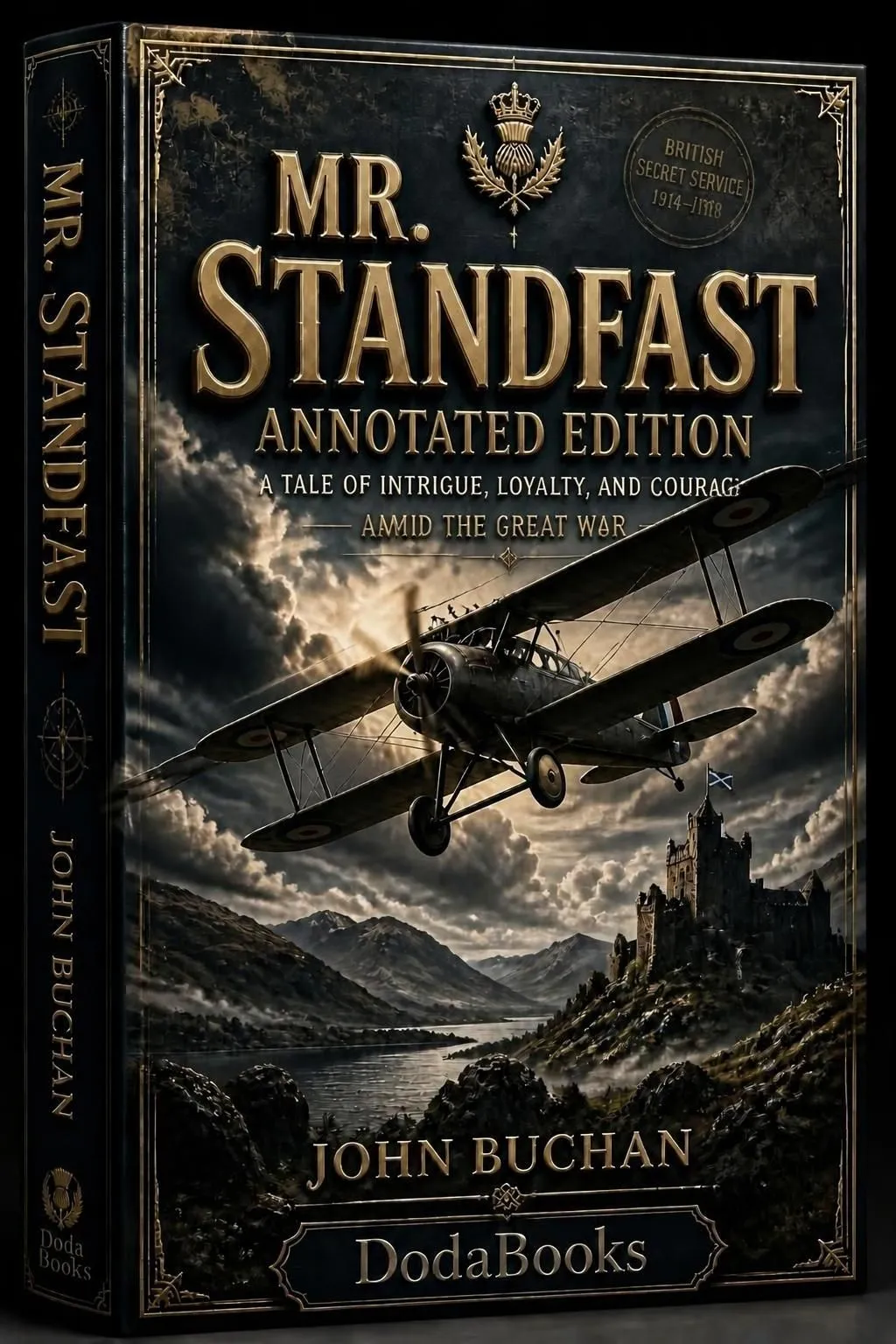
John Buchan’s Mr. Standfast is the 1919 conclusion of the Richard Hannay trilogy — and a very different book from the chase in the Highlands. Here Hannay goes undercover as a pacifist labourer to hunt the master German spy who almost brought Britain to its knees. This guide covers the plot, the name, and the DodaBooks Annotated Edition.
🖋️
Mr. Standfast
Seventeen months into the war, Hannay is given the hardest mission of his life: pretend to be a pacifist, vanish into the ordinary world, and find the most dangerous spy in Europe — whose identity is hidden in plain sight.
| Author | John Buchan |
| Published | 1919 |
| Genre | Spy thriller, WWI adventure |
| Setting | Britain, Switzerland, and the Western Front |
| Best For | Thriller fans, war readers, Buchan devotees |
| Reading Time | 7–9 hours |
🖋️ The Story
Following the events of Greenmantle, Richard Hannay is given a new role: “Cornelius Brand,” a tearful, God-fearing pacifist, despised by the very army he serves. His mission is to dive into the strange, war-torn world of English hinterland — of conscientious objectors, secret peace movements, and German agents who move freely within it — and identify Ivery, the master spy whose whole weapon is respectability.
The trail runs from provincial train platforms to a Swiss hotel under the watch of a German general, from an airfield to a submarine, and finally into the open horror of the trenches in 1918, as the German spring offensives hammer the British line. The book’s great reverse is that the “Mr. Standfast” of the title — named for a character in John Bunyan’s The Pilgrim’s Progress — is not Hannay at all, but the man who quietly, hopelessly, loves the same girl.
“I had to wash my hands of my past, to be a mean fellow and a white-livered one, when all the time I was one of the most trusted men in the Empire.”
🗺️ The Shape of the Plot
The opening chapters move at a strange, murmuring pace. Hannay, one of the most trusted soldiers in the Empire, is buried in a village called Biggleswick — a colony of conscientious objectors and pacifist lecturers — disguised as “Cornelius Brand,” a devout man of peace. No spy’s calculations include a decorated soldier hiding in the one place the army would rather not look. There he meets Mary Lamington, who is not quite what she seems, and circles ever closer to Ivery, the master spy whose weapon is not a code but pure, impenetrable respectability.
The middle of the book loosens into a restless journey across wartime Britain, into the neutral Alps, and back to France, where the story snaps shut on the Western Front of 1918 — the retreats, the exhausted gunners, Peter Pienaar’s last flight. All of it moves toward the armistice, and all of it is measured against that strange title of Bunyan’s: the pilgrim who stood his ground while others fled.
🕊️ Why the Title Is the Key to the Book
The name “Mr. Standfast” comes from Bunyan’s great allegory — the pilgrim who “stood his ground till the first clash was over” while others fled. Buchan is doing something clever with it: a book called Mr. Standfast is above all about the courage to hold still, to be thought a coward, to endure. Hannay’s undercover identity makes him a defenceless man in the most dangerous room in Europe, alone among men who would shoot him on sight.
The title also points to the book’s secret center: an episode of real heroism in the trenches, where standing not running is the whole of courage. The annotations tie this anatomy of the title to the novel’s structure — and it is the novel’s most profound idea.
🔍 The Annotated Edition
Annotation Cards
Visible, color-coded notes sitting beside the action — no clicking.
The Real War
1917–18 offensives, spy sector, and the spring campaign Hannay rides into.
Undercover Craft
How the "pacifist" identity hides a soldier in plain sight of the enemy.
Pilgrim's Progress
Bunyan's allegory and how Buchan maps it onto the espionage plot.
Conscience & Courage
The toll of pretending, the meaning of standing, and pacifism in war.
Hannay's Arc
The trilogy's hero, from man-on-the-run to the final weapon of the war.
📘 Annotated Insight — The Spy Nobody Could See
The novel’s master stroke is that Ivery’s camouflage is the very virtue British society prized — respectability, charity, home. The annotations trace how Buchan had watched, in the armed years, the real spies who hid inside wealthy houses and pacifist movements, and how the enemy’s greatest cover is the assumption that evil doesn’t look like morning tea.
🕰️ Writing the End of the War
Buchan served in the war as a propaganda officer and intelligence officer; he finished Mr. Standfast in 1918 while the actual German offensive raged. The novel’s last chapters are therefore not research but lived experience — the trenches, the air raids, the rumours that moved across France faster than trains. It is, almost uniquely in the genre, a thriller that ends exactly where history ended: the German collapse and the armistice.
🏛️ Historical & Cultural Context: The War’s Cruel Final Years
Buchan wrote the closing chapters while the fighting was still going on, and it shows. The finale rides the German spring offensives of 1918 — the last desperate German gambit, launched after the collapse of Russia freed divisions for the west — and the embankments and reeling British divisions Hannay moves among are real geography, not scenery. Buchan had served close to that war, as an officer on the Western Front and then inside the intelligence and propaganda services, so the mud and exhaustion in these pages are memory more than research.
The Biggleswick chapters are history of a quieter kind: the real Britain of the conscription years, where tribunals weighed the fate of conscientious objectors and genuine peace activity could rub shoulders with enemy networks. That picture of spies hidden inside respectable English life was written while the fear was live, which gives the book an authenticity later spy fiction can only imitate.
💭 Why It Still Matters
Mr. Standfast is the novel that turns the Hannay chase into something heavier: a home-front puzzle about hidden agents becomes a statement about the cost of courage and the price of pretending. Modern spy fiction owes much to Buchan’s insistence that an intelligence officer’s real battle is internal — keeping a face, mastering his nerve, surviving men who would shoot him on sight. Because Buchan wrote up to the armistice in real time, it is also one of the few thrillers that ends where history ended.
Read against the pure high spirits of The Thirty-Nine Steps, this is the same Hannay grown stern — a richer, sadder figure than the fugitive of 1915. Lovers of the fair-play puzzle Buchan admired should likewise try the very different detection of Fergus Hume’s The Green Mummy.
A spy novel that concludes the war — with the whole field of 1914–18 explained on every page.
🧭 How to Read It
The book moves in three gears. Savour the Biggleswick chapters as an English social comedy with a secret, take the Swiss trail at a stride, and expect the final quarter to change register completely as the war takes over. Don’t untangle every Bunyan reference on the spot — the annotations do that work while you keep your momentum. And if you plan to read the trilogy, begin with The Thirty-Nine Steps, so the second half of this book lands with full force.
❓ Frequently Asked Questions
Do I need to read The Thirty-Nine Steps first?
The book stands alone, but the Hannay arc from The Thirty-Nine Steps and Greenmantle makes it far more resonant. Read either first; this edition gives you the connections either way.
Is Mr. Standfast really about the Pilgrim's Progress?
Yes — on purpose. Buchan uses Bunyan’s famous characters as running symbolism, and the novel’s climax revolves around the allegory. The annotations unpack each reference.
How violent is the book?
There are vivid wartime deaths and a harrowing trench sequence, but the violence happens mostly off the page. This is a tense thriller, not a gory one.
Is it historically accurate?
The general contours are accurate — the Western Front, the offensives of 1918, the air war. Where Buchan compresses for the story, the annotations flag it.
How long is it?
Roughly 220 pages — bridge length, 7–9 hours of reading. One long weekend will do it.
Where should I start — The Thirty-Nine Steps or Mr. Standfast?
Start with The Thirty-Nine Steps. It introduces Hannay and the pursuit format, it is short enough to finish in an evening, and Mr. Standfast rewards that groundwork — its shocks depend on knowing how far Hannay has come. Greenmantle sits between the two and introduces Peter Pienaar, whose arc matters enormously here.
Who is Peter Pienaar and why is his ending so important?
Peter Pienaar is the Boer scout who helps Hannay in Greenmantle; in Mr. Standfast he flies for the Royal Flying Corps. His last mission, flown knowing there is no coming back, is the novel’s clearest statement of what the title means: courage is not charging forward but holding your course to the end.
Is Mr. Standfast only for readers who care about military history?
Not at all. Roughly half the novel is a drawing-room spy puzzle about ideas — pacifism, respectability, loyalty — and the military chapters carry their weight emotionally rather than technically. The annotations explain the campaigns for anyone who wants them, but none of that knowledge is required to feel the story.
📚 Related Articles
🖋️ End the War Behind Enemy Lines — Annotated
Read Buchan’s final Hannay novel with the war itself unpacked:
- ✅ Complete 1919 text — the full adventure
- 🗂️ Passage-specific annotation cards — visible, color-coded
- ⚔️ The real 1918 campaigns explained on every page
- 🕊️ The Pacifist’s mask and the meaning of standing firm
- 🔒 DRM-free — read on any device
- 📥 Instant download — EPUB format