Memoirs of the Duchesse de Dino: Inside the Nerve Center of European Diplomacy
The Confidential Journal of Talleyrand’s Brilliant Niece, Recording the Last Great Diplomatic Maneuvers of Post-Napoleonic Europe, the Death of a Colossus, and the Rise of the Victorian Era
Few figures in nineteenth-century European historiography enjoyed so privileged and acute a vantage point as Dorothée von Biron, Duchesse de Dino (later Duchesse de Talleyrand et de Sagan). Born into Baltic royalty as the daughter of the Duke of Courland, she married the nephew of Prince Charles-Maurice de Talleyrand-Périgord and rapidly evolved into the venerable diplomat’s indispensable companion, political confidante, and principal secretary. In Memoirs of the Duchesse de Dino (1836–1840), we are granted an extraordinarily penetrating, firsthand chronicle of the twilight years of Prince Talleyrand and the seismic shifts of early Victorian and July Monarchy Europe.
Covering the pivotal quadrennium between 1836 and 1840, these memoirs transport the reader inside the grand châteaux of Valençay and Rochecotte, the drawing rooms of the Faubourg Saint-Germain, and the British diplomatic circuit. Far from an idle courtier’s diary of frivolous ceremonies, the Duchesse de Dino’s journal offers trenchant political analysis, verbatim diplomatic conversations, and an unforgettable, deeply moving account of Talleyrand’s final illness, spiritual reconciliation, and death in 1838.
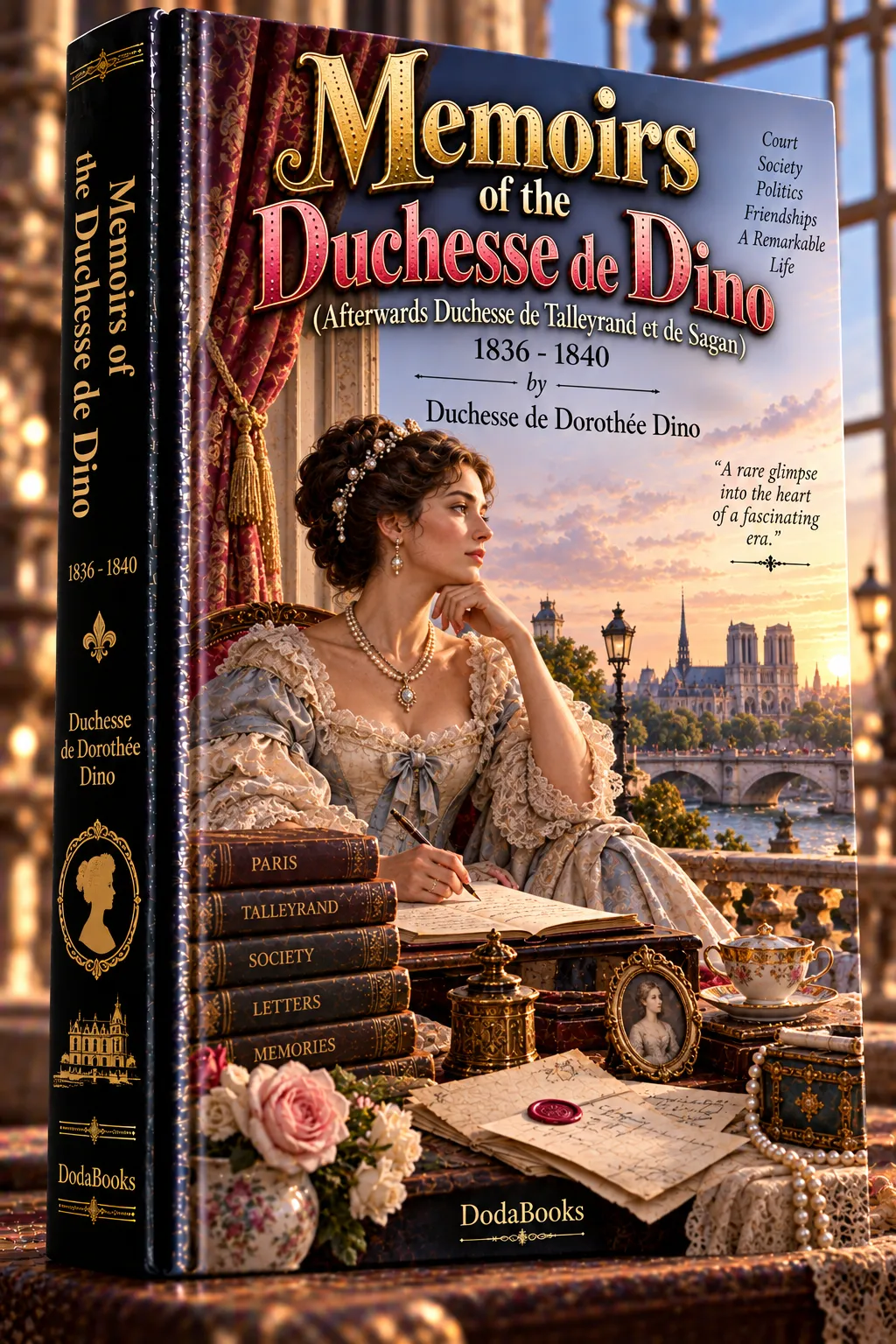
Step Inside the Secrets of High European Diplomacy
Read the complete memoirs of Dorothée de Dino (1836–1840), enriched with explanatory notes on Prince Talleyrand, King Louis-Philippe, Lord Palmerston, and the Congress system.
Read the Duchesse de Dino MemoirsWho Was Dorothée de Dino? The Intellectual Partner of Talleyrand
To understand the historical authority of these memoirs, one must appreciate Dorothée de Dino’s unique position in European high politics. While high society gossip inevitably speculated about the exact nature of her relationship with Prince Talleyrand—who was nearly forty years her senior—historians agree that their true bond was an extraordinary intellectual and diplomatic symbiosis.
Possessing exceptional linguistic fluency, sharp psychological insight, and peerless aristocratic tact, Dorothée was Talleyrand’s greatest political asset:
- The London Embassy (1830–1834): When the elderly Talleyrand was appointed French Ambassador to London by King Louis-Philippe following the July Revolution, Dorothée accompanied him. She managed the embassy with consummate elegance, winning the admiration of the Duke of Wellington, Lord Grey, and Lord Palmerston, and helping negotiate the international treaties that secured Belgian independence.
- The Scribe of Valençay: In Talleyrand’s final years at his majestic estate of Château de Valençay, Dorothée organized his extensive archives, took dictation for his memoirs, vetted visitors, and managed state correspondence with European monarchs and prime ministers.
- An Independent Observer: Dorothée was never merely Talleyrand’s echo. Her journal entries reveal a fierce, independent intelligence capable of dissecting the flaws of French ministers, lamenting the decline of aristocratic culture, and offering prophetic warnings about European radicalism.
Inside the Memoirs: Key Historical Events of 1836–1840
The period between 1836 and 1840 was a time of immense diplomatic realignment. The Napoleonic settlement of 1815 was beginning to fray, the British Empire was entering the Victorian dawn, and France was perpetually destabilized by political factionalism under the constitutional monarchy of the House of Orléans.
The Death of Prince Talleyrand (May 1838)
The emotional climax of the volume centers on the final weeks of Prince Talleyrand’s life in his Paris mansion on the Rue Saint-Florentin. Talleyrand had spent his career walking an impossible religious line: originally Bishop of Autun before the French Revolution, he had consecrated constitutional bishops, was excommunicated by Pope Pius VI, and subsequently secularized by Napoleon.
The question of whether the dying diplomat would renounce his revolutionary errors and receive the last rites was an international sensation:
- The Negotiation of Faith: Dino chronicles the delicate negotiations led by the young Abbé Félix Dupanloup (later Bishop of Orléans). Talleyrand was determined to reconcile with Rome without repudiating his dignity or his life’s political achievements.
- The Royal Visit: Hours before his death, King Louis-Philippe made an unprecedented personal visit to the dying statesman’s bedside—an extraordinary breach of royal etiquette that underscored Talleyrand’s towering importance to the Orléans dynasty.
- The Final Declaration: Dorothée preserves Talleyrand’s famous dying gesture: when the priest prepared to anoint his hands with holy oil for extreme unction, Talleyrand turned his hands palms inward, indicating that as a consecrated bishop, his palms had already been anointed—a sublime assertion of episcopal identity in the presence of death.
Literary and Political Themes in the Dino Memoirs
1. The Art of Aristocratic Character Portraiture
Dorothée de Dino was one of the finest portraitists of the nineteenth century. With a few deft, merciless strokes of her pen, she captures the essence of Europe’s leading personalities. She describes Adolphe Thiers as an energetic but vulgar bourgeois upstart lacking diplomatic poise; François Guizot as a cold, puritanical academic ill-suited to turbulent assemblies; and Lord Palmerston as an arrogant, reckless gambler risking European peace for domestic applause.
2. Nostalgia for the Ancien Régime versus Modern Bourgeois Realities
Throughout the journal, there is an underlying melancholy regarding the transformation of French society. Having known the supreme refinement of eighteenth-century manners, Dino recoiled from the transactional, money-driven vulgarity of the July Monarchy. Her observations echo Alexis de Tocqueville’s contemporary analyses, noting how the rise of democratic passions was eroding the grace, wit, and conversational artistry that had once made French civilization the envy of the globe.
3. The Mechanics of the Concert of Europe
For students of international relations, these memoirs are an invaluable case study in nineteenth-century balance-of-power diplomacy. Dino records how confidential dinners, personal letters between ambassadors’ wives, and subtle nuances of protocol prevented armed clashes between the Great Powers. Her accounts of the 1839–1840 Eastern Crisis—when the conflict between the Ottoman Sultan and Muhammad Ali of Egypt brought France to the brink of war with Britain, Russia, Prussia, and Austria—demonstrate the fragile machinery that preserved European stability.
"M. de Talleyrand said to me this morning: 'In diplomacy,
one must never display haste. The art consists in knowing
how to wait, in letting others commit their faults,
and in never shutting the door to a reasonable accommodation.'"
— Duchesse de Dino, Journal Entry, Valençay
Explore the Complete 1836–1840 Memoirs with Historical Notes
The DodaBooks annotated edition clarifies 19th-century French politics, decodes diplomatic nicknames, and provides biographical entries for every historical figure.
Get the Complete Ebook for $0.99Interlinking with Nineteenth-Century Historical Chronicles
To fully grasp the political ecosystem depicted in the Duchesse de Dino’s memoirs, readers will benefit from exploring related primary documents and historical memoirs from this transformative era.
For the military foundations that reshaped the map of Europe and set Talleyrand’s diplomatic stage, Napoleon’s Letters to Josephine offers an unvarnished view of the French Empire’s creator at his most vulnerable. Furthermore, Dalton’s The Waterloo Roll Call provides the tactical register of the Allied triumph that concluded the Napoleonic epoch and inaugurated the Congress system Dino navigated.
For those studying how private passion intersects with monarchical governance, The Love Letters of Henry VIII provides a compelling English counterpoint from three centuries earlier, demonstrating the eternal tension between statecraft and individual desire.
Why Read the DodaBooks Edition of the Dino Memoirs?
Historical memoirs from this era are frequently burdened by archaic phrasing, unreferenced political allusions, and confusing diplomatic titles. The DodaBooks Edition makes this indispensable text accessible and engrossing for modern historians and general readers:
- Comprehensive Historical Footnotes: Every minister, ambassador, treaty, and political crisis is thoroughly contextualized with clear, concise annotations.
- Biographical Register: Includes an extensive appendix identifying dozens of European aristocrats, diplomats, and literary figures who appear throughout the journal.
- Unabridged and Elegantly Formatted: Based on the authoritative English translation by Princess Radziwill (née Castellane), optimized for seamless navigation across e-readers, smartphones, and tablets.
Witness the Twilight of Diplomatic Titans
Immerse yourself in the private councils, châteaux whispers, and court intrigues that forged modern Europe, told by the woman who stood at Talleyrand's side.
Download the Complete EbookFrequently Asked Questions
Who was the Duchesse de Dino to Prince Talleyrand?
Dorothée de Dino was the daughter of the Duchess of Courland and married Prince Talleyrand’s nephew, Edmond de Talleyrand-Périgord, in 1809. She subsequently became Prince Talleyrand’s official hostess, diplomatic partner, confidante, and literary executor, remaining with him until his death in 1838.
Why are these memoirs considered so historically significant?
Because Dorothée was present at the highest levels of European decision-making—including the Congress of Vienna, the French Embassy in London, and the private councils of King Louis-Philippe—her memoirs provide an unfiltered, insider account of European diplomacy and court life that official archives cannot replicate.
Does this volume cover the earlier years of her life?
This specific volume focuses exclusively on the critical four-year span of 1836 to 1840. Earlier volumes of her memoirs cover her youth, the Congress of Vienna (1814–1815), and the London embassy (1830–1834), while this concluding volume captures Talleyrand’s final days and the onset of the Victorian age.
How reliable is Dorothée de Dino as a historical witness?
Historians consider her journals remarkably reliable because they were written on a day-to-day basis rather than reconstructed decades later from memory. While her personal aristocratic prejudices and loyalties to Talleyrand color her judgments, her factual descriptions of meetings, speeches, and diplomatic correspondence are scrupulously accurate.
What makes the DodaBooks edition ideal for readers?
The DodaBooks edition offers a clean digital layout, verified working table of contents, and extensive explanatory notes that demystify nineteenth-century diplomatic terminology, French parliamentary factions, and European nobility lineages.