Memoirs of the Court of Marie Antoinette: Eyewitness to a Doomed Throne
As Première Femme de Chambre to Queen Marie Antoinette, Jeanne-Louise-Henriette Campan stood at the Queen’s side through court splendors, malicious scandals, and the terrifying onset of the French Revolution, creating one of history’s most essential memoirs.
Few historical figures have been as violently mythologized, slandered, and tragic as Queen Marie Antoinette of France. From venomous revolutionary pamphlets depicting her as a monstrous Austrian spendthrift to sentimental Royalist hagiographies of a saintly martyr, the real woman behind the crown was frequently erased. Memoirs of the Court of Marie Antoinette (Mémoires sur la vie privée de Marie-Antoinette), written by Jeanne-Louise-Henriette Campan and published posthumously in 1823, remains the most authoritative, intimate, and humanizing primary source on the last Queen of the Ancien Régime.
Madame Campan was no detached observer. Appointed Reader to the daughters of Louis XV at the age of fifteen, and subsequently elevated to First Lady of the Bedchamber (Première Femme de Chambre) to the young Dauphine Marie Antoinette, Campan spent over twenty years inside the private apartments of Versailles. Readers navigating our authoritative historical library will discover in Campan’s memoir a masterclass in historical witnessing—an account that demystifies court etiquette while capturing the inexorable collapse of an empire.
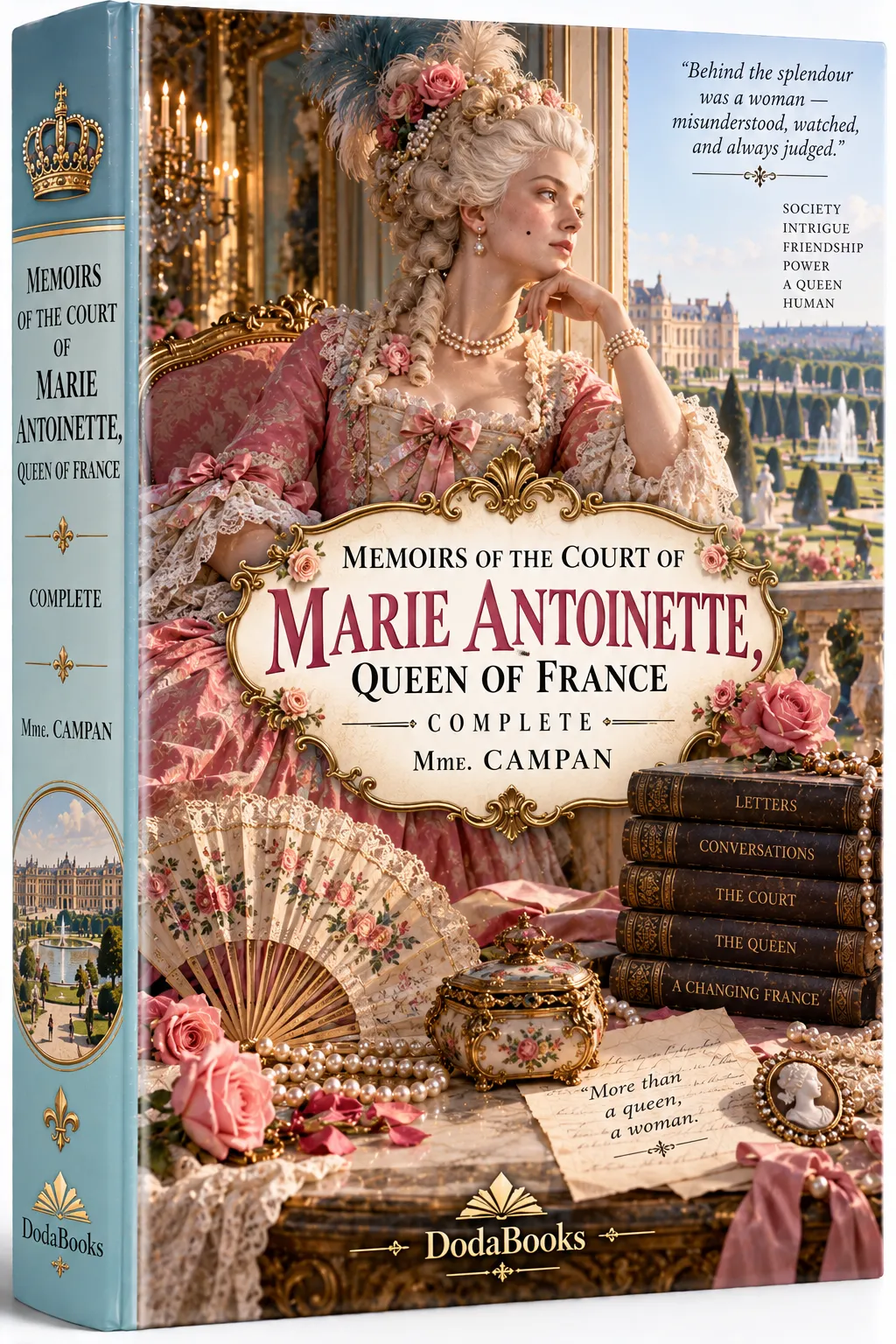
Read the Definitive Annotated Edition
Explore Madame Campan's memoirs with extensive historical annotations decoding Versailles court etiquette, biographies of royal ministers, and forensic accounts of revolutionary trials.
Get the Annotated eBookThe Insider’s Vantage: Madame Campan at Versailles
Jeanne-Louise-Henriette Genest (later Madame Campan) was born into an intellectual family; her father was a high-ranking diplomat and friend of the Philosophes. Highly educated, fluent in English and Italian, and possessed of exceptional observational acumen, she was introduced to the Court of Versailles in 1768.
When the fourteen-year-old Austrian Archduchess Maria Antonia arrived in France in 1770 to marry the future Louis XVI, Campan was assigned to her personal service. Over the subsequent two decades, Campan managed the Queen’s private wardrobe, supervised her household attendants, organized her personal finances, and was entrusted with her most confidential correspondence.
                      VERSAILLES COURT HIERARCHY & WITNESS

         [ King Louis XVI ] ◄────────► [ Queen Marie Antoinette ]
                 │                                │
                 ▼                                ▼
       Ministers of State             Première Femme de Chambre
       & Aristocratic Factions          (Madame Campan: 1770–1792)
                 │                                │
                 ▼                                ▼
         Financial Collapse               Private Apartments,
        & Revolutionary Storm            Confidence & Secret Papers
Because Campan was not an aristocratic peer angling for political offices or royal pensions, her memoirs possess a sobriety and domestic clarity rare among contemporary chronicles. While peers like Saint-Simon under Louis XIV focused on dynastic power plays and precedence disputes, Campan observed the emotional realities of royal domesticity: the Queen’s painful early marital difficulties, her yearning for pastoral simplicity at the Petit Trianon, and her profound vulnerability in the face of public hostility.
Versailles Rituals: The Cage of Etiquette
One of the greatest achievements of Campan’s memoir is its exhaustive, often satirical catalog of Ancien Régime court ritual. At Versailles, life was an unrelenting theatrical performance where every gesture was codified by rigid rules of precedence:
- The Lever of the Queen: Campan describes the excruciating morning ceremony where the Queen sat shivering in her shift while court ladies of varying ranks contested the right to hand her the royal chemise. A duchess might hand it to a princess of the blood, who in turn handed it to the Queen’s sister-in-law, turning basic bodily functions into diplomatic skirmishes.
- The Petit Trianon and Hameau de la Reine: Campan provides the vital counter-narrative to revolutionary propaganda regarding the Queen’s rustic retreat. Far from an obscene money pit designed to mock the peasantry, the Trianon was an adolescent Queen’s desperate effort to escape the suffocating public panopticon of Versailles and live a modest, family-centered existence inspired by Jean-Jacques Rousseau’s pastoral ideals.
- The Court Cabals: Campan exposes how the Queen’s genuine mistakes—such as favoring an exclusive circle of intimate friends like the Princesse de Lamballe and the Duchesse de Polignac—alienated the old nobility, who subsequently manufactured the very court leaks and malicious gossip that fueled public hatred in Paris.
Anatomy of a Catastrophe: The Diamond Necklace and 1789
Madame Campan was an eyewitness to the fatal scandals that shattered the moral legitimacy of the monarchy, chief among them the infamous Affair of the Diamond Necklace (1785–1786).
In her memoirs, Campan provides a meticulous, step-by-step account of how Cardinal de Rohan, desperate to regain royal favor, was duped by the scheming adventuress Jeanne de Valois-Saint-Rémy (Countess de La Motte) into purchasing a gargantuan 2,800-carat diamond necklace ostensibly on the Queen’s behalf. Campan reveals that Marie Antoinette never wanted the necklace, had repeatedly refused its purchase, and was entirely ignorant of the plot until the jewelers demanded payment. Yet in the eyes of an impoverished and angry French public, the Queen was already condemned.
                  THE COLLAPSE OF ROYAL LEGITIMACY (1785–1792)

       The Diamond Necklace Scandal ──────► The Queen Framed as Seductress
                  │                                     │
                  ▼                                     ▼
        Estates-General (1789) ───────────► Bread Riots & Women's March
                  │                                     │
                  ▼                                     ▼
         Tuileries Captivity  ────────────► Flight to Varennes (1791)
                  │                                     │
                  ▼                                     ▼
         Storming of Tuileries ───────────► Madame Campan Expelled /
             (August 10, 1792)                   Execution of Royals
When the Revolution erupted in 1789, Campan remained faithfully at the Queen’s side. She chronicles the terrifying night of October 5–6, 1789, when the armed Parisian crowd invaded Versailles, slaughtering royal bodyguards outside the Queen’s bedroom. Campan describes the subsequent forced relocation of the royal family to the Tuileries Palace in Paris, living as virtual prisoners. She helped the Queen sew hidden pockets into clothes to conceal jewels and code letters, and was entrusted with destroying private royal papers on the eve of the fateful insurrection of August 10, 1792, which overthrew the throne.
Key Themes Explored in Madame Campan’s Memoirs
To appreciate Campan’s historical contribution, modern readers should focus on several central thematic threads:
1. The Myth vs. The Reality of Marie Antoinette
Campan provides crucial factual refutations of long-standing revolutionary calumnies. She demonstrates conclusively that the Queen never uttered the callous phrase “Let them eat cake” (Qu’ils mangent de la brioche), an ancient folkloric quip previously attributed to other Spanish and French royal consorts decades earlier. Campan reveals a woman of generous philanthropic impulses, but one who was politically naive and tragically ill-advised.
2. The Vulnerability of Foreign Royalty
As an Austrian princess (L’Autrichienne), Marie Antoinette was viewed from the start with deep suspicion by the French xenophobic establishment. Campan highlights how every cultural misstep—such as her preference for simple muslin dresses over heavy Lyon silks—was seized upon by French manufacturers and court traditionalists as deliberate sabotage of French commercial and aristocratic traditions.
3. The Psychology of Collective Insurrection
Campan’s descriptions of the revolutionary mobs entering Versailles and the Tuileries provide extraordinary psychological insights into crowd behavior, terror, and the rapid collapse of centuries-old institutional authority.
                    MADAME CAMPAN'S HISTORICAL SPECTRUM

          Public Myth & Calumny            Eyewitness Domestic Reality
    ┌───────────────────────────────┐   ┌───────────────────────────────┐
    │ Spendthrift "Madame Deficit"  │   │ Generous, Child-Loving Mother │
    │ Treasonous Austrian Agent     │   │ Naive Queen Trapped by Etiquette│
    │ Callous, Cynical Aristocrat   │   │ Traumatized, Resolute Prisoner │
    └───────────────────────────────┘   └───────────────────────────────┘
                    ▲                                   ▲
                    └─────────────────┬─────────────────┘
                                      ▼
                        Historical Truth Restored by
                        Madame Campan's Eyewitness Record
Comparative Literary and Historical Context
To place Madame Campan’s memoirs within historical literature, compare her perspective with other great chronicles of power, aristocratic downfall, and statecraft:
| Work & Author | Setting | Focus | Perspective & Tone |
|---|---|---|---|
| Memoirs of the Court of Marie Antoinette (Mme. Campan) | Versailles & Paris (1770–1792) | Royal household, Diamond Necklace, French Revolution | Faithful, intimate, defensive, eyewitness history |
| Memoirs of Louis XIV (Duc de Saint-Simon) | Versailles (1690–1715) | The Sun King, court precedence, aristocratic factions | Acidic, aristocratic, biting political critique |
| The Letters of Franklin K. Lane (Franklin K. Lane) | Washington D.C. (1913–1921) | Progressive Era cabinet, Conservation, WWI | Democratic, introspective, lyrical epistolary |
| The Red Lily (Anatole France) | Paris & Florence (1894) | Salon politics, aesthetics, destructive passion | Skeptical, elegant, fin-de-siècle psychological |
While the Duc de Saint-Simon observed the absolute monarchy at its zenith under Louis XIV, Madame Campan stood witness to its final, bloody dissolution. In both works, the reader sees how court etiquette can blind rulers to the reality of the people outside the palace gates. Similarly, readers interested in the ethical challenges of governance and statecraft will find striking philosophical contrasts between the Ancien Régime court and the democratic cabinet deliberations recorded by Franklin K. Lane.
Step Inside the Royal Apartments of Versailles
Experience Madame Campan's legendary eyewitness memoirs in this beautifully annotated edition, featuring extensive historical notes and biographical dossiers on the court of France.
Read The Annotated EditionWhy Madame Campan’s Testimony Matters Today
Madame Campan survived the Terror to become one of the most respected female educators of Napoleonic France, founding a famous academy for young women at Saint-Germain-en-Laye where Napoleon sent his stepdaughter Hortense de Beauharnais and his sisters. Her memoirs, composed during her later years, are neither a reactionary cry for revenge nor a cynical capitulation to revolutionary violence; they are the considered, dignified testimony of a survivor.
For anyone who wishes to understand the real human tragedy of Marie Antoinette, the fatal structural flaws of the Bourbon monarchy, and the terrifying velocity with which stable societies can descend into revolutionary chaos, Madame Campan’s memoirs remain an indispensable and unforgettable masterpiece of historical literature.
Frequently Asked Questions
Who was Madame Campan and what was her relationship to Marie Antoinette?
Jeanne-Louise-Henriette Campan (1752–1822) was a French educator and courtier who served as Première Femme de Chambre (First Lady of the Bedchamber) to Queen Marie Antoinette. Having entered the royal household as a teenager, she served the Queen closely from her arrival in France in 1770 until the storming of the Tuileries Palace in 1792, remaining one of her most trusted confidantes.
Did Marie Antoinette really say "Let them eat cake"?
No. Madame Campan’s memoirs, along with modern historical scholarship, definitively disprove this myth. The phrase was never spoken by Marie Antoinette. It was a well-known satirical trope in French folklore decades prior to her reign (first mentioned by Jean-Jacques Rousseau when Marie Antoinette was still a child in Austria) and was falsely attributed to her by revolutionary pamphleteers to inflame public hatred.
What was Madame Campan's role in the Diamond Necklace Affair?
Madame Campan was an essential eyewitness during the investigation. The court jewellers Boehmer and Bassange approached Campan directly when their payments lapsed, revealing that Cardinal de Rohan claimed to have purchased the necklace on the Queen's orders. Campan immediately informed the Queen, uncovering the elaborate fraud orchestrated by the Countess de La Motte.
How did Madame Campan survive the French Revolution?
Campan was forcibly separated from the royal family during the bloody attack on the Tuileries on August 10, 1792. Escaping the massacres, she hid in the countryside during the Reign of Terror. After the fall of Robespierre, she supported herself and her family by establishing a prestigious school for young women, earning the admiration of Napoleon Bonaparte, who appointed her superintendent of the Imperial Academy at Écouen.
What makes the DodaBooks annotated edition of Madame Campan's memoirs unique?
The DodaBooks annotated edition features exhaustive historical commentary explaining the elaborate codes of Versailles etiquette, biographical sketches of French ministers and courtiers, footnotes detailing the legal trials of the King and Queen, and an extensive introduction analyzing Campan's reliability as an eyewitness chronicler. You can explore and download the definitive annotated edition directly from DodaBooks at https://dodabooks.com/ebook/memoirs-of-the-court-of-marie-antoinette-by-mme-campan/.
Related Historical and Literary Studies
Explore further classic historical memoirs, royal chronicles, and European literature: