Memoirs of Napoleon Bonaparte: The Private Secretary’s Forensic Record
From schoolboy snowball fights at Brienne to the conquest of Europe and the Egyptian sands, Louis Antoine Fauvelet de Bourrienne shared Napoleon’s closest confidences, creating an unsparing, indispensable eyewitness account of imperial ambition.
Few historical titans have been as scrutinized, mythologized, and contested as Napoleon Bonaparte. While military dispatch writers and imperial propagandists crafted the heroic myth of the invincible Corsican general, and royalist detractors painted him as an apocalyptic usurper, Memoirs of Napoleon Bonaparte (Mémoires de M. de Bourrienne sur Napoléon) by Louis Antoine Fauvelet de Bourrienne (1769–1834) offers something far rarer: the unvarnished, daily reality of the man behind the imperial laurel wreath.
Bourrienne occupied a vantage point unmatched by any contemporary memoirist. As Napoleon’s closest childhood companion at the military academy of Brienne-le-Château, his confidant during the perilous years of the French Revolution, and his official Private Secretary (secrétaire intime) during the Italian campaigns, the expedition to Egypt, the Coup of 18 Brumaire, and the Consulate, Bourrienne took dictation at Napoleon’s bedside, drafted his private treaties, and witnessed his private tantrums and domestic griefs. Readers exploring our distinguished historical memoir collection will discover in Bourrienne’s memoirs a psychological masterclass in the corrupting momentum of absolute authority.
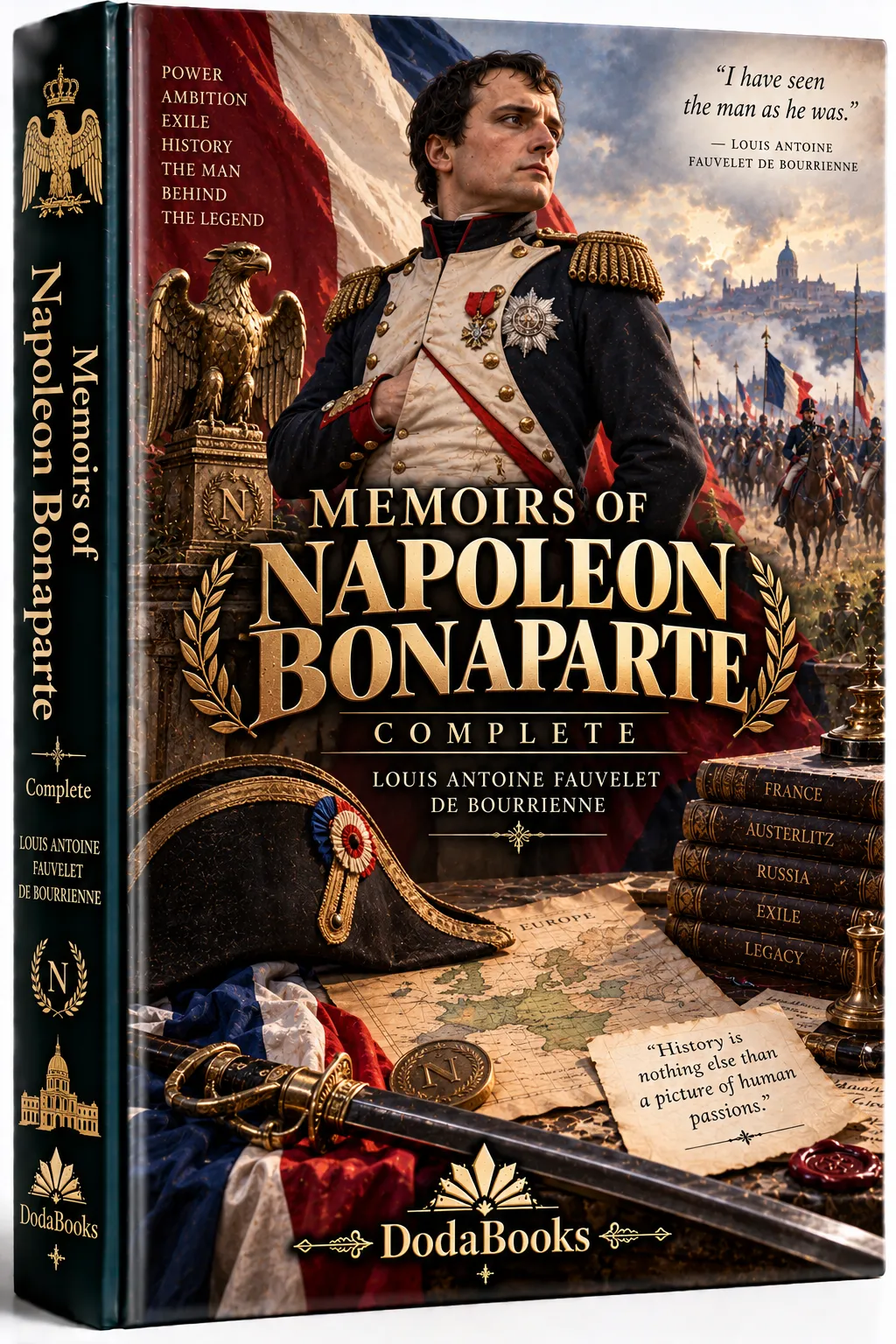
Read the Definitive Annotated Edition
Immerse yourself in Bourrienne's monumental memoirs with comprehensive annotations identifying Napoleonic marshals, historical notes on military campaigns, and diplomatic analyses.
Get the Annotated eBookFrom Schoolboy at Brienne to the Egyptian Mirage
The narrative begins not on the battlefield of Austerlitz, but in the austere dormitory of the Royal Military School of Brienne in 1779. There, the ten-year-old Bourrienne met the brooding, impoverished Corsican scholarship boy Napoleone Buonaparte. Bourrienne records the famous snowball battle organized by the young Bonaparte—organizing students into regiments, throwing up snow redoubts, and directing tactical sieges with the mathematical precocity that would later astound the Austrian Empire.
Following years of separation during the chaos of the French Revolution, the two men reunited in Paris. Recognizing Bourrienne’s administrative genius, literary fluency, and absolute loyalty, Bonaparte appointed him his Private Secretary in 1797 during the Italian campaigns.
                    THE RISE OF BONAPARTE THROUGH BOURRIENNE'S PEN

    Brienne Academy (1779) ──────► 18 Brumaire Coup (1799) ──────► Imperial Climax (1804)
    (Schoolmate Confidant)        (Architect of the Consulate)     (Absolute Caesarism)
              │                                 │                             │
              ▼                                 ▼                             ▼
       Italian Campaigns               The Egyptian Sphinx             The Continental
        & Treaty of Campo              (Jaffa, Cairo, Aboukir)        Blockade & Fall
             Formio                                                     (1812–1815)
Bourrienne’s chronicle of the Egyptian Expedition (1798–1799) remains one of the greatest travel and military narratives in French literature. He rode alongside Bonaparte beneath the shadow of the Pyramids, slept in the same desert tents, and witnessed Napoleon’s haunting confrontation with the bubonic plague at the hospital of Jaffa. Bourrienne provides an eyewitness correction to official French communiqués, documenting Napoleon’s calculated ruthlessness alongside his boundless scientific curiosity during the founding of the Institut d’Égypte.
The Inner Cabinet: 18 Brumaire and the First Consul
When Napoleon returned to France in 1799, it was Bourrienne who drafted the secret correspondence and organized the conspiratorial meetings that led to the overthrow of the corrupt Directory on the 18th Brumaire (November 9, 1799).
As the newly installed First Consul took up residence in the Tuileries Palace—the very halls where Marie Antoinette and Louis XVI had spent their final captive days—Bourrienne was given an adjoining cabinet. For three intense years (1799–1802), Bourrienne lived inside Napoleon’s mind:
- The Work Ethic of Genius: Bourrienne reveals that Napoleon worked up to eighteen hours a day, dictating simultaneously to multiple secretaries, cross-referencing artillery tables, civil statutes, and fiscal budgets without notes, driven by a kinetic energy that exhausted every subordinate.
- The Domestic Reality: At Malmaison, away from official state ceremony, Bourrienne paints charming vignettes of Bonaparte playing prisoner’s base on the lawn, laughing at amateur theatricals, and confiding his profound love for Joséphine de Beauharnais despite the venomous intrigues of the Bonaparte clan.
- The Creation of Modern France: In this private office, Bourrienne watched the drafting of the Code Napoléon (the French Civil Code), the Concordat of 1801 with the Catholic Church, the founding of the Bank of France, and the Legion of Honor.
Just as Madame Campan witnessed the tragic collapse of the French Court and the Duc de Saint-Simon dissected the absolute monarchy of Louis XIV, Bourrienne watched the birth of a new imperial order rising from the ashes of the Revolution.
The Rupture and the Fall: Ambition Unchained
Bourrienne’s relationship with Napoleon was shattered in late 1802 due to financial irregularities involving the military supplier house of Coulon, coupled with Napoleon’s growing intolerance for any adviser who spoke with republican frankness. Replaced as private secretary by Claude-François de Méneval, Bourrienne was subsequently dispatched as French Minister Plenipotentiary to Hamburg (1805–1810).
From Hamburg—the premier commercial node of northern Europe—Bourrienne was tasked with enforcing Napoleon’s ruinous Continental System, an economic blockade designed to starve Britain into submission. Here, Bourrienne’s memoir provides an indispensable economic critique of the Empire: he documents how Napoleon’s blockade crippled European commerce, forced French soldiers to march in contraband English boots and English coats, and inexorably drove Napoleon into the catastrophic invasions of Spain and Russia.
                    THE CRITIQUE OF IMPERIAL MEGALOMANIA

          Pragmatic Genius (1796–1802)         Incurable Megalomania (1806–1814)
     ┌──────────────────────────────────┐   ┌──────────────────────────────────┐
     │ Restores domestic order in France│   │ Imposes impossible trade embargo │
     │ Authors Civil Code & Concordat   │   │ Demands sycophantic court worship│
     │ Listens to frank republican vice │   │ Invades Russia, burns armies     │
     └──────────────────────────────────┘   └──────────────────────────────────┘
                      ▲                                      ▲
                      └──────────────────┬───────────────────┘
                                         ▼
                            Bourrienne's Verdict:
                         The Conqueror Destroyed by
                            His Refusal to Limit
Major Themes in Bourrienne’s Napoleonic Chronicle
1. The Anatomy of Will and Megalomania
Bourrienne’s primary psychological inquiry is the gradual transformation of Bonaparte from a brilliant, patriotic general into an isolated despot intoxicated by his own legend. He demonstrates that Napoleon’s ultimate downfall was not caused by British naval supremacy or Russian winter, but by his pathological inability to accept a negotiated peace that recognized limits to French power.
2. Myth-Making vs. Archival Truth
As Napoleon’s private scribe, Bourrienne witnessed firsthand how imperial bulletins were fabricated. He famously remarked that “to lie like a bulletin” became a common French idiom. Bourrienne painstakingly compares the published battle dispatches with the actual casualty figures and tactical confusions recorded in the emperor’s secret tents, anticipating modern investigative history.
3. The Tragedy of Joséphine
Bourrienne provides some of the most poignant passages in French biographical literature concerning the divorce of Empress Joséphine. Having known both figures intimately since the Italian campaign, he reveals the deep personal anguish Napoleon suffered when dynastic ambition forced him to discard the only woman he had ever truly loved in order to marry Marie Louise of Austria.
Comparative Historical Analysis
To appreciate Bourrienne’s place in the historiography of European power, consider how his work intersects with other landmark memoirs:
| Work & Chronicler | Historical Setting | Perspective | Key Insight |
|---|---|---|---|
| Memoirs of Napoleon Bonaparte (Bourrienne) | France & Europe (1779–1815) | Private secretary, childhood companion | The intimate machinery of imperial ambition and conquest |
| Memoirs of the Court of Marie Antoinette (Mme. Campan) | Versailles & Paris (1770–1792) | First Lady of the Bedchamber | The tragic domestic blindness of the Ancien Régime |
| Memoirs of Louis XIV (Duc de Saint-Simon) | Versailles (1690–1715) | Duke and Peer of France | Absolutist surveillance and court vanity |
| The Letters of Franklin K. Lane (Franklin K. Lane) | Washington D.C. (1913–1921) | Progressive Era cabinet secretary | Democratic statecraft and wartime mobilization |
Where Saint-Simon lamented the decline of ancient blood nobility under Louis XIV, Bourrienne watched the rise of a self-made meritocratic aristocracy created out of battlefields. And while Franklin K. Lane wrestled with the ethical dilemmas of a democratic wartime cabinet, Bourrienne documented what occurs when a single military genius wields the unconstrained resources of an entire continent.
Experience the Real Napoleon Bonaparte
Discover Bourrienne's landmark eyewitness memoirs in this comprehensive, newly annotated digital edition featuring military maps, biographical footnotes, and campaign notes.
Read The Annotated EditionWhy Bourrienne Remains an Essential Classic
First published in ten volumes in Paris in 1829, Bourrienne’s Mémoires caused an international sensation. Bonapartists attacked Bourrienne for his candid exposures of Napoleon’s temper and diplomatic deceptions; royalists criticized him for refusing to depict Napoleon as an unmitigated monster.
Yet it is precisely this balance—Bourrienne’s enduring admiration for Napoleon’s intellectual magnitude combined with his clear-eyed refusal to flatter his tyrannical excesses—that gives these memoirs their lasting authority. For readers seeking the pulse of the Napoleonic epoch, Bourrienne’s memoirs are an indispensable, electrifying tour de force.
Frequently Asked Questions
Who was Louis Antoine Fauvelet de Bourrienne?
Louis Antoine Fauvelet de Bourrienne (1769–1834) was a French diplomat and statesman who was a childhood classmate of Napoleon Bonaparte at the military academy of Brienne. He served as Napoleon's personal confidant and Private Secretary from 1797 to 1802, and later as French Minister Plenipotentiary to Hamburg during the Napoleonic Wars.
How reliable are Bourrienne's memoirs of Napoleon?
While Bourrienne was assisted in editing by the ghostwriter Charles-Maxime Villemarest and sought to justify his later cooperation with the Bourbon Restoration, his direct personal accounts of Napoleon's private habits, work methods, letters, and conversation during the Italian, Egyptian, and Consular periods are regarded by historians as extraordinary primary sources confirmed by state archives.
What was Napoleon's daily routine as described by Bourrienne?
Bourrienne reveals that Napoleon was an astonishing workaholic who rarely slept more than five or six hours a night, often dictating letters at two in the morning from his bed. He was meticulous about financial accounts, had a ferocious memory for military units and artillery inventories, and lived with Spartan simplicity regarding food, drinking watered wine and finishing meals in under twenty minutes.
What was the Continental Blockade and why does Bourrienne focus on it?
The Continental System (decreed by Napoleon in 1806) banned all European trade with Great Britain. As French minister in Hamburg, Bourrienne was responsible for enforcing this embargo across northern Germany. In his memoirs, he proves that the policy was impossible to enforce, created widespread smuggling, alienated European allies, and forced Napoleon into the disastrous invasions of Portugal, Spain, and Russia.
What makes the DodaBooks annotated edition indispensable?
The DodaBooks annotated edition includes extensive historical notes clarifying military maneuvers, biographical entries for the marshals, ministers, and diplomats surrounding the Emperor, critical assessments of Bourrienne's text by 19th-century military historians, and helpful geographical guides to the Napoleonic campaigns. You can explore and download the definitive annotated edition directly from DodaBooks at https://dodabooks.com/ebook/memoirs-of-napoleon-bonaparte-by-louis-antoine-fauvelet-de-bourrienne/.
Related Historical and Military Studies
Explore further classic memoirs, European military chronicles, and literary masterpieces in our collection: