Meditations: Marcus Aurelius’s Citadel of the Soul
Penned by candlelight in military campaign tents along the frozen Danubian frontier, Roman Emperor Marcus Aurelius’s *Meditations* (*Τὰ εἰς ἑαυτόν*) stands as history’s most profound private spiritual handbook on duty, mortality, and unshakeable inner peace.
Few texts in world literature possess the raw intimacy, moral integrity, and practical philosophical urgency of Meditations by Marcus Aurelius Antoninus (121–180 AD). Reining over the Roman Empire at the zenith of its territorial expanse from 161 until his death in 180 AD, Marcus Aurelius was the last of the “Five Good Emperors” celebrated by Machiavelli and Gibbon. Yet unlike despots intoxicated by the trappings of absolute Caesarism, Marcus was at heart a devoted disciple of Late Roman Stoicism.
Composed in Koine Greek under the original title Ta Eis Heauton (“To Himself”), the Meditations was never intended for publication, public circulation, or political propaganda. It was the private, daily spiritual journal of a man burdened with the crushing administration of millions of subjects, facing the catastrophic Antonine Plague, treasonous domestic rebellions, and brutal frontier wars against Marcomannic invaders. Readers exploring our distinguished collection of classical philosophy will discover in Marcus Aurelius an indispensable companion for cultivating resilience in an uncertain world.
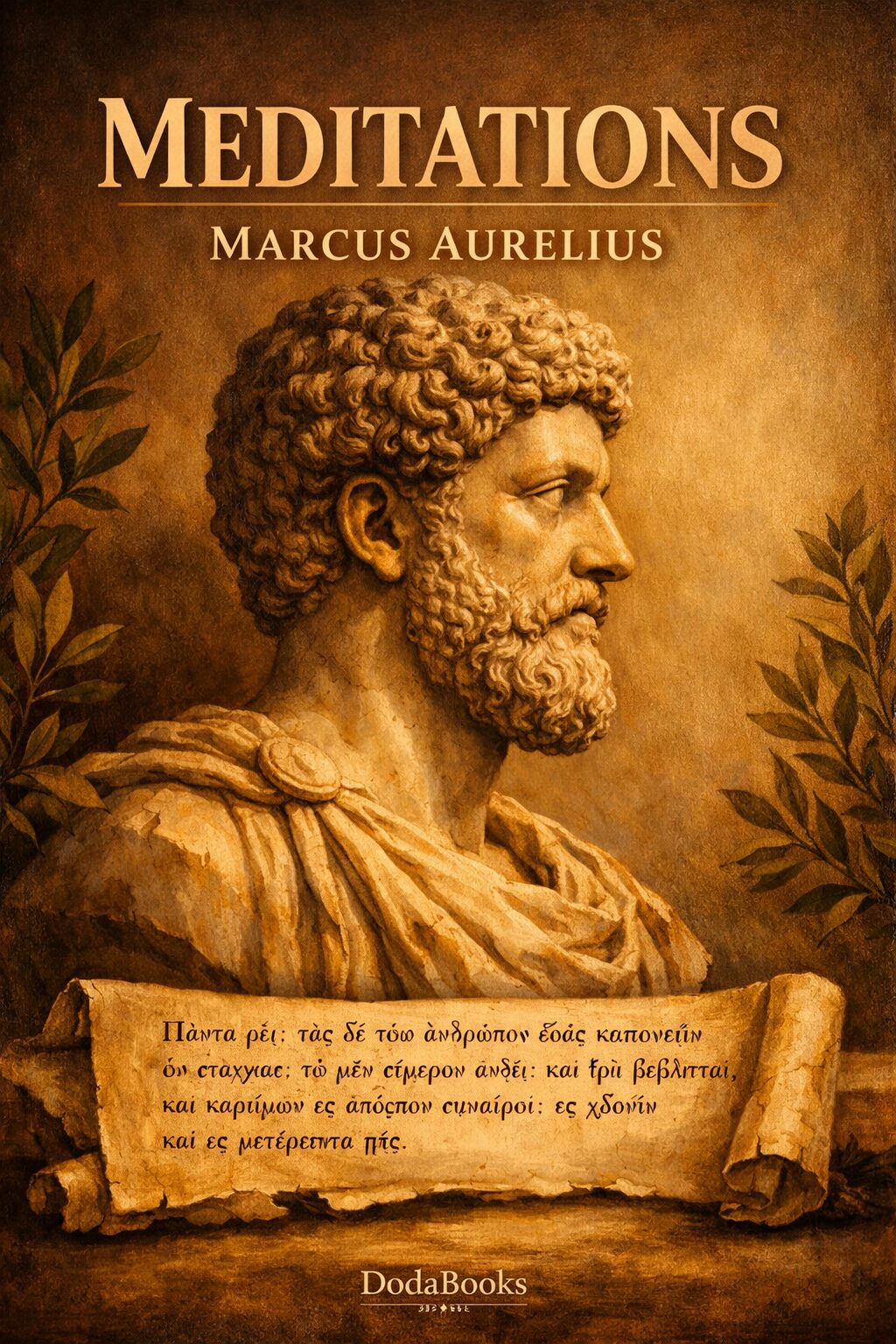
Read the Definitive Annotated Edition
Experience Marcus Aurelius's Meditations in this definitive annotated edition, complete with comprehensive notes on Roman imperial history, Greek Stoic terminology, and philosophical exercises.
Get the Annotated eBookThe Imperial Crucible: The Danubian Camps
Marcus Aurelius did not compose his philosophical maxims in serene Mediterranean villas or secluded academic libraries. The notes in the margins of the manuscript identify their origins: “Written among the Quadi on the Granua” (the modern Hron river in Slovakia) and “At Carnuntum” (near modern Vienna).
For over a decade, the Emperor lived on the muddy, freezing northern frontier, sleeping in military leather tents, suffering from chronic chest ailments, and commanding legions against invading Germanic and Sarmatian tribes. Complicating his burdens was the Antonine Plague (165–180 AD), a devastating pandemic brought back by legions from the East that decimated the empire’s population, as well as the 175 AD coup attempt by his trusted Syrian general Avidius Cassius.
                    THE STOIC CRUCIBLE OF THE EMPEROR

       EXTERNAL IMPERIAL BURDENS                   THE INNER RATIONAL CITADEL
    ┌───────────────────────────┐               ┌───────────────────────────┐
    │ Marcomannic Frontier Wars │               │ Hegemonikon: The Ruling   │
    │ Devastating Antonine Plague│ ◄───────────► │  Center of Consciousness  │
    │ Treason & Political Malice│               │ Separation of Event from  │
    │ The Fragility of the State│               │  Internal Value Judgment  │
    └─────────────┬─────────────┘               └─────────────┬─────────────┘
                  │                                           │
                  ▼                                           ▼
       MEMENTO MORI & COSMIC LOGOS ────────► Radical Acceptance of Providence
       All Empires Fade into Dust           Unflinching Devotion to Common Duty
Instead of turning to alcohol, hedonism, or autocratic cruelty, Marcus turned inward. Every evening, he subjected his own actions, temptations, and judgments to rigorous Stoic interrogation, practicing what modern cognitive therapists identify as the earliest form of rational cognitive restructuring.
The Three Disciplines of Stoic Practice
Following the teachings of the Greek freed slave Epictetus, whose discourses Marcus revered, the Meditations is structured around three interconnected spiritual disciplines:
1. The Discipline of Desire (Amor Fati / Loving Fate)
The Stoic recognizes that external events—health, sickness, wealth, reputation, rain, famine—are governed by the universal web of cause and effect, the cosmic Logos. Because we cannot control the universe, resisting it is as futile as a dog barking at the turning of a wagon wheel. Marcus trains himself to embrace whatever happens not with grudging resignation, but with willing gratitude:
“Accept the things to which fate binds you, and love the people with whom fate brings you together, but do so with all your heart.”
2. The Discipline of Action (Philanthropy and Civic Duty)
A common modern misconception paints Stoicism as cold, unfeeling detachment. In reality, Roman Stoicism was an intensely social philosophy. Marcus reminds himself every morning that human beings were created for cooperation, like hands, feet, and the rows of the upper and lower teeth:
“When you wake up in the morning, tell yourself: The people I deal with today will be meddling, ungrateful, arrogant, dishonest, jealous, and surly… But I have seen the beauty of good, and the ugliness of evil, and have recognized that the wrongdoer has a nature related to my own.”
3. The Discipline of Assent (The Inner Citadel)
This is the supreme psychological insight of Epictetus and Marcus Aurelius: we are troubled not by external events themselves, but by the opinions and judgments we form about them:
“Choose not to be harmed—and you won’t feel harmed. Don’t feel harmed—and you haven’t been.”
The mind possesses an invulnerable sanctuary—what Marcus terms the Inner Citadel (akropolis). If you do not assign moral goodness to external wealth or moral evil to physical pain, no tyrant, enemy, or illness can touch the integrity of your soul.
                      THE THREE STOIC DISCIPLINES

        Discipline of Desire             Discipline of Action            Discipline of Assent
     ┌───────────────────────────┐    ┌───────────────────────────┐    ┌───────────────────────────┐
     │ Relationship to Cosmos    │    │ Relationship to Society   │    │ Relationship to Mind      │
     │ Acceptance of Fate        │    │ Justice & Compassion      │    │ Control of Value Judgments│
     │ Amor Fati & Logos         │    │ Duty as Cosmopolitan      │    │ Guarding the Inner Citadel│
     └───────────────────────────┘    └───────────────────────────┘    └───────────────────────────┘
Major Themes in the Meditations
1. Memento Mori: The View from Above and Cosmic Perspective
Marcus continually returns to the contemplation of death. In famous passages, he instructs himself to take the “view from above”—imagining the vastness of the Earth seen from the stars. He visualizes the court of Augustus, the court of Hadrian, and realizes that all the great emperors, generals, poets, and their triumphs have dissolved into ashes and forgotten names:
“Alexander the Great and his mule-driver were brought to one and the same condition by death: either they were received into the same generative principles of the universe, or both were equally dispersed into atoms.”
Contemplating our fleeting mortality strips away vanity, anger, and petty grievances, leaving only the urgent duty of living righteously in the present moment.
2. The Transience of Acclaim
For an emperor whose statues were erected in every forum from Britain to Egypt, Marcus displayed a startling contempt for fame:
“Words once common are now obsolete. So are the names of men once much praised: Camillus, Caeso, Volesus, Leonnatus, and after a little while Scipio and Cato, so also Augustus, and then Hadrian and Antoninus. For all things soon pass away and become a mere tale, and complete oblivion soon buries them.”
Fame, Marcus reminds himself, is merely the applause of mortal fools who will themselves be dead tomorrow.
3. The Cosmopolitan Soul
Marcus coined the supreme expression of cosmopolitanism: “My city and my country, so far as I am Antoninus, is Rome, but so far as I am a man, it is the world.” He viewed humanity as a single global family bound together by shared rational consciousness, arguing that an offense against one’s neighbor is a wound inflicted upon oneself.
Comparative Philosophical Context
To contextualize Marcus Aurelius’s Stoic reflections within classic philosophy and world literature, consider these connections:
| Work & Author | Era & Milieu | Philosophy | Central Focus |
|---|---|---|---|
| Meditations (Marcus Aurelius) | Roman Empire (180 AD) | Late Stoicism | Inner Citadel, duty, memento mori, cosmic reason |
| The City of God (Saint Augustine) | Late Antiquity (426 AD) | Christian Theology | The fallen Earthly City vs. the eternal Heavenly City |
| The Expedition of Humphry Clinker (Tobias Smollett) | Georgian Britain (1771) | Picaresque Satire | Human eccentricity, social travel, domestic health |
| The Letters of Franklin K. Lane (Franklin K. Lane) | Modern America (1922) | Civic Progressivism | Democratic duty, public lands, philosophical letters |
While Saint Augustine in The City of God dismantled Roman paganism and pointed humanity toward the transcendent grace of the Heavenly City, Marcus Aurelius demonstrated how a noble soul could maintain virtue, justice, and calm solely through the resources of reason and duty within the pagan empire. And in our modern era, democratic statesmen like Franklin K. Lane echoed Marcus’s Stoic conviction that public office is not a prize to be enjoyed, but an exhausting moral duty to be fulfilled with humility.
Build Your Inner Citadel with Marcus Aurelius
Immerse yourself in Meditations in this authoritative annotated edition, featuring extensive historical notes on the Marcomannic Wars, Greek Stoic glossaries, and ethical exercises.
Read The Annotated EditionWhy Marcus Aurelius Speaks So Urgently to Our Age
Unlike many academic philosophers who constructed abstract metaphysical systems from comfortable lecture halls, Marcus Aurelius tested his philosophy under the most extreme conditions possible: absolute political power, physical pain, pandemic disease, and military siege.
He did not write to impress critics or posterity; he wrote to keep himself sane, honest, and kind. In our own noisy, hyper-connected world of anxiety, information overload, and political volatility, Marcus Aurelius’s quiet voice cuts through the chaos like a beacon of serene sanity. He reminds us that true freedom and peace cannot be found in external circumstances, but in the steadfast mastery of our own minds.
Frequently Asked Questions
Who was Marcus Aurelius and why was he called the "Philosopher King"?
Marcus Aurelius Antoninus (121–180 AD) ruled the Roman Empire from 161 to 180 AD. He is widely considered the historical fulfillment of Plato's ideal 'Philosopher King'—a ruler who governed not for personal vanity or conquest, but out of philosophical duty, justice, and intellectual restraint. He was the last of the Five Good Emperors who oversaw the Pax Romana.
Why is the book titled "Meditations" if Marcus didn't name it?
The manuscript was originally untitled, referred to in Byzantine Greek records simply as 'Ta Eis Heauton' ('Things to Himself'). When the text was first printed in Zurich in 1558 by Wilhelm Xylander, European editors titled it 'Meditations' or 'Reflections' to denote its nature as a private spiritual and philosophical journal.
How did the Meditations survive antiquity?
Because the book was a personal private notebook, very few copies existed. It was preserved in the imperial libraries of Constantinople and cited by 10th-century Byzantine scholars like Arethas of Caesarea. The sole surviving primary medieval manuscript was preserved in Germany before disappearing after its first Latin translation was printed in 1558.
What was Marcus Aurelius's relationship to Epictetus?
Marcus never met Epictetus in person (Epictetus died around 135 AD when Marcus was a child), but Marcus was introduced to Epictetus's notes by his beloved tutor Junius Rusticus. Marcus considered Epictetus his supreme spiritual master, adapting his three disciplines of desire, action, and assent throughout the Meditations.
What unique material is included in the DodaBooks annotated edition?
The DodaBooks annotated edition provides comprehensive notes explaining the Roman imperial administration and the Marcomannic Wars, Greek philosophical glossaries defining key Stoic terms (logos, hegemonikon, prohairesis, amor fati), biographical notes on Marcus's mentors and contemporaries, and an introductory essay analyzing the relevance of Stoic cognitive exercises to modern life. You can explore and download the definitive annotated edition directly from DodaBooks at https://dodabooks.com/ebook/meditations-by-marcus-aurelius/.
Related Classical Philosophy and Historical Studies
Explore further masterworks of classical philosophy, ancient theology, and classic literature: