Main Currents in American Thought
Vernon Louis Parrington’s Sweeping Three-Volume Epic of Democratic Ideals, Puritan Theocracy, and Gilded Age Capitalism
When Vernon Louis Parrington (1871–1929) published the first two volumes of Main Currents in American Thought in 1927, he revolutionized the study of American civilization. Awarded the 1928 Pulitzer Prize in History, Parrington’s monumental three-volume masterpiece was the first comprehensive attempt to trace the slow, turbulent river of American culture not through battlefield dates or presidential elections, but through the vital ideas, philosophical debates, and literary works that animated its people.
Rejecting the sterile, aesthetic formalisms of the Victorian academy, Parrington approached literature as an organic expression of social, economic, and political struggle. Across more than a thousand pages, he traces the great ideological conflict that has defined the American experiment from its inception: the perpetual dialectic between Hamiltonian commercial centralism (authoritarian, mercantilist, and aristocratic) and Jeffersonian agrarian democracy (local, humanitarian, and egalitarian).
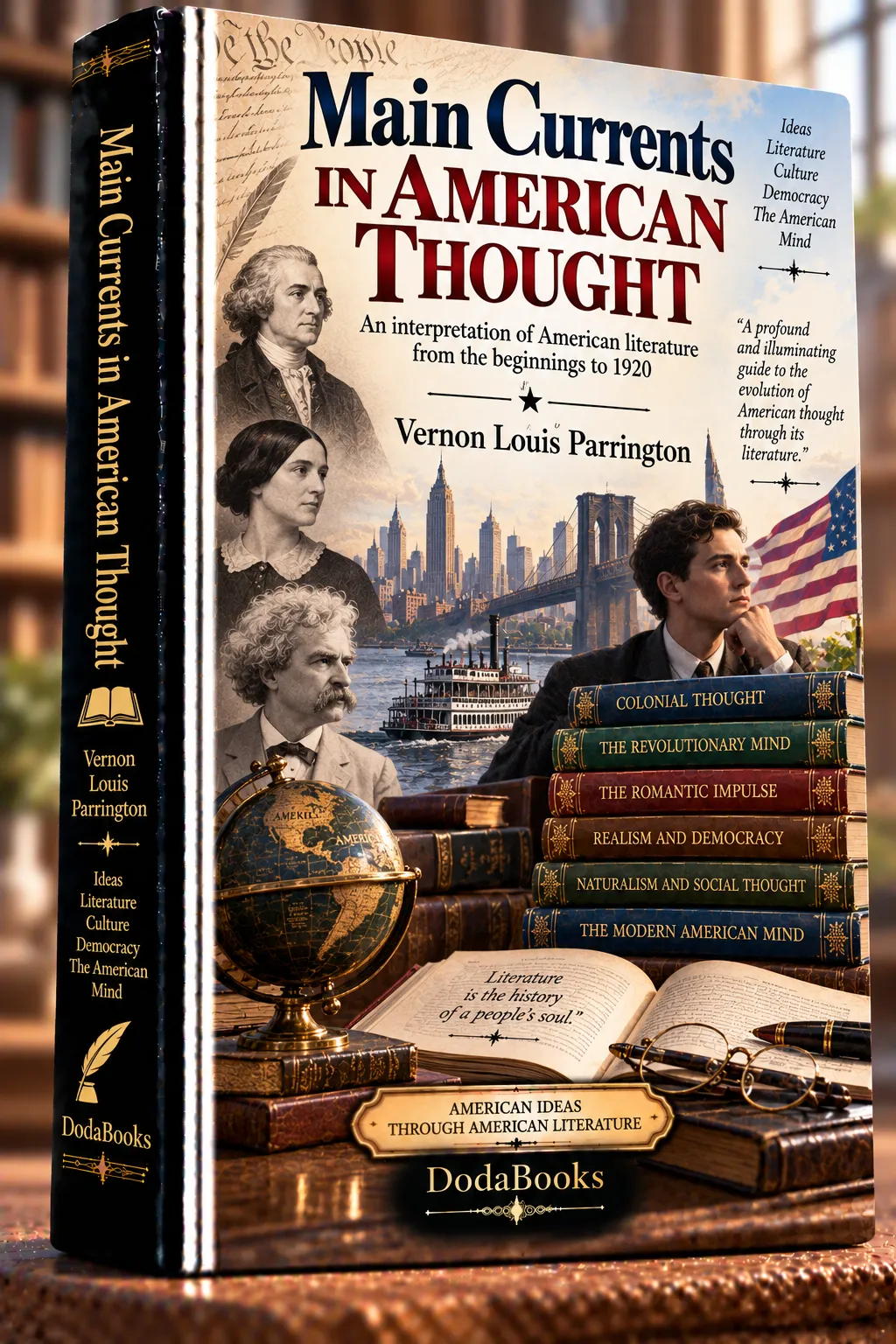
Explore the Intellectual Epic of the American Republic
Read Vernon Louis Parrington's complete three-volume masterpiece with historical annotations explaining Puritan theology, Enlightenment philosophy, and Gilded Age politics.
Get Main Currents in American ThoughtThe Three Epochs of the American Mind
Parrington structures his vast intellectual odyssey into three distinct chronological and ideological movements:
Volume I: The Colonial Mind (1620–1800)
Parrington begins with the rigid, authoritarian Calvinist theocracy of Massachusetts Bay. He examines how theological tyrants like John Cotton and Cotton Mather sought to construct an oligarchy of the “elect,” and how their closed system was challenged by the courageous, radical humanitarianism of Roger Williams—whom Parrington celebrates as the true morning star of American democratic liberty. The volume tracks the transition from Puritan dogma to the secular Enlightenment ideals of Benjamin Franklin, Thomas Paine, and Thomas Jefferson.
Volume II: The Romantic Revolution (1800–1860)
The second volume explores the flourishing of American Romanticism, Transcendentalism, and regional consciousness. Parrington contrasts the fiery Southern plantation feudalism of John C. Calhoun with the fierce moral abolitionism of the North and the transcendent individualism of Ralph Waldo Emerson and Henry David Thoreau. Here, Parrington analyzes how the agrarian West, pioneered by Andrew Jackson and Abraham Lincoln, emerged as the true reservoir of democratic egalitarianism.
Volume III: The Beginnings of Critical Realism (1860–1920)
Published posthumously following Parrington’s sudden death, the third volume examines the catastrophic transformation of America following the Civil War. Parrington documents “The Great Barbecue”—the ruthless corporate plunder of natural resources, the rise of monopolistic trusts, and the subjugation of the individual worker. He shows how writers like Walt Whitman, Mark Twain, and the early muckrakers fought to preserve human dignity in the face of mechanized industrial greed.
Parrington's Dialectical Progression:
[Puritan Theocratic Oligarchy] ➔ [Enlightenment Agrarian Liberty / Jefferson] ➔ [Romantic Transcendence] ➔ [The Gilded Age Barbecue] ➔ [Critical Realism]
The Jeffersonian Faith vs. Hamiltonian Plutocracy
The animating core of Parrington’s scholarship is his fierce, unapologetic partisanship on behalf of the common person. To Parrington, Alexander Hamilton was an intellectual genius whose fatal flaw was a profound contempt for democracy, desiring an American empire ruled by a financial oligarchy modeled on British aristocracy.
In contrast, Parrington viewed Thomas Jefferson as the supreme philosopher-statesman of human freedom. Jefferson understood that genuine political democracy cannot survive without economic independence:
“Jeffersonian democracy was founded on the conviction that the earth belongs in usufruct to the living; that a nation of freeholders, tilling their own soil and beholden to no landlord or financial master, is the sole enduring foundation of a free republic.”
Parrington’s analysis of how this Jeffersonian dream was betrayed by the post-Civil War triumph of Wall Street speculation and corporate cartels (a dilemma echoed across the Atlantic in Sir W. B. Richmond’s critique) anticipated modern economic and political critique by decades, influencing generations of historians from Henry Steele Commager to Arthur M. Schlesinger Jr.
Pulitzer Prize-Winning Scholarship
The definitive intellectual history that redefined American studies, honored with the 1928 Pulitzer Prize for its revolutionary prose and scope.
Uncompromising Economic Realism
The first major work of American criticism to examine how economic class, land distribution, and financial capital shaped literature and religion.
Portraits of Over 150 Thinkers
Masterful, psychologically penetrating essays on Roger Williams, Jonathan Edwards, Benjamin Franklin, Thomas Paine, Emerson, Melville, and Whitman.
Comprehensive Annotated Edition
Explanatory footnotes identifying period theological pamphlets, political tracts, and forgotten 19th-century legislative debates.
Parrington’s Prose: Majestic, Rhythmic, and Passionate
Unlike dry academic monographs that bury ideas beneath technical jargon, Parrington writes with the sweeping, rhythmic majesty of a master stylist. His prose carries the muscular cadence of the American frontier—rich in vivid metaphors, dry wit, and moral passion.
When Parrington describes Cotton Mather, we see a tragic, neurotic theologian pacing his study in terror of witches and demons; when he describes Herman Melville, we feel the tragic, towering despair of an artist confronting the indifferent cosmic void; when he describes Walt Whitman, his sentences unfurl with expansive, democratic celebration. Reading Parrington is not merely an intellectual education; it is an exhilarating aesthetic experience.
To trace how Parrington’s intellectual framework connects with primary works across American literature, explore our companions to The Autobiography of Benjamin Franklin Guide and Henry Clews’ firsthand record of financial capitalism in Fifty Years in Wall Street Guide.
Own the Supreme Monument of American Intellectual History
Read the definitive digital edition of Main Currents in American Thought on DodaBooks, complete with historical concordances, biographical indices, and crisp digital typography.
Purchase Main Currents on DodaBooksWhy Read the DodaBooks Edition of Main Currents in American Thought?
Because Parrington references hundreds of obscure colonial sermons, forgotten constitutional debates, and 19th-century political tracts, modern readers greatly benefit from curated historical guidance.
The DodaBooks Annotated Edition delivers:
- Integrated Biographical Index: Profiling over 150 American thinkers, statesmen, theologians, and novelists across all three volumes.
- Glossary of Historical Philosophical Terms: Explaining Covenant Theology, Deism, Physiocracy, Transcendentalism, Social Darwinism, and Agrarianism.
- Historical Timelines for Each Epoch: Mapping intellectual shifts against real-world economic panics, frontier expansions, and wars.
- Optimized Multi-Volume Formatting: Seamless navigation across all three volumes with distinct headings and comfortable margins for Kindle, iPad, Kobo, and smartphones.
The Agrarian Ethos: Parrington’s Frontier Democracy
A foundational pillar of Parrington’s critical philosophy in Main Currents in American Thought is his profound belief that true American democracy was forged not in European-style coastal cities, but along the raw agrarian frontier. Parrington grew up in the rural Midwest and worked in Kansas during the fiery Populist revolts of the 1890s. This personal immersion in agrarian struggle gave him an acute suspicion of Eastern financial orthodoxy.
In Parrington’s view, whenever American culture became overly subordinated to Boston banks or Wall Street syndicates, it withered into sterile European imitation. But whenever it drew sustenance from the pioneer soil—from the plain speech, mutual aid, and egalitarian neighborliness of the frontier—it generated vibrant democratic genius.
Parrington's Organic Cultural Continuum:
[Frontier Land Ownership] ➔ [Economic Self-Reliance] ➔ [Independent Political Conscience] ➔ [Authentic Democratic Culture]
This democratic agrarian faith makes Main Currents far more than a literary survey; it is an urgent political testament. Parrington warned that if America allowed its independent family freeholders to be converted into dependent tenant farmers or urban factory wage-slaves, the soul of the democratic republic would be extinguished.
The enduring greatness of Main Currents in American Thought lies in its sweeping vision of democracy as a living, continuous moral struggle. Parrington understood that ideas are not ornamental museum pieces; they are the battle lines along which human freedom is won or lost. His masterpiece remains essential reading for anyone seeking to understand the deep intellectual currents shaping American civilization.
Frequently Asked Questions
Who was Vernon Louis Parrington?
Vernon Louis Parrington (1871–1929) was an influential American literary scholar, historian, and professor at the University of Washington whose work founded American Studies as an academic discipline.
Why did Main Currents in American Thought win the Pulitzer Prize?
Awarded the Pulitzer Prize in History in 1928, the work was celebrated for synthesizing three centuries of American literature, economics, and political philosophy into a unified, brilliant narrative of democratic struggle.
What is Parrington's view of the conflict between Jefferson and Hamilton?
Parrington saw Hamilton as the architect of a centralized, commercial plutocracy serving financial elites, while Jefferson was the champion of decentralized, humanitarian democracy based on independent agrarian citizens.
Is the complete three-volume work included in this edition?
Yes. The DodaBooks edition consolidates all three volumes—The Colonial Mind, The Romantic Revolution, and The Beginnings of Critical Realism—into an expertly annotated and searchable digital text.
Where can I purchase and download the complete edition?
The complete digital edition is available directly from DodaBooks in EPUB and PDF formats for all modern reading devices.