Love-at-Arms: Sabatini’s Swashbuckling Renaissance Triumph
Before *Scaramouche* and *Captain Blood*, Rafael Sabatini brought the bloody, romantic tapestry of 15th-century Italy to incandescent life in *Love-at-Arms*, pitting a chivalrous soldier of fortune against the sinister machinations of Cesare Borgia and tyrannical dukes.
Renowned as the undisputed master of early twentieth-century historical adventure fiction, Rafael Sabatini (1875–1950) possessed a rare gift: the ability to weave impeccable historical scholarship with breathless narrative momentum, sparkling fencing repartee, and high-stakes romantic intrigue. Published in 1907, Love-at-Arms: A Narrative Excerpted from the Chronicles of Urbino stands as one of Sabatini’s most vibrant and atmospheric early triumphs.
Set against the tempestuous backdrop of late fifteenth-century central Italy—where rival city-states clashed beneath the shadows of fortified Apennine citadels and the predatory ambitions of Duke Valentine (Cesare Borgia)—the novel follows Francesco Gonzaga, a dashing, battle-hardened condottiere whose cynicism toward romantic love is tested by the spirited Lady Valentina Gonzaga and the perilous defense of a besieged duchy. Readers delving into our curated classic historical adventure collection will discover in Love-at-Arms an intoxicating blend of Italian Renaissance color, tactical military stratagem, and chivalric nobility.
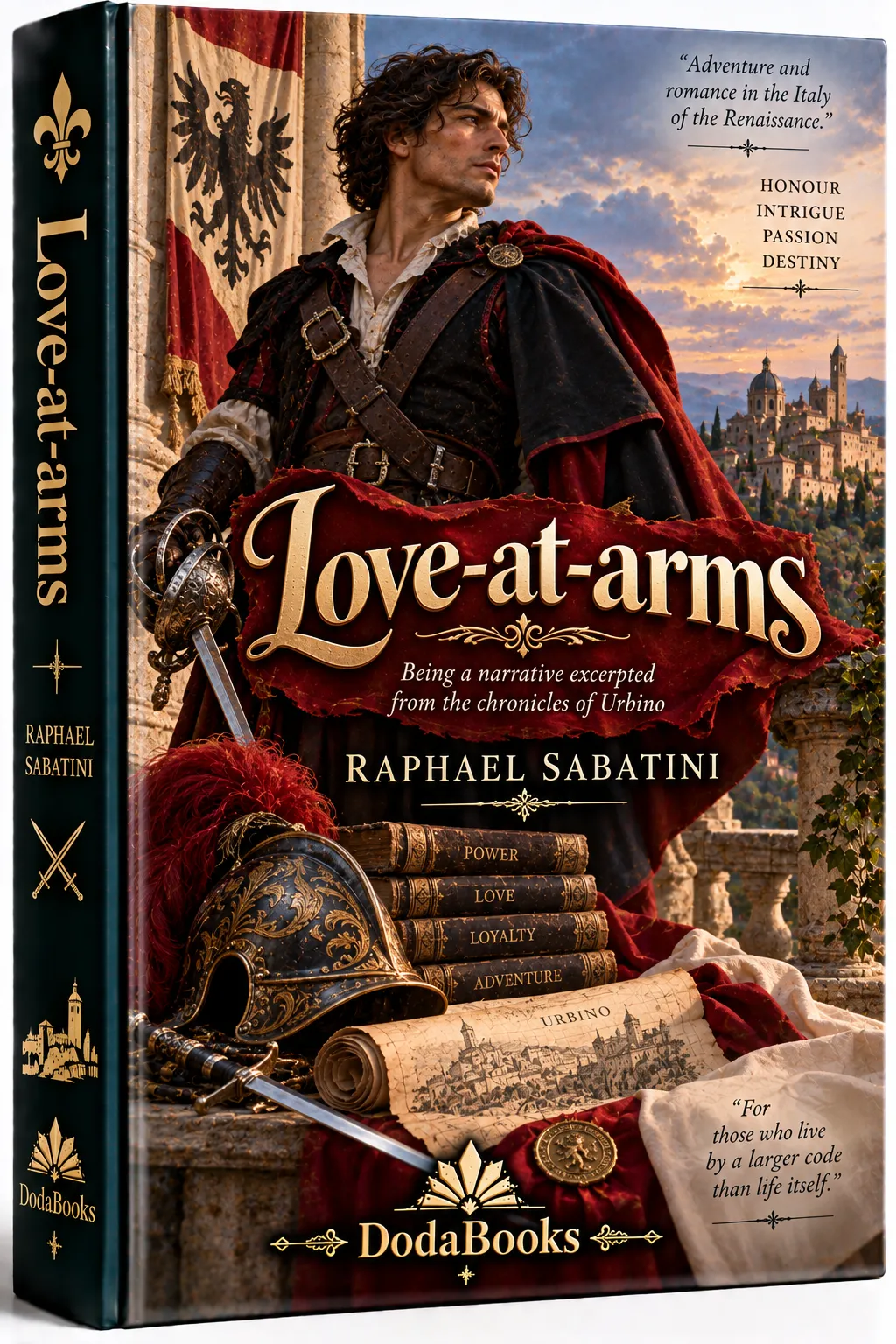
Read the Definitive Annotated Edition
Experience Rafael Sabatini's Renaissance masterpiece with detailed historical annotations on Cesare Borgia, 15th-century siegecraft, and Italian city-state politics.
Get the Annotated eBookPlot Overview: The Lion of Urbino and the Lady in Peril
The story unfolds during the treacherous campaigns that reshaped the Italian peninsula, when Cesare Borgia, backed by the papal armies of his father Alexander VI, sought to carve a unified kingdom out of the proud, independent duchies of the Romagna and the Marches.
In the mountain stronghold of Urbino, the tyrannical and cowardly Duke Andrea has alienated his subjects through taxation and cruelty. Complicating matters is the impending forced marriage of his fiery, independent niece, Valentina Gonzaga, to the brutal mercenary captain Count Malatesta. Desperate to escape this fate, Valentina seeks an ally. She encounters Francesco Gonzaga, a seasoned soldier of fortune who has sworn off women and romantic delusions, fighting strictly for gold, honor, and martial fellowship.
                    THE RENAISSANCE CHESSBOARD OF LOVE-AT-ARMS

       THE CITADEL OF URBINO                   THE ADVANCING SHADOW
    ┌───────────────────────────┐           ┌───────────────────────────┐
    │ Duke Andrea (Cowardice)   │           │ Cesare Borgia (Valentine) │
    │ Valentina Gonzaga (Pride) │ ◄───────► │ Papal Mercenary Cohorts   │
    │ Malatesta (Brutality)     │           │ Treachery & City Sieges   │
    └─────────────┬─────────────┘           └─────────────┬─────────────┘
                  │                                       │
                  ▼                                       ▼
       FRANCESCO GONZAGA (Love-at-Arms) ──► Rapier Duels, Castle Storming
        Soldier of Fortune & Savior         & Triumphant Chivalric Honor
Drawn against his better judgment into Valentina’s plight, Francesco devises an audacious scheme: a sham marriage to Valentina that technically removes her from Malatesta’s grasp while keeping his own mercenary detachment free to navigate the approaching Borgia storm. What begins as a cold, strategic transaction of convenience soon erupts into fierce passion, tested through thrilling midnight escapes, perilous rapier duels along cliffside ramparts, castle sieges, and the subtle, deadly court conspiracies characteristic of Renaissance Italy.
Major Characters: Condottieri, Tyrants, and Heroines
Rafael Sabatini populated Love-at-Arms with vividly realized archetypes drawn directly from Renaissance chronicles:
- Francesco Gonzaga: The archetypal Sabatinian hero. Cool-headed, master swordsman, witty, and fiercely honorable despite his outward veneer of mercenary detachment. Francesco lives by a soldier’s pragmatic realism until his chivalric core compels him to risk everything for love.
- Valentina Gonzaga: A heroine of immense agency and pride. Far from a passive damsel awaiting rescue, Valentina matches wits with tyrants, wields political influence, and refuses to submit to arranged dynastic auctions.
- Cesare Borgia (Il Valentino): The brooding historical catalyst hovering over the narrative. Sabatini portrays Borgia with characteristic nuance—not merely as a melodramatic monster, but as Niccolò Machiavelli’s ideal Prince: calculating, magnetic, terrifyingly efficient, and utterly devoid of moral compunction.
- Count Malatesta: The brutal, grasping condottiere whose cruelty and lust represent the savage underbelly of Renaissance warfare, providing a sharp moral counterpoint to Francesco Gonzaga’s chivalry.
- Duke Andrea of Urbino: A weak, vacillating ruler whose paranoia and cowardice illustrate how petty tyrants brought about the ruin of Italy’s ancient city-states.
Key Themes: Chivalry, Machiavellianism, and Italian Statecraft
1. The Clash Between Chivalric Honor and Machiavellian Realpolitik
The fundamental philosophical tension of Love-at-Arms is the conflict between the fading medieval ideal of chivalric romance—championed instinctively by Francesco—and the cold, amoral ragione di stato (reason of state) championed by Cesare Borgia. Sabatini demonstrates that while Machiavellian ruthlessness may win battles and capture citadels, it cannot command true human loyalty, which responds only to genuine courage and moral integrity.
2. The Mercenary System and Renaissance Condottieri
Sabatini draws upon deep archival knowledge of the Italian condottieri system. Unlike modern standing armies, Renaissance wars were fought by private military contractors (condotte) who carefully weighed risk against reward. Sabatini brings authentic historical textures to light: the negotiation of battle contracts, the specialized arms of Swiss pikemen and Italian crossbowmen, and the delicate diplomacy required to hold mountain fortresses.
                      THE MORAL CODE OF SABATINI'S HERO

          The Cold Mercenary Code              The Awakening of Chivalry
     ┌───────────────────────────────┐   ┌───────────────────────────────┐
     │ Fight only for gold & contract│   │ Fight for justice & defenseless│
     │ Shun feminine emotional traps │   │ Total devotion to Lady Valentina│
     │ Cynical emotional detachment  │   │ Sacrifice of rank and fortune │
     └───────────────────────────────┘   └───────────────────────────────┘
                     ▲                                   ▲
                     └─────────────────┬─────────────────┘
                                       ▼
                       The Synthesis of Love-at-Arms:
                       A Soldier Redeemed by Devotion
3. The Psychology of “Love-at-Arms”
The title of the novel captures Sabatini’s favorite romantic motif: love born not in peaceful gardens or comfortable ballrooms, but in the heat of conflict and shared peril. The relationship between Francesco and Valentina matures through mutual trials of courage and loyalty. Just as Anatole France analyzed the psychological torment of romance in Florence, Sabatini celebrated the heroic, elevating power of passion under pressure.
The Art of Historical Reconstruction: Sabatini’s Archival Realism
What distinguishes Rafael Sabatini from mere pulp adventure writers of the early twentieth century was his rigorous commitment to historical verisimilitude. Having lived across Italy, Switzerland, Portugal, and England, and fluent in five languages, Sabatini read primary Italian chronicles, municipal records of Urbino, and contemporary Renaissance dispatches in their original archaic vernacular.
In Love-at-Arms, this scholarly foundation enriches every scene:
- Military Architecture: The description of the fortress of Urbino—with its massive bastion angles designed by Renaissance military engineers to withstand early siege artillery, subterranean sally ports, and crenellated battlements—is rendered with meticulous architectural precision.
- Weaponry and Combat Tactics: Rather than staging generic Hollywood fencing scenes, Sabatini details the actual transitional combat methods of 1500, when heavy broadswords and plate armor were giving way to swept-hilt cut-and-thrust rapiers, dagger parries (mano sinistra), and wheel-lock firearm incursions.
- Renaissance Diplomatic Protocol: The treaty negotiations between Duke Andrea, Count Malatesta, and Borgia’s envoys mirror authentic diplomatic documents of the Romagna wars, revealing how Italian city-states routinely traded royal marriages and commercial tolls to stave off military annihilation.
By anchoring his romantic narrative in authentic material culture, Sabatini achieved a rare balance: an exhilarating, high-velocity swashbuckler that simultaneously educates the reader on the realities of Renaissance statecraft and military life.
Comparative Analysis: Sabatini in the Golden Age of Adventure
To appreciate Sabatini’s narrative brilliance, compare Love-at-Arms with other classic adventure and historical works:
| Novel & Author | Setting & Era | Tone & Style | Core Dynamic |
|---|---|---|---|
| Love-at-Arms (Rafael Sabatini) | Renaissance Italy (c. 1500) | Swashbuckling, lyrical, chivalric | Mercenary soldier vs. Borgia machinations |
| The Red Lily (Anatole France) | 1890s Paris & Florence | Fin-de-siècle, skeptical, psychological | Salon romance vs. retrospective jealousy |
| Memoirs of Napoleon Bonaparte (Bourrienne) | Napoleonic Europe (1779–1815) | Eyewitness, forensic, historical memoir | The mechanics of conquest and imperial will |
| Children of the Whirlwind (Leroy Scott) | 1920s New York City | Gritty, urban mystery, redemption | Ex-convict battling underworld conspiracy |
While modern crime mysteries like Leroy Scott’s Children of the Whirlwind translate the battle against corrupt conspirators to 1920s Manhattan streets, Sabatini operated on the grand stage of Italian history. Furthermore, where Bourrienne’s Napoleon memoirs examine real-life imperial conquest and autocratic will, Sabatini transforms Renaissance military campaigns into a thrilling showcase of individual heroism and romantic triumph.
Step into the Golden Age of Swashbuckling Romance
Immerse yourself in Rafael Sabatini's classic Italian Renaissance adventure with newly compiled historical notes on the Borgias, Urbino geography, and Renaissance weaponry.
Read The Annotated EditionWhy Rafael Sabatini Still Thrills Modern Readers
Rafael Sabatini was often called the “modern Alexandre Dumas,” but his historical novels possessed a tighter architectural structure and greater psychological subtlety than many nineteenth-century serials. His dialogue crackles with intelligence, wit, and subtle irony, making every duel of words as thrilling as a duel of rapiers.
In Love-at-Arms, Sabatini reminds us why classic adventure fiction remains an immortal art form. It transports the reader into a world where courage matters, where personal honor is worth defending against impossible odds, and where love is forged in the fire of shared danger.
Frequently Asked Questions
Who was Rafael Sabatini and what are his most famous works?
Rafael Sabatini (1875–1950) was an Italian-English author celebrated as the master of historical adventure fiction and swashbucklers. Born in Jesi, Italy, to opera singers, he wrote in English and achieved worldwide fame with bestselling novels including 'Scaramouche' (1921), 'Captain Blood' (1922), and 'The Sea-Hawk' (1915), which were adapted into legendary Hollywood films starring Errol Flynn.
What is the historical setting of Love-at-Arms?
The novel is set in late fifteenth-century central Italy, specifically in the Duchy of Urbino and the surrounding Romagna region. The historical background features the aggressive campaigns of Cesare Borgia (Duke Valentine), son of Pope Alexander VI, who sought to subjugate Italy's independent city-states using mercenary condottieri.
What does the title "Love-at-Arms" mean?
The title refers to love born in the crucible of military conflict, martial adventure, and shared physical danger. It describes the romance between Francesco Gonzaga and Valentina, which begins as a tactical military alliance and sham marriage before developing into genuine, passionate devotion through sieges, duels, and shared peril.
Is Francesco Gonzaga based on a real historical figure?
While the Gonzaga family was one of the most prominent noble dynasties of Renaissance Italy (ruling Mantua for centuries and producing celebrated condottieri like Francesco II Gonzaga), Sabatini fictionalized Francesco Gonzaga's specific adventures in Urbino, weaving real genealogical names and locations into a bespoke romantic narrative.
What enhancements are provided in the DodaBooks annotated edition?
The DodaBooks annotated edition includes detailed historical commentary explaining the campaigns of Cesare Borgia, glossaries of Renaissance Italian military and architectural terms, geographical maps of Urbino and the Marches, and an insightful literary essay on Sabatini's evolution as a historical novelist. You can explore and download the definitive annotated edition directly from DodaBooks at https://dodabooks.com/ebook/love-at-arms-by-rafael-sabatini/.
Related Classic Adventure and Literary Guides
Discover further masterworks of historical fiction, psychological drama, and classic memoirs in our collection: