Little Women Characters Explained: Jo, Meg, Beth, Amy & Laurie
When Louisa May Alcott published Little Women in 1868, she transformed the landscape of nineteenth-century American fiction by presenting something rarely seen in Victorian literature: four distinct, deeply flawed, and fiercely individual young women whose personal growth, internal struggles, and life choices were treated with profound emotional seriousness.
Unlike the flat, moralizing heroines of nineteenth-century Sunday school tracts, the March sisters—Meg, Jo, Beth, and Amy—did not fit a single mold. They represented four distinct responses to the constraints of Victorian womanhood: Meg embraced domestic beauty and gentle romance; Jo defied patriarchal conventions through literary ambition and fiercely guarded independence; Beth cultivated quiet, selfless spirituality within the sanctuary of home; and Amy pursued social polish, worldly ambition, and European artistic refinement.
Surrounding the sisters is a brilliant supporting ensemble: the charming, impetuous boy next door Theodore “Laurie” Laurence, the wise maternal matriarch Marmee, the upright tutor John Brooke, and the warm, intellectual German scholar Professor Friedrich Bhaer.
Whether you are preparing a literature seminar paper, analyzing Victorian gender roles, or debating why Jo did not marry Laurie, this comprehensive character guide provides an exhaustive psychological breakdown of every major figure in Alcott’s masterpiece.
⚡ Little Women Cast: At a Glance
- The Literary Rebel: Josephine "Jo" March — Second sister (15); fiercely independent tomboy with a fiery temper and an unyielding passion for authorship; Alcott’s autobiographical surrogate.
- The Romantic Traditionalist: Margaret "Meg" March — Eldest sister (16); pretty, dignified, and drawn to high-society luxury; chooses humble love with tutor John Brooke over wealthy marriage.
- The Sacred Peacemaker: Elizabeth "Beth" March — Third sister (13); painfully shy musical genius who embodies pure, unselfish Christian devotion; dies of cardiac complications following scarlet fever.
- The Ambitious Artist: Amy March — Youngest sister (12); vain, conceited child who matures into an elegant, clear-eyed visual artist; marries Laurie in Europe.
- The Chivalric Boy Next Door: Theodore "Laurie" Laurence — Impetuous, charming, wealthy neighbor whose unrequited passion for Jo matures into enduring love with Amy.
- The Intellectual Partner: Professor Friedrich Bhaer — Gentle, middle-aged German scholar who respects Jo's mind, critiques her sensation fiction, and becomes her equal husband at Plumfield.
🧭 The Sisterly Quaternity: Foils & Personality Matrix
Louisa May Alcott structures the novel around pairs of complementary sisters. Meg and Amy share an aesthetic appreciation for beauty, fashion, and social elegance, while Jo and Beth represent the inward extremes of fiery rebellion versus serene domestic submission:
+---------------------------------------------------------------------------------------+
|                         THE MARCH SISTERS COMPARISON MATRIX                           |
+---------------------+-------------+-------------------+-------------------------------+
| SISTER              | TEMPERAMENT | ARTISTIC OUTLET   | ULTIMATE LIFE DESTINY         |
+---------------------+-------------+-------------------+-------------------------------+
| Meg (Eldest, 16)    | Conventional| Acting & Domestic | Marries John Brooke; mothers  |
|                     | & Romantic  | Craftsmanship     | twins Daisy & Demi at Dovecote|
+---------------------+-------------+-------------------+-------------------------------+
| Jo (Second, 15)     | Rebellious  | Authorship, Drama | Marries Prof. Bhaer; founds   |
|                     | & Ambitious | & Playwriting     | progressive school Plumfield  |
+---------------------+-------------+-------------------+-------------------------------+
| Beth (Third, 13)    | Shy, Gentle | Piano & Folk      | Dies young in Jo's arms; acts |
|                     | & Saintly   | Melodies          | as family's spiritual angel   |
+---------------------+-------------+-------------------+-------------------------------+
| Amy (Youngest, 12)  | Ambitious & | Drawing, Painting | Marries Laurie; enters wealthy|
|                     | Worldly     | & Clay Sculpting  | society with refined grace    |
+---------------------+-------------+-------------------+-------------------------------+
🖋️ 1. Josephine “Jo” March: The Unconventional Heroine
Jo March is widely celebrated as one of the first truly modern, proto-feminist heroines in American literature. Directly modeled on Louisa May Alcott herself, Jo is an explosive rejection of nineteenth-century decorative womanhood.
The Anatomy of the Rebel
From the opening pages, Jo mourns the limitations imposed on female biology:
- “I can’t get over my disappointment in not being a boy; and it’s worse than ever now, for I’m dying to go and fight with papa, and I can only stay at home and knit, like a poky old woman!”
- Physical Non-Conformity: Jo is tall, thin, and awkward, with sharp gray eyes and long, thick chestnut hair that is perpetually tied in a net or scorched by fireplace coals. She whistles, walks with long strides, and refuses to wear corsets or silk gloves that restrict her movement.
- The Burning of the Manuscript & The Temper: Jo’s greatest struggle is her volcanic temper. When Amy burns her beloved fairy-tale manuscript, Jo allows her anger to harden into icy cruelty, nearly allowing Amy to drown beneath the river ice. Overcoming her wrath—guided by Marmee’s confession that she, too, fought a violent temper for forty years—is Jo’s deepest moral journey.
The Great Hair Sacrifice
When a telegram arrives in Chapter 15 announcing that Father is dying in a Washington hospital, Jo demonstrates the true nature of her heroism:
- She does not beg for money or weep passively. She walks into a barber shop and cuts off her “one beauty”—her long, thick chestnut hair—selling it for twenty-five dollars.
- While she cries softly into her pillow that night for the aesthetic loss, she never regrets the sacrifice.
Why Jo Refuses Laurie
The central controversy of Little Women for 150 years has been Jo’s rejection of Laurie’s marriage proposal:
- Temperamental Incompatibility: Jo and Laurie are too much alike—both are fiery, volatile, and headstrong. As Jo wisely predicts: “We’d quarrel, and we’d be miserable!”
- Fraternal Love: Jo loves Laurie passionately, but as a brother and playmate, not a romantic partner. She refuses to fake romantic desire simply to please society.
- Preservation of Liberty: Jo famously tells Laurie: “I love my liberty too well to be in any hurry to give it up.” Marrying Laurie would have absorbed Jo into high-society leisure as a decorative hostess; marrying Friedrich Bhaer gives her an intellectual companion who encourages her writing and joins her in building a progressive school.
🎀 2. Margaret “Meg” March: The Temptations of High Society
As the eldest sister, sixteen-year-old Meg carries the memory of the March family’s pre-Civil War wealth. Consequently, she suffers more acutely from their current genteel poverty than her younger sisters.
The Battle with Vanity
- Vanity Fair (Chapter 9): When Meg stays with the wealthy Moffat family, she allows them to dress her in low-cut pink silk, apply makeup, and parade her as a fashionable social doll. Overhearing guests whisper that Marmee is scheming to trap Laurie for his fortune fills Meg with burning shame.
- The Choice of John Brooke: Meg’s ultimate moral victory occurs when she rejects Aunt March’s tyrannical command to marry for wealth. When Aunt March threatens to disinherit her if she marries penniless tutor John Brooke, Meg’s latent March courage awakens: she defends John’s poverty, virtue, and character, choosing genuine love over societal status.
- Domestic Maturation: In Part II, Meg navigates the trials of early marriage—ruining currant jelly, buying expensive violet silk that strains their budget, and balancing motherhood with marital intimacy. Meg represents the dignity of ordinary domestic womanhood when grounded in mutual respect and frugality.
🕊️ 3. Elizabeth “Beth” March: The Saint of the Hearth
Thirteen-year-old Beth is the emotional conscience and spiritual anchor of the March household.
The Music of the Sanctuary
Unlike her ambitious sisters who construct “castles in the air” (fame, wealth, travel), Beth’s only wish is to stay at home with Father and Mother and care for the family.
- The Broken Piano: Beth spends her days playing hymns on an ancient, out-of-tune piano. When old Mr. Laurence gifts her a magnificent mahogany piano in gratitude for her gentle companionship, it is the crowning joy of her life.
- The Price of Charity: Beth is the only sister who continues visiting the impoverished German Hummel family when Marmee is away. Her selflessness costs her life: she contracts malignant scarlet fever from a dying infant.
- The Valley of the Shadow: Although she survives the acute infection, Beth’s physical health is permanently broken. In Part II, Beth accepts her approaching death with transcendent peace: “I never wanted to go away, and the hard part is leaving you all; but I’m not afraid.” Her peaceful death in Jo’s arms at dawn remains one of the most heartbreaking scenes in nineteenth-century literature.
🎨 4. Amy March: From Selfish Child to Gracious Lady
Amy March is often disliked by first-time readers because of her childhood selfishness—pinching her nose with a clothespin to make it aristocratic, demanding pickled limes at school, and vindictively burning Jo’s precious manuscript. Yet across the novel, Amy undergoes arguably the most realistic and impressive transformation of all four sisters.
+-------------------------------------------------------------------------------+
|                       THE MATURATION OF AMY MARCH                             |
+-------------------+-----------------------------------------------------------+
| STAGE / SETTING   | CHARACTER FLAWS & LESSONS LEARNED                         |
+-------------------+-----------------------------------------------------------+
| Concord           | Childish conceit; burns Jo's manuscript in revenge; nearly|
| (Childhood)       | drowns in river; learns consequences of spite.            |
+-------------------+-----------------------------------------------------------+
| Boston / Aunt     | Learns social etiquette, French language, and poise under |
| March's Tutelage  | the strict discipline of wealthy Aunt March.              |
+-------------------+-----------------------------------------------------------+
| Rome & Paris      | Studies painting; humbly realizes her talent is not       |
| (European Tour)   | genius; trades grandiosity for authentic craftsmanship.   |
+-------------------+-----------------------------------------------------------+
| Nice, France      | Confronts Laurie's drunken cynicism; inspires him to work;|
| (Reunion)         | forms a mature, harmonious, and loving marriage.          |
+-------------------+-----------------------------------------------------------+
The Pragmatic Realist
Amy possesses a clear-eyed understanding of Victorian socioeconomic realities:
- She knows that as a poor woman, she must either achieve great artistic success or marry well to support herself and her family.
- When she realizes in Rome that her artistic talent is respectable but will never rival Michelangelo or Raphael, she demonstrates profound humility: “I want to be great, or nothing… I won’t be a commonplace scribbler or painter.”
- When she scolds Laurie in Nice for wasting his youth in idle sorrow, she sparks Laurie’s resurrection. Laurie falls in love not with a spoiled child, but with a poised, intelligent woman of purpose.
🎻 5. Theodore “Laurie” Laurence: The Romantic Boy Next Door
Theodore “Laurie” Laurence is charming, wealthy, handsome, and deeply lonely when the novel begins. The grandson of wealthy Mr. Laurence, Laurie is half-Italian, inheriting a passionate love for music from his late mother.
The Journey from Youth to Adulthood
- The Adopted Brother: Finding the March house filled with laughter, noise, and love, Laurie eagerly attaches himself to the family, joining the Pickwick Club and performing in Jo’s plays.
- The Obsessive Suit: Laurie falls into a passionate infatuation with Jo. He idealizes her as his salvation, believing that marriage to Jo will tame his wandering spirit. When Jo refuses him, Laurie’s ego and heart are shattered, sending him into aimless dissipation in European cafes.
- The Mature Union: In Europe, Amy provides Laurie with the firm moral guidance and artistic companionship he truly needs. Laurie realizes that his stormy passion for Jo was a youthful tempest, whereas his connection with Amy is mature, peaceful, and constructive.
📚 6. Professor Friedrich Bhaer: The Equal Partner
Often dismissed in superficial film adaptations as an unromantic, elderly bore, Professor Friedrich Bhaer in Alcott’s novel is a warm, deeply appealing intellectual partner for Jo.
+-------------------------------------------------------------------------------+
|                       LAURIE LAURENCE VS. PROFESSOR BHAER                     |
+-----------------------------------+-------------------------------------------+
| THEODORE "LAURIE" LAURENCE        | PROFESSOR FRIEDRICH BHAER                 |
+-----------------------------------+-------------------------------------------+
| - Wealthy American aristocrat     | - Impoverished German immigrant scholar   |
| - Youthful, volatile, tempestuous | - Mature, steady, emotionally grounded    |
| - Views Jo as a wild muse to tame | - Treats Jo as an intellectual equal      |
| - Encouraged Jo's sensation tales | - Guides Jo toward authentic literature   |
| - Demands Jo surrender her liberty| - Joins Jo in co-founding Plumfield school|
+-----------------------------------+-------------------------------------------+
The Intellectual Catalyst
When Jo moves to New York, Professor Bhaer becomes her mentor and friend:
- The Moral Mentor: When Bhaer discovers that Jo is writing sensational murder mysteries for the Weekly Volcano, he does not shame her. Instead, he gently critiques the sensational press, urging Jo to write literature that has moral truth and genuine heart. Jo burns her sensational drafts and subsequently writes her greatest, most authentic stories.
- The Umbrella Proposal: Bhaer’s proposal in the rain (“Under the Umbrella”) is one of the tenderest scenes in American literature: he offers Jo nothing but his empty hands and loving heart, and Jo accepts him with total joy.
❓ Frequently Asked Questions (FAQ)
Why is Amy March often considered the villain of Little Women?
Many readers dislike Amy because in Chapter 8, during a childhood fit of rage, she burns Jo’s handwritten manuscript of fairy tales—an act of devastating spite. However, Alcott uses this incident to showcase that all the March sisters were deeply flawed children who had to overcome their faults. By Part II, Amy matures into a generous, clear-headed, and dignified woman who inspires Laurie to give up his cynical idleness.
Was Laurie in love with Amy or was she a replacement for Jo?
Laurie’s love for Amy is genuine, mature, and distinct from his feelings for Jo. His affection for Jo was a stormy, youthful infatuation based on boyhood camaraderie; his love for Amy was built on mutual admiration, shared European experiences, and artistic appreciation. Laurie realizes that he and Jo would have made each other miserable, whereas Amy brings balance, grace, and purpose to his life.
Who is Marmee based on in real life?
Marmee is directly based on Louisa May Alcott’s real-life mother, Abigail May Alcott. Like Marmee, Abigail was an abolitionist, suffragist, and social reformer in Concord, Massachusetts, who taught her daughters to think independently, practice radical charity toward the poor, and master their internal tempers.
Why did Louisa May Alcott write Little Women?
Alcott wrote the novel reluctantly at the request of publisher Thomas Niles of Roberts Brothers, who asked her to write “a story for girls.” In desperate need of money to pay off her family’s crushing debts, Alcott wrote Little Women in just ten weeks during May and July 1868. It became an instant commercial phenomenon, making Alcott financially independent for the rest of her life.
What happened to John Brooke in the novel?
John Brooke, Laurie’s former tutor, marries Meg in Chapter 25. He works as a bookkeeper, serves in the Union Army (where he is wounded), and fathers twins, Daisy and Demi. He lives a quiet, honorable, and modest life as a devoted husband and father before passing away in the later sequel Little Men.
📚 Related Articles & Guides
Looking for an overarching analysis of domestic realism and American literature? Explore our master Little Women Novel Guide.
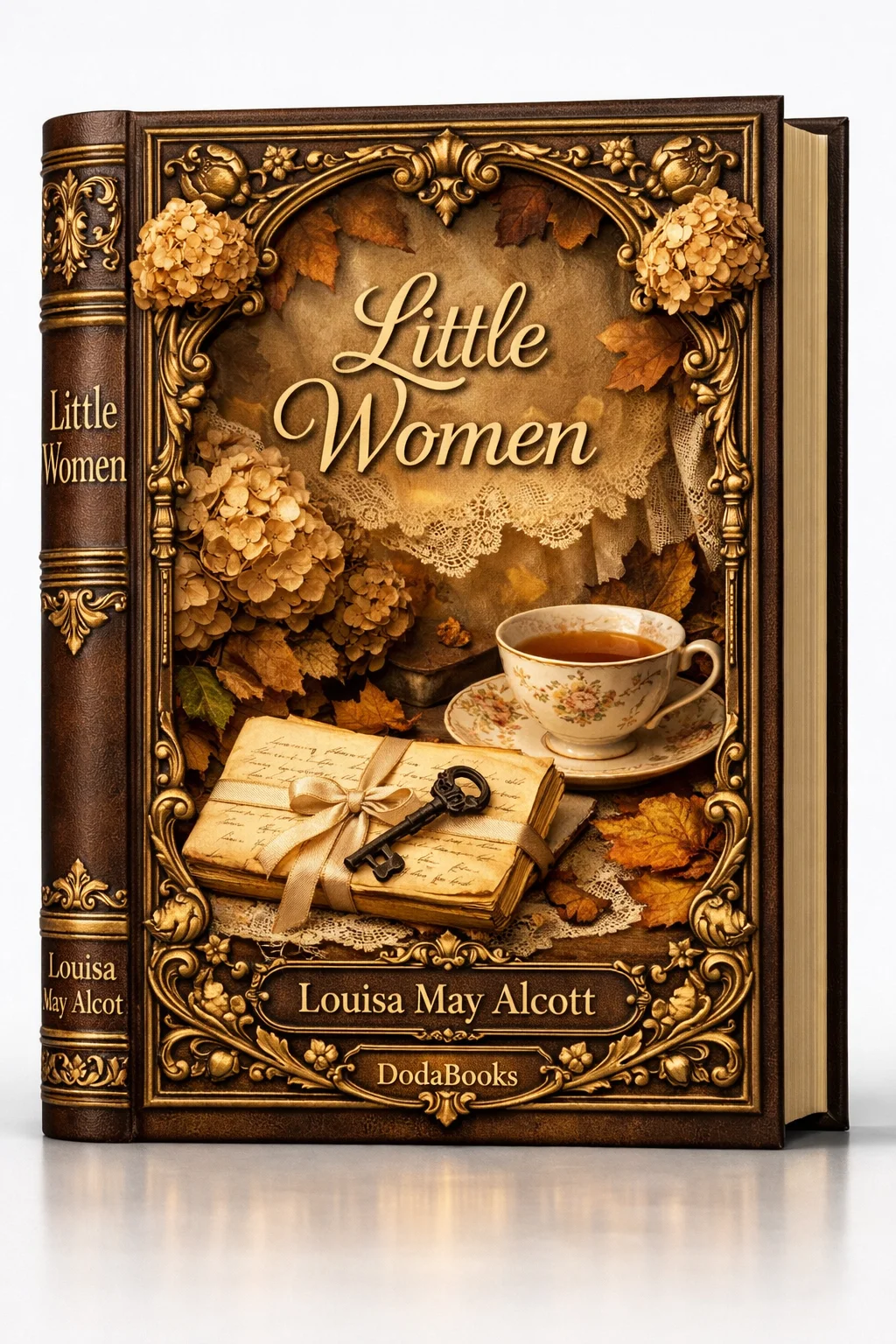
🏠 Read the Definitive Annotated Edition of Little Women
Experience Louisa May Alcott’s beloved classic with complete Civil War historical context, Concord notes, and literary commentary:
- ✅ Complete Unabridged 48-Chapter Text — Includes both Part I and Part II (Good Wives) uncut
- 📜 Pilgrim’s Progress Concordance — Decode every Bunyan allegory and Victorian moral allusion
- 🏛️ Orchard House & Alcott Biography Notes — Discover the real-life sisters behind Jo, Meg, Beth, and Amy
- ✒️ Smart Typography & Formatting — Beautifully formatted for Kindle, Kobo, and iPad
- 🔒 Universal DRM-Free Formats — Delivered instantly in EPUB, PDF, and AZW3 formats