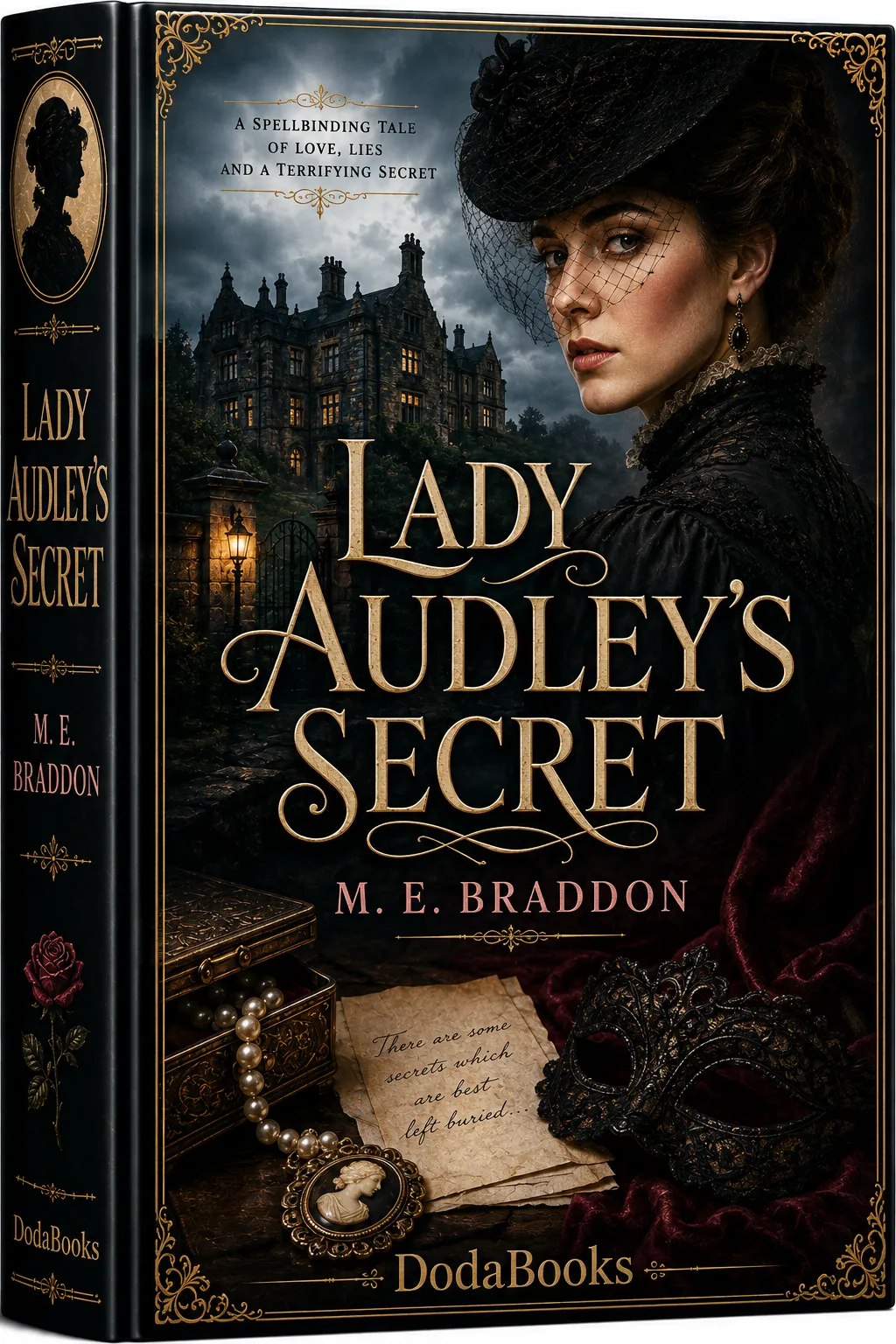
Mary Elizabeth Braddon’s Lady Audley’s Secret is the 1862 sensation novel that scandalized Victorian England — a twisting story of beauty, bigamy, and a heroine whose angelic face hides something far darker. This guide explains the plot, the sensation-fiction craze, and how the DodaBooks Annotated Edition brings 164 annotation cards to Braddon’s most audacious work.
👤
Lady Audley's Secret
A charming baronet marries a beautiful governess. A stepson disappears. And somewhere in the Audley household, a secret is buried that could destroy them all. The definitive Victorian sensation novel, fully annotated.
| Author | Mary Elizabeth Braddon |
| Published | 1862 |
| Genre | Sensation fiction, mystery, gothic |
| Setting | Audley Court, Essex and London |
| Annotation Cards | 164 passage-specific notes |
| Best For | Mystery fans, Victorian enthusiasts, studies of gender |
| Reading Time | 8–10 hours |
👤 The Story
When the wealthy widower Sir Michael Audley marries the young, beautiful governess Lucy Graham, everyone at Audley Court is charmed. No one is more charmed than Sir Michael — which is precisely the point. Lucy Graham is not who she appears to be, and she has married a fortune to escape a past that is catching up with her.
The trouble begins when Sir Michael’s nephew and heir, Robert Audley, starts investigating the disappearance of his friend George Talboys, who vanished the day after revisiting Audley Court. Robert is lazy, detached, and uninterested in the world — until grief makes him a detective. Piece by piece, he assembles a damning picture: bigamy, false names, manufactured deaths, and a woman who will do anything — anything — to protect the secret at the center of her life.
“I shall not be the first woman who has made a false step in appearing too perfect.”
Braddon’s daring stroke was to make her villain a beautiful, talented, sympathetic woman — then let the reader watch, fascinated, as that surface cracks. Victorian reviewers were outraged, which of course only sold more copies.
👥 Inside Audley Court
The novel unfolds in two worlds. At Audley Court, Sir Michael’s estate in Essex, Lucy plays the perfect young wife with ruthless skill — charming the servants, adoring her elderly husband, and hiding the dread beneath her smiles. Here Braddon plants her most famous image: the house itself, with its locked rooms, a mysterious building at the end of a lime-tree walk, and the sense that the walls keep a criminal secret. It is the machinery of Gothic fiction transplanted indoors.
The second world is London, where Robert Audley retreats after his friend’s disappearance. Robert begins as the laziest man in the book — an idle Victorian gentleman who has never done an honest day’s work. But his friendship with George Talboys, and his growing unease around his young aunt, transform him. What starts as curiosity hardens into obsession: he follows papers, interviews servants, visits madhouses, and opens every locked drawer Lucy has tried to close behind her. Braddon turns Robert into an early detective, decades before the genre’s official birth in The Moonstone — which is why her book, alongside Wilkie Collins’s The Woman in White, is so often credited with inventing the English sensation thriller.
🏛️ The Sensation Fiction Craze
Lady Audley’s Secret didn’t just become a bestseller; it defined an entire genre. Sensation fiction of the 1860s took the respectable Victorian drawing room and planted a bomb underneath it — bigamy, murder, madness, and inheritance scandals hiding behind lace curtains. Where Gothic novels fled to ancient castles, sensation novels insisted the real horror lived at home.
Braddon’s novel was the genre’s most successful example precisely because it was so ambiguous. Is Lucy mad or simply ruthless? Is she a monster or the product of a society that offering women no legal escape? The book lets you hold both answers — and the DodaBooks annotations make that ambiguity visible on almost every page.
🔍 What the Annotated Edition Adds
The DodaBooks edition sets Braddon’s original text beside 164 visible, color-coded annotation cards spanning the whole novel.
164 Annotation Cards
Passage-specific notes in distinct pastel colors — read them as you go, no tapping required.
Gender & Marriage
Victorian marriage law, domestic power, and the legal trap women like Lucy were caught in.
Victorian Society
Class, wealth, reputation, and the social machinery of a world ruled by appearances.
Character Psychology
Motivation, self-deception, and the moral logic of Braddon's unforgettable villain.
Symbolism & Imagery
The recurring images — fire, dolls, locked rooms — that reveal what the plot conceals.
Reading Lenses
Chapter-end "What to Remember" sections, a Themes guide, and a full Annotation Index.
📘 Annotated Insight — Why “Angel in the House” Was a Trap
Every description of Lucy Graham’s golden curls and childish charm uses the language of Victorian domesticity — the “angel in the house,” the perfect wife. Braddon is playing a long game: she loads the novel’s first half with this ideal, then uses it as the weapon her heroine turns upon the men who see only the surface. The annotations trace how Braddon weaponizes the era’s own ideal of womanhood against the reader’s assumptions.
⚖️ The Ending and Its Controversy
Few endings in Victorian fiction caused as much argument. Without spoiling the resolution, the novel’s conclusion raises a question that still fascinates critics: is Braddon condemning her villainess, or quietly celebrating a woman who refused to be a victim? Manuscripts, medical certificates, and a madhouse feature in the climax — and Victorian law about marriage and female insanity sits at the heart of it all.
The annotations unpack the controversy as you read — the verdict on Lucy Audley is genuinely your own to reach.
🏛️ The Legal Trap at the Heart of the Plot
To understand why Lucy behaves as she does — and why Victorian readers were so shaken — you have to see the legal cage her world built for women. In 1862, a married woman in England had no independent legal existence. Her property, income, and earnings belonged to her husband, and divorce was so rare and ruinous that it was effectively closed to all but the wealthiest men. Marriage was, for most women, the single most consequential financial decision of their lives.
This is the sharp edge of the novel. When we learn that Lucy has reinvented herself and married Sir Michael under a false name, we are forced to ask whether she is a monster or a survivor. The DodaBooks annotations return again and again to the Matrimonial Causes Act of 1857 and the era’s laws of coverture, because they are not background colour — they are the engine of the plot. Braddon refused to let readers forget that a woman whose first marriage was a trap might see a second marriage as her only ladder out.
📖 Why It Still Matters
Lady Audley’s Secret remains essential reading for three reasons. First, it is a masterclass in suspense — a tightly wound, three-volume plot that thriller writers still study for its pacing and misdirection. Second, it is a landmark in the history of the detective novel, sitting alongside The Moonstone as a genuine ancestor of the genre. And third — most importantly — it is a surprisingly radical book about women. Braddon’s sympathetic treatment of a bigamist and possible killer was scandalous in 1862, and it still feels provocative because the novel refuses a simple verdict.
That ambiguity is why critics keep returning to it. Is Lucy Audley mad, or is “madness” the convenient label Victorian men attached to any woman who refused to be their victim? Braddon’s own career defied the rules — she was a bestselling author, a working woman, and a partner who lived with her lover for years before marrying him. The novel is inseparable from its author’s defiance of respectability, which makes it feel startlingly contemporary.
📖 How to Read It
Give the novel its Victorian pace. As with any sensation novel, the plot rewards you most when you let suspicion, rather than impatience, drive you forward. Watch Lucy’s every gesture for cracks, and watch Robert’s certainty harden into purpose. Pay attention to Braddon’s recurring images — fire, dolls, mirrors, locked rooms — which the annotated notes trace across the three volumes. And resist reading ahead: Braddon withholds the central revelation with such craftsmanship that the reveal rearranges everything before it. Reading with the annotations makes you a detective alongside Robert, and that is exactly what the book was designed to do.
Is Lady Audley's Secret the same as a Jane Austen novel?
Completely different energy. Austen wrote comedies of manners; Braddon wrote sensation fiction — melodramatic, suspenseful, and shocking for its time. If you love mystery and gothic atmosphere with a Victorian setting, this is much closer to a thriller.
Why was the novel so scandalous?
Because the villain is a beautiful young wife — the last person Victorian readers expected to be dangerous. Bigamy was a criminal and moral scandal, and reviewers were horrified by a novel that made a scheming woman the hero of her own story. That scandal is exactly what made it a bestseller.
Do I need to know Victorian history to enjoy it?
No, but you’ll enjoy it more. The DodaBooks edition explains the marriage laws, class assumptions, and legal realities that drive the plot — and which modern readers almost always miss.
How is this connected to other sensation novels?
Lady Audley’s Secret (1862) is the genre’s most famous example, alongside Wilkie Collins’s The Woman in White (1859–60) and The Moonstone (1868) — all available in annotated DodaBooks editions.
Is the ending satisfying, not just shocking?
Yes — the final act resolves the mystery with genuine courtroom-and-confrontation tension. The novel is tightly plotted across its three volumes, and the secret, once revealed, retroactively reworks everything before it.
Who tells the story, and whose point of view matters?
Most of the novel is narrated in a close third person that shifts between Lucy Audley and Robert Audley. Braddon keeps the reader’s sympathy oscillating — we see Lucy’s terror and calculation, but we also live inside Robert’s growing detective’s certainty. That alternating point of view is one of the reasons the novel pulls both ways emotionally.
Is Lady Audley's Secret connected to any other famous Victorian novels?
Yes — it belongs to the same 1860s sensation wave as Wilkie Collins’s The Woman in White (1859–60) and The Moonstone (1868), and it nods back to the Gothic tradition reaching from Ann Radcliffe’s The Mysteries of Udolpho. All of these are available in annotated DodaBooks editions, so you can trace the whole genre in sequence.
📚 Related Articles
👤 Read the Sensation Novel That Shocked Victorian England
Experience Braddon’s masterpiece with the full annotated reading layer:
- ✅ Complete 1862 text — all three volumes
- 🗂️ 164 annotation cards — visible and color-coded
- 👩 Gender & marriage analysis — the legal trap at the story’s core
- 🏛️ Victorian social context and class insight
- 🔒 DRM-free — read on any device
- 📥 Instant download — EPUB format