Jekyll and Hyde Chapter Summary: Complete Chapter-by-Chapter Guide
Robert Louis Stevenson’s The Strange Case of Dr. Jekyll and Mr. Hyde (1886) is one of the most culturally influential psychological horror stories ever written. The phrase “Jekyll and Hyde” has passed into everyday language as the universal idiom for a divided personality or someone who conceals a monstrous dark side beneath a polished public facade.
Yet, because modern pop culture has turned Stevenson’s masterpiece into a ubiquitous trope, many readers are surprised by the actual text of the novella. Far from a straightforward monster rampage, the original book is an intricate Victorian detective mystery. The story is told primarily through the eyes of Mr. Gabriel John Utterson, a reserved, dignified London lawyer investigating why his wealthy, philanthropic client Dr. Henry Jekyll has signed over his entire fortune to a grotesque, violent street criminal named Edward Hyde.
Whether you are studying the novella for an English literature class, analyzing Victorian duality and Darwinian anxiety, or rediscovering Stevenson’s prose for yourself, this complete chapter-by-chapter summary outlines every scene, analyzes key character motives, and unpacks the psychological revelation at the heart of the mystery.
⚡ Jekyll and Hyde at a Glance
- Author: Robert Louis Stevenson (published January 1886 as a "shilling shocker")
- Setting: Fog-bound streets, gaslit alleyways, and grand townhouses of late-Victorian London
- Narrative Structure: Three nested perspectives — Chapters 1–8 follow Utterson in the third person; Chapter 9 is Dr. Lanyon's epistolary testimony; Chapter 10 is Dr. Jekyll’s full written confession
- Core Themes: The duality of human nature, Victorian hypocrisy and repression, the limits of scientific materialism, the corrupting power of unchecked indulgence
- The Turning Point: Chapter 4, when Mr. Hyde violently clubs Member of Parliament Sir Danvers Carew to death in the street
🚪 Chapter 1: Story of the Door
The novella opens with an introduction to Mr. Gabriel John Utterson, a cold, dry, reserved London lawyer whose austere exterior conceals a remarkably loyal, non-judgmental heart. Despite his taciturn nature, Utterson enjoys a weekly Sunday walk through London with his distant cousin, Mr. Richard Enfield, a fashionable “man about town.”
During their walk through a respectable, bustling London commercial street, Enfield points his cane at a sinister, neglected two-story building that juts onto the street like a blighted blister:
“It was two storeys high; showed no window, nothing but a door on the lower storey and a blind forehead of discoloured wall on the upper; and bore in every feature the marks of prolonged and sordid negligence.”
Enfield recounts a horrific memory associated with this door. Late one black winter morning around three o’clock, he witnessed a small, cloaked man and an eight-year-old girl running across a crossroads collide with one another. Without a word or hesitation, the man heartlessly trampled over the screaming child’s body and left her weeping on the pavement.
Enfield chased the man, collared him, and dragged him back to the scene. A crowd gathered, including the child’s family and an Edinburgh doctor (a “sawbones”) whose face burned with a desperate urge to kill the callous stranger. Enfield and the doctor threatened to create such a public scandal that the man’s name would stink across London unless he compensated the girl’s family.
The stranger sneered with cold contempt, agreed to pay £100, unlocked the mysterious door with a key, and emerged with £10 in gold coins and a draft for the remaining £90 drawn on a prestigious bank.
To Enfield’s shock, the signature on the check was that of a celebrated, highly respected London philanthropist—a man of unimpeachable moral standing. When Enfield verified the check the following morning, it cleared without question.
Enfield reveals the name of the detestable stranger: Mr. Edward Hyde. When Utterson asks if Hyde used a key, Enfield confirms it, remarking on Hyde’s disturbing physical aura:
“He is not easy to describe. There is something wrong with his appearance; something displeasing, something downright detestable. I never saw a man I so disliked, and yet I scarce know why. He must be deformed somewhere; he gives a strong feeling of deformity, although I couldn’t specify the point.”
Utterson is deeply shaken, revealing that he knows whose house that door belongs to.
🔍 Chapter 2: Search for Mr. Hyde
Utterson returns to his bachelor home in profound distress. Opening his private safe, he takes out the holographic will of his client and oldest friend, Dr. Henry Jekyll.
The will contains a bizarre, deeply unsettling stipulation: in the event of Dr. Jekyll’s death or “disappearance or unexplained absence for any period exceeding three calendar months,” all of Jekyll’s vast estate, property, and fortune are to pass immediately into the hands of his “friend and benefactor Edward Hyde.”
Previously, Utterson regarded the will with professional disapproval; now, knowing Hyde’s vicious character, he suspects something far more sinister: that Hyde is blackmailing Jekyll over some scandalous youthful indiscretion.
Seeking clarity, Utterson visits Dr. Hastie Lanyon in Cavendish Square, Jekyll’s closest friend since medical school. Lanyon reveals that he has seen little of Jekyll for over a decade because Jekyll had developed bizarre, heretical scientific theories:
“It is more than ten years since Henry Jekyll became too fanciful for me. He began to go wrong, wrong in mind; and though of course I continue to take an interest in him for old sake’s sake, as they say, I see and I have seen devilish little of the man. Such unscientific balderdash would have estranged Damon and Pythias.”
That night, Utterson is tormented by nightmares of a faceless figure gliding through London to blackmail Jekyll in his bed. Utterson resolves to hunt Hyde down: “If he be Mr. Hyde, I shall be Mr. Seek.”
Utterson begins staking out the neglected door in the alley off Cavendish Square day and night. Finally, on a frosty, starlit night, he spots a small, plainly dressed man approaching the door with a key.
Utterson steps forward and touches him on the shoulder: “Mr. Hyde, I think?”
Hyde shrinks back with a hissing intake of breath. When Utterson mentions that they have common friends—namely Dr. Jekyll—Hyde snarls that Jekyll never told him about Utterson and demands to know how Utterson recognized him. Hyde looks Utterson squarely in the face, offers him his address in Soho, and slips into the building.
Utterson is left trembling with a profound, instinctive disgust:
“Mr. Hyde was pale and dwarfish, he gave an impression of deformity without any nameable malformation, he had a displeasing smile, he had borne himself to the lawyer with a sort of murderous mixture of timidity and boldness, and he spoke with a husky, whispering and somewhat broken voice… O my poor old Harry Jekyll, if ever I read Satan’s signature upon a face, it is on that of your new friend.”
Utterson rounds the corner to the front entrance of Jekyll’s imposing townhouse in the square. Jekyll’s butler, Poole, answers the door. Poole confirms that Jekyll is out, and reveals that Hyde has a key to the old dissection laboratory (the mysterious door Enfield saw) and that all the servants have strict orders to obey Hyde as if he were Jekyll himself. Utterson leaves convinced that Hyde plans to murder Jekyll to claim the inheritance.
🍷 Chapter 3: Dr. Jekyll Was Quite at Ease
A fortnight later, Dr. Jekyll hosts a pleasant dinner party for a half-dozen old cronies, all reputable, intelligent men of good standing. Utterson deliberately lingers behind after the other guests have departed, sitting beside Jekyll before the glowing hearth.
Jekyll is described as a large, handsome, well-made man of fifty, with an expression of polished intelligence and kindness. When Utterson brings up the topic of the will, Jekyll’s smile fades and a pale, tense expression settles over his face:
“I have been in an impossible position, Utterson. The situation is very strange—very strange indeed… It is one of those affairs that cannot be mended by talking.”
When Utterson warns Jekyll that he has learned things about Hyde that are abominable, Jekyll asserts that the moment he chooses, he can be rid of Hyde forever. Jekyll extracts a solemn, binding promise from Utterson: should Jekyll die, Utterson must bear with Hyde and ensure that his legal rights under the will are strictly honored. Reluctantly, the loyal lawyer gives his word.
🩸 Chapter 4: The Carew Murder Case
Nearly a year passes. In October 1886, all London is horrified by a crime of monstrous ferocity.
Around eleven o’clock on a fog-choked, moonlit night, an elderly, silver-haired gentleman was walking through the streets near the Thames when he asked directions from a small man holding a heavy cane. A maidservant, looking out her upstairs window, recognized the small man as Mr. Hyde, who had once visited her master.
Suddenly, without provocation, Hyde exploded into a hurricane of berserk fury:
“He broke out in a great flame of anger, stamping with his foot, brandishing the cane, and carrying on like a madman. The old gentleman took a step back, with the air of one very much surprised and a trifle hurt; and at that Mr. Hyde broke out of all bounds and clubbed him to the earth. And next moment, with ape-like fury, he was trampling his victim under foot and hailing down a storm of blows, under which the bones were audibly shattered and the body jumped upon the roadway.”
The maid fainted in horror. When police arrived at dawn, the victim was dead, his body savagely battered. On the corpse was a sealed envelope addressed to Mr. Gabriel John Utterson.
Police summon Utterson to identify the body. The victim is Sir Danvers Carew, a beloved and distinguished Member of Parliament. When the police inspector produces the shattered piece of the wooden cane found beside the corpse, Utterson recognizes it immediately: it was a rare, heavy cane of odd wood that Utterson had presented to Henry Jekyll as a gift years before.
Utterson guides Inspector Newcomen to Hyde’s lodgings in the dingy, impoverished slum of Soho. An evil-faced old woman with ivory hair answers the door, laughing with vicious joy when she learns Hyde is in trouble with the law.
Searching Hyde’s rooms, Utterson is astonished: while the neighborhood is squalid, the interior is decorated with refined, luxurious taste—costly wines, fine china, and framed master paintings (obviously selected by Jekyll). In the fireplace, they discover the ashes of burned papers and the scorched remains of a green chequebook. In a corner behind the door, they find the other half of the murder cane. Hyde, however, has vanished without a trace.
✉️ Chapter 5: Incident of the Letter
Later that afternoon, Utterson visits Dr. Jekyll’s home. Poole leads him through the old surgical dissection theater—a cold, windowless brick laboratory littered with chemical glass carboys and crated straw—up into Jekyll’s private study (the “cabinet”).
Utterson finds Jekyll looking deathly ill, sitting by the hearth with cold, clammy hands:
“Utterson, I swear to God,” cried the doctor, “I swear to God I will never set eyes on him again. I bind my honour to you that I am done with him in this world. It is all at an end. And indeed he does not want my help; you do not know him as I do; he is safe, he is quite safe; mark my words, he will never more be heard of.”
Jekyll hands Utterson a letter written in an odd, upright hand, signed by Edward Hyde. The letter states that Jekyll need not worry about Hyde’s safety, as Hyde has a secure means of escape. Jekyll begs Utterson to handle the matter quietly to protect his own reputation.
As Utterson leaves the house, he casually asks Poole to describe the messenger who delivered the letter. Poole insists that no letter arrived that day by messenger—only the circulars delivered by the regular morning post. Utterson realizes with a chill that the letter must have been delivered through the laboratory door or written inside the cabinet.
Back in his office, Utterson consults his trusted head clerk, Mr. Guest, an expert in graphology (handwriting analysis). While Guest examines the letter, Jekyll’s footman delivers a dinner invitation written in Jekyll’s own hand.
Guest places the two letters side by side:
“There is a rather singular resemblance; the two hands are in many points identical: only differently sloped.”
Utterson is paralyzed with moral horror, concluding that Henry Jekyll has forged a letter to protect a cold-blooded murderer from the gallows.
🕊️ Chapter 6: Remarkable Incident of Dr. Lanyon
Following the murder of Sir Danvers Carew, a massive police manhunt sweeps London, but Mr. Hyde has utterly disappeared as if he never existed. Tales of his past cruelty, debauchery, and callous violence emerge across the city.
Meanwhile, Dr. Jekyll undergoes an extraordinary moral and physical renaissance. He emerges from his laboratory seclusion, renews his friendships, hosts philanthropic charities, and attends church regularly. For two full months, Jekyll lives in serene, radiant peace.
On January 8, Utterson dines at Jekyll’s house alongside Dr. Lanyon. On January 12, 14, and 15, Utterson attempts to visit, but the door is barred: Poole announces that the doctor is confined to his room and will see no one.
Utterson visits Dr. Lanyon to find out what has happened. He is horrified: Lanyon looks physically destroyed, pale, visibly aged, and gripped by deep, terror-stricken horror:
“He had his death-warrant written legibly upon his face. The rosy man had grown pale; his flesh had fallen away; he was visibly balder and older; and yet it was not so much these tokens of a swift physical decay that arrested the lawyer’s notice, as a look in the eye and quality of manner that seemed to testify to some deep-seated terror of the mind.”
Lanyon announces that he has suffered a mortal shock from which he will never recover, declaring that he will die within weeks. When Utterson mentions Jekyll’s name, Lanyon turns white with trembling rage:
“I have had a shock,” he said, “and I shall never recover. It is a question of weeks. Well! life has been pleasant; I liked it; yes, sir, I used to like it. I sometimes think if we knew all, we should be more glad to get away… I am quite done with that person; and I beg that you will spare me any allusion to one whom I regard as dead.”
Utterson returns home and writes an anxious letter to Jekyll. Jekyll responds with an agonizing confession of profound, incurable guilt:
“You must not be surprised, nor must you doubt my friendship, if my door is often shut even to you. You must suffer me to go my own dark way. I have brought on myself a punishment and a danger that I cannot name. If I am the chief of sinners, I am the chief of sufferers also.”
Less than three weeks later, Dr. Lanyon dies. Following the funeral, Utterson sits in his private study and opens a sealed envelope left by his deceased friend. Inside is another sealed envelope with the strict inscription: “Not to be opened till the death or disappearance of Dr. Henry Jekyll.”
Utterson honors the solemn seal, locking the packet away in his safe, tormented by the recurring word “disappearance.”
🪟 Chapter 7: Incident at the Window
One Sunday afternoon, Utterson and Enfield are once again taking their customary walk through London. Passing by the courtyard of Jekyll’s house, they see three upper windows standing half-open to let in the cool evening air.
Sitting beside the middle window, taking the air with an expression of infinite, heartbreaking sadness like a disconsolate prisoner, is Dr. Henry Jekyll.
Utterson calls up to him, urging him to grab his hat and join them for a restorative walk in the streets. Jekyll shakes his head sadly:
“I am very low, Utterson,” replied the doctor drearily, “very low. It will not last long, thank God… I dare not. But indeed, indeed, I am very glad to see you; this is really a great pleasure. I would ask you and Mr. Enfield up, but the place is really not fit.”
Suddenly, as they speak, Jekyll’s smile freezes. A look of such abject, unspeakable horror and terror sweeps across his face that it curdles the blood of the two men below:
“The smile was struck out of his face and succeeded by an expression of such abject terror and despair, as froze the very blood of the two gentlemen below. They saw it but for a glimpse, for the window was instantly thrust down; but that glimpse had been sufficient, and they turned and left the court without a word.”
Utterson and Enfield walk through the streets in complete, stunned silence. Utterson whispers: “God forgive us, God forgive us!”
🔨 Chapter 8: The Last Night
On a bitter, windy March night, Poole arrives unannounced at Utterson’s house, pale and trembling with terror. Poole confesses that something dreadful has happened to Dr. Jekyll, begging Utterson to come immediately.
Walking through the dark, wind-swept London streets, Poole confides that Jekyll has remained locked inside the laboratory cabinet for over a week:
“There is something wrong,” said Poole. “I think there’s been foul play… You know the doctor’s ways, sir, and how he shut himself up. Well, he’s shut up again in the cab’net; and I don’t like it, sir—I wish I may die if I like it. Mr. Utterson, sir, I’m afraid.”
Arriving at Jekyll’s home, Utterson finds the entire household staff—cook, footman, maids—huddled together in terror around the kitchen fire like a flock of frightened sheep.
Poole leads Utterson to the dissection theater. Approaching the locked cabinet door, Poole calls out that Mr. Utterson has arrived to see the doctor. A strange, muffled, reedy voice from within snaps: “Tell him I cannot see anyone.”
Poole pulls Utterson aside. That voice was not Henry Jekyll’s voice: Jekyll was murdered days ago, and the thing living in the cabinet has been pacing the floor day and night, weeping and crying out for chemicals. Poole shows Utterson desperate, handwritten notes shoved under the door, commanding wholesale chemists across London to locate an impure white salt that Jekyll purchased in 1886.
Poole reveals that earlier that day, he caught a glimpse of the creature digging among the crates in the laboratory:
“Sir,” said Poole, “was that my master? My master is a tall, fine build of a man, and this was more of a dwarf… I saw what was in the cabinet, and if that was my master, why had he a mask upon his face? If it was my master, why did he cry out like a rat, and run from me? I have been twenty years in this man’s house, and I ought to know his voice.”
Utterson and Poole resolve to break down the door with an axe and a kitchen poker.
Utterson calls through the door, demanding admission in the name of the law. The reedy voice cries out: “Utterson, for God’s sake, have mercy!”
Poole swings the axe. The wood splinters; five crashing blows smash the lock and hinges, and the door falls inward onto the red carpet.
The study is warm and quiet: a bright fire burns on the grate, the tea-kettle sings, papers are neatly arranged on the desk, and the chemical apparatus stands on the counter. In the middle of the floor lies the twitching body of Edward Hyde, dressed in clothes far too large for him, clutching a crushed vial of cyanide in his hand. He has swallowed poison moments before the door gave way.
Utterson and Poole search the entire laboratory building, searching every closet, cellar, and corner for Henry Jekyll’s body, but find nothing.
Returning to the cabinet desk, Utterson discovers three sealed documents:
- A rewritten will leaving everything to Gabriel John Utterson instead of Edward Hyde.
- A brief, frantic note from Jekyll dated that day, commanding Utterson to read Dr. Lanyon’s sealed narrative and then read Jekyll’s own written confession.
Utterson takes the documents back to his study in the middle of the night to read the terrible truth.
🧪 Chapter 9: Dr. Lanyon’s Narrative
Chapter 9 is Dr. Hastie Lanyon’s posthumous written testimony, recounting the horrifying event that caused his mortal shock.
Four months earlier, on December 9, Lanyon received an urgent, registered letter from Henry Jekyll begging him, for the sake of their lifelong friendship, to perform a bizarre errand: Lanyon must take a cab to Jekyll’s house, force open the cabinet door with a locksmith, remove a specific drawer containing certain chemical powders and a notebook, and bring it back to Cavendish Square.
At midnight, a visitor would arrive to collect the drawer. If Lanyon failed, Jekyll warned that his life and sanity would be forfeit.
Lanyon retrieved the drawer, which contained a crystalline white salt, a phial of blood-red liquid smelling pungently of ether, and a notebook recording years of chemical experiments.
At midnight, a small, grotesque man arrived at Lanyon’s door, twitching with nervous agitation, dressed in expensive clothes that hung loosely on his shrunken limbs. It was Edward Hyde.
Hyde eagerly examined the chemicals, mixed the red liquor with the white salt in a graduated glass. The potion effervesced violently, turned dark purple, and settled into a bright, watery green.
Hyde turned to Lanyon and offered him a fateful choice:
“Will you be wise? will you be guided? will you suffer me to take this glass in my hand and to go forth from your house without further parley? or has the greed of curiosity too much command of you? Think before you answer, for it shall be done as you decide. As you decide, you shall be left as you were before, neither richer nor wiser… or a new province of knowledge and new avenues to fame and power shall be laid open to you, here, in this room, upon the instant; and your sight shall be blasted by a prodigy to stagger the unbelief of Satan.”
Lanyon, prideful of his scientific rationalism, declared that he had gone too far to back down.
Hyde raised the glass to his lips and drained it in a single swallow:
“A cry followed; he reeled, staggered, clutched at the table and held on, staring with injected eyes, gasping with open mouth; and as I looked there came, I thought, a change—he seemed to swell—his face became suddenly black and the features seemed to melt and alter—and the next moment, I had sprung to my feet and leaped back against the wall, my arm raised to shield me from that prodigy, my mind submerged in terror. ‘O God!’ I screamed, and ‘O God!’ again and again; for there before my eyes—pale and shaken, and half fainting, and groping before him with his hands, like a man restored from death—there stood Henry Jekyll!”
The horror of witnessing this chemical metamorphosis shattered Lanyon’s belief in the rational physical world, condemning him to a swift death.
📜 Chapter 10: Henry Jekyll’s Full Statement of the Case
The final chapter is Dr. Jekyll’s comprehensive written confession, unravelling the entire metaphysical and scientific mystery.
The Double Life and the Discovery of Duality
Jekyll recounts that he was born to a large fortune and endowed with excellent talents. However, he possessed a passionate love of sensual pleasure that he felt compelled to hide to maintain his austere, respected reputation in Victorian society:
“It was the curse of mankind that these incongruous faggots were thus bound together—that in the agonised womb of consciousness, these polar twins should be continuously struggling… With every day, and from both sides of my intelligence, the moral and the intellectual, I thus drew steadily nearer to that truth, by whose partial discovery I have been doomed to such a dreadful shipwreck: that man is not truly one, but truly two.”
Jekyll hypothesized that if these two distinct natures—the higher moral self and the lower animal self—could be separated into separate physical bodies, life would be relieved of all guilt. The virtuous self could walk upright without shame, while the animal self could indulge in every forbidden vice without staining the public reputation.
The Potion and the Birth of Hyde
After years of biochemical research, Jekyll synthesized a drug using a particular volatile white salt. Drinking the bitter potion, he experienced excruciating bodily agony: grinding bones, deadly nausea, and spiritual horror.
Suddenly, the agony passed, and he felt light, extraordinarily youthful, reckless, and free. Looking in a mirror, he saw Edward Hyde for the first time:
“I looked upon that ugly idol in the glass, I was conscious of no repugnance, rather of a leap of welcome. This, too, was myself. It seemed natural and human. In my eyes it bore a livelier image of the spirit, it seemed more erect and single, than the imperfect and divided countenance I had been used to call mine.”
Hyde was smaller, slighter, and younger than Jekyll because Jekyll’s life had been composed nine-tenths of moral effort; the evil side was less developed and less exercised. Furthermore, while all other humans are a composite blend of good and evil, Edward Hyde was pure, unadulterated evil.
The Loss of Control
For years, Jekyll drank the potion to indulge his darkest desires in the slums of London, setting up the furnished rooms in Soho and opening a bank account for Hyde. Whenever Hyde indulged his vices, Jekyll merely drank the potion again, woke up as the respected doctor, and smiled with hypocritical smugness.
However, the balance of power shifted catastrophically:
- The Involuntary Metamorphosis: One morning in Jekyll’s bedroom, Jekyll woke up feeling strange. Looking down at his hand on the bedsheets, he saw not the large, white, doctor’s hand, but the lean, corded, knuckly hand of Edward Hyde covered with dark hair! He had transformed into Hyde in his sleep without taking the drug.
- The Escalation to Murder: Horrified, Jekyll resolved to lock Hyde away and live a life of moral virtue. But after two months of forced abstinence, Jekyll’s repressed desires raged within him. In a moment of weakness, he drank the potion again. The long-caged beast erupted with volcanic savagery, brutally clubbing Sir Danvers Carew to death in the street.
- The Trap Closes: With Hyde wanted for murder across England, Jekyll could no longer use the potion voluntarily. But the atavistic monster within him had grown too strong. In January, while sitting peacefully on a park bench in Regent’s Park, Jekyll’s thoughts drifted into sinful pride—and in broad daylight, his body spontaneously dissolved into Edward Hyde!
Desperate, Hyde was forced to write the letter summoning Lanyon to retrieve the chemicals from his house.
The Final Tragedy: The Impure Salt
Back in his laboratory, Jekyll discovered the final, crushing irony: the original batch of white salt he purchased in 1886 contained an unknown chemical impurity that had made the transformation potion work.
When that original supply ran out, all new batches of the salt failed to induce the reverse metamorphosis. As the last crystals of the original salt dissolved, Jekyll realized that the moment he put down his pen, he would permanently transform into Edward Hyde forever, leaving Hyde either to hang on the gallows or poison himself in the cabinet.
Jekyll concludes his tragic manuscript:
“Here then, as I lay down the pen and proceed to seal up my confession, I bring the life of that unhappy Henry Jekyll to an end.”
📊 Structural Breakdown: The Three Layers of Narration
+--------------------------------------------------------------------------------+
|  LAYER 1: The Public Mystery (Chapters 1–8)                                    |
|  - Narrator: Third-person limited following lawyer Gabriel John Utterson      |
|  - Genre: Victorian detective story / urban gothic investigation               |
|  - Focus: External clues, torn checks, broken canes, locked doors              |
|  +--------------------------------------------------------------------------+  |
|  |  LAYER 2: The Eyewitness Scientific Testimony (Chapter 9)                |  |
|  |  - Narrator: First-person letter written by Dr. Hastie Lanyon             |  |
|  |  - Genre: Gothic body horror / supernatural revelation                    |  |
|  |  - Focus: The physical transformation witnessed in Cavendish Square       |  |
|  |  +--------------------------------------------------------------------+   |  |
|  |  |  LAYER 3: The Metaphysical & Psychological Confession (Chapter 10) |   |  |
|  |  |  - Narrator: First-person autobiography written by Dr. Henry Jekyll|   |  |
|  |  |  - Genre: Psychological tragedy / Faustian confession              |   |  |
|  |  |  - Focus: The duality of man, Victorian repression, and the trap   |   |  |
|  |  +--------------------------------------------------------------------+   |  |
|  +--------------------------------------------------------------------------+  |
+--------------------------------------------------------------------------------+
Experience Stevenson's Gothic masterpiece with complete Victorian clarity. The DodaBooks Annotated Edition includes explanatory margin notes, 1880s London maps, and medical history profiles.
Get the Annotated Edition at DodaBooks❓ Frequently Asked Questions
Why does Mr. Hyde look so small and young compared to Dr. Jekyll?
Hyde is smaller and younger because he represents only the evil, animal side of Jekyll’s nature. Because Jekyll had spent nine-tenths of his fifty years living a life of moral effort, public duty, and professional discipline, his evil side had been exercised far less, resulting in an underdeveloped, dwarfish physical frame.
What is the unknown impurity in the salt mentioned in Chapter 10?
Stevenson intentionally leaves the exact nature of the chemical impurity unexplained. The impurity symbolizes the element of unpredictable fate: Jekyll believed he had mastered science and nature, but his godlike power was merely the accidental byproduct of a contaminated chemical supply that could never be replicated.
Why does Utterson suspect blackmail before learning the truth?
In Victorian London, wealthy gentlemen frequently hid secret scandals (gambling debts, mistresses, or homosexual relationships) to avoid social ostracism. When Utterson discovers that Jekyll has willed all his fortune to an obscure, violent street criminal, blackmail is the most logical, rational explanation available to a Victorian lawyer.
How does Dr. Lanyon die in Chapter 6?
Dr. Lanyon dies of severe psychological shock and mental trauma. As a staunch scientific rationalist who dismissed Jekyll's metaphysical theories as "balderdash," witnessing Hyde physically transform into Jekyll before his eyes shattered his entire worldview, destroying his will to live.
Did Robert Louis Stevenson really write the first draft in three days?
Yes. In late 1885 at Bournemouth, Stevenson awoke from a feverish nightmare of a man transforming into a monster. He wrote the initial 30,000-word draft in just three days. When his wife, Fanny, criticized it for being a simple horror story rather than a moral allegory of human duality, Stevenson burned the draft in his fireplace and rewrote the entire masterpiece from scratch in another three to six days.
📚 Related Reading Guides
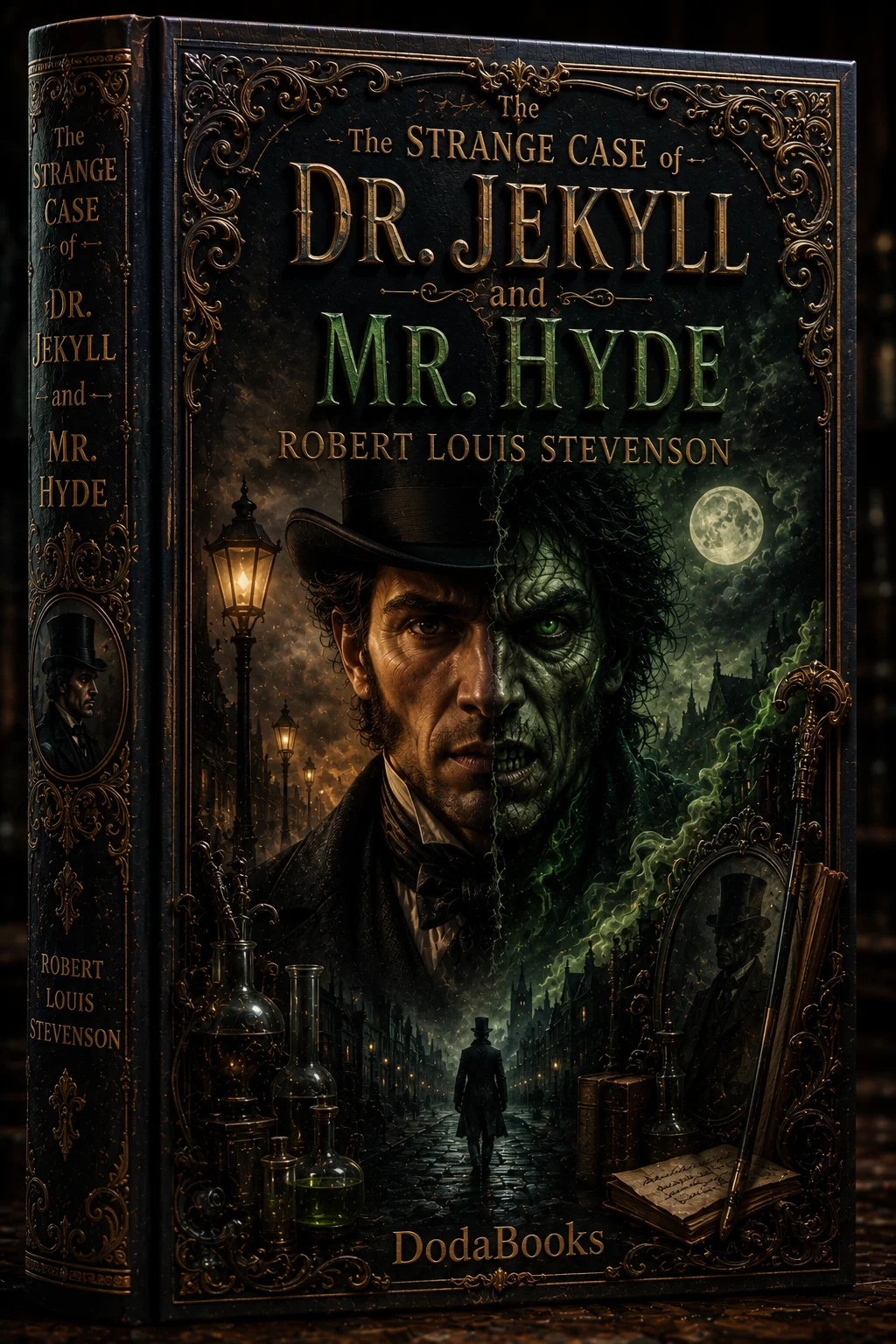
Read Stevenson's Classic Without Missing a Layer
Read The Strange Case of Dr. Jekyll and Mr. Hyde in the definitive DodaBooks Annotated Edition:
- Complete, unabridged 1886 text of all 10 chapters
- Explanatory margin notes decoding Victorian medicine, social class, and legal terms
- Psychological essays exploring Victorian repression and the Gothic double
- Instant digital delivery compatible with Kindle, Apple Books, Kobo, and Android