Jekyll and Hyde Characters: Complete Analysis & Duality Guide
Robert Louis Stevenson’s The Strange Case of Dr. Jekyll and Mr. Hyde (1886) is often remembered simply as a story about a man with a divided personality. Yet, examining the novella’s characters through the lens of late-Victorian society reveals a far deeper psychological tragedy.
Stevenson’s characters do not represent a simplistic fairytale battle between good and evil; they represent the paralyzing hypocrisy and psychological repression of Victorian society. In Stevenson’s London, every gentleman lives in fear of public scandal, burying his authentic human desires beneath a frozen mask of professional respectability. Dr. Jekyll’s creation of Edward Hyde is not an aberration; it is the inevitable explosion of a repressed culture.
Whether you are writing an essay on Victorian literature, preparing for an exam on character foils, or analyzing Stevenson’s psychological themes, this comprehensive guide provides an in-depth breakdown of every major figure and their complex relationships.
⚡ Jekyll and Hyde Character Guide: At a Glance
- The Divided Self: Dr. Henry Jekyll — A wealthy, respected fifty-year-old physician whose obsession with separating his virtuous public persona from his hidden vices leads to catastrophic ruin.
- The Pure Evil: Edward Hyde — Jekyll's atavistic, dwarfish alter ego; pure, unadulterated malice unencumbered by conscience or social restraint.
- The Stoic Detective: Mr. Gabriel John Utterson — Jekyll's loyal lawyer and the primary narrator; an austere, non-judgmental bachelor who personifies Victorian professional honor.
- The Materialist Foil: Dr. Hastie Lanyon — Jekyll's former medical school friend whose rigid rationalism is shattered when he witnesses the supernatural transformation.
- The Loyal Servant: Poole — Jekyll's dedicated butler of twenty years, whose courage to break Victorian domestic decorum ultimately uncovers the truth.
🧪 1. Dr. Henry Jekyll: The Divided Victorian Soul
Dr. Henry Jekyll is the tragic protagonist whose metaphysical ambitions spark the catastrophe. Born to an affluent family and possessing brilliant intellectual gifts, Jekyll enjoys every social privilege: he is an M.D., a D.C.L., an LL.D., and a Fellow of the Royal Society.
The Hypocrisy of Respectability
Jekyll’s fundamental struggle is not that he was born more wicked than other men, but that he was born with an exceptionally intense craving for sensual pleasure combined with an equally intense desire to appear morally upright in the eyes of society:
“The worst of my faults was a certain impatient gaiety of disposition… which I found it hard to reconcile with my imperious desire to carry my head high, and wear a more than commonly grave countenance before the public. Hence it came about that I concealed my pleasures.”
To maintain his austere, philanthropic reputation, Jekyll forced himself into severe hypocrisy, keeping his desires locked away in secrecy. This intense repression fostered a profound philosophical obsession with human duality:
“With every day, and from both sides of my intelligence, the moral and the intellectual, I thus drew steadily nearer to that truth, by whose partial discovery I have been doomed to such a dreadful shipwreck: that man is not truly one, but truly two.”
The Fatal Illusion of Separation
Jekyll concocts his chemical potion not to destroy evil, but to indulge his vices without consequence. He rationalizes that if he can house his dark impulses in an alternate body (Edward Hyde), his respectable self can walk through London with unblemished virtue while Hyde indulges in the shadows.
Jekyll’s fatal mistake is believing he could control the beast: “The moment I choose, I can be rid of him.” In reality, evil is an addictive, expanding power. By giving his repressed desires physical form, Jekyll feeds the monster until Hyde overpowers him entirely, transforming spontaneously without the drug and dragging Jekyll to suicide.
🧌 2. Edward Hyde: The Unadulterated Shadow
Edward Hyde is not merely an angry version of Jekyll; he is pure, concentrated evil. While all other human beings are a composite mixture of good and bad impulses, Hyde is the only soul on earth composed entirely of malice:
“Edward Hyde, alone in the ranks of mankind, was pure evil.”
The Aura of Unnameable Deformity
Every character who encounters Hyde experiences visceral nausea and instinctive horror, yet no one can pinpoint an exact physical deformity:
“He is not easy to describe. There is something wrong with his appearance; something displeasing, something downright detestable. I never saw a man I so disliked, and yet I scarce know why. He must be deformed somewhere; he gives a strong feeling of deformity, although I couldn’t specify the point.”
This unnameable deformity is metaphysical: people recoil from Hyde because they instinctively recognize Satan’s signature upon his face. Hyde radiates pure, concentrated human selfishness stripped of empathy, shame, and remorse.
Atavism and Darwinian Terror
In 1886, British readers were deeply unsettled by Charles Darwin’s theory of evolution, fearing that human beings might regress into primitive, violent primates—a concept known as atavism or biological degeneration.
Stevenson deliberately describes Hyde using animalistic, evolutionary language:
- Hyde moves with “ape-like fury” when bludgeoning Sir Danvers Carew.
- He shrinks back with a “hissing intake of breath” like a serpent.
- Utterson describes him as “troglodytic” (primitive caveman).
- Poole notes that Hyde cries out “like a rat” in the cabinet.
Hyde is smaller, younger, and dwarfish compared to Jekyll because Jekyll’s life had been composed nine-tenths of moral discipline; the animal self had been starved of exercise. But once unleashed, the animal grows rapidly until it devours its creator.
⚖️ 3. Mr. Gabriel John Utterson: The Moral Compass
Mr. Gabriel John Utterson is the beating heart of the novella and the reader’s primary lens through the first eight chapters.
The Professional Stoic
Utterson embodies the supreme virtues of the Victorian professional class: austere, discreet, self-controlled, and reluctant to judge others:
“Mr. Utterson the lawyer was a man of a rugged countenance that was never lighted by a smile; cold, scanty and embarrassed in discourse; backward in sentiment; lean, long, dusty, dreary and yet somehow lovable… He had an approved tolerance for others; wondering almost with envy at the high pressure of spirits involved in their misdeeds; and in any extremity inclined to help rather than to reprove.”
Utterson lives by the creed of Cain: “I incline to Cain’s heresy,” he used to say quaintly: “I let my brother go to the devil in his own quaint way.” Because he never gossips or judges, Utterson is the last good influence in the lives of down-going men.
The Limits of Victorian Rationalism
Utterson’s great limitation is his inability to conceive of the supernatural. When he examines Jekyll’s bizarre will leaving everything to Hyde, Utterson assumes a conventional Victorian explanation: blackmail over a past sexual scandal.
Utterson constantly seeks logical, material explanations for supernatural horrors. When he finally breaks down the cabinet door with an axe in Chapter 8, it represents the violent shattering of Victorian rationalism by the metaphysical reality of the soul.
🩺 4. Dr. Hastie Lanyon: The Orthodox Scientific Foil
Dr. Hastie Lanyon is a healthy, wealthy, prosperous physician living in fashionable Cavendish Square, serving as Jekyll’s primary professional foil:
+-------------------------------------------------------------------------------+
|                    THE SCHISM IN VICTORIAN SCIENCE                            |
+------------------------------------+------------------------------------------+
| DR. HASTIE LANYON (Materialism)    | DR. HENRY JEKYLL (Metaphysics)           |
+------------------------------------+------------------------------------------+
| - Orthodox, rational medicine      | - Transcendental, spiritual chemistry    |
| - Rejects non-physical theories    | - Seeks to separate the human soul       |
| - Calls Jekyll's ideas "balderdash"| - Believes physical science can conquer  |
| - Shattered by the impossible      |   the moral divide                       |
+------------------------------------+------------------------------------------+
When Lanyon witnesses Hyde drink the green potion and swell into Henry Jekyll in Chapter 9, the shock is literally fatal. Lanyon’s entire identity is rooted in the belief that the physical universe is orderly, predictable, and purely material.
Witnessing the supernatural metamorphosis shatters his cognitive framework, proving that Jekyll’s “unscientific balderdash” was true, and he dies of psychological shock weeks later.
🎩 5. Secondary Characters & Victorian Social Codes
| Character | Role & Background | Thematic Function |
|---|---|---|
| Mr. Richard Enfield | Utterson’s distant cousin; fashionable “man about town” who witnesses the trampling of the child. | Embodies the Victorian gentleman’s unspoken code of discretion: “I make it a rule of mine: the more it looks like Queer Street, the less I ask.” Avoids questions to preserve public reputations. |
| Poole | Dr. Jekyll’s faithful butler of twenty years. | Represents the working-class domestic loyalty; his decision to summon Utterson breaks Victorian domestic decorum to save his master. |
| Sir Danvers Carew | Distinguished, silver-haired Member of Parliament clubbed to death by Hyde. | Symbolizes the vulnerability of innocent, civilized Victorian society when confronted by unchecked primal barbarism. |
| Mr. Guest | Utterson’s chief clerk and handwriting analyst. | Represents forensic observation; discovers that Jekyll and Hyde share identical handwriting with opposing slopes, hinting at their shared identity. |
📊 Character Foils and Dynamics Matrix
| Foil Pairing | Core Contrast | Thematic Revelation |
|---|---|---|
| Dr. Jekyll vs. Mr. Hyde | Respectable, cultured philanthropist vs. Brutal, atavistic predator. | The fundamental duality of human nature; civilization is merely a fragile veneer over primal animal instincts. |
| Dr. Jekyll vs. Dr. Lanyon | Metaphysical, daring mystic vs. Rigid, dogmatic materialist. | Both forms of pride are dangerous: Jekyll’s hubris destroys his life, while Lanyon’s dogmatism destroys his sanity. |
| Mr. Utterson vs. Mr. Enfield | Disciplined, inquisitive lawyer who actively investigates vs. Casual dandy who deliberately ignores suspicious secrets. | The Victorian conflict between the moral duty to uncover truth and the social desire to preserve polite appearances. |
| Poole vs. The House Servants | Resolute, proactive servant who takes action vs. Terrified domestic staff huddled around the kitchen fire. | Class solidarity and courage in the face of supernatural terror. |
Decode the psychological depths of Stevenson's characters. The DodaBooks Annotated Edition includes comprehensive profiles, Victorian psychiatric context, and historical margin notes.
Get the Annotated Edition at DodaBooks❓ Frequently Asked Questions
Why does Mr. Hyde commit suicide at the end of the novella?
Hyde commits suicide out of desperate terror and self-preservation. With Utterson and Poole smashing down the cabinet door with an axe, Hyde knew that capture by the police was imminent. If arrested, he would face the public shame of the gallows for the murder of Sir Danvers Carew. By swallowing cyanide moments before the door fell, Hyde escaped mortal execution.
Are Dr. Jekyll and Mr. Hyde two completely different people?
No. They share the same soul and memory. Edward Hyde is Henry Jekyll stripped of moral conscience, fear of social ruin, and societal restraint. When Jekyll transforms into Hyde, he remembers everything Jekyll did; when Hyde indulges in cruelty, Jekyll remembers the pleasure and feels the subsequent guilt.
Why does Stevenson describe Mr. Utterson as loving down-going men?
In Victorian society, anyone caught in a financial, moral, or criminal scandal was instantly ostracized. Utterson is unique because he is completely non-judgmental: he never lectures, condemns, or cuts off friends who fall into disgrace. This makes him the ideal confidant and lawyer to navigate Jekyll's nightmare.
What does the maidservant witness in Chapter 4 during the murder?
The maidservant witnesses Sir Danvers Carew politely asking Mr. Hyde for directions in the street under the moonlight. Without any warning, Hyde brandishes his heavy cane, flies into an "ape-like fury," clubs Carew to the ground, and tramples his body until his bones shatter. The murder demonstrates that Hyde kills purely for the sadistic joy of violence.
Why does Dr. Jekyll's handwriting look identical to Mr. Hyde's?
In Chapter 5, graphologist Mr. Guest discovers that Jekyll and Hyde’s handwriting are virtually identical, differing only in the slant (slope) of the letters. This is Stevenson’s subtle clue that the two men share the same hand, brain, and physical nervous system, with Hyde being the psychological inversion of Jekyll.
📚 Related Reading Guides
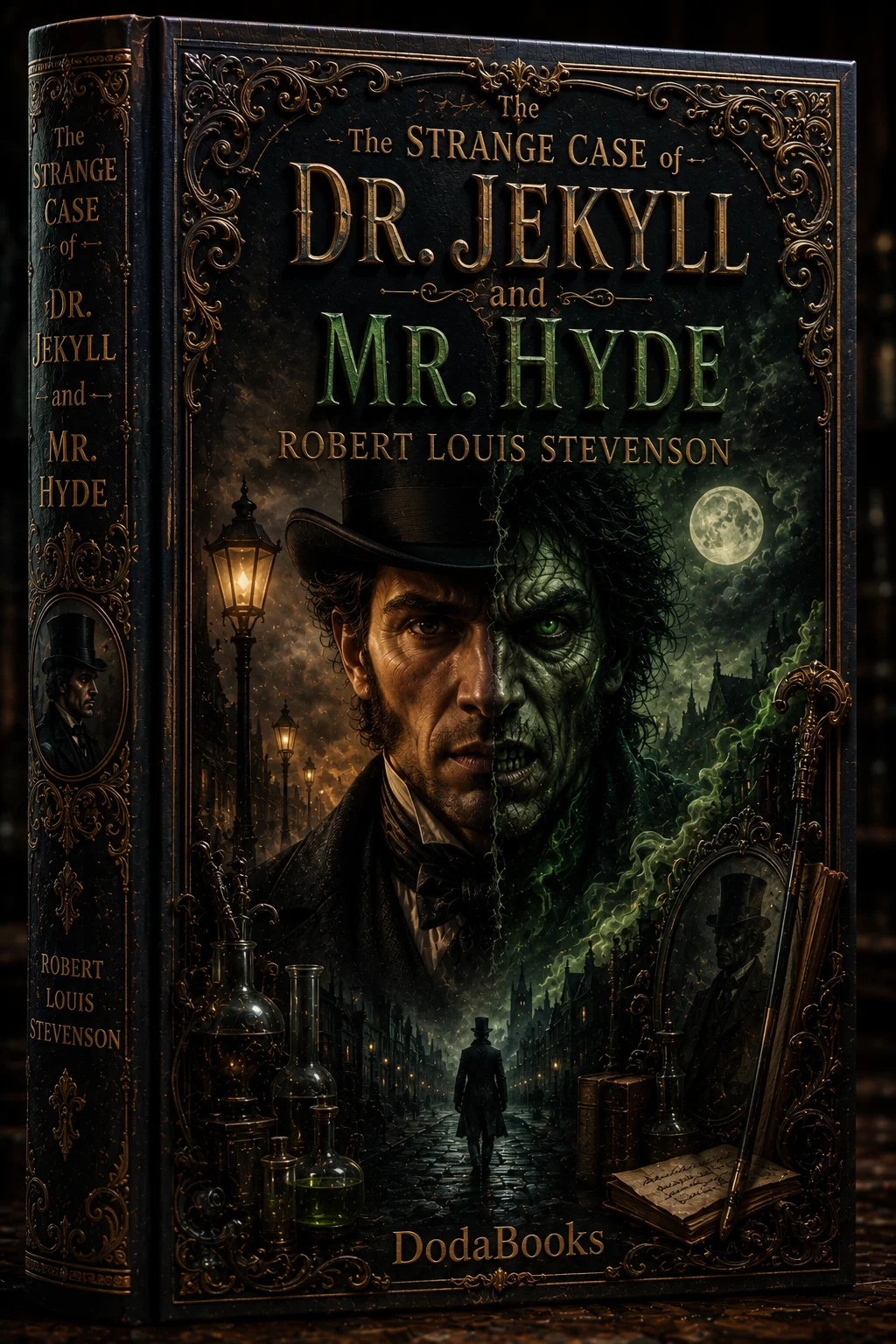
Master the Depths of Stevenson's Characters
Read The Strange Case of Dr. Jekyll and Mr. Hyde with expert character profiles and Victorian context alongside the text:
- Complete, authoritative 1886 text of all 10 chapters
- Explanatory notes detailing Victorian psychology, Darwinian anxiety, and medicine
- Full breakdown of the Jekyll and Hyde duality matrix
- Instant digital delivery compatible with Kindle, Apple Books, Kobo, and Android