Jane Eyre Chapter Summary: Complete 38-Chapter Plot Breakdown
Published in October 1847 under the androgynous pseudonym “Currer Bell,” Charlotte Brontë’s Jane Eyre shocked and electrified Victorian England. At a time when women in literature were expected to be decorative, submissive, or quietly suffering, Brontë introduced a plain, impoverished orphan who asserted her moral and spiritual equality with fiery conviction:
“Do you think, because I am poor, obscure, plain, and little, I am soulless and heartless? You think wrong!—I have as much soul as you,—and full as much heart!… I am no bird; and no net ensnares me; I am a free human being with an independent will.”
Jane Eyre is structured as an autobiographical Bildungsroman (novel of moral and psychological growth) tracing Jane’s journey across five distinct geographical locations: Gateshead Hall, Lowood School, Thornfield Hall, Moor House, and Ferndean. Each setting tests Jane against a different form of tyranny—class cruelty, religious fanaticism, unlawful passion, and cold asceticism—until she achieves absolute independence and true love.
Whether you are preparing a paper for class, studying Victorian social history, or reading Brontë’s masterpiece for the first time, this complete chapter-by-chapter summary covers all 38 chapters in exhaustive detail.
⚡ Jane Eyre at a Glance
- Author: Charlotte Brontë (published under the pen name "Currer Bell" in 1847)
- Structure: 38 chapters tracing 5 distinct physical and emotional stages of Jane's life
- Setting: Gateshead Hall (Childhood oppression), Lowood School (Institutional deprivation), Thornfield Hall (Gothic romance & passion), Moor House (Spiritual trial & family), Ferndean (Mature reconciliation)
- Core Themes: Autonomy vs. submission, passion vs. moral duty, Victorian class hypocrisy, gender equality, religious fanaticism vs. authentic spiritual faith
- The Turning Point: Chapter 26, when Jane’s wedding to Edward Rochester is violently interrupted by the revelation that his mad wife, Bertha Mason, is locked in the attic
🏛️ Stage 1: Gateshead Hall (Chapters 1–4)
Chapter 1: The Window Seat and John Reed’s Abuse
The novel opens with ten-year-old Jane Eyre living as an unwelcome, impoverished orphan in the wealthy household of her maternal aunt by marriage, Mrs. Sarah Reed, at Gateshead Hall. Excluded from joining her cousins—John, Eliza, and Georgiana—around the drawing room hearth, Jane curls up in a window seat behind scarlet damask curtains, reading Bewick’s History of British Birds.
Fourteen-year-old John Reed discovers her. A cruel, gluttonous bully, John hurls insults, strikes Jane, and violently throws the heavy book at her head, cutting her scalp. Pushed beyond endurance, Jane flies into a furious physical defense. Mrs. Reed and the servants rush in, blaming Jane entirely and ordering her locked in the dreaded “Red-Room.”
Chapter 2: The Terror of the Red-Room
The Red-Room is a cold, rarely used state bedchamber where Jane’s benevolent uncle, Mr. Reed, died nine years earlier. As darkness falls, Jane gazes into the shadowy mirror and reflects upon the cruel injustice of her existence: despised by the Reeds simply because she is poor, plain, and passionately honest.
Suddenly, Jane sees an eerie shaft of light moving across the ceiling. Believing it to be a ghost or the restless spirit of Uncle Reed returning to avenge her abuse, Jane screams in abject terror, beating desperately against the heavy door. Mrs. Reed unlocks the door, but coldly scorns Jane’s terror, thrusting her back inside and locking the door. Overcome by convulsive panic, Jane faints.
Chapter 3: Apothecary Mr. Lloyd and the Prospect of School
Jane awakens in her own nursery bed, cared for by the sympathetic apothecary, Mr. Lloyd, and the gentle servant Bessie Lee. Mr. Lloyd treats Jane with genuine professional kindness. Recognizing that the child’s illness stems from severe domestic unhappiness, Lloyd gently suggests to Jane that she might be happier attending a boarding school. Jane eagerly seizes upon the idea as an escape from Gateshead.
Chapter 4: Confrontation with Brocklehurst and Defiance of Mrs. Reed
Months later, Mr. Brocklehurst, the grim, hypocritical clergyman who directs the Lowood School for orphan girls, arrives at Gateshead. A severe Calvinist who dresses his own daughters in silk while forcing charity girls into coarse frieze, Brocklehurst questions Jane on religion and declares that deceitful children will burn in hellfire. Mrs. Reed spitefully warns Brocklehurst that Jane is a habitual liar.
After Brocklehurst departs, Jane experiences an eruption of righteous volcanic fury. Turning on her aunt, Jane delivers a scorching verbal rebuke:
“I am not deceitful: if I were, I should say I loved you; but I declare I do not love you: I dislike you the worst of anybody in the world… People think you are a good woman, but you are bad, hard-hearted, deceitful… How dare you affirm that I was a liar? You told a dreadful story!”
Mrs. Reed is stunned and cowed by the child’s ferocious truth. Jane feels a fleeting sense of triumphant liberation, followed quickly by the bitter taste of emotional exhaustion.
❄️ Stage 2: Lowood School (Chapters 5–10)
Chapter 5: Arrival at Lowood Institution
Jane departs Gateshead alone before dawn on a fifty-mile coach ride through freezing rain, arriving at Lowood School. The institution houses eighty impoverished orphan girls dressed in drab brown frocks and coarse linen. Jane discovers the brutal conditions of the school: freezing dormitories with cracked water pitchers, burnt porridge, inedible boiled meat, and relentless religious lectures.
Chapter 6: Friendship with Helen Burns
Jane forms a life-changing friendship with fourteen-year-old Helen Burns, an intellectually brilliant student who reads Samuel Johnson’s Rasselas. When Helen is brutally whipped with a bundle of birch twigs by the cruel teacher Miss Scatcherd for having untidy fingernails, Helen endures the agony without shedding a tear.
Jane is baffled by Helen’s passive submission, urging that one should strike back against bullies. Helen gently articulates her philosophy of Christian forbearance and universal forgiveness derived from the New Testament:
“Love your enemies; bless them that curse you; do good to them that hate you and despitefully use you… Life appears to me too short to be spent in nursing animosity or registering wrongs.”
Chapter 7: Brocklehurst’s Humiliation of Jane
Winter brings bitter suffering: the girls’ hands and feet are covered with agonizing chilblains, and water freezes solid in their wash basins. Mr. Brocklehurst visits the school, scolding the teachers for feeding the starving girls and commanding that a student with naturally curly red hair have her locks shorn to mortify the flesh.
Spotting Jane, who accidentally drops her writing slate, Brocklehurst makes her stand upon a high stool in the middle of the schoolroom. In front of all the teachers and students, he publicly denounces Jane as an outcast and an emissary of the devil, commanding everyone to shun her as a wicked liar. Jane is crushed by shame, but Helen Burns catches her eye and smiles, infusing Jane with heroic spiritual strength.
Chapter 8: Exoneration by Miss Temple
When classes dismiss, Jane collapses weeping onto the floor. Helen comforts her, and the gentle, noble headmistress, Miss Maria Temple, invites both girls to her private parlor. Miss Temple treats them with motherly warmth, serving them hot tea and seed-cake.
Miss Temple writes to Mr. Lloyd to verify Jane’s character. When Lloyd confirms that Jane is a truthful, honorable child, Miss Temple gathers the entire school and publicly clears Jane of Brocklehurst’s slanderous accusations. Relieved of disgrace, Jane throws herself into her studies, mastering French and watercolor drawing.
Chapter 9: The Typhus Epidemic and Helen’s Death
With the arrival of spring, melting snow reveals the natural beauty of the surrounding woods. However, the semi-starvation and damp conditions at Lowood trigger a catastrophic epidemic of typhus fever. More than half the students fall sick, and several die each week.
Helen Burns, however, is dying not of typhus, but of consumption (tuberculosis). Late one night, knowing Helen is near the end, Jane slips into Miss Temple’s room and crawls into Helen’s bed. Helen embraces Jane, reassuring her that she is going home to God:
“I am sure there is a future state; I believe God is good; I can resign my life without a pang to Him. I am very happy, Jane; and when you hear that I am dead, you must not be grieved: there is no crying there.”
The two girls fall asleep in each other’s arms. When Jane awakens in the morning, Helen is dead, her small face peaceful. She is buried in a quiet churchyard with a gray marble stone bearing the single Latin word: Resurgam (“I shall rise again”).
Chapter 10: Eight Years Later and Departure from Lowood
The typhus scandal exposes Brocklehurst’s cruel negligence. Wealthy local philanthropists rebuild Lowood into a healthy, reputable school, stripping Brocklehurst of his tyrannical power.
Jane spends eight years at Lowood—six as a student and two as a beloved teacher. However, when Miss Temple marries a clergyman and leaves the school, Jane’s craving for freedom reignites:
“I desired liberty; for liberty I gasped; for liberty I uttered a prayer… Then, grant me at least a new servitude!”
Jane places an advertisement in the Herald offering her services as a private governess. She receives a single reply from a Mrs. Fairfax, offering £30 a year to teach a ten-year-old girl at Thornfield Hall near Millcote. Before departing, Bessie Lee visits Jane, expressing pride in Jane’s refined manners and revealing that a mysterious relative—John Eyre, a merchant from Madeira—had visited Gateshead searching for Jane seven years earlier.
🏰 Stage 3: Thornfield Hall (Chapters 11–26)
Chapter 11: Arrival at Thornfield
Jane arrives at Thornfield Hall, an imposing, ancient stone manor surrounded by gloomy battlements and ancient rook trees. She is warmly greeted by Mrs. Alice Fairfax, an elderly, kind widow whom Jane assumes is the owner of the estate.
Mrs. Fairfax quickly clarifies that she is merely the housekeeper; the estate belongs to the wealthy, eccentric, and frequently traveling master, Mr. Edward Fairfax Rochester. Jane meets her pupil, Adèle Varens, a vivacious French girl whose deceased mother was a Parisian opera dancer.
Touring the upper floors of the mansion, Mrs. Fairfax leads Jane to the deserted, shadowy third story, lined with antique furniture. Suddenly, a sound chills Jane’s blood: a low, mirthless, mocking laugh echoing through the empty corridor. Mrs. Fairfax casually attributes the laughter to Grace Poole, a middle-aged, eccentric seamstress who works in seclusion on the top floor.
Chapter 12: The Meeting on the Mist-Covered Road
In January, during a quiet twilight walk to post a letter in the village of Hay, Jane sits on a stile. The stillness is broken by the clatter of a horse approaching through the freezing mist. A great black-and-white Newfoundland dog, Pilot, bounds past.
Suddenly, the horse slips on a sheet of ice, crashing onto the roadway and pinning its rider beneath its flank. Jane steps forward to offer assistance. The rider is a broad-chested, dark-featured gentleman of thirty-five with a harsh, brooding, imperious countenance:
“He had a dark face, with stern features and a heavy brow; his eyes and gathered eyebrows looked ireful and annoyed just now… I knew the glance and the frown; and I loved them.”
The stranger leans heavily upon Jane’s shoulder to remount his horse and gallops off without thanking her. Returning to Thornfield, Jane discovers that the fallen traveler was none other than her employer, Mr. Rochester.
Chapter 13: Evening Conversation at Thornfield
The following evening, Mr. Rochester summons Jane and Adèle to the drawing room. Moody, blunt, and abrupt, Rochester examines Jane’s watercolor paintings, marveling at their wild, visionary Romantic power (paintings of drowned corpses, arctic icebergs, and ethereal phantoms). Rochester treats Jane not as a hired domestic servant, but as an intellectual equal, engaging in sharp, stimulating philosophical banter.
Chapter 14: Conversations on Sin and Experience
As weeks pass, Rochester frequently summons Jane for fireside conversations. Confessing that his past has been stained by debauchery, mistresses, and cynical bitterness, Rochester claims he is seeking moral regeneration. When Rochester asks Jane if she thinks him handsome, Jane bluntly answers: “No, sir.” Rochester delights in her honesty, contrasting her purity and unvarnished truth with the shallow flatterers of high society.
Chapter 15: The Bedcurtain Fire
Late one night, Rochester confides the truth of Adèle’s heritage: Adèle is the daughter of his former Parisian mistress, Céline Varens. When Céline proved unfaithful, Rochester abandoned her, but took pity on the innocent child, bringing her to England to be raised.
Unable to sleep, Jane hears stealthy footsteps outside her room, followed by the same demonic, low laugh she heard on the third floor. Stepping into the dark corridor, she smells smoke: billowing from Rochester’s open bedroom door are heavy fumes. Rushing in, Jane finds the bedcurtains ablaze and Rochester lying unconscious, on the verge of suffocating in the flames.
Jane furiously douses the flames with water pitchers and shakes Rochester awake. Shaken, Rochester ascends to the third floor, returns pale and agitated, and commands Jane to keep the incident an absolute secret, attributing the fire to Grace Poole’s drunken carelessness. Rochester grasps Jane’s hands with intense, trembling passion, reluctant to let her leave his sight.
Chapter 16: The Enigma of Grace Poole
The next morning, Jane is stunned to find Grace Poole calmly mending the burned curtains in Rochester’s room, showing no signs of guilt or arrest. Jane wonders why Rochester tolerates an attempted murderer in his house.
Furthermore, Jane learns that Rochester has abruptly departed for a fortnight to attend a lavish house party at the Leas, where he will court the celebrated high-society beauty, Miss Blanche Ingram. Realizing that she has fallen deeply in love with Rochester, Jane sternly reprimands her own vanity, drawing a plain chalk self-portrait labeled “An Orphan Governess” and an idealized ivory miniature of the dazzling Blanche Ingram to remind herself of the unbridgeable class chasm between them.
Chapter 17: The High-Society House Party
Rochester returns to Thornfield with an aristocratic entourage of elegant lords and ladies, including Blanche Ingram. Jane is forced to sit quietly in the drawing room each evening with Adèle. Jane observes Blanche Ingram: she is tall, dazzlingly beautiful, and accomplished, but cold, spiteful, and shallow, openly mocking governesses within Jane’s hearing. Jane realizes with bittersweet clarity that while Blanche desires Rochester’s wealth and title, she does not understand his soul:
“I saw he was going to marry her, for family, perhaps on political grounds; because her rank and connections suited his; I felt he had not given her his love, and that her nature was not of a sort to be an acceptable offering to his.”
Chapter 18: The Charades and the Fortune-Teller
The house guests stage elaborate parlor charades, acting out scenes of Rebecca at the well and a mock marriage between Rochester and Blanche.
While Rochester is away on business, an old, wrinkled Romani fortune-teller arrives at the house, insisting on reading the palms of all the unmarried ladies. After Blanche leaves the library looking sullen and disappointed, the gipsy demands to see the young governess.
Chapter 19: The Gipsy Unmasked
Jane enters the library. The fortune-teller questions Jane closely about her feelings for Rochester, noting that Jane is close to happiness but holds herself back out of fear. Looking into the gipsy’s piercing dark eyes, Jane suddenly notices a ring and recognizes the voice: the gipsy is Mr. Rochester in disguise!
As Rochester laughs at his successful deception, news arrives that an unexpected guest has arrived from Spanish Town, Jamaica: Mr. Richard Mason. Rochester turns pale as death, whispering in shock: “Mason!—the West Indies!… I wish I were on a quiet island with you alone, Jane, and trouble, and danger, and hideous recollections banished from our thoughts.”
Chapter 20: The Midnight Attack on Mason
In the dead of night, a blood-curdling human shriek rings out from the third floor, accompanied by the sounds of violent struggle. The house guests rush into the corridors in terror, but Rochester calms them, claiming a nervous servant had a nightmare.
Once the guests return to bed, Rochester summons Jane to the third floor. Inside a secret inner chamber behind a tapestry, they find Richard Mason sitting in a chair, bleeding profusely from savage bites and deep stab wounds on his arm and shoulder. Rochester commands Jane to sponge Mason’s wounds while he retrieves a surgeon, warning them under penalty of death not to exchange a single word.
While Rochester is away, the snarling, dog-like snarl of an unseen human beast echoes from behind the adjoining locked door. A surgeon, Dr. Carter, dresses Mason’s wounds, and Rochester smuggles Mason into a waiting carriage at dawn before the guests awaken.
Chapter 21: Return to Gateshead and Mrs. Reed’s Confession
Jane receives an urgent letter: her cousin John Reed has committed suicide in London after squandering his fortune on gambling, and Mrs. Reed has suffered an apoplectic stroke. Respecting her dying aunt’s summons, Jane returns to Gateshead.
On her deathbed, Mrs. Reed breaks her silence and gives Jane a letter received three years earlier from Jane’s wealthy uncle, John Eyre of Madeira. The uncle had written offering to adopt Jane and make her his sole heir. Consumed by vindictive hatred, Mrs. Reed had written back falsely claiming that Jane had died of typhus at Lowood. Jane forgives her aunt, but Mrs. Reed dies unrepentant.
Chapter 22: The Return to Thornfield
Returning to Thornfield, Jane is welcomed by Rochester with radiant warmth. The high-society guests have departed, and rumors indicate that the marriage to Blanche Ingram has been called off. Jane is overjoyed to be home, confessing that wherever Rochester is, there is her true home.
Chapter 23: The Proposal Under the Chestnut Tree
On a warm midsummer eve, Jane encounters Rochester in the fragrant orchard under a giant horse-chestnut tree. Rochester torments Jane by claiming that his marriage to Blanche is imminent and that he has secured a governess position for Jane in Ireland.
Overcome by grief at the thought of being separated from him across the Irish Sea, Jane unleashes the most famous declaration of passion in English literature:
“I tell you I must go!” I retorted, roused to something like passion. “Do you think I can stay to become nothing to you? Do you think I am an automaton?—a machine without feelings?… Do you think, because I am poor, obscure, plain, and little, I am soulless and heartless? You think wrong!… It is my spirit that addresses your spirit; just as if both had passed through the grave, and we stood at God’s feet, equal,—as we are!”
Rochester embraces her with overwhelming joy, declaring that he never intended to marry Blanche Ingram; he only used her to awaken Jane’s jealousy. Rochester passionately proposes marriage, and Jane accepts.
That night, a violent thunderstorm erupts, and a bolt of lightning strikes the horse-chestnut tree, splitting it cleanly in two—an ominous harbinger of the catastrophe to come.
Chapter 24: Uneasy Courtship
During their month of engagement, Rochester showers Jane with expensive jewels, dresses, and carriage luxuries, which Jane firmly resists, refusing to be dressed like an ornamental harem doll. She insists on remaining Adèle’s paid governess until the wedding day, maintaining her financial self-respect.
Chapter 25: The Tearing of the Veil
Two nights before the wedding, Jane is terrified by a midnight visitation while Rochester is away. She wakes to find a tall, menacing woman with wild, disheveled dark hair and a bloated, purple, savage face rummaging through her closet.
The woman takes Jane’s expensive bridal veil, tears it in half, tramples it underfoot, and holds a candle over the paralyzed Jane before vanishing.
When Jane recounts the nightmare to Rochester, he turns white, attempting to comfort her by claiming it was a waking hallucination of Grace Poole.
Chapter 26: The Aborted Wedding and the Madwoman in the Attic
On a misty morning, Jane and Rochester stand at the altar of the quiet village church. Just as the clergyman asks if anyone knows any impediment to the marriage, a voice rings out from the back of the church:
“The marriage cannot go on: I declare the existence of an impediment.”
The speaker is London lawyer Mr. Briggs, accompanied by Richard Mason. Briggs produces a legal certificate proving that Edward Fairfax Rochester married Bertha Antoinetta Mason fifteen years ago in Spanish Town, Jamaica, and that she is still alive!
Cornered, Rochester confesses with defiant fury. He leads the clergyman, lawyer, and Jane back to Thornfield, ascending to the secret third-story room behind the bookcase.
Inside, they witness the horrific reality: a savage, four-legged figure pacing in the shadows like an untamed beast:
“In the deep shade, at the farther end of the room, a figure ran backwards and forwards on all fours; it grovelled and growled like some strange wild animal: but it was covered with clothing, and a quantity of dark, grizzled hair, wild as a mane, hid its head and face.”
Bertha Mason lunges at Rochester, attempting to bite his throat. Rochester overpowers her without hurting her, binding her to a chair with ropes. Turning to the horrified onlookers, Rochester contrasts this snarling, maniacal demon with the small, pale, pure form of Jane Eyre: “That is my wife… And this is what I wished to have.”
🌾 Stage 4: Moor House / Marsh End (Chapters 27–35)
Chapter 27: Temptation, Moral Crisis, and Flight
Locked in her room, Jane experiences an agonizing spiritual crisis. Rochester visits her, revealing the full, tragic history of his youth:
- His greedy father and brother had arranged the marriage in Jamaica to secure Bertha’s £30,000 fortune, concealing the fact that her mother was a lunatic in an asylum.
- Soon after the wedding, Bertha’s vices, violent madness, and nymphomania emerged.
- Barred by English law from securing a divorce, Rochester brought her to Thornfield, housed her in comfort under Grace Poole’s care, and sought escape across Europe in mistresses.
Rochester begs Jane to flee with him to a secluded villa in the South of France, living as husband and wife in all but legal name.
The temptation is overwhelming: Jane loves him with every fiber of her soul, and she has no family or friends to be hurt by her scandal. Yet, Jane realizes that becoming his mistress would destroy her self-respect and violate divine law:
“Laws and principles are not for the times when there is no temptation: they are for such moments as this, when body and soul rise in mutiny against their rigour… If at my individual convenience I might break them, what would be their worth? Preconceived opinions, foregone determinations, are all I have at this hour to stand by; there I plant my foot.”
In the middle of the night, while Rochester sleeps, Jane slips out of Thornfield with only twenty shillings in her purse, boards a passing coach, and flees into the unknown.
Chapter 28: Starvation on the Moors
The coachman leaves Jane at a remote crossroads in northern England called Whitcross. For three days, Jane wanders the desolate moors without money or food, sleeping in the heather, begging for pig porridge from peasant cottages, and suffering the agonizing degradation of slow starvation.
On a rainy, pitch-black night, guided by a faint light across the bogs, she arrives at Moor House (Marsh End). Peering through the kitchen window, she sees two gentle young women studying German.
Jane knocks and begs for bread. The stern servant Hannah suspects her of being a beggar and turns her away into the freezing rain. Collapsing on the doorstep on the verge of death, Jane whispers: “I can do no more: I must die.”
A voice answers from the dark: “All men must die, but all are not condemned to die on our doorstep.” The house’s master, St. John Rivers, arrives and carries her inside.
Chapter 29: Sanctuary with the Rivers Family
Jane is nursed back to health by the three Rivers siblings: St. John (a stern, handsome, ascetic clergyman of twenty-nine), and his warm, cultivated sisters, Diana and Mary. Jane gives her name as “Jane Elliott” to conceal her past.
Chapter 30: The Morton Village School
As Jane recovers, a deep kinship forms between her, Diana, and Mary. St. John, an intensely ambitious evangelical minister preparing to leave for missionary work in India, secures Jane a position as the schoolmistress of a newly opened rural girls’ charity school in the village of Morton. Jane moves into a humble stone cottage, deriving pride from her self-sufficiency and the affectionate respect of her peasant students.
Chapter 31: St. John’s Secret Passion
St. John visits Jane’s cottage. A dazzling local heiress, Rosamond Oliver, arrives; St. John is desperately in love with her, but deliberately crushes his romantic desires underfoot, believing that an earthly marriage would compromise his heavenly calling as an apostle in India.
Chapter 32: The Portrait and the Signature
While examining Jane’s watercolors, St. John spots a signature on the paper wrapper: “Jane Eyre.” He tears off the edge and leaves without explanation.
Chapter 33: The Fortune and the Family Revelation
The next day, during a blizzard, St. John returns to Jane’s cottage and reveals an astonishing story:
- His maternal uncle, John Eyre of Madeira, has died, leaving an immense fortune of £20,000.
- The search for the missing heiress led lawyer Mr. Briggs to St. John’s rectory.
- John Eyre was also the uncle of St. John, Diana, and Mary—meaning Jane, Diana, Mary, and St. John are first cousins!
Jane is overwhelmed with joy, not by the wealth, but by discovering that she has loving family of her own blood. In an act of radical generosity, Jane insists on dividing the £20,000 equally among the four cousins, giving each £5,000, enabling Diana and Mary to give up their despised governess jobs and return home.
Chapter 34: St. John’s Proposal of Marriage
Jane spends a blissful winter restoring Moor House for her cousins. However, St. John’s religious intensity begins to suffocate her. Recognizing Jane’s tireless work ethic and resilience, St. John demands that she marry him and accompany him to India as his missionary wife:
“God and nature intended you for a missionary’s wife… you are formed for labour, not for love. A missionary’s wife you must—shall be. You shall be mine: I claim you—not for my pleasure, but for my Sovereign’s service.”
Jane agrees to go to India as his sister and fellow worker, but refuses to marry him: she does not love him, and his cold, unyielding asceticism would freeze her spirit and kill her heart. St. John treats her refusal with icy, relentless clerical disapproval.
Chapter 35: The Telepathic Call Across the Night
On their final evening, St. John reads from the Book of Revelation, praying over Jane with such hypnotic spiritual power that her resolve begins to waver. She is on the verge of surrendering her life to his will when the room falls utterly silent.
Suddenly, an electrifying sensation runs through her veins. A voice—wild, familiar, and thrilling—cries out in the darkness:
“Jane! Jane! Jane!”
The voice is the unmistakable voice of Edward Rochester! Jane cries out: “I am coming! I am coming! Oh, I will come!” Breaking free from St. John’s hypnotic grip, Jane falls to her knees in prayer, resolving to return to Thornfield immediately.
🌲 Stage 5: Ferndean and Resolution (Chapters 36–38)
Chapter 36: The Ruin of Thornfield Hall
Jane boards the northern coach and rushes to Thornfield. Arriving at the gates, she is paralyzed by a horrifying sight: Thornfield Hall is a blackened, roofless, charred ruin!
At the local Rochester Arms inn, the landlord recounts the disaster:
- Two months after Jane’s flight, Bertha Mason escaped Grace Poole’s watch, set fire to Jane’s former bedchamber, and ignited the roof.
- Rochester heroically braved the flames to rescue the servants, ascending to the blazing battlements where Bertha stood laughing maniacally. As Rochester approached, Bertha leaped from the roof to her death, her head smashed on the stones below.
- As Rochester attempted to escape down the collapsing staircase, the burning timber collapsed upon him. He survived, but lost one eye, had the other blinded, and had his left hand amputated at the wrist. He now lives in complete, isolated seclusion at Ferndean, a desolate country manor deep in the woods.
Chapter 37: The Reunion at Ferndean
Jane travels through the dense, gloomy forest to Ferndean. Approaching the manor, she sees Rochester emerge onto the path: sightless, scarred, with his hair grown long and wild like a wounded lion.
Entering the parlor, Jane carries a glass of water to him. Recognizing her voice, Rochester touches her hands, face, and hair with trembling, incredulous ecstasy:
“Is it Jane? What, a dream? … Her very size! and her slender, little fingers! … Jane! you are come back to me, then?”
Jane declares her love, revealing that she is now a wealthy, independent woman who will never leave his side. Rochester confesses that on Monday night at midnight (the exact moment Jane heard the call at Moor House), in a moment of desperate prayer, he had cried out three times: “Jane! Jane! Jane!”
Rochester humbles himself before God, thanking Providence for sparing him and restoring his beloved.
Chapter 38: “Reader, I married him.”
The novel concludes with Jane’s famous direct address to the audience:
“Reader, I married him. A quiet wedding we had: he and I, the parson and clerk, were alone present.”
Jane reflects upon ten years of blissful marriage. Living in perfect spiritual, intellectual, and emotional equality, they share every thought and joy. Gradually, Rochester regains sight in one eye, allowing him to see his firstborn son, who has inherited his own large, brilliant dark eyes.
Jane reports that Diana and Mary are happily married, Adèle has grown into a sensible, sweet Englishwoman, and St. John Rivers remains in India, unmarried and tirelessly laboring for his divine calling, writing his final letter as he awaits the approach of death with peaceful certainty: “Amen; even so come, Lord Jesus!”
Experience Charlotte Brontë's revolutionary prose with total clarity. The DodaBooks Annotated Edition includes translations for all French dialogue, historical context on Cowan Bridge School, and biblical glossaries.
Get the Annotated Edition at DodaBooks📊 Jane’s Five Life Stages: Character Development Matrix
| Life Stage & Location | Age | The Core Conflict & Oppressor | Moral & Spiritual Victory |
|---|---|---|---|
| 1. Gateshead Hall | 10 | Class cruelty & physical abuse by John and Mrs. Reed; terror in the Red-Room. | Discovers her capacity for righteous anger; refuses to accept false labels of inferiority. |
| 2. Lowood School | 10–18 | Hypocritical Calvinist asceticism and physical starvation under Brocklehurst. | Learns Christian forbearance from Helen Burns; gains education and intellectual mastery from Miss Temple. |
| 3. Thornfield Hall | 18–19 | Passion vs. Moral Duty; temptation to become Rochester’s illegal mistress. | Refuses to sacrifice her integrity and self-respect; flees into destitution to preserve her soul. |
| 4. Moor House | 19–20 | Cold religious tyranny; St. John demands marriage without love for missionary service. | Balances spiritual duty with emotional truth; rejects loveless marriage; discovers family and wealth. |
| 5. Ferndean | 20+ | Physical vulnerability & sightless seclusion; rebuilding an equal life with Rochester. | True companionate marriage based on mutual independence, shared equality, and mature love. |
❓ Frequently Asked Questions
Why is Bertha Mason locked in the attic instead of an asylum?
In 1840s England, Victorian lunatic asylums were notorious for horrific physical abuse, squalor, and cruelty. Rochester refused to subject his legal wife to such torture, keeping her in comfort at Thornfield under the dedicated care of a private nurse (Grace Poole) while hiding her to avoid social scandal and shame.
Is Lowood School based on a real institution?
Yes. Lowood School was modeled directly on the Clergy Daughters' School at Cowan Bridge, which Charlotte Brontë and her sisters attended in 1824–1825. Just like in the novel, the school suffered from inedible food, freezing cold, and a catastrophic outbreak of illness. Charlotte's two beloved elder sisters, Maria and Elizabeth, contracted tuberculosis at the school and died young; Charlotte immortalized Maria as the saintly Helen Burns.
Why does Jane refuse to become Rochester's mistress in Chapter 27?
Jane loves Rochester deeply, but recognizes that becoming his mistress would violate God's moral law and destroy her self-respect. Jane knew that if she compromised her principles for comfort, she would become merely another kept woman like Céline Varens, dependent on Rochester's whims rather than an autonomous, equal human being.
Why is St. John Rivers an important foil to Mr. Rochester?
Rochester and St. John represent the dual extremes of the human spirit: Rochester represents Passion without Law (willing to commit bigamy to satisfy his emotional desire), while St. John represents Law without Passion (demanding marriage without love strictly for religious duty). Jane rejects both extremes, ultimately choosing a mature partnership that unites passion, morality, and equality.
What is the significance of Rochester's physical injuries at Ferndean?
Rochester’s blindness and the loss of his hand symbolize physical and spiritual purification. When Jane first met him, Rochester was arrogant, powerful, and deceitful. Losing his physical sight forces him to develop spiritual humility and depend on God and Jane, establishing true equality between them when they marry.
📚 Related Reading Guides
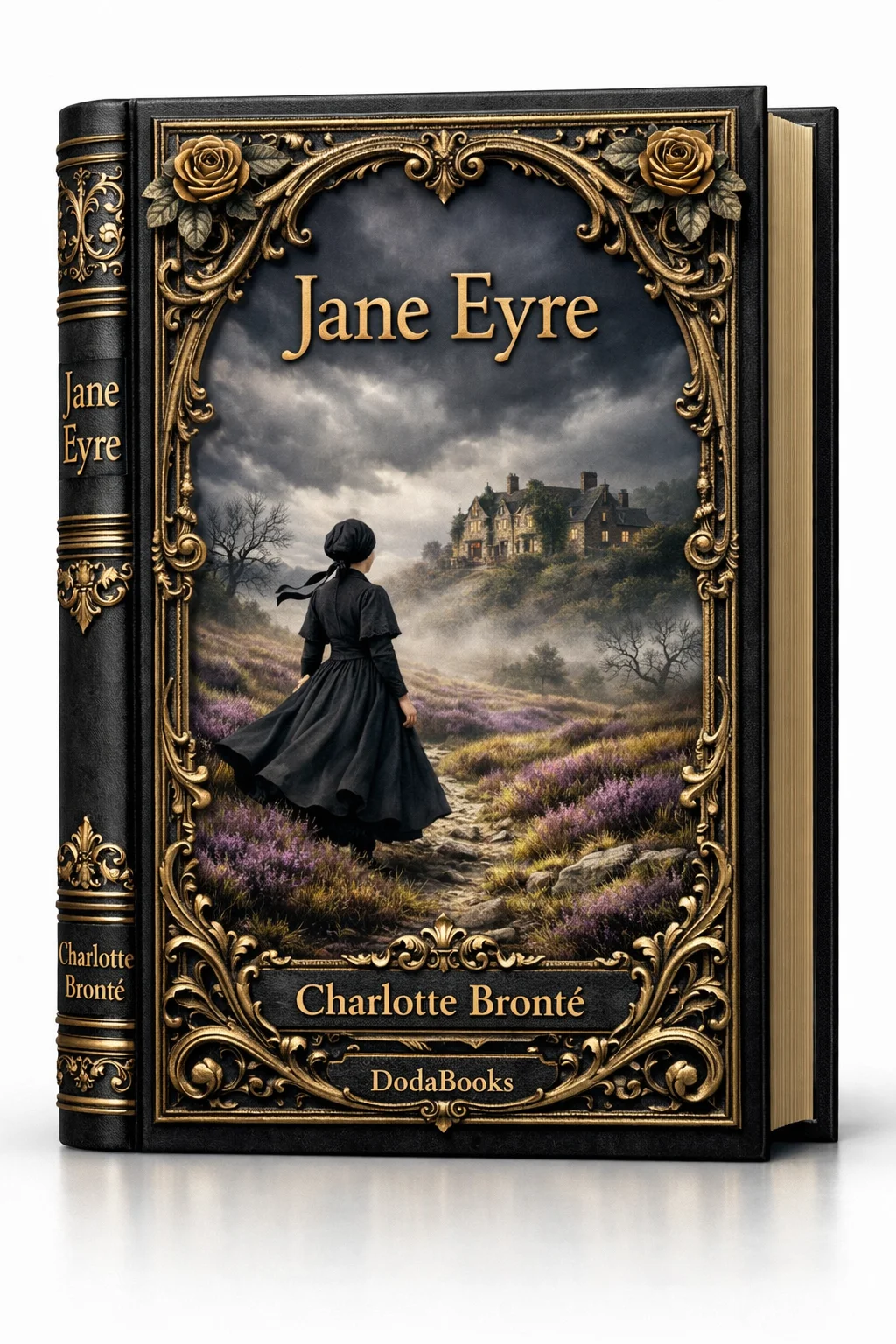
Read Charlotte Brontë's Masterpiece with Total Clarity
Read Jane Eyre in the definitive DodaBooks Annotated Edition:
- Complete 38-chapter authorial text of the 1847 novel
- Instant margin translations for all conversational French dialogue
- Explanatory notes detailing Cowan Bridge School, Victorian law, and biblical references
- Universal DRM-free download compatible with Kindle, Apple Books, Kobo, and phone