Is Twenty Years After Hard to Read? Reading Difficulty & Study Guide
When readers finish The Three Musketeers, they are frequently intoxicated by Alexandre Dumas’s breathless swashbuckling energy. Naturally, they turn to the direct sequel, Twenty Years After (Vingt ans après). Yet upon opening the book, many readers find themselves confronted by an 800-page volume involving seventeenth-century French parliamentary tax disputes, barricades in the streets of Paris, and the execution of an English monarch, leading them to ask: Is Twenty Years After harder to read than The Three Musketeers?
The short answer is: It is slightly more complex politically, but just as fast-paced and thrilling to read.
While The Three Musketeers was a high-spirited romance of youthful bravado, Twenty Years After is an epic historical drama. It trades romantic duels over handkerchiefs for high-stakes political intrigue, espionage, and national civil war. Yet because Dumas was the undisputed master of serial storytelling, every chapter moves with lightning-quick dialogue, constant plot twists, and thrilling cliffhangers.
This reading difficulty guide breaks down the language, historical background knowledge, and narrative pacing of Twenty Years After, providing an actionable 8-week reading plan to help you enjoy every page of this classic sequel.
| Difficulty Metric | Rating & Evaluation | Context & Reader Advice |
|---|---|---|
| Overall Difficulty | Moderate (2.5 / 5) | Highly accessible dialogue and rapid action; requires basic familiarity with 17th-century French and English politics. |
| Lexile Measure | 1080L – 1160L | Equivalent to 9th Grade to High School Junior reading level. |
| Length & Scope | ~280,000 words (90 Chapters across 4 Parts) | Substantial length; roughly equal in size to The Three Musketeers. |
| Pacing Style | Rapid Serialized Swashbuckler | Short, dramatic chapters ending with hooks and cliffhangers; moves briskly despite its length. |
| Biggest Hurdle | The Complex Politics of The Fronde | The shifting alliances between Mazarin, the Queen Regent, the Parliament, and rebel nobles can feel confusing without a guide. |
| Greatest Reward | Matured Characters & Deep Themes | Deepening of the friendship between D’Artagnan, Athos, Porthos, and Aramis across two decades. |
🔬 Analyzing the 3 Reading Challenges of Dumas’s Sequel
To conquer Twenty Years After with total ease, readers should understand three primary elements: political context, serialized narrative pacing, and historical duality.
            [ THE 3 UNIQUE ATTRIBUTES OF TWENTY YEARS AFTER ]

        +-------------------------+-------------------------+
        |                         |                         |
        v                         v                         v
[ 1. The Fronde Politics ]  [ 2. Serialized Pacing ]  [ 3. English Civil War ]
Complex French civil war     90 short, dramatic        The trial & execution of
between royal court,         chapters with cliffhangers Charles I; Cromwell vs.
parliament, and nobles.      and rapid dialogue.       Stuart royalist forces.
1. Navigating the Shifting Alliances of The Fronde (1648–1649)
The primary obstacle for non-French readers is understanding the Fronde—the complex series of civil wars that erupted in France between 1648 and 1653.
In The Three Musketeers, the political lines were simple: the King’s Musketeers hated the Cardinal’s Guards, and both served France against foreign enemies like Spain and England. In Twenty Years After, the lines are fractured:
- The Court Party (Mazarinists): Led by Cardinal Mazarin and the Regent Queen Anne of Austria, defending the royal prerogative of the young boy-king Louis XIV. (Supported by D’Artagnan and Porthos).
- The Frondeurs (The Parliamentary & Aristocratic Rebels): Led by the Parliament of Paris, the Coadjutor of Paris (Jean François Paul de Gondi), the Duc de Beaufort, and the Duchesse de Longueville. They rebelled against Mazarin’s crushing financial taxes and foreign dominance. (Supported by Athos and Aramis).
       [ QUICK GUIDE TO THE FRONDE FACTIONS IN 1648 ]
+-------------------------------------------------------------+
| COURT FACTION (Palais-Royal):                               |
| • Cardinal Mazarin (Prime Minister, Italian, disliked)      |
| • Queen Anne of Austria (Regent for 10-year-old Louis XIV)  |
| • D'Artagnan & Porthos (Musketeers protecting the Crown)    |
+-------------------------------------------------------------+
                               VS.
+-------------------------------------------------------------+
| THE FRONDE (Parisian Rebellion):                            |
| • Parliament of Paris (Demanding tax relief & civil rights) |
| • Duc de Beaufort (Populist "King of the Markets")          |
| • Athos & Aramis (Defending noble liberties & chivalry)     |
+-------------------------------------------------------------+
Reader Tip: Do not worry about memorizing every minor French magistrate. The key takeaway is that D’Artagnan and Porthos serve the royal government, while Athos and Aramis sympathize with the rebels—forcing them to confront each other before their brotherhood reunites them.
2. Alexandre Dumas’s Serialized Dialogue Technique
Unlike the dense, essayistic paragraphs of George Eliot or the ornate descriptive landscapes of Ann Radcliffe, Alexandre Dumas wrote for a mass popular audience. He was paid by the line for his serialization in Le Siècle, which led him to develop one of the most brisk, entertaining dialogue styles in literary history.
Scenes consist largely of rapid-fire repartee, witty banter, and dramatic declarations:
"— ‘You are going to England?’ asked D’Artagnan.
— ‘Tomorrow,’ replied Athos.
— ‘And who is your companion?’
— ‘Aramis.’
— ‘Then take care of yourselves, my friends; for across the sea, you may find enemies with swords as sharp as your own!’"
Because of this theatrical dialogue technique, pages fly by with astonishing speed. An 800-page Dumas novel can be read in roughly half the time required for an 800-page Victorian novel like Middlemarch.
3. The English Civil War and Charles I
In the middle of the novel, the narrative abruptly shifts from Paris to England. Dumas immerses his French musketeers directly into the historical climax of the English Civil War:
- The betrayal of King Charles I by the Scottish army at Newcastle.
- The rise of Oliver Cromwell and the New Model Army.
- The harrowing trial and public execution of Charles I outside the Banqueting House at Whitehall on January 30, 1649.
Dumas treats this historical tragedy with immense emotional gravity. Readers familiar with British history will be thrilled to see these iconic historical events brought to life through the perspective of four French Catholic swordsmen.
📅 The 8-Week Twenty Years After Reading Plan
Twenty Years After contains 90 chapters. Breaking the book down across eight weeks yields an average of 11 to 12 chapters per week (~15 to 20 pages per day). This schedule keeps the narrative fresh, provides steady momentum, and lets you savor each dramatic movement.
Week 1: Chapters 1–12   ====> Mazarin's Peril & Gathering the Friends
Week 2: Chapters 13–25  ====> The Place Royale Conflict & Reconciliation
Week 3: Chapters 26–37  ====> The Voyage to England & The Battle of Newcastle
Week 4: Chapters 38–50  ====> The Musketeers Reunited Behind King Charles
Week 5: Chapters 51–62  ====> Mordaunt's Terror & The Whitehall Scaffold
Week 6: Chapters 63–72  ====> The Gunpowder Ship & Mordaunt's Final Duel
Week 7: Chapters 73–82  ====> Imprisonment at Rueil & Kidnapping Mazarin
Week 8: Chapters 83–90  ====> The Treaty of Victory & Triumphal Return
Week 1: Chapters 1–12 — The Call of Mazarin
- Daily Reading: ~15 pages per day.
- Plot Focus: Paris on the brink of revolt; Cardinal Mazarin summons the stagnant Lieutenant D’Artagnan; D’Artagnan seeks out his old friends; Aramis at Noisy; Porthos on his country estate wanting a barony.
- Reading Tip: Enjoy the humor of D’Artagnan recruiting Porthos by promising him a royal title!
Week 2: Chapters 13–25 — Brother Against Brother
- Daily Reading: ~18 pages per day.
- Plot Focus: D’Artagnan visits Athos at Blois; meeting the noble young Raoul; the escape of the Duc de Beaufort; D’Artagnan and Porthos clash swords with Athos and Aramis in the dark; the emotional reconciliation on the Place Royale.
- Reading Tip: Pay close attention to Athos’s speech in Chapter 24—it is the emotional thesis of the entire novel.
Week 3: Chapters 26–37 — The English Mission
- Daily Reading: ~18 pages per day.
- Plot Focus: Queen Henrietta Maria in the Louvre; Athos and Aramis sail for England; Mazarin sends D’Artagnan and Porthos as envoys to Cromwell; meeting Mordaunt; the betrayal of King Charles at Newcastle.
- Reading Tip: Notice how Mordaunt is introduced—his cold, fanatical demeanor immediately sets him apart as Dumas’s darkest villain.
Week 4: Chapters 38–50 — United for the King
- Daily Reading: ~20 pages per day.
- Plot Focus: Athos captured; D’Artagnan and Porthos desert Cromwell’s army; the four musketeers reunite to plan the rescue of King Charles; the thrilling escape from Newcastle.
- Reading Tip: Watch how D’Artagnan takes command as the master tactician of the group.
Week 5: Chapters 51–62 — The Tragedy of Whitehall
- Daily Reading: ~20 pages per day.
- Plot Focus: The daring plot to tunnel beneath the scaffold; kidnapping the London executioner; Mordaunt secretly volunteers as headsman; the heartbreaking execution of Charles I; Athos beneath the platform.
- Reading Tip: This is Dumas’s historical masterpiece; read Chapters 58–60 in a single uninterrupted sitting.
Week 6: Chapters 63–72 — The Lightning and the Sea
- Daily Reading: ~18 pages per day.
- Plot Focus: Flight from London; the chartered ship Lightning; Mousqueton discovers the gunpowder barrels; escape in the longboat; explosion of the ship; Mordaunt clings to the boat; Athos slays Mordaunt in the icy sea.
- Reading Tip: A masterclass in nautical suspense and Gothic vengeance.
Week 7: Chapters 73–82 — The Hostage Cardinal
- Daily Reading: ~18 pages per day.
- Plot Focus: Return to France; Mazarin arrests D’Artagnan, Porthos, and Athos; imprisonment in the château of Rueil; escaping through the chimney; discovering Mazarin’s underground treasure vault; abducting the Cardinal in his nightshirt!
- Reading Tip: Dumas pivots effortlessly from Gothic tragedy to sparkling comedic swashbuckler.
Week 8: Chapters 83–90 — Triumph and Brotherhood
- Daily Reading: ~15 pages per day.
- Plot Focus: Mazarin forced to sign the treaty at Athos’s estate; Porthos gets his barony; D’Artagnan becomes Captain of the Musketeers; the royal entry into Paris; final farewells.
- Reading Tip: Celebrate the hard-won victories of the four friends!
💡 4 Pro Tips for Reading Twenty Years After
- Keep a Character Bookmark: Remind yourself of the four friends’ new names and stations (Athos = Comte de la Fère, Porthos = Monsieur du Vallon, Aramis = Abbé d’Herblay).
- Treat History as Drama: Do not get bogged down in textbook details about the Fronde; follow the emotional loyalty between the four friends.
- Read Aloud During Duels: Dumas’s dialogue has theatrical, rhythmic timing designed for vocal performance.
- Choose an Annotated Edition: Having quick footnotes (like DodaBooks or Oxford) that explain 17th-century French currency (pistoles, livres, crowns) and historical figures keeps you moving without interruptions.
❓ Frequently Asked Questions
How long does it take an average person to read Twenty Years After?
At an average reading speed of 250 words per minute, Twenty Years After (approximately 280,000 words) requires roughly 18 to 22 hours of total reading time. Following our 8-week reading plan requires roughly 25 to 30 minutes of reading per day, making it a fast-moving, deeply enjoyable reading habit.
Is Twenty Years After historically accurate?
Alexandre Dumas famously joked: "What is history? A nail upon which I hang my pictures." Dumas uses real historical events (the Fronde, the Battle of Lens, the trial of Charles I) with great geographical and atmospheric fidelity, but freely invents secret missions and heroic interventions for his fictional musketeers.
Why does Athos fight for King Charles I?
Athos is an aristocrat of ancient noble blood who believes passionately in the sacred, divinely ordained status of monarchs. To Athos, Oliver Cromwell's rebellion and the trial of King Charles represent the destruction of civilized European order. He risks his life to defend the King out of pure chivalric duty.
Is there a sequel to Twenty Years After?
Yes! The story concludes in Dumas's epic third installment, The Vicomte of Bragelonne: Ten Years Later, which follows the musketeers into the glorious reign of the Sun King, Louis XIV, and includes the famous conclusion, The Man in the Iron Mask.
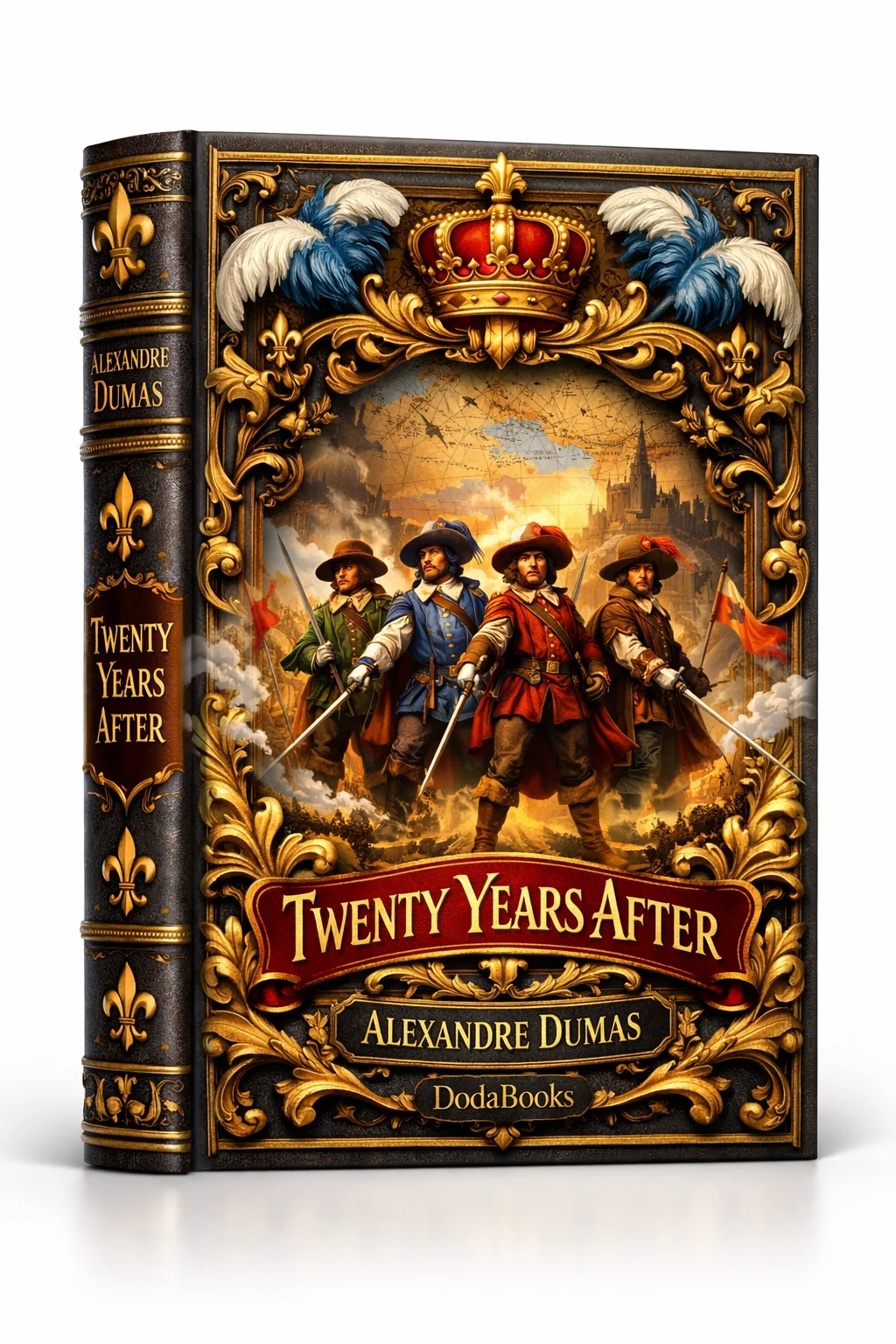
⚔️ Master Alexandre Dumas’s Classic Adventure with Ease
Enjoy the thrilling sequel to The Three Musketeers with the definitive, reader-friendly digital edition of Twenty Years After from DodaBooks:
- 📖 Complete 90-Chapter Unabridged Text — All four thrilling parts preserved intact
- 💡 Exhaustive Contextual Explanations — Clarifying the Fronde, Cardinal Mazarin, and the English Civil War
- 📱 Designed for Modern Screens — Flawless digital typography engineered for Kindle, Kobo, iPad, and Android
- 🔓 100% DRM-Free — Download immediately and keep your digital book forever
👉 Get the Annotated Edition of Twenty Years After at DodaBooks →