Is Twenty-Five Ghost Stories Hard to Read? Reading Difficulty & Study Guide
Anthologies of supernatural fiction occupy a unique place in classic literature. While Victorian three-decker novels require dozens of hours of sustained commitment, short story collections like W. Bob Holland’s Twenty-Five Ghost Stories (1904) offer concise, self-contained bursts of atmospheric dread that can easily be consumed in a single sitting before bed.
However, readers approaching an anthology published in 1904 face distinctive linguistic and historical challenges. The prose styles across the twenty-five selections vary widely—from the ornate, Latinate vocabulary of Edgar Allan Poe and the psychological naturalism of Guy de Maupassant, to the dry legalistic jargon of nineteenth-century police constables and the archaic regional idioms of Scottish highland folklore. Furthermore, the stories assume an intimate familiarity with Victorian spiritualism, crisis apparitions, and turn-of-the-century technologies (such as early spirit photography and steam travel).
This comprehensive study guide evaluates the reading difficulty of Twenty-Five Ghost Stories, breaking down its vocabulary, thematic demands, and structural patterns, while providing an actionable 4-week reading roadmap for readers, students, and book clubs.
| Difficulty Metric | Level / Measurement | Comparative Context |
|---|---|---|
| Average Lexile Score | 1000L – 1120L | Moderate; accessible to high schoolers and adult readers; comparable to Dracula (1060L). |
| Total Word Count | ~78,000 words (~240 pages) | 25 discrete stories ranging from 1,200 to 4,500 words each. |
| Sentence Structure | Varied (Brisk to Elaborate) | Ranges from fast-paced journalistic anecdotes to dense, periodic Poe paragraphs. |
| Primary Challenge | Victorian spiritualist concepts | Understanding bilocation, crisis apparitions, table-rapping, and period folklore. |
| Vocabulary Level | High in select stories | French idioms (Maupassant), Scottish dialect (“Sandy’s Ghost”), and legal terminology. |
| Ideal Pacing | 6 stories per week (4-week plan) | Perfect for episodic, nightly fireside reading. |
📊 Lexile & Linguistic Breakdown
Because Twenty-Five Ghost Stories is an anthology by diverse authors rather than a single unified novel, its difficulty varies from tale to tale:
STORY DIFFICULTY SPECTRUM ACROSS THE 1904 ANTHOLOGY
┌─────────────────────────────────────────────────────────────┐
│ High Challenge (1150L - 1220L):                             │
│ • "The Black Cat" (Poe) — Dense periodic syntax, perversity │
│ • "Colonel Halifax's Ghost Story" (Baring-Gould) — Heraldry │
├─────────────────────────────────────────────────────────────┤
│ Moderate / Standard Classical (1020L - 1120L):             │
│ • "The Flayed Hand" & "From the Tomb" (Maupassant)          │
│ • "The Spectre Bride" (Peattie)                             │
│ • "The Ghost of Buckstown Inn" (Anderson)                   │
├─────────────────────────────────────────────────────────────┤
│ Highly Accessible / Anecdotal (900L - 1000L):               │
│ • "The Parlor-Car Ghost" ("A Lady") — Conversational        │
│ • "A Misfit Ghost" (Anonymous) — Humorous satire            │
│ • "The Dead Woman's Photograph" — Direct mystery            │
└─────────────────────────────────────────────────────────────┘
Compared to other classic horror works, the short-story format makes the anthology significantly less intimidating to read:
- Brevity: Most stories can be read in 10 to 20 minutes, eliminating the fatigue often associated with 800-page Victorian novels.
- Narrative Economy: Short ghost stories avoid lengthy digressions into municipal politics or extended domestic subplots, focusing entirely on setting, atmosphere, and the spectral reveal.
🔍 The 3 Greatest Reading Challenges
1. Victorian Spiritualism & Psychical Terminology
A modern reader encountering a story like “The Ghost of a Live Man” might assume the apparition is an evil demon or a time-traveler. In 1904, however, every educated reader immediately recognized it as a crisis apparition—a concept popularized by the Society for Psychical Research.
Victorians lived in a culture obsessed with séances, mediumship, table-rapping, and the possibility of telepathic communication at the moment of death. Without this context, modern readers may miss the scientific seriousness with which the characters approach their hauntings.
VICTORIAN PSYCHICAL MATRIX
Telepathy / Astral Travel ──► Crisis Apparition ──► Spirit Photography ──► Ghost Society
(Mental Broadcast)            (Seen at Trauma)     (Glass Negative)       (Scientific SPR)
2. Shifting Narrative Registers & Pseudonymous Bylines
Holland deliberately arranged the anthology to alternate between high literary art and popular period reportage. Readers must adjust their expectations between selections:
- Literary Masterpieces: Poe and Maupassant demand close reading, symbolic analysis, and attention to psychological unreliability.
- Folklore & Folk Anecdotes: “Sandy’s Ghost” and “Grand-Dame’s Ghost Story” rely on oral storytelling conventions, dialect, and generational nostalgia.
- Satirical Counterpoints: “A Misfit Ghost” and “How He Caught the Ghost” subvert Gothic horror with comedy, requiring the reader to switch emotional gears.
3. Archaic Period Vocabulary & Material Culture
The stories are filled with material details from the nineteenth-century world—such as carriage types (brougham, post-chaise), currency (liras, guineas, sovereigns), and medical practices (leeching, trepanning).
📚 Key Supernatural & Historical Vocabulary
Familiarity with these twenty period terms will greatly enhance your reading:
| Term | Historical Meaning & Context |
|---|---|
| Apparition | A supernatural appearance of a person or thing; an uncanny manifestation of a deceased spirit. |
| Bilocation | The supposed supernatural phenomenon of being in two distinct physical places at the same time. |
| Crisis Apparition | The phantom of a living person appearing to a loved one at the precise instant of sudden trauma or death. |
| Doppelgänger | An apparitional double or psychic twin of a living person, traditionally regarded as an omen of bad luck or death. |
| Flayed | Having had the skin stripped or peeled off; seen in Maupassant’s macabre relic in “The Flayed Hand.” |
| Gallows | A wooden frame used for the execution of criminals by hanging; Pluto’s white fur mark in “The Black Cat.” |
| Immurement | The horrific act of entombing or walling someone up alive within a brick or plaster partition. |
| Medium / Clairvoyant | An individual claimed to possess psychic abilities capable of communicating with deceased spirits during séances. |
| Night-Hag | An archaic folklore entity associated with sleep paralysis; a suffocating spirit that sits on a sleeper’s chest. |
| Parlor Car | A first-class railway passenger car furnished with individual swivel armchairs, velvet upholstery, and private service. |
| Peddler | An itinerant merchant who traveled on foot or by horse wagon selling goods to rural homesteads and taverns. |
| Perversity | A philosophical term popularized by Poe meaning the deliberate impulse to do wrong simply because it is forbidden. |
| Psychical Research | The late-Victorian scientific study of telepathy, clairvoyance, apparitions, and mediumship (e.g., the SPR). |
| Revenant | A visible ghost or reanimated corpse believed to have returned from the dead to terrorize the living. |
| Shrouded | Wrapped in a burial cloth or winding sheet; traditional attire of churchyard specters. |
| Spirit Photography | The late-19th-century practice of using photographic cameras to capture faint, transparent impressions of departed loved ones. |
| Table-Rapping | The practice in spiritualist séances where spirits allegedly communicated by knocking or rapping against wooden tables. |
| Turnpike | A toll road with tollgates maintained by private investors; a common setting for wayside highway robberies and hauntings. |
| Unbidden | Without having been invited or asked; an unwelcome or uninvited guest. |
| Wraith | A Scottish term for a ghost or spectral apparition, especially one seen shortly before or after a person’s death. |
🗓️ 4-Week Comprehensive Reading Plan
To fully enjoy the variety and atmosphere of Twenty-Five Ghost Stories, we recommend reading six stories per week, ideally late at night:
4-WEEK ANTHOLOGY STUDY SCHEDULE
Week 1 (Stories 1–6):   Master Horrors & Transitory Phantoms (Poe, Maupassant, Parlor Car)
Week 2 (Stories 7–12):  Severed Digits, Society Séances & French Nightmares
Week 3 (Stories 13–18): Frontier Blood, Drowned Brides & Mountain Combat
Week 4 (Stories 19–25): Loire Châteaux, Spirit Photos, Doppelgängers & Washington
Week 1: Psychological Dread & Technological Phantoms (Stories 1–6)
- Selections: The Black Cat, The Flayed Hand, The Vengeance of a Tree, The Parlor-Car Ghost, The Ghost of Buckstown Inn, The Burglar’s Ghost.
- Thematic Focus: How Poe and Maupassant lay the psychological foundation for modern horror; the clash between nature and human exploitation; the railway train as a haunted space.
- Reading Time: ~75 minutes total.
Week 2: Macabre Curiosities & Psychic Mediums (Stories 7–12)
- Selections: A Phantom Toe, Mrs. Davenport’s Ghost, The Phantom Woman, The Phantom Hag, From the Tomb, Sandy’s Ghost.
- Thematic Focus: Dark comedy vs. abject terror; the role of sleep paralysis in “The Phantom Hag”; high-society spiritualist séances; Scottish Highland folk fidelity.
- Reading Time: ~70 minutes total.
Week 3: Frontier Massacres, Drowned Brides & Physical Combat (Stories 13–18)
- Selections: The Ghosts of Red Creek, The Spectre Bride, How He Caught the Ghost, Grand-Dame’s Ghost Story, A Fight with a Ghost, Colonel Halifax’s Ghost Story.
- Thematic Focus: American frontier violence; the tragic drowned bride in Peattie’s folklore; unmasking village hoaxes; hand-to-hand combat with a tangible entity.
- Reading Time: ~80 minutes total.
Week 4: Spirit Photography, Astral Projection & National Legends (Stories 19–25)
- Selections: The Ghost of the Count, The Old Mansion, A Misfit Ghost, An Unbidden Guest, The Dead Woman’s Photograph, The Ghost of a Live Man, The Ghost of Washington.
- Thematic Focus: European aristocracy and French Revolution memories; satire in lower Manhattan tenements; Victorian spirit photography; the telepathic crisis apparition; George Washington’s patriotic apparition.
- Reading Time: ~85 minutes total.
💬 Discussion & Book Club Questions
- Poe vs. Maupassant: Compare the terror in “The Black Cat” with “The Flayed Hand.” How does Poe’s internal psychological guilt differ from Maupassant’s physical, bodily horror?
- Technology and the Supernatural: How do Victorian and Edwardian writers incorporate new technologies (trains, spirit photography, telegraphs) into ghost stories that were traditionally set in medieval castles?
- The Morality of Ghosts: Do the ghosts in this collection punish evil and protect the innocent, or are their actions chaotic and indiscriminate? Give examples of both types of entities.
- The Ghost of a Live Man: Discuss the concept of the living crisis apparition. Why was this idea so appealing to a nineteenth-century public grappling with the death of loved ones across distant colonial empires and oceans?
- Humor in the Macabre: How do stories like “A Misfit Ghost” and “How He Caught the Ghost” function as comic relief? Does humor diminish or enhance the dread of the serious stories surrounding them?
❓ Frequently Asked Questions
Is this collection suitable for younger readers or teenagers?
Most stories are mild-to-moderate in violence and rely on psychological suspense and atmosphere rather than graphic gore. However, "The Black Cat" (animal cruelty, wife murder with an axe) and "The Flayed Hand" (a severed criminal's hand that strangles a student) contain intense macabre content suitable for ages 14 and older.
Are all 25 stories written by W. Bob Holland?
No. W. Bob Holland was the editor and compiler. He wrote the preface and gathered tales from various writers—some renowned (Poe, Maupassant, Baring-Gould, Peattie) and others anonymous journalists and magazine contributors from period periodicals.
How does this collection compare to M. R. James?
M. R. James specialized in antiquarian, scholarly ghost stories set in English cathedral closes, libraries, and coastal inns. Holland's anthology is broader and more American-focused, encompassing popular pulp fiction, folklore, railroad transit, and frontier tales alongside European classics.
Why did ghost stories peak in popularity during the Victorian and Edwardian eras?
The era experienced intense spiritual anxiety: traditional religious orthodoxies were challenged by Darwinian evolution and industrial urbanization, while high infant mortality and warfare spurred deep mourning customs. Ghost stories provided a thrilling yet comforting exploration of the possibility of consciousness surviving after bodily death.
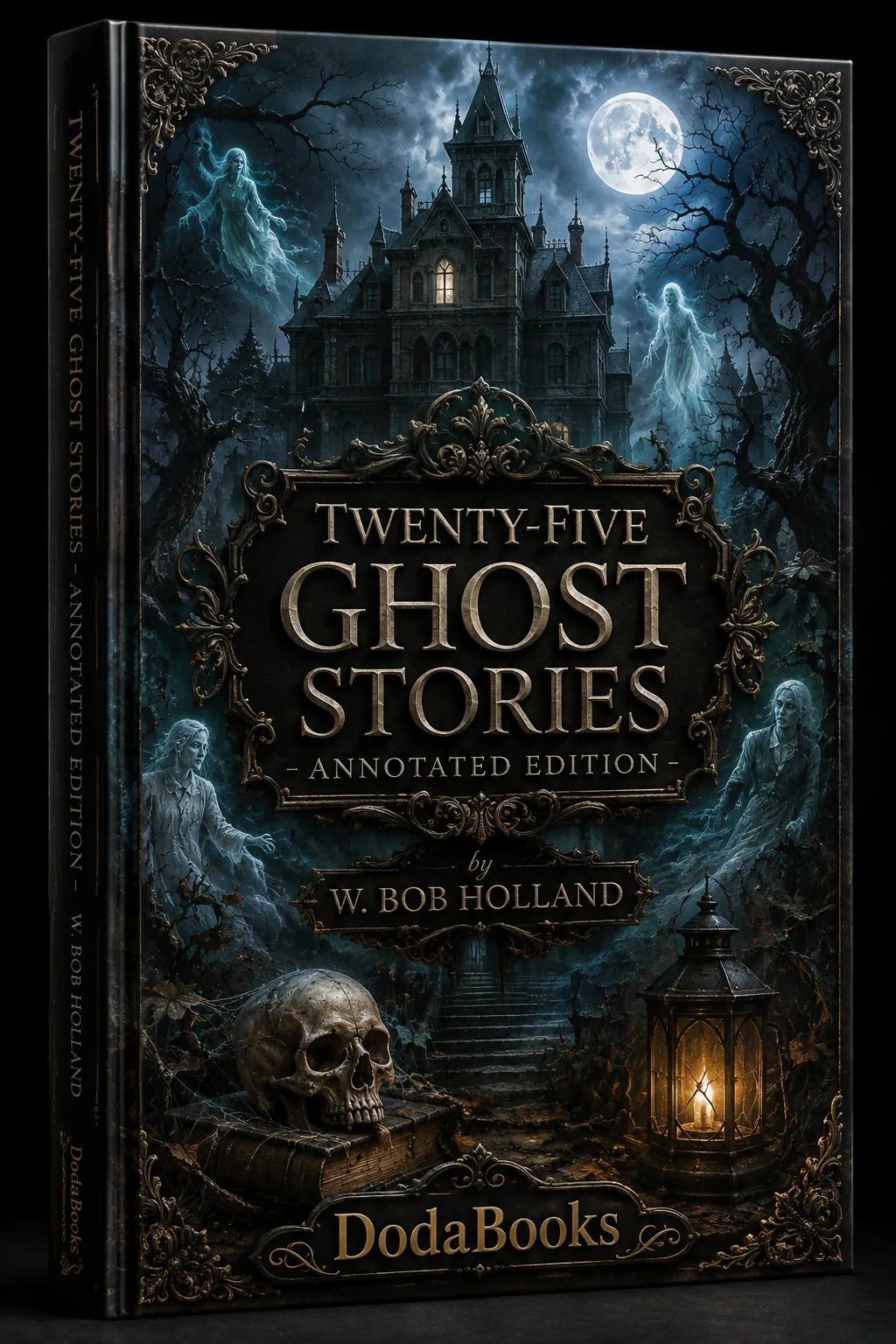
📖 Master the 1904 Supernatural Anthology
Experience Twenty-Five Ghost Stories with complete scholarly notes, author histories, and contextual explanations in the DodaBooks Annotated Edition:
- 🕯️ All 25 Complete Tales Unabridged — Restored from the original 1904 J. S. Ogilvie first edition
- 💡 Exhaustive Footnotes on Spiritualism & Folklore — Understand crisis apparitions, bilocation, and period idioms
- 📱 Designed for Late-Night Reading — High-contrast dark-mode typography and smooth chapter navigation
- 🔓 100% DRM-Free — Read anywhere on Kindle, Kobo, iPad, or Android
👉 Get the Annotated Edition of Twenty-Five Ghost Stories at DodaBooks →