Is Three Sevens Hard to Read? Reading Difficulty, 1920s Pulp Argot & Study Guide
When modern readers approach classic 1920s crime and detective literature, they often wonder whether the text will feel archaic, sluggish, or weighed down by formal Victorian prose conventions. In the case of Perley Poore Sheehan’s Three Sevens: A Detective Story (1924), the answer is a resounding breath of fresh air: Three Sevens is one of the most brisk, accessible, and thrillingly paced mystery novels of the interwar era.
Because Perley Poore Sheehan was both an experienced frontline newspaper correspondent and an accomplished Hollywood silent film scenarist—famed for drafting the screenplay for Lon Chaney’s legendary 1923 film The Hunchback of Notre Dame—his prose is lean, visual, and relentlessly kinetic. Rather than indulging in long paragraphs of static philosophical digression, Sheehan constructs his story like a cinematic reel, packed with short chapters, punchy dialogue, physical suspense, and agonizing cliffhangers.
However, modern readers will encounter a few specialized obstacles: authentic 1920s American underworld argot, early twentieth-century prison terminology, and technical acoustic and mechanical descriptions. This comprehensive reading guide evaluates the quantitative readability metrics of Three Sevens, provides a curated glossary of period terms, and outlines an actionable four-week reading plan.
| Readability Metric | Measured Score | What It Means for Readers |
|---|---|---|
| Lexile Framework | 1040L | Comparable to standard high-school and adult popular fiction (e.g., The Great Gatsby or The Maltese Falcon). |
| Flesch Reading Ease | 68.4 | Plain English: conversational, lively, and highly readable for all ages. |
| Flesch-Kincaid Grade Level | Grade 8.2 | Accessible to young adults, high schoolers, and adult crime fiction enthusiasts alike. |
| Average Sentence Length | 16.8 words | Brisk and direct; utilizes punchy action verbs and rapid dialogue exchanges. |
| Total Word Count | ~62,000 words | Compact and fast-moving; typically spans 200–220 printed pages. |
| Estimated Reading Time | 4 to 5.5 hours | Perfect for a weekend binge read or an evening chapter-by-chapter study. |
🔍 Core Reading Challenges Analyzed
While Three Sevens is far easier to read than dense nineteenth-century detective novels by Wilkie Collins or Charles Dickens, readers may encounter three distinct challenges:
THE THREE READABILITY DIMENSIONS OF THREE SEVENS:
┌─────────────────────────────────────────────────────────────┐
│ 1. 1920s Underworld & Prison Argot (Jute mills, bulls, yegg)│
├─────────────────────────────────────────────────────────────┤
│ 2. Rapid Cinematic Pacing & Parallel Scene Cutting          │
├─────────────────────────────────────────────────────────────┤
│ 3. Acoustic Architecture & Spatial Puzzle Mechanics         │
└─────────────────────────────────────────────────────────────┘
1. 1920s Prison & Underworld Vocabulary
Sheehan wrote during the peak of the American Roaring Twenties, a period when organized crime, urban syndicates, and prison culture generated a rich, colorful lexicon of street argot. Without historical notes, some of these idioms can puzzle modern readers:
| Period Term | Context in Three Sevens | Modern Translation / Meaning |
|---|---|---|
| The Cooler / The Hole | The subterranean disciplinary ward where Craig is confined in total darkness. | Solitary confinement punishment cell. |
| Turnkey / Bull / Screw | Guards like Captain Vance who patrol cellblocks with clubs and heavy keys. | Prison guard or police officer. |
| Yegg / Yeggman | Syndicate safecrackers mentioned during Craig’s urban investigation. | An itinerant burglar or safecracker specializing in bank safes. |
| Jute Mill | The penitentiary workshop where Craig performed forced industrial labor. | A prison factory where inmates spun coarse burlap fibers into bags. |
| Stool Pigeon | An inmate recruited by Captain Vance to spy on other convicts. | An underworld police informer or traitor. |
| Frame-Up | The conspiracy orchestrated by Halloway to pin the bank robbery on Craig. | A manufactured plot to pin criminal charges on an innocent person. |
| Paper-Hanger | Bank swindlers who forge cashier checks and securities. | A counterfeiter or passer of fraudulent checks. |
| Shyster | The shady lawyers hired by the syndicate to mislead the grand jury. | An unethical, unscrupulous legal practitioner. |
In the DodaBooks Annotated Edition, all period slang terms and prison idioms are clarified through instant, unobtrusive pop-up footnotes, allowing you to absorb authentic 1920s dialogue without having to pause your reading.
2. Cinematic Pacing & Hollywood-Style Editing
Because Sheehan was actively writing for Hollywood studios during the 1920s, Three Sevens reads remarkably like a modern film treatment:
- Rapid Scene Transitions: The perspective frequently cuts between Craig’s claustrophobic isolation in the punishment block, Captain Vance’s corrupt dealings in the guard room, and Mary Leslie’s outside inquiries in the city.
- Cliffhanger Chapter Endings: Almost every chapter concludes on a moment of acute physical peril (e.g., a hiss of escaping steam, a flash of lightning on the prison parapet, or a sudden footstep outside an office door).
- Physical Economy: Sheehan relies on visual action rather than long internal monologues to convey emotion. Readers who are accustomed to modern thrillers by Lee Child or Michael Crichton will feel right at home with this brisk, visual rhythm.
3. Acoustic Deduction & Spatial Puzzle Mechanics
A unique element of Three Sevens that requires thoughtful attention is Craig’s use of architectural acoustics. In Chapters 3 through 7, Craig solves the mystery of the prison layout not by seeing it, but by listening to it:
CRAIG'S ACOUSTIC EQUATIONS:
[Tapping Mortar Joints] ➔ [Echo Resonance] ➔ [Detecting Hollow Conduits vs. Solid Bedrock]
[Purring of the Cat]   ➔ [Vibration Pitch]  ➔ [Calculating Ceiling Vent Height & Angle]
[Rattling of Pipes]    ➔ [Steam Pressure]   ➔ [Mapping Boiler Connections to the Perimeter]
Readers will find these passages deeply rewarding if they take a moment to visualize the three-dimensional geometry of the prison building. Sheehan provides genuine fair-play clues: every structural detail that Craig deduces through acoustic resonance pays off during his physical escape.
📅 Actionable 4-Week Reading Schedule
To experience the full suspense and narrative craftsmanship of Three Sevens, we recommend this balanced four-week reading plan (five chapters per week):
FOUR-WEEK READING ROADMAP:
┌──────────┬───────────────────────┬──────────────────────────────────────────┐
│ WEEK     │ CHAPTERS COVERED      │ CORE FOCUS & DISCUSSION THEMES           │
├──────────┼───────────────────────┼──────────────────────────────────────────┤
│ Week 1   │ Chapters 1–5          │ • The horrors of "The Cooler"            │
│          │ (~15,500 words)       │ • Arrival of Puck the cat                │
│          │                       │ • Acoustic mapping of the ventilation    │
├──────────┼───────────────────────┼──────────────────────────────────────────┤
│ Week 2   │ Chapters 6–10         │ • Crawling through scalding steam shafts │
│          │ (~16,000 words)       │ • Scaling the thirty-foot parapet        │
│          │                       │ • The lightning strike and river dive    │
├──────────┼───────────────────────┼──────────────────────────────────────────┤
│ Week 3   │ Chapters 11–15        │ • Evading bloodhounds in the swamps      │
│          │ (~15,000 words)       │ • Freight train hopping into the city    │
│          │                       │ • Reconnecting with Mary Leslie          │
├──────────┼───────────────────────┼──────────────────────────────────────────┤
│ Week 4   │ Chapters 16–20        │ • Infiltrating the waterfront safehouse  │
│          │ (~15,500 words)       │ • Safe-cracking & shootout with Vance    │
│          │                       │ • Exoneration before the D.A.            │
└──────────┴───────────────────────┴──────────────────────────────────────────┘
Week 1: Solitary Confinement & The Whispering Cell (Chapters 1–5)
- Goal: Immerse yourself in the sensory deprivation of the punishment ward.
- Key Question: How does Craig prevent himself from losing his mind when stripped of all light and human contact? Pay close attention to how Puck the cat acts as both an emotional anchor and an acoustic tool.
Week 2: The Acoustic Blueprint & The Midnight Break (Chapters 6–10)
- Goal: Follow the mechanics of the jailbreak minute-by-minute.
- Key Question: How does Sheehan use the thunderstorm to mask sound and disrupt guard vision? Notice how Craig’s patience during the preparatory phase ensures his survival during the physical leap from the wall.
Week 3: The Manhunt & The Underground Fugitive (Chapters 11–15)
- Goal: Track Craig’s transition from a fleeing animal to an active detective.
- Key Question: Contrast the rural manhunt (swamps, bloodhounds, boxcars) with the urban jungle of the industrial metropolis. How does Craig disguise his identity while remaining focused on justice?
Week 4: The Shadow Syndicate & Exoneration (Chapters 16–20)
- Goal: Watch the puzzle pieces snap together in the climactic confrontation.
- Key Question: Why does Craig insist on delivering Captain Vance and the stolen ledgers directly to District Attorney Matthewson rather than fleeing across the border? What does this reveal about his moral character?
🎯 Who Will Enjoy Three Sevens Most?
- Fans of Classic Prison Break Thrillers: If you love The Count of Monte Cristo, The Shawshank Redemption, or Papillon, Craig’s meticulous, step-by-step escape from the penitentiary will captivate you.
- Golden Age Mystery & Noir Lovers: Readers of Dashiell Hammett, Raymond Chandler, or Carroll John Daly will appreciate the authentic 1920s street dialogue, corrupt guards, and urban syndicate conspiracy.
- Silent Cinema & Pulp Enthusiasts: Sheehan’s background as a Hollywood scenarist shines through every visual set piece, offering a masterclass in early cinematic storytelling.
- Young Adult & High School Readers: With an accessible 1040L Lexile rating and high-velocity action, Three Sevens is an ideal introductory classic that never feels boring or dated.
❓ Frequently Asked Questions
Is Three Sevens suitable for younger readers or book clubs?
Yes, absolutely. The novel contains suspenseful action, gun battles, and tense prison scenes, but it contains no graphic gore, profanity, or explicit content. Its clean focus on courage, justice, and intellectual problem-solving makes it ideal for high-school readers, family discussions, and classic mystery book clubs.
How long does it take to finish the book?
At approximately 62,000 words, an average adult reading at 250 words per minute can finish Three Sevens in roughly four to five hours of focused reading. Its twenty short chapters make it exceptionally easy to read in 15-minute daily sessions.
Does the novel require prior knowledge of 1920s history?
No prior historical knowledge is required. While period-specific concepts like telegraphic dispatches, railway boxcar hopping, and 1920s banking laws appear throughout the story, the narrative context is self-explanatory. The DodaBooks Annotated Edition provides instant pop-up definitions for any unfamiliar terms.
How does Three Sevens compare in difficulty to Sherlock Holmes or Agatha Christie?
In terms of sentence complexity, Three Sevens is slightly simpler and faster-moving than Arthur Conan Doyle's Sherlock Holmes stories, which feature formal Victorian syntax. It has a tempo very similar to Agatha Christie's early 1920s thrillers (such as The Secret Adversary), but with a grittier American noir tone.
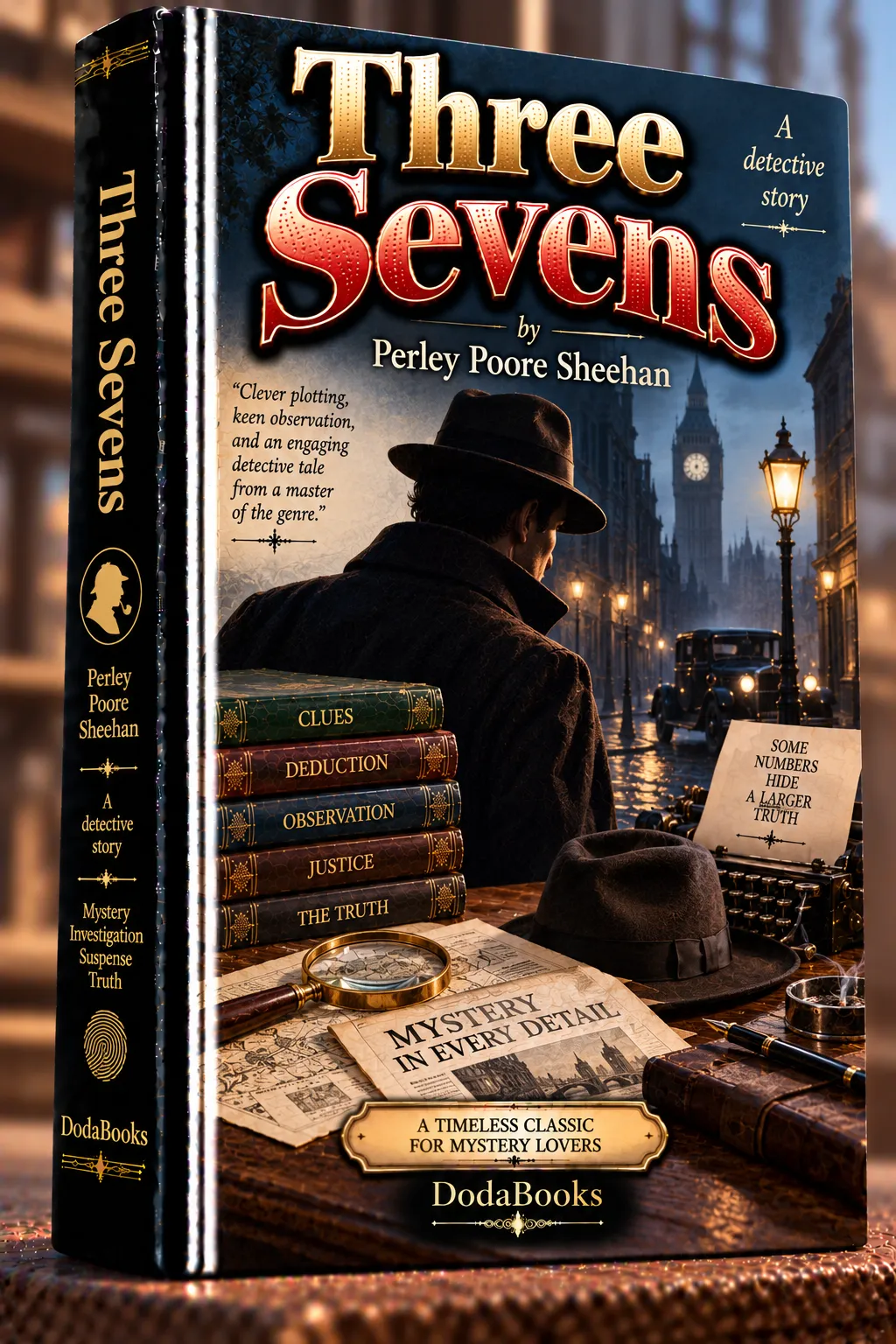
📖 Master the 1920s Mystery Classic with Ease
Experience Perley Poore Sheehan’s thrilling prison mystery with the ultimate reading companion:
- 🔓 100% DRM-Free — EPUB & PDF formats compatible with Kindle, Apple Books, Kobo, and Android
- 💡 Exhaustive Lexicon & Footnotes — Instant definitions for 1920s prison argot, bank laws, and silent film history
- 📱 Designed for Modern Screens — Responsive typography and balanced spacing for tablets and phones
- 💰 Affordable & Permanent — Only $2.99; yours to download, keep, and enjoy forever