Is The Woman in White Hard to Read? Reading Difficulty & Level Guide
When modern readers contemplate diving into Wilkie Collins’s 1859 masterpiece The Woman in White, they are often intimidated by its sheer physical heft: running over 600 pages and approximately 240,000 words, it matches the scale of monumental Victorian triple-decker novels. Readers wonder whether Collins’s prose is dense and archaic like George Eliot’s or labyrinthine and digressive like Charles Dickens’s.
Is The Woman in White hard to read? The short answer is no: it earns an accessible difficulty rating of 5.5 / 10 (Moderate).
Unlike many Victorian doorstoppers that prioritize sweeping philosophical treatises or leisurely pastoral descriptions, The Woman in White was written as high-voltage sensation fiction. Collins was an obsessive master of narrative propulsion, structural suspense, and serialized cliffhangers. The novel moves with the relentless momentum of a modern legal thriller.
However, readers unfamiliar with 19th-century customs often confront four specific stumbling blocks:
- The Courtroom Testimony Structure: The narrative is passed between twelve distinct first-person witnesses, each with their own biases, vanities, and gaps in knowledge.
- Archaic Victorian Property & Marriage Laws: The entire criminal conspiracy hinges on mid-Victorian legal concepts like coverture, marriage settlements, trust reversion, and private lunacy certificates.
- Pacing Shifts Across Three Epochs: The story shifts between atmospheric gothic suspense at country manors and meticulous, forensic detective work through parish registers.
- Epistolary Chronology: Dates and timestamps matter immensely; missing a single date can obscure the timeline trick Collins plays on his characters.
This comprehensive reading difficulty guide breaks down Collins’s prose style, provides an objective difficulty comparison against other Victorian classics, maps out a comfortable 14-day reading schedule, and shares practical tips for an effortless read.
⚡ The Woman in White Reading Difficulty: At a Glance
- Difficulty Rating: 5.5 / 10 (Moderate) — Substantially faster and more suspenseful than Middlemarch (8.5/10) or Bleak House (8.0/10); comparable in accessibility to Charlotte Brontë's Jane Eyre (5.5/10) and Bram Stoker's Dracula (5.0/10).
- Length: Approximately 240,000 words across Three Epochs (around 600–670 pages in standard print editions).
- Estimated Reading Time: 18 to 25 hours depending on your reading pace (about 45–60 minutes per day on a 14-day schedule).
- Lexile Measure & Grade Level: Approximately 1020L–1150L (Grades 10–12 / High School to College undergraduate).
- Primary Stumbling Blocks: Mid-Victorian legal jargon (*coverture*, marriage settlements, power of attorney), shifting narrator credibility, and forensic timeline tracking.
📊 Difficulty Comparison: How The Woman in White Measures Up
To understand where The Woman in White falls on the spectrum of classic 19th-century literature, consider this comparative matrix:
+---------------------------------------------------------------------------------------------------------------+
|                               CLASSIC 19TH-CENTURY NOVEL READING DIFFICULTY COMPARISON                        |
+--------------------------+------------+--------------+------------------+-------------------------------------+
| TITLE & AUTHOR           | DIFFICULTY | PAGE COUNT   | PROSE COMPLEXITY | PRIMARY CHALLENGE                   |
+--------------------------+------------+--------------+------------------+-------------------------------------+
| The Hound of the         | 3.5 / 10   | ~180 pages   | Clear, modern    | Straightforward deduction, short    |
| Baskervilles (Conan Doyle)|           |              | journalistic     | length, fast pacing                 |
+--------------------------+------------+--------------+------------------+-------------------------------------+
| Dracula (Bram Stoker)    | 5.0 / 10   | ~400 pages   | Journalistic &   | Shifting journal/letter entries,    |
|                          |            |              | gothic letters   | slow middle section in Transylvania |
+--------------------------+------------+--------------+------------------+-------------------------------------+
| The Woman in White       | 5.5 / 10   | ~640 pages   | Vivid, dramatic, | 600+ page length, 12 narrators,     |
| (Wilkie Collins)         |            |              | episodic pacing  | Victorian marriage & lunacy laws    |
+--------------------------+------------+--------------+------------------+-------------------------------------+
| Jane Eyre                | 5.5 / 10   | ~500 pages   | Introspective,   | Moral monologues, 19th-century      |
| (Charlotte Brontë)       |            |              | poetic romantic  | religious debates, slow childhood   |
+--------------------------+------------+--------------+------------------+-------------------------------------+
| Frankenstein             | 6.5 / 10   | ~220 pages   | Dense, elevated  | Philosophical debate, formal Latinate|
| (Mary Shelley)           |            |              | Romantic syntax  | rhetoric, frame-narrative layers    |
+--------------------------+------------+--------------+------------------+-------------------------------------+
| Bleak House              | 8.0 / 10   | ~950 pages   | Elaborate satire,| Massive cast of 50+ characters,     |
| (Charles Dickens)        |            |              | dual perspectives| Chancery court legal satire         |
+--------------------------+------------+--------------+------------------+-------------------------------------+
| Middlemarch              | 8.5 / 10   | ~880 pages   | Dense, deeply    | Heavy sociological analysis,        |
| (George Eliot)           |            |              | psychological    | slow philosophical development      |
+--------------------------+------------+--------------+------------------+-------------------------------------+
As the comparison shows, The Woman in White is one of the most readable and engaging large-scale novels of the 19th century. If you enjoyed Dracula or Jane Eyre, you will find Collins’s plotting equally addictive.
🧗 The 4 Primary Reading Hurdles Explained
1. The Multi-Narrator Courtroom Framework
The most distinctive structural feature of The Woman in White is its lack of an omniscient storyteller. Instead, Walter Hartright acts as an organizing solicitor assembling a file for trial:
“This is the story of what a Woman’s patience can endure, and what a Man’s resolution can achieve. If the machinery of the Law could be depended on to decide these questions… there would have been no need to tell this story. As the Law is, it is the Woman who suffers and the Man who acts… and the story here presented will be told by more than one pen, as the story of an offence against the laws is told in Court by more than one witness.”
Because each narrator writes strictly from their personal vantage point, you must actively evaluate their reliability:
- Marian Halcombe: Highly intelligent, perceptive, and courageous, but her deep devotion to Laura occasionally clouds her objective calculation of Count Fosco’s maneuvers.
- Frederick Fairlie: Laura’s uncle is an indolent, neurotic hypochondriac who finds human conversation agonizing. His section is hilarious satire, but he ignores vital warnings simply to avoid personal inconvenience.
- Eliza Michelson: The housekeeper at Blackwater Park is deeply pious, smug, and easily flattered. Fosco manipulates her religious vanity to trick her into cooperating with his plot without her realizing she is aiding a crime.
- Count Fosco: When Fosco pens his confession in the Third Epoch, he is charming, theatrical, and shockingly candid about his villainy, treating his criminal artistry like a fine symphony.
How to conquer it: Treat the novel like a jury trial! Track which character is speaking and ask yourself: What does this witness know firsthand? What are they assuming? What are they deliberately hiding?
2. Victorian Property Law and “Coverture”
The entire plot of The Woman in White revolves around the legal status of married women in 1850. Modern readers are often bewildered by why Laura Fairlie cannot simply leave her cruel husband or keep her own money.
Under the historic English common law doctrine of coverture:
- Upon marriage, a woman’s legal existence was incorporated into that of her husband.
- A married woman (feme covert) could not own personal property in her own right, could not sign contracts without her husband’s consent, and could not sue or be sued independently.
- Sir Percival Glyde marries Laura specifically because he is drowning in catastrophic gambling and mortgage debts, and her marriage settlement involves £20,000 (equivalent to several million dollars today).
- When Laura steadfastly refuses to sign away her trust fund, Sir Percival and Count Fosco realize they cannot legally take her money while she is alive and legally acknowledged. Their horrifying solution is identity theft: substituting Anne Catherick (who dies of heart disease) for Laura, burying Anne under Laura’s name, and locking the real Laura in a private asylum under Anne’s identity.
+-----------------------------------------------------------------------------------------------+
|                            KEY VICTORIAN LEGAL TERMS DECODED IN THE NOVEL                     |
+--------------------------+--------------------------------------------------------------------+
| LEGAL TERM               | WHAT IT MEANS IN THE CONSPIRACY                                    |
+--------------------------+--------------------------------------------------------------------+
| Coverture                | The legal status where a married woman has no separate property,   |
|                          | contracts, or legal rights apart from her husband.                 |
+--------------------------+--------------------------------------------------------------------+
| Marriage Settlement      | A legal trust drawn up by solicitors before marriage to protect    |
|                          | portions of the bride's wealth from being seized by her husband.   |
+--------------------------+--------------------------------------------------------------------+
| Lunacy Certificate       | Under the 1845 Lunacy Acts, an individual could be committed to a  |
|                          | private asylum with signatures from two doctors without a trial.   |
+--------------------------+--------------------------------------------------------------------+
| Parish Vestry Register   | Hand-written church ledgers recording births, marriages, and       |
|                          | deaths—the central forensic clue in Sir Percival's secret.         |
+--------------------------+--------------------------------------------------------------------+
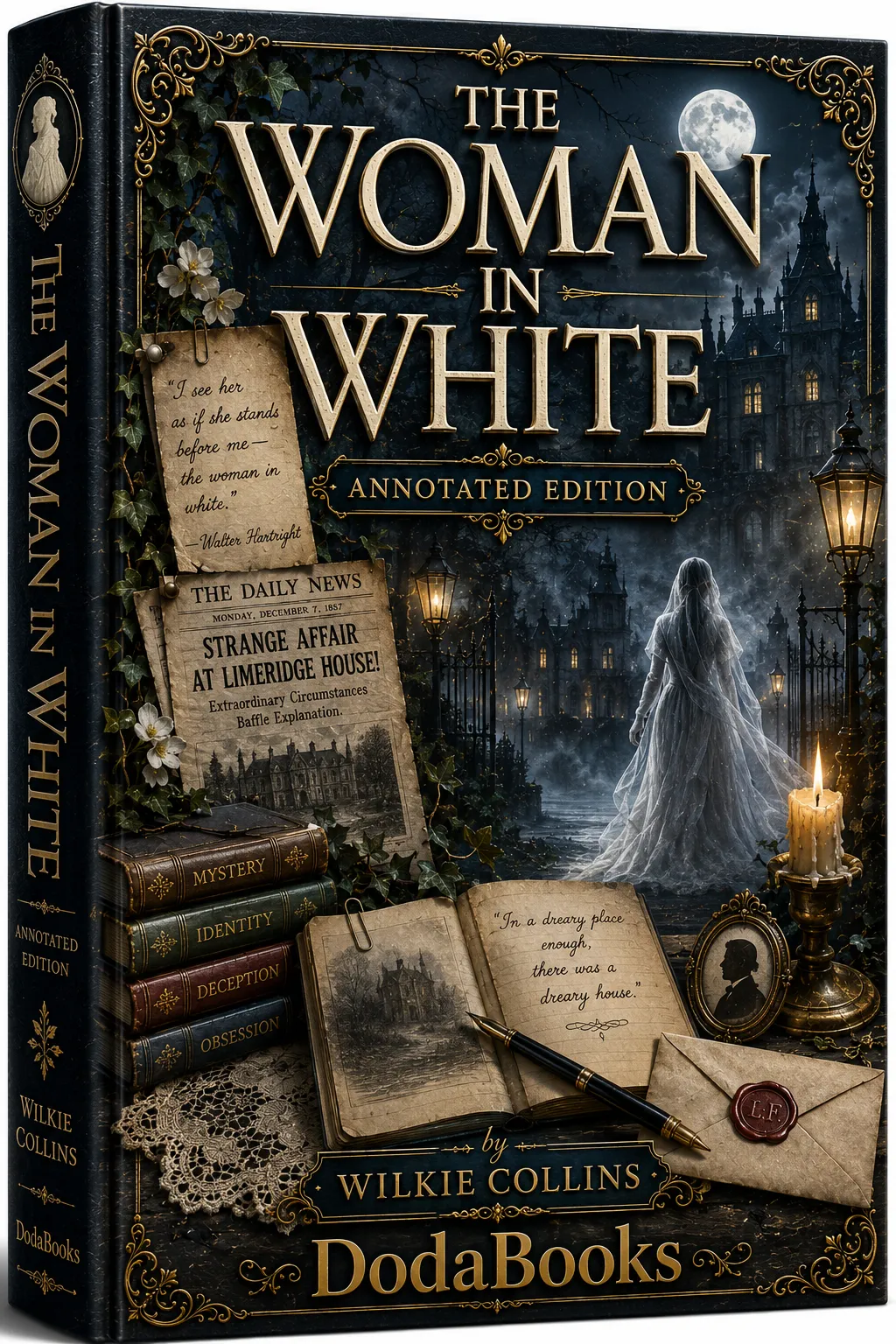
How to conquer it: Understand that Sir Percival is not merely being “mean”; he is weaponizing real English marriage laws against his wife. An annotated edition like the DodaBooks Annotated Edition provides instant notes whenever a legal mechanism appears.
3. Pacing and Serial Installment Architecture
Because Collins wrote the novel in weekly installments for Dickens’s magazine All the Year Round, every chapter is engineered with psychological hooks, dramatic revelations, and suspenseful chapter endings.
However, the pacing is not a monotonous sprint. It is structured into three distinct rhythms:
- First Epoch (Limmeridge House): A slow-burn, atmospheric mystery establishing the haunting encounter on Hampstead Heath, Walter’s forbidden love for Laura, and the dark premonitions surrounding Sir Percival.
- Second Epoch (Blackwater Park): A claustrophobic gothic thriller. Marian and Laura are trapped in a decaying country estate, surrounded by surveillance, intercepted letters, and mounting dread. This epoch contains the most celebrated suspense sequences in 19th-century fiction.
- Third Epoch (London & Welmingham): An investigative detective hunt. Walter returns to London, pieces together the broken pieces of Laura’s identity, tracks down witnesses, and hunts through church archives to destroy Sir Percival and Count Fosco.
4. 19th-Century Vocabulary & Social Customs
While Collins avoids archaic Old English, he employs several period-specific terms common in the 1850s:
- Drawing Master: Walter Hartright is an educated artist hired to teach drawing to wealthy young ladies. While refined, he is socially inferior to the landed gentry, making his romance with Laura socially forbidden.
- Laudanum: A tincture of opium dissolved in alcohol, widely used in Victorian medicine as a sedative and painkiller (and heavily abused by both Count Fosco’s wife and Collins himself).
- Post-Chaise / Fly: Horse-drawn hired carriages used before and during the early railway era.
- The Secret Societies (The Brotherhood): Count Fosco’s background as an Italian political traitor fleeing carbonari-style revolutionary secret societies reflects the turbulent Italian unification (Risorgimento) movements of 1848–1860.
📅 The 14-Day Reading Schedule
To read The Woman in White smoothly without feeling overwhelmed by its 600-page length, follow this balanced two-week plan (reading approximately 40 to 45 pages per day):
+--------------------------------------------------------------------------------------------------------------------+
|                                    THE 14-DAY THE WOMAN IN WHITE READING PLAN                                      |
+------+-------------+------------------------------------+----------------------------------------------------------+
| DAY  | EPOCH       | SECTIONS COVERED                   | KEY PLOT MILESTONES                                      |
+------+-------------+------------------------------------+----------------------------------------------------------+
| 01   | Epoch 1     | Walter Hartright (Chapters 1–8)    | Hampstead Heath meeting with Anne; arrival at Limmeridge |
| 02   | Epoch 1     | Walter Hartright (Chapters 9–15)   | Walter falls for Laura; the mysterious warning letter    |
| 03   | Epoch 1     | Gilmore & Hartright (Ch. 1–3)      | Gilmore debates marriage settlements; Walter departs     |
| 04   | Epoch 2     | Marian's Diary (Part 1, Ch. 1–3)   | Arrival at Blackwater Park; introduction of Count Fosco  |
| 05   | Epoch 2     | Marian's Diary (Part 1, Ch. 4–6)   | Glyde's violent financial demands; Laura resists signing |
| 06   | Epoch 2     | Marian's Diary (Part 1, Ch. 7–9)   | Marian climbs onto the roof; overhears Fosco & Glyde     |
| 07   | Epoch 2     | Marian & Postscripts (Ch. 10–end)  | Marian collapses with fever; the web tightens            |
| 08   | Epoch 2     | Housekeeper & Cook Testimonies     | Laura leaves Blackwater; the reported death in London    |
| 09   | Epoch 3     | Walter Hartright (Part 1, Ch. 1–4) | Walter visits Laura's tomb; the shocking revelation      |
| 10   | Epoch 3     | Walter Hartright (Part 1, Ch. 5–8) | Walter, Marian, and Laura live secretly in London        |
| 11   | Epoch 3     | Walter Hartright (Part 1, Ch. 9–11)| Walter investigates the Old Welmingham church vestry     |
| 12   | Epoch 3     | Walter Hartright (Ch. 12–end)      | The vestry fire; the destruction of Sir Percival Glyde   |
| 13   | Epoch 3     | Confrontation & Fosco's Narrative | Walter confronts Fosco; Fosco's theatrical confession   |
| 14   | Epoch 3     | Conclusion & Postscripts           | The Morgue in Paris; Laura restored; Walter's triumph   |
+------+-------------+------------------------------------+----------------------------------------------------------+
💡 Top 3 Tips for First-Time Readers
- Pay Close Attention to Dates: Whenever a narrator begins an entry with a specific date and time (e.g., “July 24th, 1850”), jot it down or take mental note. The resolution of the novel rests entirely on establishing an ironclad alibi and exposing a 48-hour gap in the villains’ timeline.
- Embrace Marian Halcombe as the Hero: Marian is widely hailed as one of the most brilliant characters in Victorian literature. Watch how she employs deduction, courage, and psychological acumen long before Sherlock Holmes ever picked up a magnifying glass.
- Use an Annotated Edition for Legal Mechanisms: Don’t get slowed down guessing how 1850s property law worked. Reading with the DodaBooks Annotated Edition gives you immediate, visual annotation cards that explain every legal twist right on the page.
❓ Frequently Asked Questions
Is The Woman in White suitable for readers who have never read Victorian literature?
Yes! In fact, The Woman in White is often recommended as the single best entry point into Victorian literature alongside Arthur Conan Doyle and Robert Louis Stevenson. Because it was written as popular sensation fiction, its plot moves rapidly with gripping cliffhangers, shocking twists, and memorable villains, avoiding the dry pedagogical lectures found in some 19th-century novels.
How does the reading difficulty compare to Wilkie Collins's The Moonstone?
Both novels share a similar difficulty level (around 5.5 / 10) and both use multiple narrators. The Moonstone is slightly more lighthearted and focuses on a classic country-house jewel heist, while The Woman in White has a darker, more intense psychological and gothic atmosphere centered on identity theft and institutional confinement.
Why are there so many different narrators in the book?
Collins designed the novel as a legal case file. In the 1850s, English courts required multiple corroborating witness testimonies to establish fraud. By structuring the novel as a series of first-person witness statements, Collins puts the reader in the role of a jury weighing evidence. To understand each narrator’s role, consult our The Woman in White Characters Explained.
Can I read a chapter summary before reading the book?
If you want an overview of the three Epochs or need help keeping track of the multi-narrator testimonies while reading, explore our detailed The Woman in White Summary by Epoch & Chapter.
What is the best edition of The Woman in White to buy?
For everyday readers who want clear typography, interactive annotation cards decoding Victorian legal statutes, and universal DRM-free compatibility across devices, we recommend the DodaBooks Annotated Edition. Read our complete buying comparison in Where to Buy The Woman in White: Best Editions.
📚 Related Articles
Curious about other Victorian sensation classics and mysteries? Explore our The Hound of the Baskervilles Guide and our The Phantom of the Opera Guide.
👗 Experience Collins’s Labyrinth With Every Secret Decoded
Read the thriller that founded sensation fiction in an authoritative, distraction-free edition:
- ✅ Complete, unabridged 1859–60 text across all three Epochs and witness testimonies
- ⚖️ Victorian legal context decoded — understand marriage settlements, coverture, and asylums
- 🗂️ Passage-specific annotation cards revealing historical clues and narrative timelines
- 🔒 DRM-free EPUB format — readable on any Kindle, Kobo, iPad, or mobile device
- 📥 Instant digital download delivered directly after checkout