Is The Thirty-Nine Steps Hard to Read? Reading Difficulty, Scottish Slang & Study Guide
When modern readers pick up John Buchan’s The Thirty-Nine Steps, they are often surprised by just how rapidly it moves. Unlike many sprawling Victorian novels loaded with multi-page descriptive passages and philosophical digressions, Buchan’s 1915 novella is lean, kinetic, and razor-sharp. At approximately 41,000 words across ten compact chapters, it can comfortably be devoured in an afternoon or over a single weekend.
However, calling The Thirty-Nine Steps “easy” overlooks several genuine hurdles that trip up contemporary readers. Buchan wrote during the opening weeks of the First World War for an audience steeped in the geography of the Scottish Borders, the anxieties of the 1914 European political crisis, and the nuances of the British class system. Furthermore, the dialogue is rich in Scots dialect terms, archaic Edwardian idioms, and specialized railway and mining terminology.
This comprehensive reading difficulty guide analyzes the text’s readability scores, provides a vital glossary of Scottish and Edwardian vocabulary, evaluates narrative pacing, and offers an accessible 7-day reading schedule to help you master Buchan’s classic shocker.
| Assessment Category | Measurement / Rating | Practical Reading Implication |
|---|---|---|
| Lexile Measure | 980L–1040L | Comparable to The Hound of the Baskervilles and The Great Gatsby; accessible to high schoolers and adults |
| Reading Age / Grade Level | Grades 8–10 (Age 13+) | Vocabulary requires occasional dictionary lookups; syntax is direct, active, and fast-paced |
| ATOS Book Level | 6.8 | Moderate syntactic complexity balanced by brisk first-person adventure narrative |
| Word Count / Length | ~41,000 words (10 chapters) | Short novella length; typically 110–130 pages depending on typography |
| Estimated Reading Time | 3 to 4 hours | Ideal for a single weekend read or daily 30-minute commuting segments |
| Primary Difficulties | Scots vernacular, 1914 geopolitics, Edwardian slang | Regional vocabulary (moss-hags, whaups) and pre-WWI naval deployment references require contextual notes |
📊 Readability Metrics: How Difficult Is the Text?
Quantitative readability formulas place The Thirty-Nine Steps in the upper-intermediate category for young readers and light-to-moderate reading for adults.
                      [READABILITY METRIC BENCHMARKS]
                                     │
      ┌──────────────────────────────┼──────────────────────────────┐
      ▼                              ▼                              ▼
[LEXILE: 1010L]              [FLESCH-KINCAID: 7.4]          [PAGE COUNT: ~120]
- Balanced sentence length    - Clean narrative syntax      - Short, compact novella
- Moderate vocabulary range   - High action density         - Zero narrative bloat
- Clear chronological drive   - First-person clarity        - 3–4 hours completion
1. Lexile Framework: ~1010L
A score of 1010L indicates that while individual sentences are relatively straightforward, the lexical density—the proportion of specialized or non-modern words—is elevated. Readers will encounter vocabulary common in 1914 but largely absent from modern casual speech (brougham, scullery, subaltern, billet).
2. Syntactic Directness vs. Victorian Prolixity
Unlike his contemporaries Henry James or Joseph Conrad, whose prose features intricate subordinating clauses and psychological convolutions, John Buchan was trained as a journalist, barrister, and war correspondent. His prose is vigorous, athletic, and stripped of unnecessary ornament:
“I walked out of the station and found a quiet-looking cab. I drove to the park, where I got out and walked… My heart was beating like a sledge-hammer, but my head was cool.”
Buchan favors active verbs and concrete sensory details, making the novel read more like a contemporary screenplay than an Edwardian museum piece.
🗣️ The Linguistic Hurdles: Scottish Dialect & Edwardian Slang
The single greatest barrier for modern readers is Buchan’s unrestrained use of regional Scots vernacular and early-twentieth-century colloquialisms. When Hannay escapes into the hills of Galloway, he interacts with shepherds, road-menders, and local innkeepers whose dialogue reflects authentic regional speech patterns.
                  ┌─────────────────────────────────────────┐
                  │    LINGUISTIC HURDLES IN THE NOVEL      │
                  └────────────────────┬────────────────────┘
                                       │
         ┌─────────────────────────────┼─────────────────────────────┐
         ▼                             ▼                             ▼
┌───────────────────┐        ┌───────────────────┐         ┌───────────────────┐
│ Scottish Regional │        │ Edwardian Social  │         │ Pre-WWI Military  │
│ Topography & Slang│        │ & Class Idioms    │         │ & Geopolitical Jargon│
│ - moss-hag, whaup │        │ - ticket-of-leave │         │ - First Sea Lord  │
│ - clachan, burn   │        │ - bammock, bobby  │         │ - mobilization,   │
│ - shieling, stot  │        │ - sovereign, quid │         │   Grand Fleet     │
└───────────────────┘        └───────────────────┘         └───────────────────┘
Essential Scottish Scots & Topographical Glossary
- Moss-hag: A peat bog or dark, muddy pit in a moorland, often eroded by water and treacherous to traverse on foot.
- Burn: A fresh-water stream or brook flowing down from the hills.
- Whaup: The Scottish vernacular name for the Eurasian curlew, a moorland wading bird renowned for its eerie, mournful cry that frequently echoes across Hannay’s path.
- Clachan: A small hamlet, rural village, or cluster of farm cottages lacking a church or market.
- Shieling: A crude, seasonal hut or shelter used by shepherds during summer pasture grazing in the uplands.
- Sike: A tiny marshy rill or trickle of water through the heather.
- Knowe: A rounded hillock, knoll, or grassy mound.
- Plashy: Waterlogged, swampy, or marshy ground.
- Bammock: A Scottish term for striking or battering, or a heavy flat cake.
Essential Edwardian Colloquialisms & Social Terms
- Fed up: In 1914, this phrase was relatively fresh military and colonial slang meaning utterly bored, disgusted, or exhausted with one’s circumstances.
- Ticket-of-leave: A license allowing a convicted prisoner to be released from custody before the expiration of their sentence under ongoing police surveillance (parole).
- Sovereign / Half-sovereign: Gold coins worth one pound and ten shillings respectively; substantial sums of money in 1914 capable of purchasing days of labor or clothing.
- Roadman / Road-mender: A municipal day laborer employed to break rocks with a sledgehammer into gravel to maintain unpaved public carriage roads.
- Brougham / Dog-cart: Common horse-drawn carriages of the late Victorian and Edwardian era used for suburban and rural travel.
- Subaltern: A junior commissioned military officer below the rank of captain (such as a second lieutenant or lieutenant).
🌍 The Historical Context: The Powder Keg of Summer 1914
To appreciate the book’s tension, modern readers must understand the historical atmosphere in which Buchan set his story.
The novel takes place between May and July 1914, the exact months preceding the outbreak of World War I. While modern readers know that the assassination of Archduke Franz Ferdinand in Sarajevo on June 28, 1914, triggered the conflict, Buchan’s characters are focused on a fictional equivalent: the impending murder of Constantine Karolides, the Premier of Greece.
Historical Context Notes:
- The Balkan Crisis: In 1914, southeastern Europe was viewed as the “powder keg of Europe.” Minor political assassinations in the Balkans were widely feared as catalysts that would trigger reciprocal military alliances between Germany, Austria-Hungary, Russia, France, and Britain.
- Naval Superiority and the Grand Fleet: The supreme guarantee of the British Empire’s survival was the Royal Navy. If German intelligence obtained the deployment charts of the British fleet, the German High Seas Fleet could strike a decapitating blow against the Channel defenses, clearing the way for a cross-Channel invasion.
- The Spy Scare: Between 1908 and 1914, Britain experienced widespread public paranoia regarding covert German espionage networks operating inside the country. Buchan tapped directly into these collective public fears, transforming tabloid rumors into high-stakes narrative reality.
⚡ Narrative Pacing: Why The Thirty-Nine Steps Never Flags
One of the great pleasures of reading The Thirty-Nine Steps is its relentless narrative velocity. Buchan structure the narrative around three classic storytelling engines:
[THE CATALYST: Scudder's Murder]
         │
         ▼
[THE TIME CLOCK: June 15 Assassination & High Tide 10:17 p.m.]
         │
         ▼
[THE DOUBLE JEOPARDY: Hunted by Scotland Yard AND The Black Stone]
         │
         ▼
[THE RAPID CAMOUFLAGE: Milkman → Candidate → Roadman → Gentleman]
         │
         ▼
[THE CLIMAX: 39 Steps at Trafalgar Cottage]- The Time Clock: From Chapter 1 onward, Hannay operates under strict, immovable deadlines. First, he must survive until June 15th to avert Karolides’ death; later, he must solve Scudder’s riddle before the tide turns at 10:17 p.m. on the Kentish coast.
- Double Jeopardy: Hannay is simultaneously hunted by two opposing forces: Scotland Yard detectives who believe he is a ruthless murderer, and the Black Stone’s foreign operatives who know he holds their cipher notebook. He can seek sanctuary with neither side.
- Episodic Variety: Each chapter presents a self-contained tactical problem requiring a distinct solution: outwitting a suspicious landlord, fleeing a reconnaissance monoplane, delivering an impromptu political speech, or blowing open an iron cellar door with homemade cordite.
📅 The 7-Day Reading Plan: Master Buchan in One Week
Because the novel is barely 120 pages, an aggressive reader can finish it in an afternoon. However, breaking it down into a structured 7-day plan allows readers to absorb the historical background and appreciate the intricate clues without rushing.
| Day | Chapters | Assigned Reading | Page Count | Reading Focus & Discussion Points |
|---|---|---|---|---|
| Day 1 | Chapter 1 | The Man Who Died | ~12 pages | Hannay’s colonial background; Scudder’s warning; the knife murder in Portland Place |
| Day 2 | Chapter 2 | The Milkman Sets on the Road | ~10 pages | The milkman disguise; St. Pancras Station; train journey to Galloway |
| Day 3 | Chapters 3–4 | The Literary Innkeeper & The Radical Candidate | ~22 pages | The moorland chase; hiding with the innkeeper; the unexpected political speech |
| Day 4 | Chapter 5 | The Adventure of the Spectacled Roadman | ~14 pages | Alexander Turnbull’s trade; stone-breaking; decoding Scudder’s black notebook |
| Day 5 | Chapter 6 | The Adventure of the Bald Archaeologist | ~16 pages | Entering the enemy lair; the hawk-eyed leader; the explosive cellar breakout |
| Day 6 | Chapters 7–8 | The Dry-Fly Fisherman & The Black Stone | ~24 pages | Meeting Sir Walter Bullivant; Karolides’ death; Admiralty council infiltrated |
| Day 7 | Chapters 9–10 | The Thirty-Nine Steps & Climax at Bradgate | ~22 pages | Solving the tide table riddle; counting 39 steps; the cliff-top card game showdown |
🔍 How Annotated Editions Transform the Experience
Attempting to read The Thirty-Nine Steps in a bare-bones public domain edition can occasionally leave readers puzzled by unexplained historical references, archaic railway logistics, and thick regional dialects.
An annotated edition bridges these gaps by providing:
- Instant Scots Dialect Glosses: Clear, on-the-spot translations of words like moss-hags and whaups right alongside the text.
- Topographical Maps & Route Outlines: Visual maps of Dumfriesshire, Galloway, and the Kent coastline that ground Hannay’s journey in real British geography.
- Espionage Decoders: Explanations of how Scudder’s ciphers work and why pre-WWI naval mobilization schedules were of supreme strategic importance.
- Biographical & Literary Context: Notes tracing John Buchan’s transition from sickly bed-ridden author to Britain’s Director of Information during the Great War.
❓ Frequently Asked Questions
Is The Thirty-Nine Steps suitable for teenage readers?
Yes, absolutely. The novel contains no graphic gore, explicit violence, or coarse language. Its fast-paced plotting, inventive escapes, and historical intrigue make it an ideal introductory classic for middle and high school students (ages 13 and up).
Do I need to understand British politics to follow the plot?
Not at all. While the background involves real pre-WWI political tensions and party dynamics (such as the Free Trade vs. Protectionism debate in Chapter 4), the core story is a pure, universal adventure of survival, disguise, and suspense that anyone can enjoy without prior knowledge of British parliamentary history.
How does the novel's length compare to other spy classics?
At roughly 41,000 words, The Thirty-Nine Steps is unusually brief—about half the length of an average contemporary thriller and significantly shorter than Victorian detective novels. Buchan deliberately designed it as an unpadded "shocker" intended to be read in a single burst of energy.
Is the book difficult to read on an e-reader?
The prose reads wonderfully on modern e-readers, provided you choose an edition with proper typography and formatting. High-quality annotated EPUB editions make reading even smoother by integrating vocabulary definitions directly into the reading flow, eliminating the need to search an external dictionary.
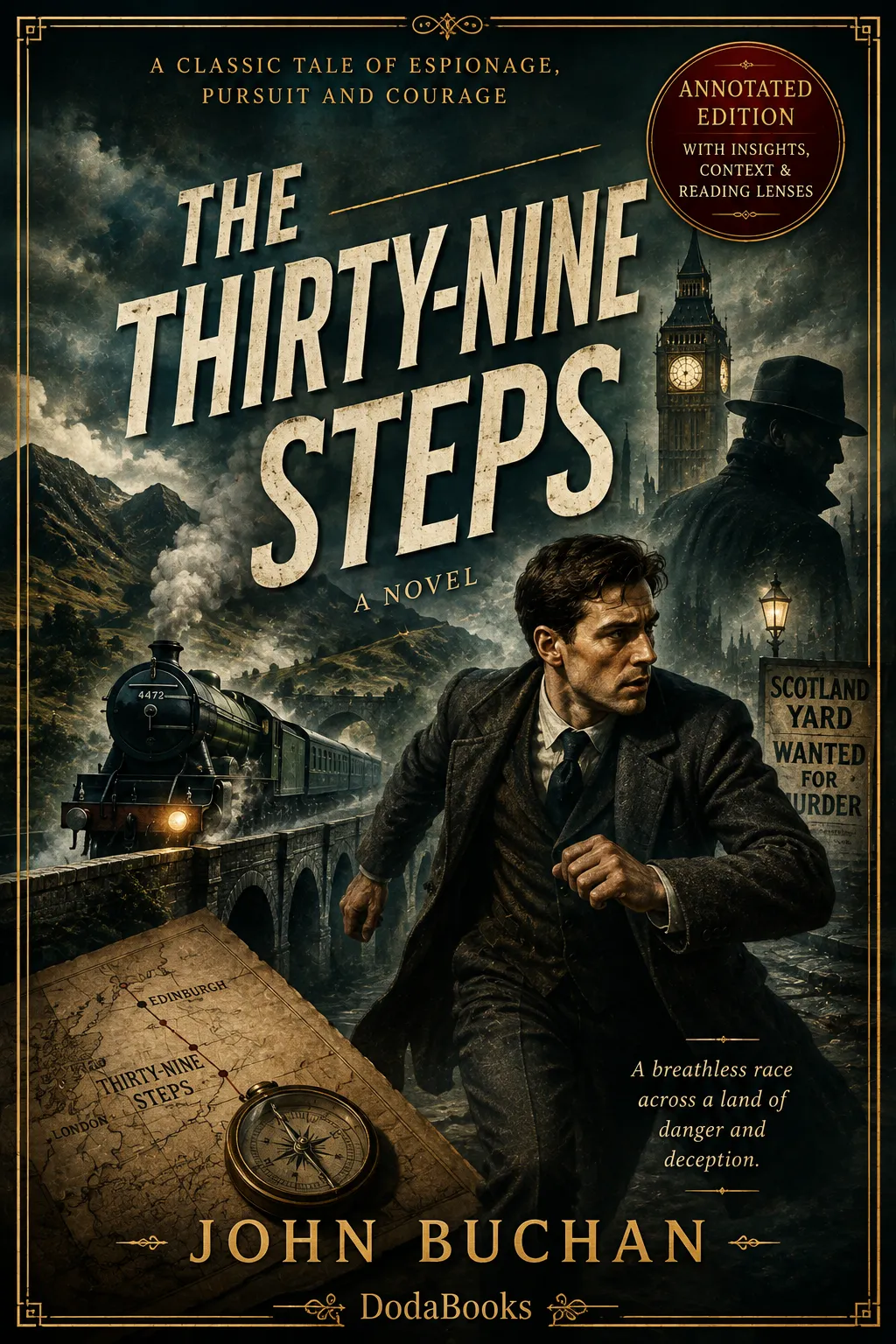
🕵️ Master The Thirty-Nine Steps with Complete Reading Notes
Read John Buchan’s pulse-pounding classic with every Scottish term, historical reference, and disguise decoded. The DodaBooks Annotated Edition includes:
- ✅ Complete Unabridged 1915 Text — The original 10-chapter masterpiece in pristine layout
- 🗂️ 50 Color-Coded Annotation Cards — Instant translations of Scots vernacular and Edwardian slang
- 🗺️ Geographical Route Tracking — Follow Hannay from London to Galloway and Kent
- 🔒 100% DRM-Free Ownership — Enjoy forever on Kindle, Kobo, iPad, and Android
- 📥 Instant EPUB Delivery — Download your digital copy immediately