Is The Secret Agent Hard to Read? Reading Difficulty & Study Guide
When readers approach Joseph Conrad, they are often warned about the dense, seafaring vocabulary of Lord Jim or the feverish psychological obscurity of Heart of Darkness. Because The Secret Agent (1907) is set entirely on dry land in the gas-lit streets of London and revolves around an anarchist bomb plot, many expect a conventional, fast-paced Edwardian detective thriller.
They are quickly startled to discover that The Secret Agent is something far more demanding: a brilliantly disorienting masterpiece of non-linear storytelling, corrosive irony, and suffocating psychological realism.
With a Lexile score of approximately 1060L, the novel is linguistically sophisticated and structurally complex. Conrad scrambles the chronological sequence of events, withholds the central catastrophe until its aftermath is already being examined, and maintains a tone of cool, pitiless irony that never tells the reader what to feel.
This comprehensive reading difficulty guide breaks down the novel’s readability metrics, analyzes its primary narrative hurdles, and provides an actionable 10-day reading schedule to help you conquer Conrad’s greatest political novel.
| Metric | Score / Level | Context & Explanation |
|---|---|---|
| Lexile Measure | 1060L–1100L | College and advanced high school reading level |
| Total Word Count | ~92,000 words | 13 Chapters + 1920 Author’s Note; ~280–300 printed pages |
| Flesch-Kincaid Grade Level | Grade 10.4 | Complex multi-clause sentences, passive constructions, and French syntax |
| Estimated Reading Time | 6–8 hours | Average pace of 200–250 words per minute across 10 days |
| Primary Challenge | Non-Linear Timeline | The bombing occurs off-page between Chapters 3 and 4; Chapters 6–10 jump back and forth |
| Recommended Age | 16+ (High School to Adult) | Mature themes of terrorism, murder, suicide, and domestic horror |
🧭 The Core Narrative Hurdle: Conrad’s Scrambled Chronology
The single greatest source of confusion for first-time readers is Conrad’s non-linear timeline. In a traditional detective novel, events occur in strict chronological order: the conspiracy is hatched, the bomb is planted, the explosion occurs, the police investigate, and the culprit is brought to justice.
Conrad deliberately fractures this order to keep the reader as disoriented as the police:
┌─────────────────────────────────────────────────────────────┐
│  Chronological Reality vs. Narrative Sequence               │
├─────────────────────────────────────────────────────────────┤
│  Order in the Book:                                         │
│  Ch. 1–3: The Plot Ordered (Morning, Day 1)                 │
│  Ch. 4–5: After the Bombing (Afternoon, Day 2)              │
│  Ch. 6–7: Police Examine the Body (Evening, Day 2)          │
│  Ch. 8: Flashback — Winnie's Mother Leaves (A Week Earlier) │
│  Ch. 9: Flashback — Verloc & Stevie in the Country          │
│  Ch. 10: Police Interrogate Verloc (Evening, Day 2)         │
│  Ch. 11: The Sofa Murder (Late Evening, Day 2)              │
│  Ch. 12–13: The Escape, Suicide & Aftermath                 │
└─────────────────────────────────────────────────────────────┘
Notice what Conrad has done: The explosion itself is never described directly!
In Chapter 3, the anarchists talk in the parlor. In Chapter 4, the bomb has already detonated hours earlier in Greenwich Park, and we only learn about it through secondhand gossip between Ossipon and The Professor. Conrad intentionally hides the catastrophe to force the reader to focus not on the pyrotechnic spectacle of terrorism, but on its horrific, quiet human consequences.
🎭 Conrad’s Corrosive Irony: How to Read the Tone
The second major hurdle is Conrad’s tone of relentless, detached irony.
Conrad almost never speaks directly in his own voice. Instead, he treats all human posturing—whether from high-ranking British cabinet ministers, pompous foreign diplomats, fanatical bomb-makers, or lazy shopkeepers—with razor-sharp satirical skepticism:
- When Conrad describes Verloc as a “thoroughly domestic man,” he means that Verloc is so lazy that he treats his home as a warm blanket to shield him from physical labor.
- When he calls the book “A Simple Tale,” it is a supreme black joke: the plot involves a multi-layered web of deceit where nobody understands anyone else.
- When Chief Inspector Heat observes that “the terrorist and the policeman come from the same basket,” Conrad is exposing how law enforcement and criminal underworlds rely on each other to maintain their social importance.
Reading Tip: Never take Conrad’s adjectives at face value. If he calls an action “noble,” “respectable,” or “patriotic,” look closely at the scene: he is almost certainly exposing a self-serving lie.
🏛️ Edwardian Linguistic & Bureaucratic Hurdles
1. Polish and French Cadences in English Prose
English was Joseph Conrad’s third language (after Polish and French). Although Conrad was a prose genius, his sentences reflect French syntactic structures:
- Long, periodic sentences with multiple qualifying subordinate clauses.
- Heavy reliance on abstract Latinate nouns rather than simple Anglo-Saxon action verbs.
- Deliberate withholding of the subject or verb until the very end of the sentence:
“In the silence of the room, broken only by the steady, quiet ticking of the clock on the mantelpiece, Mrs. Verloc listened to the heavy breathing of her husband, whose eyes were closed in that profound and comfortable slumber which is the reward of an easy conscience.”
2. Edwardian Political & Legal Jargon
Conrad writes for an audience intimately familiar with the machinery of 1907 British government:
- “Ticket-of-Leave”: A Victorian parole license granted to convicts before the full expiration of their sentence (as in “Michaelis, the ticket-of-leave apostle”).
- Special Crime Division vs. CID: The internal jurisdictional rivalry between street detectives (Heat) and administrative commissioners.
- Cesare Lombroso’s Phrenology: Comrade Ossipon’s obsessive references to “cranial asymmetry,” “degeneracy,” and earlobes reflect the fashionable 19th-century pseudo-science of criminal anthropology.
Conquer Conrad's non-linear timeline and complex vocabulary with on-page annotations.
📖 Get the Annotated Edition at DodaBooks →📅 The 10-Day Reading Plan (Master the Novel in Under Two Weeks)
At approximately 92,000 words across 13 chapters, The Secret Agent is best read in a structured 10-day schedule averaging about 25 to 30 minutes (one to two chapters) per day:
| Day | Chapters | Setting & Key Events | Reading Focus |
|---|---|---|---|
| Day 1 | Chapters 1–2 | The Soho shop; Verloc visits the foreign embassy; Vladimir’s ultimatum | Notice Verloc’s laziness and Vladimir’s aristocratic cruelty |
| Day 2 | Chapter 3 | Anarchist gathering in the parlor; Stevie draws circles in the kitchen | Pay attention to Stevie’s extreme sensitivity to suffering |
| Day 3 | Chapters 4–5 | The Silenus beer-hall; The Professor’s flask bomb; Heat meets the Professor | Notice the sudden time jump: the bombing has already occurred! |
| Day 4 | Chapters 6–7 | Police morgue; Heat finds Stevie’s coat label; Scotland Yard rivalry | Observe the bureaucratic self-interest between Heat and the Commissioner |
| Day 5 | Chapter 8 | Flashback: Winnie’s mother’s journey to the almshouse in the decrepit cab | Savor this quiet, heartbreaking chapter—it is the emotional key to the book |
| Day 6 | Chapters 9–10 | Flashback: Verloc takes Stevie to the country; Commissioner in disguise | Understand Winnie’s tragic misunderstanding of Verloc’s motives |
| Day 7 | Chapter 11 (Part 1) | Heat arrives at the shop; Winnie sees the burnt coat label | Watch the veil drop from Winnie’s eyes |
| Day 8 | Chapter 11 (Part 2) | Verloc’s self-pity on the sofa; Winnie takes the carving knife | Experience the chilling, slow-motion domestic murder |
| Day 9 | Chapter 12 | Winnie’s panic in the street; Ossipon’s cowardly betrayal on the train | Observe Ossipon’s pseudo-scientific confidence shatter into cowardice |
| Day 10 | Ch. 13 & Author’s Note | The newspaper report of suicide at sea; The Professor walks into the crowd | Read Conrad’s 1920 Author’s Note to understand his full artistic vision |
The Chronology Key
A quick-reference timeline diagram mapping out exactly when each chapter takes place relative to the Greenwich explosion.
Decoding Conrad's Irony
How to identify when Conrad is mocking his characters' self-serving moral justifications and bureaucratic pride.
The Real 1894 Greenwich Incident
A historical summary of French anarchist Martial Bourdin and the actual bomb that detonated outside the Royal Observatory.
The Symbolism of Circles
Explore Stevie's obsessive spiral drawings as an artistic metaphor for the dizzying, trapped nature of the characters.
Victorian Police Politics
A breakdown of the jurisdictional tensions between the Home Office, CID, and Scotland Yard's Special Crime Division.
College Essay Prompts
Six provocative discussion questions exploring domestic terrorism, gender roles, and early modernist narrative structure.
❓ Frequently Asked Questions
Why is The Secret Agent considered easier than Heart of Darkness or Nostromo?
*The Secret Agent* is set in a familiar urban landscape (London) rather than a remote jungle or fictional South American republic, and it centers on an immediate domestic murder mystery rather than philosophical sea voyages. While its irony and chronology are challenging, its plot momentum is gripping.
Why didn't Conrad show the Greenwich explosion in a dramatic scene?
Conrad deliberately avoided pyrotechnic melodrama. By withholding the explosion and showing only the bloody fragments in a police basement, Conrad forces the reader to confront the real, visceral human cost of terrorism rather than treating violence as cinematic entertainment.
What does the title "The Secret Agent" actually mean?
The title is an ironic double-meaning. On the surface, it refers to Adolf Verloc, who is a paid spy for a foreign embassy and an informant for Scotland Yard. Symbolically, however, every character acts as a "secret agent" hiding their true identity and motives from their own family and colleagues.
How long does it take an average reader to finish the novel?
At approximately 92,000 words, an average adult reading at 250 words per minute will complete *The Secret Agent* in roughly 6 to 8 hours. Following our 10-day reading schedule requires just 25 to 30 minutes of reading per day.
Why are annotations especially helpful for this book?
Conrad was writing about the live politics of 1907. Modern readers unfamiliar with Edwardian police divisions, the real Greenwich bombing, Cesare Lombroso's phrenology, or the British asylum system miss dozens of crucial satirical points without on-page footnotes.
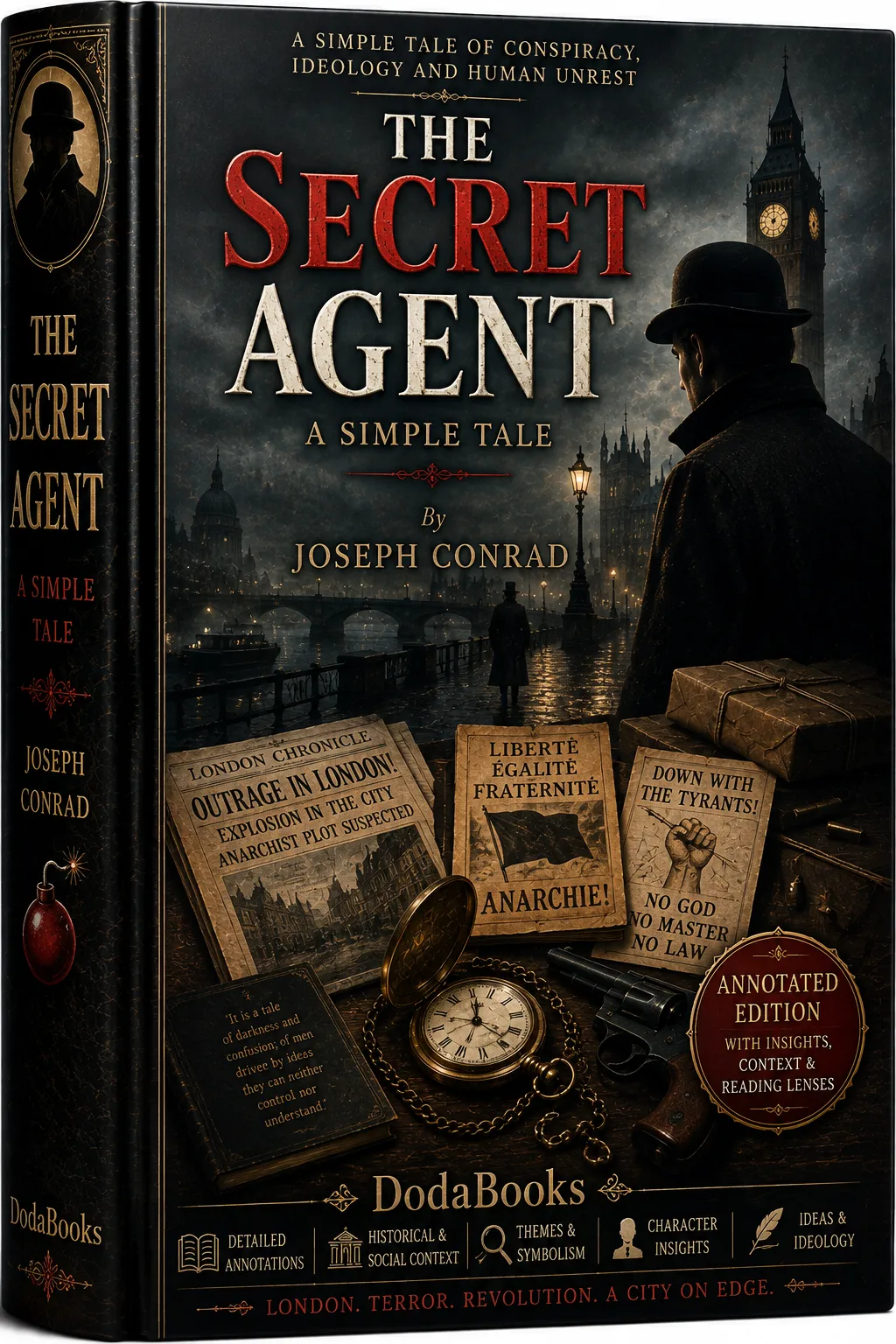
⚗️ Read Conrad’s Thriller with Complete Comprehension
Don’t let non-linear chronology or Victorian police politics confuse you. The DodaBooks Annotated Edition of The Secret Agent gives you:
- ✅ Complete Unabridged 1907 Text — All 13 chapters plus the 1920 Author’s Note
- 📜 Over 250 Explanatory Footnotes — Decoded Edwardian politics, London geography, and timeline cues
- ✒️ Typeset for Modern E-Readers — Beautiful typography, clean margins, and clear chapter links
- 🔒 100% DRM-Free Ownership — Yours permanently across Kindle, Kobo, iPad, and desktop
- 📥 Instant EPUB Delivery — Download your digital copy immediately