Is The Problem of Cell 13 Hard to Read? Reading Difficulty, Clues & Study Guide
Compared to sprawling Victorian multi-plot novels or dense Renaissance treatises, Jacques Futrelle’s The Problem of Cell 13 is extraordinarily accessible. Written in 1905 for the daily serialized readers of the Boston American, Futrelle’s prose is lean, journalistic, fast-paced, and largely free of ornate literary digressions. At approximately 9,500 words, an average reader can finish the entire story in a single sitting of roughly an hour and a half.
However, calling The Problem of Cell 13 a “simple read” misunderstands its specific genre demands. Futrelle was a pioneer of the fair-play puzzle mystery. Every seemingly casual sentence in the opening pages—the professor’s request for tooth powder, a mention of an uninsulated electric lamp, or the behavior of a sewer rat—is a load-bearing clue in an intricate scientific escape engine. Furthermore, modern readers unfamiliar with early-twentieth-century electrical wiring, chemical reagents, and Edwardian currency values can easily miss the ingenious mechanics of Van Dusen’s escape.
This comprehensive reading difficulty guide analyzes the readability metrics of Futrelle’s classic novelette, breaks down its period scientific vocabulary, explains fair-play locked-room mystery conventions, and provides a structured 5-day study plan to help you master the puzzle.
| Assessment Category | Measurement / Benchmark | Practical Reading Implication |
|---|---|---|
| Lexile Measure | 960L–1030L | Comparable to Arthur Conan Doyle’s The Hound of the Baskervilles and Agatha Christie’s Poirot mysteries |
| Reading Age / Grade Level | Grades 8–10 (Age 13+) | Accessible to middle schoolers, high schoolers, and adults; excellent introduction to classic mystery |
| ATOS Book Level | 6.7 | Moderate syntactic complexity balanced by rapid dialogue and active narrative velocity |
| Total Word Count | ~9,500 words | Novelette length; approximately 28–35 pages in standard print format |
| Estimated Reading Time | 1 to 2 hours | Perfect for a single evening read, a daily commute, or a weekend study session |
| Primary Difficulties | 1905 electrical/chemical concepts, fair-play clue spotting, archaic prison terminology | Readers benefit from annotations explaining early arc-lighting, nitric acid chemistry, and currency |
📊 Readability Metrics: How Difficult Is the Text?
Quantitative readability formulas place The Problem of Cell 13 squarely in the intermediate reading category, making it an ideal entry point for readers new to early twentieth-century American fiction.
                      [READABILITY BENCHMARKS: CELL 13]
                                     │
      ┌──────────────────────────────┼──────────────────────────────┐
      ▼                              ▼                              ▼
[LEXILE: ~990L]              [FLESCH-KINCAID: 6.8]          [PAGE COUNT: ~30]
- Direct journalistic syntax  - Short, punchy dialogue      - Self-contained novelette
- Conversational pacing       - Active, kinetic narrative   - Zero descriptive filler
- Clear chronological drive   - High puzzle engagement      - 90-minute completion
1. Journalistic Clarity vs. Victorian Prolixity
Before becoming a popular fiction author, Jacques Futrelle spent years working as a newspaper editor and reporter for the Boston American, The Boston Post, and The New York Herald. That journalistic training is evident on every page:
- Sentences are concise, active, and forward-moving.
- Paragraphs rarely exceed four or five sentences.
- Exposition is delivered through sharp, realistic dialogue between Van Dusen, Warden Baker, and Hutchinson Hatch rather than long interior monologues.
Unlike Edgar Allan Poe’s dense, gothic prose in “The Murders in the Rue Morgue,” Futrelle’s prose feels strikingly modern. The narrative moves with the velocity of an early twentieth-century silent film or radio drama.
⚡ The Primary Reading Hurdles: 1905 Technology & Science
The real challenge in The Problem of Cell 13 lies not in difficult vocabulary, but in historical technology. Because Van Dusen’s escape relies on early twentieth-century physics, chemistry, and municipal infrastructure, modern readers must understand the physical realities of 1905 America.
                  ┌─────────────────────────────────────────┐
                  │    HISTORICAL SCIENTIFIC HURDLES        │
                  └────────────────────┬────────────────────┘
                                       │
         ┌─────────────────────────────┼─────────────────────────────┐
         ▼                             ▼                             ▼
┌───────────────────┐        ┌───────────────────┐         ┌───────────────────┐
│ Early Electrical  │        │ Corrosive Chemical│         │ Municipal Urban   │
│ Arc Lighting      │        │ Reagents          │         │ Infrastructure    │
│ - Uninsulated wire│        │ - Nitric acid     │         │ - Gravity-fed     │
│ - Short-circuiting│        │   dissolves iron  │           sewer conduits    │
│   fuse blowouts   │        │ - Dough & shoe-ink│         │ - Tidal river flow│
└───────────────────┘        └───────────────────┘         └───────────────────┘
1. Early Electrical Systems & Arc Lighting
When Van Dusen tampers with the electric light in Cell 13, modern readers accustomed to sealed, insulated low-voltage LED fixtures may wonder how this was possible:
- In 1905, electric lighting in public institutions was still relatively primitive. Wires running to ceiling sockets were often bare or insulated only with cotton-wrapped rubber.
- High-voltage direct current (DC) or alternating current (AC) ran through exposed fuse blocks.
- By short-circuiting the two exposed leads with a smuggled wire, Van Dusen could intentionally blow out the main fuse, generating loud electrical pops, showers of sparks, and localized fires that caused immediate panic among the guards.
2. Nitric Acid and Chemical Corrosion
Van Dusen uses smuggled nitric acid ($HNO_3$) to weaken the steel bars of his window:
- In 1905, concentrated nitric acid was a common commercial reagent used by engravers and jewelers.
- Applied repeatedly to wrought iron or steel, nitric acid undergoes an aggressive chemical reaction, converting solid iron into soluble iron nitrate ($Fe(NO_3)_3$) and releasing reddish, fuming nitrogen dioxide gas.
- Over three days, the acid dissolved the iron at the joint, allowing Van Dusen to snap the weakened bar with modest physical pressure.
3. Edwardian Currency and Labor Economics
Throughout the story, Van Dusen throws five-dollar and ten-dollar bills out his window to bribe yard workers.
- In 1905, five dollars was equivalent to approximately $160 to $180 in modern purchasing power—representing nearly half a week’s wages for an unskilled day laborer.
- Understanding this economic reality explains why the yard laborers were so eager to risk their jobs to deliver Van Dusen’s mysterious linen notes to Hutchinson Hatch.
📖 Glossary of Period Terms in The Problem of Cell 13
| Period Term | Historical Definition (1905 Context) | Relevance to the Story |
|---|---|---|
| Turnkey | A prison guard or jailer in charge of the keys to cell doors | The front-line guards who inspect Cell 13 and report unusual noises |
| Death Tier / Death Cell | The isolated cellblock reserved for prisoners condemned to capital execution | Cell 13; the most secure, strictly guarded cell in Chisholm Prison |
| Shoe Blacking / Shoe Polish | A waxy, carbon-black paste used to clean and shine leather shoes | Mixed with water and tooth powder to create makeshift permanent ink |
| Tooth Powder | A dry, chalky powder (usually calcium carbonate) used before modern tube toothpaste | Mixed with shoe blacking to give body to Van Dusen’s improvised ink |
| Steeplejack | A skilled craftsman who climbs church spires, chimneys, and towers to make repairs | The specialist hired by Hutchinson Hatch to rig wires on the prison wall |
| Conduit | A subterranean channel, pipe, or stone culvert for conveying water or sewage | The old drainage pipe connecting Cell 13 to the outside tidal river |
| Percussion Cap / Torpedo | A small explosive device that detonates with a loud bang when struck | Smuggled to create confusing loud noises that distracted wall sentries |
| Short-Circuit | An abnormal connection between two electrical nodes, causing an overcurrent | Van Dusen’s method of blowing out the prison’s electrical lights |
🧩 The Fair-Play Rule: How to Read a Locked-Room Puzzle
The Problem of Cell 13 belongs to the golden tradition of the fair-play mystery, later codified by mystery masters like John Dickson Carr and Ellery Queen.
In a fair-play story, the author enters into an unwritten contract with the reader:
- No Superhuman Magic: The escape cannot rely on secret trapdoors that the author invented at the last second, supernatural powers, or bribed guards who violate the rules of the wager.
- Every Clue Must Be Declared: Every material object used by Van Dusen (the toothpicks, the shoe polish, the tooth powder, the money) must be explicitly listed at the beginning of the story.
- The Reader Has Equal Opportunity: If you read carefully and apply logic, you have all the necessary information to deduce how Van Dusen will escape before he explains it in the final chapter.
[THE FAIR-PLAY PUZZLE ARCHITECTURE]
        │
        ├─► 1. THE INVENTORY: The author reveals all starting items in Chapter 1
        │
        ├─► 2. THE ANOMALIES: Weird events occur (notes, rat, flickering light)
        │
        ├─► 3. THE CHAIN OF LOGIC: Every anomaly corresponds to a physical action
        │
        └─► 4. THE PROOF: The solution explains every anomaly without cheating
💡 The Two-Read Strategy: Double Your Enjoyment
To extract maximum satisfaction from The Problem of Cell 13, adopt the two-read strategy:
Read 1: The Blind Mystery Pass
Read the story purely for entertainment. Do not stop to analyze every clue; simply enjoy the mounting tension, the escalating bewilderment of Warden Baker, and the audacity of Van Dusen’s impossible boast. Let the ending surprise you!
Read 2: The Forensic Re-Read
Once you know the solution, go back and read the story a second time with a pencil or highlighter:
- Notice how casually Futrelle mentions the uninsulated light cord in paragraph four.
- Observe the exact moment Van Dusen notices the sewer rat and calculate how quickly his brain formulated the conduit escape plan.
- Track how the seemingly insignificant items allowed during the strip-search (the two toothpicks, the tooth powder) were the only tools he needed to dismantle a maximum-security prison.
📅 The 5-Day Study Plan: Master the Puzzle in Bite-Sized Steps
Because the novelette is brief, you can read it in one sitting. However, for book clubs, literature classes, or aspiring mystery writers, this structured 5-day plan allows you to analyze each phase of the puzzle in depth.
| Day | Narrative Section | Pages | Focus Questions & Learning Objectives |
|---|---|---|---|
| Day 1 | The Wager & Incarceration | ~7 pages | What is Van Dusen’s philosophy? Why does he choose those specific allowed items? |
| Day 2 | The First Clues & Yard Notes | ~6 pages | How did the ink and paper originate? Why did Van Dusen write the first message? |
| Day 3 | The Sewer Rat & Outside Ally | ~7 pages | What does the presence of the rat prove? How does Hatch become involved? |
| Day 4 | The Blackout & Acid Attack | ~6 pages | How was the short-circuit created? What is the purpose of the strange wall noises? |
| Day 5 | The Reveal & Escape Mechanics | ~6 pages | How did Van Dusen exit the cell? Why did the warden’s security fail? |
❓ Frequently Asked Questions
Is The Problem of Cell 13 suitable for young readers?
Yes, absolutely. The story contains zero graphic violence, coarse language, or explicit content. Its emphasis on scientific curiosity, chemistry, physics, and intellectual problem-solving makes it an exceptional classic for middle school, high school, and adult readers alike.
How does Van Dusen's escape compare to real prison breaks?
Real-life prison escapes (such as the famous 1962 Alcatraz escape by Frank Morris and the Anglin brothers) often share elements with Van Dusen's method: exploiting subterranean utility corridors, improvising tools from everyday personal effects, and using decoys to fool cell-checks. Futrelle based his story on contemporary 1900s American penitentiary investigations.
What makes The Problem of Cell 13 an "impossible crime" story?
In traditional locked-room mysteries, a crime is committed inside a sealed room where entry seems impossible. Futrelle inverted this formula into an "impossible escape": a prisoner is locked inside an inspected, monitored, and sealed room where exit is theoretically impossible, challenging the reader to figure out the physical escape route.
Why did Jacques Futrelle include Hutchinson Hatch in the story?
Hutchinson Hatch provides the external muscle and logistical execution that the frail professor cannot perform himself. Furthermore, as an investigative journalist, Hatch represents the voice of the reader, asking practical questions and following up leads in the real world.
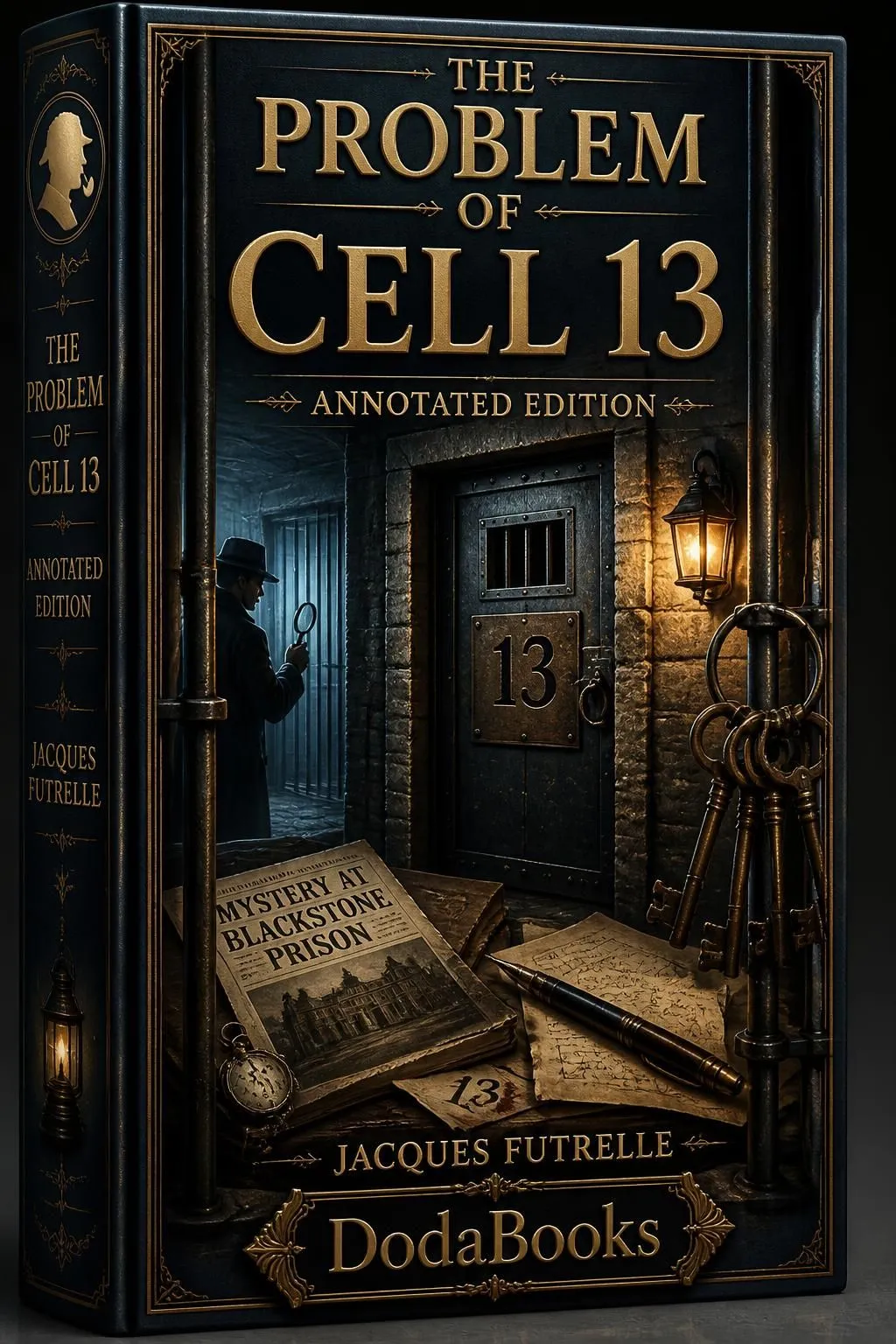
🔒 Master the World’s Greatest Locked-Room Mystery
Experience Jacques Futrelle’s timeless puzzle with full chemical explanations and clue-decoding guides. The DodaBooks Annotated Edition of The Problem of Cell 13 includes:
- ✅ Complete Unabridged 1905 Text — All 9,500 words of Futrelle’s original classic
- 🗂️ 50 Color-Coded Annotation Cards — Instant explanations of 1905 science, chemistry, and wiring
- 🧩 The Complete Clue Map — Follow every step of Van Dusen’s escape trail
- 🔒 100% DRM-Free Ownership — Read across Kindle, Kobo, iPad, and Android without restrictions
- 📥 Instant EPUB Delivery — Download your digital copy immediately