Is The Picture of Dorian Gray Hard to Read? Difficulty & Reading Guide
If you are thinking of reading Oscar Wilde’s The Picture of Dorian Gray for high school, university, a book club, or simply your personal pleasure, you are likely wondering what kind of challenge lies ahead. Is it a dense, archaic 19th-century chore full of incomprehensible Victorian prose, or is it a fast-moving, entertaining gothic thriller?
The straightforward answer: The Picture of Dorian Gray is one of the easiest, most entertaining 19th-century classics you will ever read.
Oscar Wilde was a master playwright, and that dramatic flair shines on every page. The dialogue is brisk, crackling with unforgettable wit, and packed with hilarious, sharp-edged paradoxical epigrams. However, it is not without its hurdles: modern readers often struggle with the philosophical paradoxes of Aestheticism, subtle Victorian social codes, and one notorious “slump” in Chapter 11 that catches unprepared readers off guard.
This comprehensive guide breaks down the true reading difficulty of The Picture of Dorian Gray, maps out the hurdles you need to watch for, provides a proven 7-day reading plan, and shares essential tips to ensure your read is effortless and deeply rewarding.
⚡ Dorian Gray Reading Difficulty: At a Glance
- Difficulty Rating: 5.5 / 10 (Moderate to Accessible) — Considerably easier than Frankenstein (6.5/10) and vastly more accessible than Moby-Dick (9.5/10).
- Length: Approximately 78,000 words (230–260 pages in standard print editions).
- Estimated Reading Time: 5 to 6 hours for an average adult reader (250 words per minute).
- Recommended Reading Age: Grades 10–12 (ages 15+) through adult readers.
- Biggest Stumbling Block: Chapter 11's dense, encyclopedic catalogs of perfumes, jewels, and tapestries.
🧗 The 4 Specific Hurdles for Modern Readers
While The Picture of Dorian Gray reads like a sparkling, dark conversation, first-time readers should be aware of four specific literary hurdles:
1. The “Chapter 11 Slump”: The Decadent Catalogs
Nearly every reader who gets bogged down in The Picture of Dorian Gray hits the wall in Chapter 11.
In this chapter, Wilde charts eighteen years of Dorian’s life under the influence of the mysterious French “Yellow Book.” Instead of standard dialogue or dramatic scenes, Wilde spends fifteen pages listing the esoteric obsessions Dorian studies to distract himself from his aging portrait:
- Paragraphs listing Renaissance perfumes and aromatic gums.
- Catalogs of rare, exotic musical instruments from Peru and Africa.
- Multi-page descriptions of medieval Roman Catholic vestments and altar frontals.
- Exhaustive inventories of Renaissance jewels (jacynths, chrysoberyls, carbuncles) and their folkloric properties.
Why Wilde did this: Chapter 11 is an intentional homage to Joris-Karl Huysmans’ French Decadent novel À rebours (1884). Wilde wanted to demonstrate how a Decadent aesthete attempts to replace moral life with sensory cataloging.
How to conquer it: Do not feel obligated to memorize every mineral and gemstone! Read through Chapter 11 with an appreciative, atmospheric rhythm. Absorb the sensory richness, recognize that Dorian is numbing his soul with luxury, and know that Chapter 12 immediately returns to intense, edge-of-your-seat drama when Basil arrives in the fog.
2. Decoding Wilde’s Paradoxical Epigrams
Lord Henry Wotton speaks almost entirely in paradoxes—statements that seem completely contradictory or absurd on the surface, but reveal a sly, biting social truth upon reflection:
“I can believe anything, provided that it is quite incredible.”
“The only way to get rid of a temptation is to yield to it.”
“Conscience and cowardice are really the same things… Conscience is the trade-name of the firm. That is all.”
“Whenever a man does a thoroughly stupid thing, it is always from the noblest motives.”
For modern readers accustomed to straightforward, earnest dialogue, Lord Henry’s cynical inversions can initially feel disorienting.
How to conquer it: Treat Lord Henry’s speeches not as rigid moral rules, but as sparkling intellectual acrobatics. Henry is an aristocratic provocateur who enjoys tossing verbal firecrackers into polite Victorian dinner parties. Laugh at his audacity while noticing how his seductive words plant poison in Dorian’s mind.
3. Understanding the Aesthetic Movement & Decadence
Wilde was the undisputed champion of the Aesthetic movement, whose slogan was “L’art pour l’art” (“Art for art’s sake”). Aesthetes believed that art should not exist to teach moral lessons, preach sermons, or support political causes; art exists purely to be beautiful.
If you read the novel assuming that Wilde is preaching a conventional Victorian sermon on the dangers of sin, you will miss the book’s deep irony. Wilde presents a tragic paradox: while art should be autonomous, living one’s entire life as an amoral work of art destroys human empathy and leads inevitably to monstrous corruption.
4. Subtle Coded Subtext and Victorian Censorship
Written in 1890, the novel could not openly depict homosexuality without risking instant arrest under Britain’s Criminal Law Amendment Act of 1885. Instead, Wilde used coded, subtle language to depict the deep emotional intimacy between men:
- Basil’s “passionate idolatry” of Dorian Gray.
- Dorian’s mysterious power over handsome young aristocrats who end up ruined.
- The unnamed secret Dorian writes on the slip of paper to blackmail chemist Alan Campbell.
Understanding that this subtext is intentionally veiled adds an exciting layer of historical suspense to the text.
📖 Mini-Glossary: Key Aesthetic & Victorian Terms
- Dandy: A gentleman who places supreme importance on physical appearance, refined language, and leisurely personal cultivation.
- Hedonism: The philosophical belief that pleasure and sensory enjoyment are the ultimate good in human life.
- Fin-de-Siècle: French for “end of the century” (the 1890s); refers to the decadent, cynical, and sophisticated artistic climate of the late-Victorian era.
- Philistine: A person who is indifferent or hostile to art, culture, and intellectual refinement.
- Languid: Pleasantly lazy, lacking in physical energy, slow and relaxed.
- Sallow: An unhealthy, sickly yellowish or pale brown complexion.
- Apotheosis: The highest point in the development of something; the elevation of a mortal to divine status.
⏱️ Recommended 7-Day Reading Schedule
At roughly 78,000 words, The Picture of Dorian Gray is the perfect length for a one-week reading journey. By reading approximately 30–35 pages (around 45 minutes) per day, you will finish comfortably in seven days:
+------------------------------------------------------------------------------------+
|                    7-DAY DORIAN GRAY READING SCHEDULE                              |
+------------------------------------------------------------------------------------+
| DAY 1: The Preface & Chapters 1–3 (Basil's Studio, Lord Henry's Sermon, The Wish)  |
| DAY 2: Chapters 4–6 (Dorian Falls for Sybil Vane, The Vane Family in the Slums)    |
| DAY 3: Chapters 7–8 (The Failed Theater Night, Dorian's Cruelty, Sybil's Suicide)  |
| DAY 4: Chapters 9–10 (Confronting Basil, Locking the Portrait in the Attic School) |
| DAY 5: Chapters 11–13 (The Decadent Years, Basil's Midnight Visit, The Murder)     |
| DAY 6: Chapters 14–16 (Blackmailing Alan Campbell, Opium Dens, James Vane's Trap)  |
| DAY 7: Chapters 17–20 (Paranoia at Selby Royal, The Shooting, The Final Stabbing)  |
+------------------------------------------------------------------------------------+
📊 Classic Victorian Gothic Difficulty Comparison
| Book Title | Author | Word Count | Difficulty (1–10) | Style & Key Hurdle |
|---|---|---|---|---|
| Dr. Jekyll and Mr. Hyde | R.L. Stevenson | ~25,000 | 4.5 / 10 | Very short novella; straightforward mystery narrative. |
| The Picture of Dorian Gray | Oscar Wilde | ~78,000 | 5.5 / 10 | Brisk theatrical dialogue; Chapter 11 catalog slump. |
| Dracula | Bram Stoker | ~160,000 | 5.5 / 10 | Epistolary letters and diaries; fast modern horror pacing. |
| Frankenstein | Mary Shelley | ~75,000 | 6.5 / 10 | Formal Romantic vocabulary; nested narration frames. |
| Wuthering Heights | Emily Brontë | ~107,000 | 8.0 / 10 | Heavy Yorkshire dialect; complex multi-generational family trees. |
💡 Top 5 Tips for First-Time Readers
- Read the Preface as an Artistic Manifesto: The 24 epigrams opening the book are Wilde’s direct defense of his artistic freedom. Take five minutes to read them carefully—they set the provocative tone for everything that follows.
- Treat the Dialogue Like a Play: Wilde wrote The Importance of Being Earnest and Lady Windermere’s Fan. Read the conversations between Lord Henry, Basil, and Dorian as if you were watching world-class actors on a West End stage.
- Pace Yourself Through Chapter 11: When you reach the descriptions of gems, tapestries, and perfumes in Chapter 11, relax! Enjoy the sensory language without worrying about memorizing technical antique terms.
- Notice the Duality of London: Pay attention to how Wilde divides London into two opposite worlds: the sunny, fragrant, luxurious drawing rooms of Mayfair in the West End vs. the damp, foggy, dangerous opium dens of Whitechapel in the East End.
- Read with an Annotated Edition: Having margin notes explaining historical French novels, Greek mythology, and Victorian aesthetic terms transforms potential confusion into absolute delight.
Conquer Oscar Wilde's masterwork effortlessly. The DodaBooks Annotated Edition includes explanatory cards for all aesthetic references, Victorian historical scandals, and the famous 1891 Preface.
Get the Annotated Edition at DodaBooks❓ Frequently Asked Questions
Is The Picture of Dorian Gray hard to understand?
No. Compared to many 19th-century Victorian novels, The Picture of Dorian Gray is remarkably modern, direct, and accessible. Wilde avoids the lengthy historical digressions of Charles Dickens or Herman Melville, focusing instead on witty conversations and high-stakes psychological suspense.
Why is Chapter 11 so different from the rest of the book?
Chapter 11 functions as an intentional Decadent experiment. It covers an eighteen-year gap in Dorian's life by detailing how he uses exotic sensory collections—perfumes, jewels, vestments, and tapestries—to numb his conscience and escape the psychological dread of his decaying portrait.
At what age is The Picture of Dorian Gray recommended?
The novel is widely recommended for students aged 15 and up (grades 10 through adult). While it deals with dark themes of murder, drug addiction, blackmail, and suicide, there is no explicit graphic gore or graphic sexual content.
Is the book scary like modern horror?
It is not a modern "jump-scare" horror novel; rather, it is a psychological and Gothic horror story about conscience, paranoia, and the creeping terror of watching one's own soul rot on canvas while remaining powerless to stop it.
How does Dorian Gray compare in difficulty to Frankenstein?
The Picture of Dorian Gray is notably easier and faster to read than Frankenstein. While Frankenstein uses high-flown, formal Romantic prose and nested epistolary layers, Wilde’s prose is lively, dramatic, satirical, and filled with sparkling theatrical dialogue.
📚 Related Reading Guides
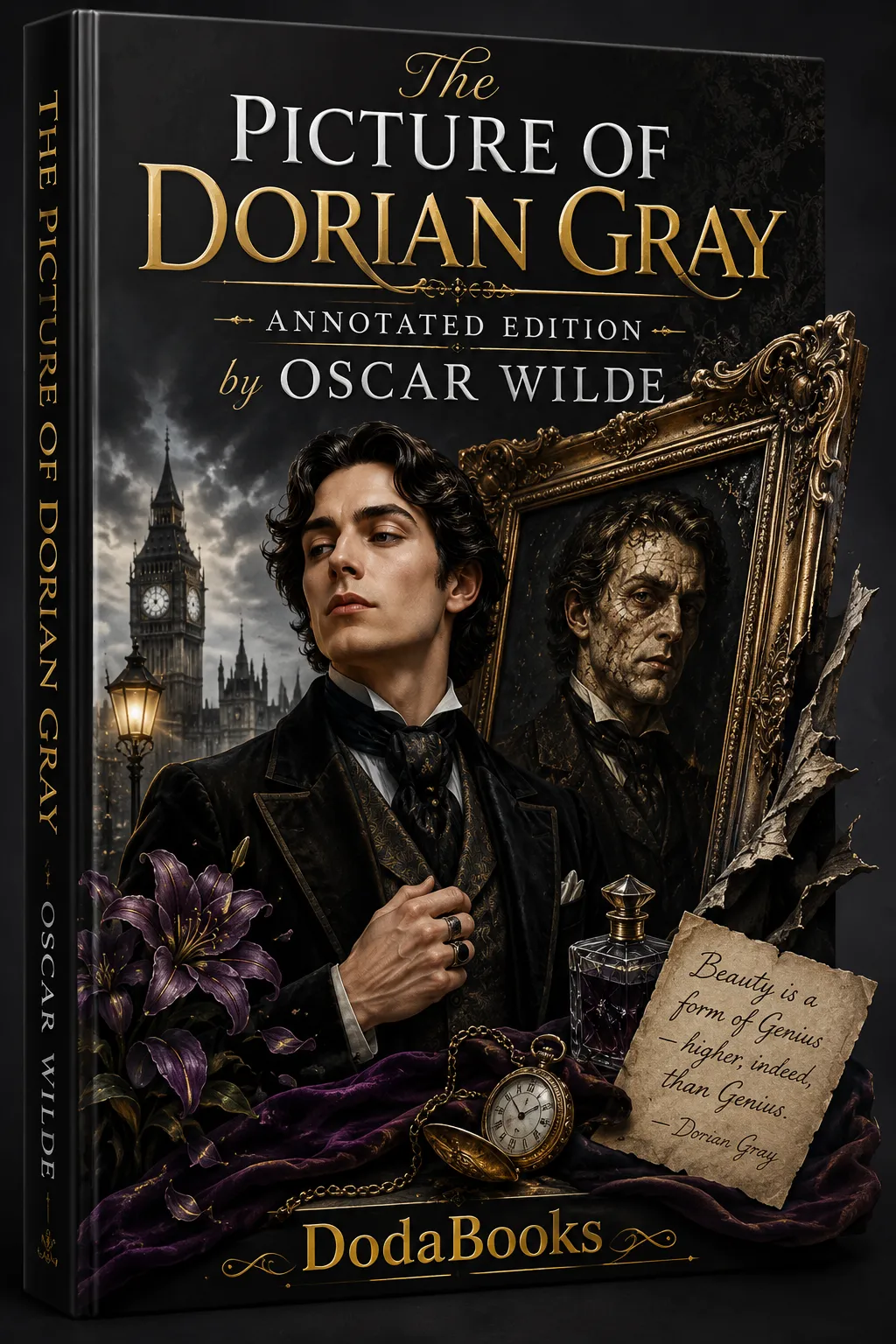
Read Dorian Gray Without the Struggle
Enjoy Oscar Wilde's masterwork with total clarity and confidence:
- Complete 20-chapter authorial text including the 24-epigram Preface
- Instant margin explanations for all Victorian aesthetic terms and French Decadence
- Chapter reading notes and character breakdown cards
- Distraction-free digital typography designed for Kindle, iPad, Kobo, and phone