Is The Phantom of the Opera Hard to Read? Reading Difficulty Guide
If you are planning to read Gaston Leroux’s The Phantom of the Opera (Le Fantôme de l’Opéra) for high school, a university French or Gothic literature course, a book club, or simply because you love Andrew Lloyd Webber’s stage musical, you are likely wondering what kind of challenge lies ahead. Is the 1910 prose dry and archaic? Will you get lost in dense descriptions of nineteenth-century Parisian stage machinery? And how much French do you need to know to follow the plot?
The short answer: The Phantom of the Opera is one of the most accessible, thrilling, and fast-paced gothic mysteries you will ever pick up (Difficulty Rating: 5.5 / 10).
Before turning to fiction, author Gaston Leroux was an acclaimed investigative court reporter for the Paris newspaper Le Matin. He covered high-profile courtroom trials, criminal underworld investigations, and political upheavals. Consequently, he wrote The Phantom of the Opera not in dense, ornate Victorian prose, but with the brisk, sensational, edge-of-your-seat energy of a modern investigative true-crime thriller.
However, modern readers do encounter a few specific stumbling blocks: French operatic terminology, the mock-documentary journalistic framing device, and the labyrinthine architectural geography of the Palais Garnier.
This comprehensive guide breaks down the true reading difficulty of The Phantom of the Opera, maps out the four specific hurdles to watch for, compares it to other gothic classics, and provides a proven 10-day reading schedule to make your journey effortless.
⚡ The Phantom of the Opera Reading Difficulty: At a Glance
- Difficulty Rating: 5.5 / 10 (Moderate to Accessible) — Far easier and faster than Frankenstein (6.5/10) or Jane Eyre (6.0/10), and roughly comparable to Dracula (5.5/10) and The Hound of the Baskervilles (5.0/10).
- Length: Approximately 75,000 words across 26 chapters, a prologue, and an epilogue (roughly 260–310 pages in standard print editions).
- Estimated Reading Time: 5 to 6 hours for an average adult reader (at 250 words per minute).
- Recommended Reading Age: Ages 13+ (Grades 8–12, high school, university, and adult readers).
- Primary Stumbling Blocks: Late 19th-century French theatrical jargon (foyer de la danse, abonnés), mock-documentary journalistic framing, and the subterranean architectural layout of the Palais Garnier.
🧗 The 4 Specific Hurdles for Modern Readers
While The Phantom of the Opera reads with the momentum of a detective procedural, first-time readers should be prepared for four distinct literary elements:
1. The Mock-Journalistic Framing Device
Modern audiences expect the story to open immediately with romantic drama or a haunting organ melody. Instead, Gaston Leroux begins the book as a formal investigative report:
“The Opera Ghost really existed. He was not, as was long believed, a creature of the imagination of the artists, the superstition of the managers, or a product of the absurd and impressionable brains of the young ladies of the ballet…”
The first two chapters read like a journalistic dossier, quoting theater archives, police records, memoirs by retired managers, and coroner testimonies. Some first-time readers find this initial documentary framing jarring.
How to conquer it: Recognize that Leroux was pioneering the “found footage” / investigative true-crime style that later popularized works like The Blair Witch Project and Dracula. Leroux is creating an atmosphere of authentic reality. Once you realize the narrator is playing a detective piecing together a terrifying historical puzzle, the documentary style becomes immensely entertaining.
2. French Theatrical & Operatic Terminology
The novel is set exclusively within the high-society world of the Paris Opéra during the Belle Époque. Leroux assumes his 1910 French audience was intimately familiar with the social rituals of the theater:
+-------------------------------------------------------------------------------+
|                       KEY THEATRICAL TERMINOLOGY IN THE NOVEL                 |
+-------------------+-----------------------------------------------------------+
| TERM              | MEANING & NARRATIVE SIGNIFICANCE                          |
+-------------------+-----------------------------------------------------------+
| Les Abonnés       | Wealthy aristocratic season-ticket subscribers who held   |
|                   | exclusive privileges to visit ballerinas backstage.       |
+-------------------+-----------------------------------------------------------+
| Foyer de la Danse | The opulent backstage green room where the ballet corps   |
|                   | warmed up and mingled with aristocratic patrons.          |
+-------------------+-----------------------------------------------------------+
| Box Five (Loge 5) | The private second-tier opera box Erik demands for his    |
|                   | exclusive use; contains a hollow acoustic column.         |
+-------------------+-----------------------------------------------------------+
| The Fly Gallery   | The high catwalks and suspended ropes above the stage     |
| (Les Cintres)     | where stagehands work; Joseph Buquet is hanged here.      |
+-------------------+-----------------------------------------------------------+
| Marguerite        | The tragic heroine of Charles Gounod's opera Faust; the   |
| (Faust)           | role Christine Daaé sings to international acclaim.       |
+-------------------+-----------------------------------------------------------+
How to conquer it: You don’t need a degree in opera history to enjoy the story. Simply understand that Box Five is Erik’s perch, the Fly Gallery is the high rope-rigging above the stage, and the Abonnés are wealthy aristocratic gentlemen like Count Philippe de Chagny.
3. The Labyrinthine Architecture of the Palais Garnier
The Palais Garnier is a massive architectural marvel consisting of seventeen distinct levels, eighty dressing rooms, subterranean vaults, and a real water reservoir in the foundation.
Erik’s subterranean movements—traveling from Dressing Room 7 down through trapdoors, along hidden wall pipes, across the dark lake on the fifth cellar level, and into his mirrored torture chamber—can be confusing if you try to visualize it as a standard theater.
How to conquer it: Picture the Opera House as an iceberg: one-third is the glittering surface theater where wealthy aristocrats applaud, while two-thirds is a dark subterranean subterranean fortress of stone vaults, water pipes, and iron mechanisms.
4. The Satirical Comedy of the Managers
In Chapters 4, 6, and 12, Leroux devotes significant time to the petty squabbles between the new opera managers, Armand Moncharmin and Firmin Richard. As Erik continually extorts money from them using safety pins and pocket tricks, the two directors grow increasingly paranoid, accusing each other of embezzlement.
Readers coming from the tragic Broadway musical are often surprised by these comedic, satirical interludes.
How to conquer it: Enjoy the dark humor! Leroux deliberately contrasts the petty, greedy bureaucracy of the surface world with the horrifying, life-and-death gothic nightmare unfolding in the cellars below.
📊 How Hard Is The Phantom of the Opera Compared to Other Classics?
+---------------------------------------------------------------------------------------+
|                       CLASSIC GOTHIC & MYSTERY DIFFICULTY BENCHMARK                   |
+-----------------------------+-------------+------------+------------------------------+
| BOOK & AUTHOR               | DIFFICULTY  | WORD COUNT | PRIMARY CHALLENGE            |
+-----------------------------+-------------+------------+------------------------------+
| The Hound of the Baskervilles| 5.0 / 10    | ~59,000    | Fast detective thriller;     |
| (Arthur Conan Doyle)        | (Accessible)|            | regional Dartmoor terms      |
+-----------------------------+-------------+------------+------------------------------+
| The Phantom of the Opera    | 5.5 / 10    | ~75,000    | Journalistic pace; French    |
| (Gaston Leroux)             | (Accessible)|            | opera terms; architecture    |
+-----------------------------+-------------+------------+------------------------------+
| Dracula                     | 5.5 / 10    | ~160,000   | Epistolary journal format;   |
| (Bram Stoker)               | (Moderate)  |            | long middle section pacing   |
+-----------------------------+-------------+------------+------------------------------+
| Jane Eyre                   | 6.0 / 10    | ~185,000   | 185k words; Victorian syntax;|
| (Charlotte Brontë)          | (Moderate)  |            | periodic sentences & French  |
+-----------------------------+-------------+------------+------------------------------+
| Frankenstein                | 6.5 / 10    | ~75,000    | Dense Romantic rhetoric;     |
| (Mary Shelley)              | (Challenging|            | philosophical soliloquies    |
+-----------------------------+-------------+------------+------------------------------+
As the benchmark table demonstrates, The Phantom of the Opera is roughly equal in accessibility to The Hound of the Baskervilles and Dracula, while being significantly shorter and more brisk than Jane Eyre or Frankenstein.
✍️ Gaston Leroux’s Secret Weapon: The French Feuilleton Style
To understand why The Phantom of the Opera reads so differently from classic English Victorian novels like Wuthering Heights or Jane Eyre, modern readers must understand the French feuilleton tradition.
In late nineteenth- and early twentieth-century France, newspapers like Le Gaulois and Le Matin competed aggressively for daily subscribers by publishing sensational serialized fiction at the bottom of their front pages. Gaston Leroux was a master of this form.
The Mechanics of Feuilleton Suspense
Leroux engineered every chapter using specific newspaper storytelling techniques:
- The Compulsory Cliffhanger: Every single chapter terminates with an unanswered question, a sudden scream, a vanishing figure, or an enigmatic piece of physical evidence (e.g., an empty hangman’s noose, a dropped fan, or two glowing eyes in the dark).
- Short, Punchy Paragraphs: Because feuilletons were printed in narrow newspaper columns, Leroux avoided the sprawling half-page sentences common in English literature. His sentences are rapid, visual, and rhythmic, making the reading experience fly by.
- Multi-Perspective Interrogation: Rather than sticking to a single narrator, Leroux constantly shifts between the anxious gossip of the ballet dancers, the pompous memorandums of the opera managers, the romantic journals of Raoul, and the solemn forensic testimony of the Persian. This keeps the narrative fresh and multi-dimensional.
📅 The Proven 10-Day Phantom of the Opera Reading Schedule
At approximately 75,000 words, reading the novel in 10 days requires reading 2 to 3 short chapters per day (about 7,500 words, or roughly 30 to 40 minutes of reading). This schedule maps naturally onto the dramatic mystery:
+-------------------------------------------------------------------------------+
|                    THE 10-DAY PHANTOM OF THE OPERA READING PLAN               |
+-----+-------------+-----------------------------------------------------------+
| DAY | CHAPTERS    | MAJOR DRAMATIC HIGHLIGHTS                                 |
+-----+-------------+-----------------------------------------------------------+
| 1   | Prologue–Ch.2| The living corpse sighting; Joseph Buquet found hanging;  |
|     |             | Christine's miraculous debut in Faust.                    |
+-----+-------------+-----------------------------------------------------------+
| 2   | Ch. 3–5     | The mysterious voice in Dressing Room 7; Box Five terms;  |
|     |             | Midnight violin in the snows of Brittany.                 |
+-----+-------------+-----------------------------------------------------------+
| 3   | Ch. 6–7     | The managers inspect Box 5; Carlotta croaks like a toad;  |
|     |             | The 7-ton chandelier crashes into the audience.           |
+-----+-------------+-----------------------------------------------------------+
| 4   | Ch. 8–9     | The Masked Ball; Red Death; Christine's secret abduction; |
|     |             | Secret rendezvous on the highest roofs of Paris.          |
+-----+-------------+-----------------------------------------------------------+
| 5   | Ch. 10–11   | Christine tears off Erik's mask; The corpse-face fury;    |
|     |             | Christine vanishes mid-song from the stage.               |
+-----+-------------+-----------------------------------------------------------+
| 6   | Ch. 12–14   | The Persian steps forward; Down the catacombs; Dodging    |
|     |             | the deadly Punjab lasso in the darkness.                  |
+-----+-------------+-----------------------------------------------------------+
| 7   | Ch. 15–17   | The Rat-catcher; The iron trapdoor falls; Trapped in the  |
|     |             | Hexagonal Mirror Torture Chamber.                         |
+-----+-------------+-----------------------------------------------------------+
| 8   | Ch. 18–20   | The tropical illusion; Dehydration fever; The water flood |
|     |             | bursts into the chamber.                                  |
+-----+-------------+-----------------------------------------------------------+
| 9   | Ch. 21–23   | The Choice of the Scorpion vs. the Grasshopper; Erik's    |
|     |             | gunpowder cellar; Christine saves Raoul.                  |
+-----+-------------+-----------------------------------------------------------+
| 10  | Ch. 24–End  | The kiss of compassion; Erik weeps; The Persian's         |
|     | & Epilogue  | death announcement; The skeleton discovered in vaults.    |
+-----+-------------+-----------------------------------------------------------+
💡 4 Practical Tips for an Effortless Read
- Don’t Expect the Broadway Musical: The stage musical is a lush, romantic gothic fantasy. The novel is a chilling, fast-paced detective thriller with real horror elements, an emaciated living skeleton, and an international police conspiracy. Embracing the book as a gothic mystery makes it infinitely more thrilling.
- Read with an Architectural Eye: Pay attention to Leroux’s descriptions of the Palais Garnier. Knowing that the building has real underground waterways and deep cellars enhances the claustrophobic dread.
- Appreciate the Persian: The Persian is the hero of the second half of the book. His calm, forensic knowledge of Erik’s illusions grounds the supernatural terror in cold, scientific reality.
- Choose an Annotated Edition: Reading an edition with inline notes decoding 19th-century French theater terms and translations ensures that your reading flow is never broken.
❓ Frequently Asked Questions (FAQ)
At what age is The Phantom of the Opera appropriate?
The Phantom of the Opera is appropriate for readers aged 13 and older (Grades 8 and up). While it contains gothic horror, murder, and intense psychological suspense, there is no explicit graphic sexuality or profanity.
Is The Phantom of the Opera harder than Dracula?
No, it is generally considered easier. Bram Stoker’s Dracula is over twice as long (160,000 words vs. 75,000 words) and contains lengthy philosophical diary entries in its middle section. Leroux’s Phantom moves at a relentless, journalistic pace.
How long does it take to read the book?
At an average reading speed of 250 words per minute, it takes approximately 5 to 6 hours of total reading time to finish The Phantom of the Opera. Following our 10-day reading schedule of roughly 35 minutes per day makes completing it effortless.
Does the novel contain French dialogue?
While the book was originally written in French, English translations translate nearly all prose into English. However, some French theatrical titles (foyer de la danse, loge, chef machiniste) and short songs are occasionally left in French. Annotated editions decode these instantly.
What is the best way to read The Phantom of the Opera for beginners?
The best way is to read an annotated digital edition with inline notes and architectural floor plans, such as the DodaBooks Annotated Ebook. Listening to an audiobook while following along in the text is also an excellent method to absorb the theatrical cadence.
📚 Related Articles & Guides
Looking for an overarching analysis of themes, Victorian theater, and Gothic mystery? Explore our master The Phantom of the Opera Novel Guide.
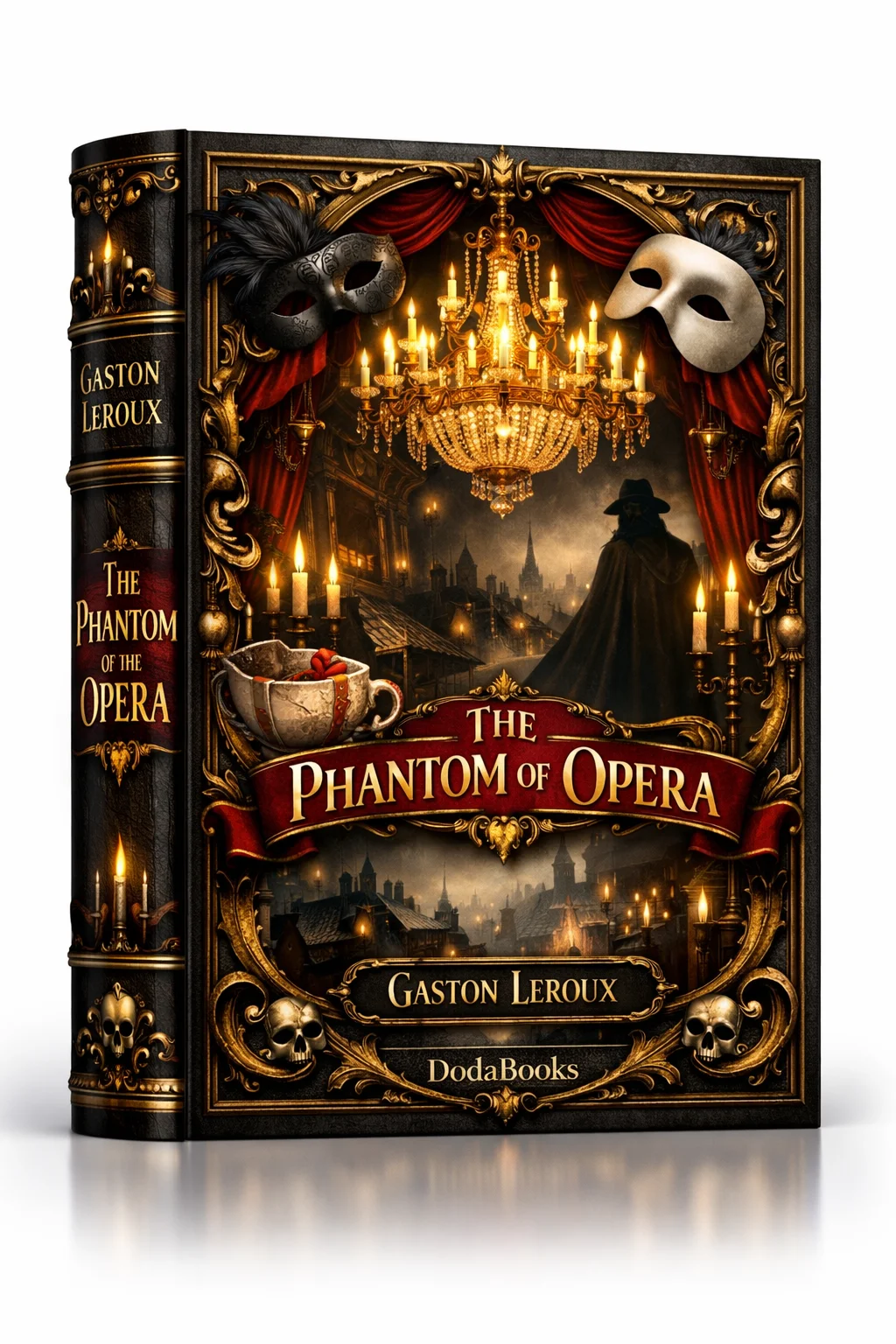
📖 Read the Definitive Annotated Edition of The Phantom of the Opera
Experience Gaston Leroux’s chilling gothic original with complete architectural notes, French opera history, and Parisian commentary:
- ✅ Complete Authoritative 1910 Text — Unabridged English translation with authentic chapter divisions
- 🏛️ Palais Garnier Blueprints & Notes — Understand the real subterranean lake, trapdoors, and fly machinery
- 🎭 French Theatrical Context — Learn about Gounod’s Faust, Meyerbeer’s operas, and Belle Époque society
- 📜 The Persian’s Complete Epilogue — Discover Erik’s backstory in Persia and Constantinople
- 🔒 Universal DRM-Free Formats — Delivered instantly in EPUB, PDF, and AZW3/Kindle formats
Get The Phantom of the Opera Annotated Edition at DodaBooks →