Is The Mysteries of Udolpho Hard to Read? Reading Difficulty & Study Guide
For fans of classic horror, Gothic romances, and nineteenth-century literature, Ann Radcliffe’s The Mysteries of Udolpho occupies a legendary status. Famously referenced in Jane Austen’s Northanger Abbey, championed by Sir Walter Scott, and revered by Lord Byron and Edgar Allan Poe, it is the mother of all Gothic novels.
Yet many modern readers, eager to experience the terrifying secrets of Castle Udolpho, pick up the book and find themselves confronted by an unexpected surprise: pages upon pages of lush, poetic descriptions of sunsets over the Pyrenees, extended philosophical discussions about “Sensibility,” and nineteenth-century syntax that feels remarkably ornate. They quickly wonder: Is The Mysteries of Udolpho too hard to read?
The truth is that The Mysteries of Udolpho is not impenetrable, but it requires a very different reading mindset than modern horror or fast-paced thrillers. Once you understand Ann Radcliffe’s unique eighteenth-century artistic rhythm—her intentional blending of landscape painting, psychological suspense, and poetic sentiment—the novel transforms into a hypnotic and thrilling aesthetic experience.
This reading difficulty guide breaks down Radcliffe’s prose style, explains the aesthetic conventions of the Sublime and the Picturesque, and provides a realistic 4-week reading plan to help you conquer this Gothic masterpiece.
| Difficulty Metric | Rating & Evaluation | Context & Reader Advice |
|---|---|---|
| Overall Difficulty | Moderate (3 / 5) | Clear, highly visual narrative; challenging eighteenth-century vocabulary and expansive descriptive passages. |
| Lexile Measure | 1140L – 1220L | Equivalent to High School Senior to College Freshman reading level. |
| Word Count & Length | ~260,000 words (58 Chapters across 4 Volumes) | Substantial length; roughly comparable to Jane Eyre or Wuthering Heights. |
| Pacing Style | Atmospheric & Alternating | Slow, contemplative landscape journeys punctuated by sudden bursts of Gothic terror, duels, and midnight abductions. |
| Main Obstacle | Expansive Landscape Descriptions | Readers expecting non-stop dungeon action may feel impatient with Radcliffe’s picturesque scenes. |
| Greatest Payoff | Foundational Gothic Atmosphere | The definitive haunted castle experience, masterly suspense, and brilliant proto-Byronic villainy. |
🔬 Analyzing the 3 Reading Challenges of Radcliffe’s Prose
To enjoy The Mysteries of Udolpho without getting bogged down, modern readers must understand three primary characteristics of Radcliffe’s eighteenth-century technique:
            [ THE 3 UNIQUE ATTRIBUTES OF RADCLIFFE'S PROSE ]

        +-------------------------+-------------------------+
        |                         |                         |
        v                         v                         v
[ 1. The Sublime Landscape ] [ 2. 18th-Century Syntax ] [ 3. The Explained Ghost ]
Prose designed to mirror     Inverted sentence order    Apparent spectral terrors
18th-century landscape oil   and formal vocabulary      ultimately resolved by
paintings (Claude & Rosa).   reflecting "Sensibility."  rational, natural causes.
1. Landscape as Emotional Atmosphere: The Sublime vs. The Picturesque
The single biggest shock for first-time readers of The Mysteries of Udolpho is the sheer volume of landscape description. In modern fiction, landscape is usually background dressing. In Radcliffe’s world, landscape is the main character:
- The Picturesque (Claude Lorrain style): Soft, pastoral, sunlit river valleys (like La Vallée in Gascony) characterized by winding streams, blooming vineyards, and gentle shepherd flutes. These scenes evoke tranquility, domestic virtue, and innocent happiness.
- The Sublime (Salvator Rosa style): Immense, towering Alpine cliffs, jagged ravines, lightning-shattered pine forests, and gloomy medieval castles perched over bottomless chasms. Following the aesthetic philosophy of Edmund Burke, Radcliffe uses the Sublime to induce a state of “delightful terror” and moral awe, preparing the reader’s psyche for Gothic danger.
When Radcliffe describes the Apennine mountains for three consecutive pages, she is not “padding” the word count; she is actively orchestrating your mood, slowing your heart rate with awe before throwing you into the terrifying clutches of Montoni’s castle.
2. Eighteenth-Century Sentence Architecture and Vocabulary
Written in 1794, the novel employs the formal, elevated diction of late Enlightenment Britain. Sentences are long, balanced, and frequently employ syntactic inversion (e.g., placing adjectives or adverbial phrases before the main noun and verb):
“It was a silent and majestic evening: the fading light still lingered upon the peaks of the distant mountains, while the deep shadows of night began to steal along the valleys, wrapping in gloom the pine forests that bordered the road.”
Furthermore, Radcliffe uses several key words with distinct 18th-century meanings:
- Sensibility: An exquisite capacity for moral, emotional, and aesthetic feeling (not to be confused with modern “common sense”).
- Melancholy: A pleasurable, reflective state of gentle sadness and poetic contemplation, rather than modern clinical depression.
- Transport: An overwhelming, ecstatic rush of emotion or joy.
- Condottieri: Italian mercenary soldiers who fought for hire and frequently turned into armed brigands.
       [ 18TH-CENTURY VOCABULARY KEY FOR UDOLPHO ]
+-------------------------------------------------------------+
| "Sensibility"  ====> Deep moral and emotional sensitivity   |
| "Melancholy"   ====> Sweet, contemplative poetic reflection |
| "Sublime"      ====> Awe-inspiring, terrifying majesty     |
| "Romantic"     ====> Picturesque, wild, resembling an epic  |
| "Banditti"     ====> Mercenary mountain outlaws/condottieri |
+-------------------------------------------------------------+
3. The “Explained Supernatural”
Unlike Horace Walpole’s The Castle of Otranto (which features a giant ghostly helmet that crushes a prince) or Matthew Lewis’s The Monk (which features the actual Devil and bleeding phantoms), Ann Radcliffe pioneered the “explained supernatural” (le surnaturel expliqué):
- Every ghostly sigh, creeping phantom, moving tapestry, and blood-soaked horror that Emily encounters is eventually revealed to have a logical, physical, and rational explanation.
- For modern readers accustomed to Hollywood supernatural horror films, this technique can occasionally produce a humorous or anticlimactic reaction (such as discovering that a terrifying ghost on the ramparts was simply a secret smuggler or an imprisoned French soldier playing the lute).
However, within eighteenth-century intellectual culture, this technique was revolutionary: Radcliffe demonstrated that the human imagination, when stoked by fear and unchecked sensibility, is capable of generating far more terrifying horrors than any demon or ghost.
📅 The 4-Week Mysteries of Udolpho Reading Schedule
Because The Mysteries of Udolpho was originally published and read in four distinct volumes, following a one-volume-per-week schedule provides the ideal narrative momentum. It divides the 58 chapters into manageable reading chunks of approximately 14 to 15 chapters per week (~20 to 25 pages per day).
Week 1: Volume I (Chapters 1–13)   ====> The Pastoral Eden & The Pyrenees
Week 2: Volume II (Chapters 14–25)  ====> Toulouse, Venice & Castle Udolpho
Week 3: Volume III (Chapters 26–40) ====> The Siege & Escape from Udolpho
Week 4: Volume IV (Chapters 41–58)  ====> Château-le-Blanc & The Resolution
Week 1: Volume I (Chapters 1–13) — The Pyrenees & Pastoral Innocence
- Daily Reading: ~20 pages per day.
- Plot Focus: Life at La Vallée; Monsieur St. Aubert’s philosophy of emotional restraint; the sublime journey across the Pyrenees; romantic meeting with Chevalier Valancourt; St. Aubert’s death and the mystery of the burnt papers.
- Reader Tip: Do not rush through the Pyrenees travel scenes! Enjoy Radcliffe’s poetic descriptions of mountain waterfalls and pastoral villages; they establish the emotional sanctuary that Emily will long for throughout her captivity.
Week 2: Volume II (Chapters 14–25) — The Clutches of Montoni
- Daily Reading: ~22 pages per day.
- Plot Focus: Emily lives with her vain aunt Madame Cheron; Madame Cheron marries the sinister Italian Signor Montoni; the move to Venice; Count Morano’s forced courtship; the midnight flight to the Apennines; first arrival at Castle Udolpho; the terror of the Black Veil.
- Reader Tip: Pay attention to the sudden shift in atmospheric color—from the bright pastoral greens of Gascony to the gloomy, dark granite and crimson sunsets of Castle Udolpho.
Week 3: Volume III (Chapters 26–40) — The Horrors of Castle Udolpho
- Daily Reading: ~25 pages per day.
- Plot Focus: Montoni’s extortion of Madame Montoni; her imprisonment and tragic death; Count Morano’s midnight raid and sword duel; the spectral music on the battlements; Emily lifting the Black Veil; the thrilling midnight escape with Du Pont and Ludovico.
- Reader Tip: This is the fastest, most suspenseful volume in the novel. Keep a brief note of the different castle towers and secret passages as Emily explores them.
Week 4: Volume IV (Chapters 41–58) — The Secrets of Château-le-Blanc
- Daily Reading: ~25 pages per day.
- Plot Focus: Shipwreck on the coast of France; hospitality of Count De Villefort at Château-le-Blanc; the haunted chamber of the late Marchioness; Ludovico’s overnight disappearance; Sister Agnes’s shocking deathbed confession; rational explanation of all supernatural mysteries; Emily and Valancourt’s marriage.
- Reader Tip: Prepare yourself for Radcliffe’s ingenious narrative puzzle pieces falling into place—almost every strange occurrence from Volumes I, II, and III receives its logical solution in Volume IV.
💡 4 Essential Tips for Mastering The Mysteries of Udolpho
- Read with an 18th-Century Mindset: Remember that The Mysteries of Udolpho was published before cinema, television, or photography existed. Radcliffe’s expansive landscape descriptions were designed to serve as “virtual reality tourism” for British readers who had never seen the Alps or the Mediterranean.
- Embrace the Lute Songs and Poetry: The poems composed by Emily and Valancourt are not random interruptions; they reflect the characters’ deepest moral and emotional reflections. Read them aloud to experience their musical meter.
- Analyze Emily’s Agency: Rather than dismissing Emily when she faints, observe how she behaves when confronted by Montoni’s legal threats. She consistently demonstrates extraordinary moral backbone, defying the tyrant to protect her inheritance.
- Choose an Annotated Edition: Using an edition with helpful explanatory footnotes (like DodaBooks or Oxford) ensures you never get stuck on unfamiliar architectural, medical, or legal terms.
❓ Frequently Asked Questions
How long does it take an average person to read The Mysteries of Udolpho?
At an average adult reading speed of 250 words per minute, The Mysteries of Udolpho (approximately 260,000 words) requires roughly 17 to 20 hours of total reading time. Following our 4-week reading plan requires roughly 40 to 45 minutes of daily reading, making it a completely manageable and thoroughly engaging month-long project.
Why did Ann Radcliffe explain all her ghosts instead of using real ones?
Ann Radcliffe was a creature of the late European Enlightenment. While she loved creating the emotional thrill of supernatural terror (what she called "terror" that expands the soul, as opposed to "horror" that contracts it), she fundamentally believed that reason, science, and virtue govern the universe. Revealing that ghosts were merely human tricks or misunderstandings allowed her to write thrilling Gothic romances while upholding Enlightenment rationality.
Do I need to read The Castle of Otranto before Udolpho?
No. While Horace Walpole’s The Castle of Otranto (1764) is technically the first Gothic novel in English, The Mysteries of Udolpho is completely self-contained. In fact, many modern readers find Radcliffe’s psychological subtlety, rich character development, and landscape beauty vastly more engaging than Walpole’s shorter, more primitive melodrama.
Is The Mysteries of Udolpho scary by modern standards?
It is not "scary" in the modern sense of jump-scares or visceral gore. Instead, Radcliffe specializes in creeping psychological dread and claustrophobic suspense: being trapped in an isolated mountain castle, hearing strange footsteps outside your bedroom door at two in the morning, and not knowing whether your host intends to murder you or force you into marriage.
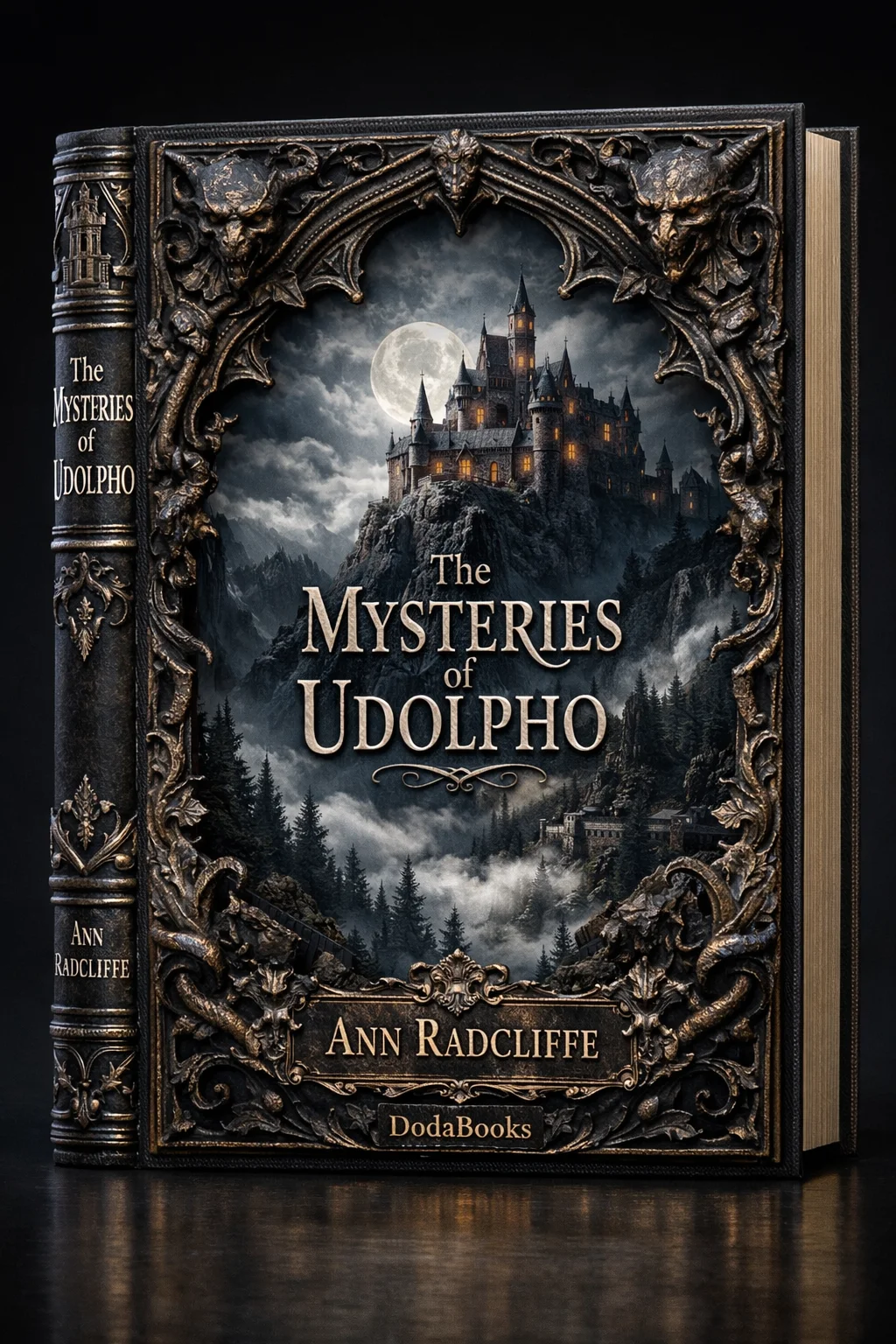
🏰 Experience Ann Radcliffe’s Gothic Classic with Confidence
Conquer eighteenth-century literature’s greatest Gothic adventure with the definitive, reader-friendly digital edition of The Mysteries of Udolpho from DodaBooks:
- 📖 Complete 4-Volume Unabridged Text — All 58 chapters and original poetry preserved intact
- 💡 Exhaustive Contextual Explanations — Clarifying the Sublime, 18th-century Sensibility, and Italian history
- 📱 Designed for Modern Screens — Flawless digital typography engineered for Kindle, Kobo, iPad, and Android
- 🔓 100% DRM-Free — Download immediately and keep your digital book forever
👉 Get the Annotated Edition of The Mysteries of Udolpho at DodaBooks →