Is The Moonstone Hard to Read? Reading Difficulty & Level Guide
Because Wilkie Collins’s The Moonstone (1868) is widely celebrated as the foundational ancestor of the modern detective novel, many mystery fans wonder whether tackling this 500-page Victorian classic feels like reading a dusty legal treatise or an exhilarating page-turner. Readers often ask: Is Collins’s language convoluted like Charles Dickens’s or dense like George Eliot’s? How difficult is it to track fourteen different narrators across five hundred pages?
Is The Moonstone hard to read? The short answer is no: it earns an accessible difficulty rating of 5.0 / 10 (Moderate).
In fact, The Moonstone is widely considered one of the easiest, most entertaining, and most rapidly paced Victorian novels ever published. Written for serialization in Charles Dickens’s magazine All the Year Round, every installment was engineered with sharp psychological hooks, cliffhangers, and vibrant character dialogue.
However, readers approaching the novel for the first time will encounter four specific challenges:
- The Epistolary Multi-Narrator Structure: The narrative passes between fourteen different eyewitnesses, each with their own idiosyncrasies, speech patterns, and personal biases.
- 1840s Medical & Pharmacological Theories: The resolution of the diamond theft hinges on mid-Victorian medical debates regarding somnambulism (sleepwalking) and the physiological effects of laudanum (liquid opium).
- Victorian Colloquialisms and Social Hierarchy: Understanding the strict servant-master boundaries maintained by house steward Gabriel Betteredge and the religious tract culture satirized by Miss Drusilla Clack.
- Forensic Timeline Clues: Paying attention to minute timestamps, paint-drying rates, and laundry registers that solve the puzzle.
This comprehensive reading guide breaks down the true reading level of The Moonstone, analyzes the four key reading hurdles, compares it to other Victorian classics, and maps out a comfortable 10-day reading plan.
⚡ The Moonstone Reading Difficulty: At a Glance
- Difficulty Rating: 5.0 / 10 (Moderate & Engaging) — More accessible than Frankenstein (6.5/10) and The Woman in White (5.5/10); roughly equal in accessibility to Bram Stoker's Dracula (5.0/10) and Louisa May Alcott's Little Women (5.0/10).
- Length: Approximately 190,000 words across a Prologue, First Period, Second Period (8 narratives), and Epilogue (about 480–520 pages in standard paperback print).
- Estimated Reading Time: 12 to 16 hours for an adult reader (about 45–60 minutes per day on a 10-day schedule).
- Lexile Measure & Grade Level: Approximately 980L–1100L (Grades 9–12 / High School level).
- Primary Stumbling Blocks: Shifting narrator credibility, archaic 1840s medical terminology regarding opium and delirium, and forensic attention to dates.
📊 Classics Difficulty Comparison Matrix
To understand how The Moonstone compares with other major 19th-century works of fiction, examine this comparative benchmark:
+---------------------------------------------------------------------------------------------------------------+
|                               19TH-CENTURY MYSTERY & NOVEL READING DIFFICULTY COMPARISON                      |
+--------------------------+------------+--------------+------------------+-------------------------------------+
| TITLE & AUTHOR           | DIFFICULTY | PAGE COUNT   | PROSE COMPLEXITY | PRIMARY CHALLENGE                   |
+--------------------------+------------+--------------+------------------+-------------------------------------+
| The Hound of the         | 3.5 / 10   | ~180 pages   | Clear, modern    | Short novella length, straightforward|
| Baskervilles (Conan Doyle)|           |              | journalistic     | Watson narration, high momentum     |
+--------------------------+------------+--------------+------------------+-------------------------------------+
| Alice in Wonderland      | 4.0 / 10   | ~130 pages   | Playful, witty,  | Obscure schoolroom parodies, puns,  |
| (Lewis Carroll)          |            |              | non-linear dream | non-sequitur philosophical logic    |
+--------------------------+------------+--------------+------------------+-------------------------------------+
| The Moonstone            | 5.0 / 10   | ~500 pages   | Witty, episodic, | 14 narrators, 1840s opium science,  |
| (Wilkie Collins)         |            |              | dramatic dialogue| epistolary case-file structure      |
+--------------------------+------------+--------------+------------------+-------------------------------------+
| Dracula (Bram Stoker)    | 5.0 / 10   | ~400 pages   | Epistolary logs, | Shifting journal/phonograph entries,|
|                          |            |              | gothic letters   | slow middle section in Transylvania |
+--------------------------+------------+--------------+------------------+-------------------------------------+
| The Woman in White       | 5.5 / 10   | ~640 pages   | Dramatic legal   | 600+ page length, complex property  |
| (Wilkie Collins)         |            |              | testimonies      | laws (*coverture*), asylum abuses   |
+--------------------------+------------+--------------+------------------+-------------------------------------+
| Frankenstein             | 6.5 / 10   | ~220 pages   | Elevated, formal | Triple-frame narrative, philosophical|
| (Mary Shelley)           |            |              | Romantic rhetoric| moral debates, Latinate vocabulary  |
+--------------------------+------------+--------------+------------------+-------------------------------------+
| Bleak House              | 8.0 / 10   | ~950 pages   | Elaborate satire,| Massive cast of 50+ characters,     |
| (Charles Dickens)        |            |              | dual perspectives| Chancery court legal satire         |
+--------------------------+------------+--------------+------------------+-------------------------------------+
As the matrix illustrates, The Moonstone strikes the sweet spot: it is rich and sophisticated enough to reward serious literary study, yet far more conversational, witty, and gripping than heavy Victorian social realism.
🧗 The 4 Primary Reading Hurdles Explained
1. Navigating Fourteen Shifting Narrators
Unlike modern detective fiction where a single detective (like Sherlock Holmes or Hercule Poirot) or a single sidekick (like Dr. Watson or Captain Hastings) tells the whole story, The Moonstone is arranged as an evidentiary archive.
Franklin Blake commissions the testimonies to clear up public rumors. Consequently, each narrator brings their own voice, prejudices, and blind spots:
- Gabriel Betteredge (First Period): Funny, talkative, and comforting. Betteredge speaks like a warm grandfather who constantly quotes Robinson Crusoe as an oracle for life.
- Miss Drusilla Clack (Second Period, Narrative 1): Highly stylized, venomous comic satire. Clack writes with pious outrage, scattering evangelical conversion pamphlets and viewing every misfortune as divine wrath.
- Mathew Bruff (Second Period, Narrative 2): Clear, methodical, and dryly legalistic. Bruff focuses strictly on property covenants, wills, and bank receipts.
- Ezra Jennings (Second Period, Narrative 4): Intense, clinical, and emotionally vulnerable. Jennings writes in medical journal format, quoting scientific authorities and reproducing verbatim delirium transcripts.
How to conquer it: Enjoy the shifts in personality! Instead of trying to find an objective narrator, treat each section as an encounter with an eccentric human witness. Ask yourself: What is this character proud of? What are they trying to justify? What did they overlook?
2. Victorian Opium Science & Somnambulism
The entire resolution of the mystery rests on a medical phenomenon that modern readers might initially find bizarre: unconscious somnambulism caused by an involuntary dose of laudanum.
In the 1840s and 1860s, liquid opium (laudanum dissolved in alcohol) was available over the counter and used as a household remedy for everything from toothaches to coughs. Wilkie Collins himself was a heavy laudanum addict who consumed wine-glassfuls daily to combat severe rheumatic gout.
In the novel, Collins relies on real 19th-century psychiatric and physiological research:
- Dr. William Benjamin Carpenter: Famous Victorian physiologist who theorized that under certain states of narcotics or nervous exhaustion, the brain could act automatically without conscious memory.
- Retrograde Amnesia: Franklin Blake took the diamond while sleepwalking under the influence of laudanum, intending to protect it, and awakened with zero recollection of what he did.
- The Delirium Shorthand: Ezra Jennings decodes Dr. Candy’s feverish ramblings to discover that Candy slipped the drug into Franklin’s brandy as a practical joke.
+-----------------------------------------------------------------------------------------------+
|                            KEY 1840s MEDICAL TERMS DECODED IN THE NOVEL                       |
+--------------------------+--------------------------------------------------------------------+
| MEDICAL TERM             | WHAT IT MEANS IN THE INVESTIGATION                                 |
+--------------------------+--------------------------------------------------------------------+
| Laudanum                 | Tincture of opium dissolved in alcohol; widely used as a sedative; |
|                          | administered to Franklin Blake without his knowledge.              |
+--------------------------+--------------------------------------------------------------------+
| Somnambulism             | Sleepwalking induced by nervous agitation and narcotic sedation;   |
|                          | the physiological explanation for Franklin taking the diamond.     |
+--------------------------+--------------------------------------------------------------------+
| Brain Fever              | 19th-century term for severe encephalitis, meningitis, or delirium |
|                          | caused by acute physical exhaustion and exposure to cold rain.     |
+--------------------------+--------------------------------------------------------------------+
| Shorthand Reconstruction | Jennings's linguistic method of filling in the blanks of         |
|                          | Dr. Candy's feverish mutterings to uncover the secret drugging.   |
+--------------------------+--------------------------------------------------------------------+
How to conquer it: Understand that Collins was not inventing “magic”; he was showcasing cutting-edge Victorian brain science. Reading with the DodaBooks Annotated Edition provides interactive medical cards that decode every scientific principle as Ezra Jennings presents it.
3. Forensic Timelines & The Mystery of the Smear
Like all great whodunits, The Moonstone plays fair with the reader. Every clue necessary to solve the mystery is presented in plain view, but disguised beneath casual household conversations:
- The Paint Smear: Sergeant Cuff deduces that someone brushed against Rachel’s sitting-room door between 12:00 AM and 3:00 AM because the white varnish takes twelve hours to dry and was still wet at midnight.
- The Laundry Book: Rosanna Spearman’s purchase of unbleached cloth and her anxiety over the missing nightgown points to someone covering up a paint stain.
- The Pawn Receipt: Septimus Luker’s bank vault deposit in June 1848 has an expiration date of June 1849, creating a strict ticking clock for the second half of the book.
4. Victorian Social Norms and Class Boundaries
Collins uses the investigation to explore the rigid social hierarchies of Victorian England:
- Upper-Class Immunity vs. Servant Suspicions: Local police superintendent Seegrave immediately searches the boxes of the female servants, assuming the lower class must be guilty. When Sergeant Cuff turns his suspicions toward the aristocratic daughter of the house, Lady Verinder is outraged and fires him.
- The Hypocrisy of Philanthropy: Godfrey Ablewhite represents the moral posturing of wealthy Victorian charity organizers who embezzled money while lecturing the working class on sobriety and thrift.
- The Plight of the Fallen Woman: Rosanna Spearman is a reformed pickpocket who finds that Victorian society will never truly forgive a former criminal, no matter how hard she works.
📅 The 10-Day Reading Schedule
To read The Moonstone comfortably in about 45 to 60 minutes per day, follow this balanced 10-day reading plan (averaging 45 to 50 pages per day):
+--------------------------------------------------------------------------------------------------------------------+
|                                      THE 10-DAY THE MOONSTONE READING PLAN                                         |
+------+-------------+------------------------------------+----------------------------------------------------------+
| DAY  | SECTION     | CHAPTERS / NARRATIVES              | KEY PLOT MILESTONES                                      |
+------+-------------+------------------------------------+----------------------------------------------------------+
| 01   | Prologue &  | Prologue & Betteredge (Ch. 1–6)    | Seringapatam storming; the curse; Franklin arrives       |
|      | First Period|                                    | in Yorkshire with the diamond; Betteredge & Crusoe       |
+------+-------------+------------------------------------+----------------------------------------------------------+
| 02   | First Period| Betteredge (Ch. 7–11)              | Rachel's 18th birthday party; the diamond displayed;   |
|      |             |                                    | morning panic: the Moonstone vanishes from the cabinet   |
+------+-------------+------------------------------------+----------------------------------------------------------+
| 03   | First Period| Betteredge (Ch. 12–16)             | Sergeant Cuff arrives; the rose gardens; the paint smear |
|      |             |                                    | on the door; Rosanna Spearman's suspicious behavior     |
+------+-------------+------------------------------------+----------------------------------------------------------+
| 04   | First Period| Betteredge (Ch. 17–23)             | Cuff accuses Rachel; Rosanna drowns in Shivering Sand;    |
|      |             |                                    | Cuff dismissed; Franklin Blake leaves England in despair |
+------+-------------+------------------------------------+----------------------------------------------------------+
| 05   | 2nd Period  | Miss Clack (Narrative 1)           | Drusilla Clack in London; religious tract satire;        |
|      |             |                                    | Godfrey's courtship of Rachel; the Indian search attack|
+------+-------------+------------------------------------+----------------------------------------------------------+
| 06   | 2nd Period  | Mathew Bruff (Narrative 2) &       | Bruff discovers Luker's 12-month bank loan; Franklin    |
|      |             | Franklin Blake (Part 1, Ch. 1–3)   | returns to Yorkshire; retrieving Rosanna's letter      |
+------+-------------+------------------------------------+----------------------------------------------------------+
| 07   | 2nd Period  | Franklin Blake (Part 1, Ch. 4–8)   | The shock of Franklin's name on the nightgown;          |
|      |             |                                    | confrontation with Rachel: "I saw you take it!"          |
+------+-------------+------------------------------------+----------------------------------------------------------+
| 08   | 2nd Period  | Ezra Jennings (Narrative 4)        | Jennings introduces Dr. Candy's delirium shorthand;     |
|      |             |                                    | the physiological theory of involuntary opium trance     |
+------+-------------+------------------------------------+----------------------------------------------------------+
| 09   | 2nd Period  | The Opium Experiment &             | The dramatic reconstruction of June 21; Franklin        |
|      |             | Tracking the Sailor (Narrative 5)  | sleepwalks again; tracking the disguised sailor in London|
+------+-------------+------------------------------------+----------------------------------------------------------+
| 10   | 2nd Period  | Sergeant Cuff (Narrative 6) &      | The corpse at The Wheel of Fortune unmasked as Godfrey;  |
|      | & Epilogue  | Epilogue in India                  | the gem restored to Somnath; Rachel & Franklin reunited  |
+------+-------------+------------------------------------+----------------------------------------------------------+
💡 Top 3 Tips for First-Time Readers
- Keep Track of What Each Narrator Witnessed Firsthand: Remember that no narrator knows the full story until the final two chapters. When Miss Clack or Gabriel Betteredge presents an opinion as an absolute fact, treat it with healthy skepticism.
- Don’t Skip Ezra Jennings’s Medical Notes: When you reach Ezra Jennings’s section in the Second Period, slow down and enjoy the scientific brilliance of his deductions. It is one of the greatest passages in Victorian literature.
- Use an Annotated Edition for Opium and Colonial Nuances: Understanding the imperial context of the 1799 Seringapatam assault and 1840s medical debates makes the novel ten times richer. Reading with the DodaBooks Annotated Edition ensures that every obscure reference is instantly decoded right beside the text.
❓ Frequently Asked Questions
Is The Moonstone suitable for readers new to classic literature?
Yes, absolutely! Because it was written as popular serialized entertainment, The Moonstone reads much faster than most 19th-century novels. The chapter cliffhangers, lively dialogue, and colorful eccentric characters make it as addictive as a modern Agatha Christie or Arthur Conan Doyle mystery.
How does The Moonstone differ from Arthur Conan Doyle's Sherlock Holmes stories?
While Sherlock Holmes mysteries are generally short, episodic novellas where Holmes quickly deduces the solution, The Moonstone is a sprawling 500-page epic where the detective fails halfway through, and the mystery must be solved by an ensemble of witnesses through psychology and science.
Why does the novel begin in India in 1799?
The Prologue in India establishes the curse of the Moonstone and introduces Collins’s critique of British imperial plunder. The theft of the sacred gem from Somnath by English soldiers sets in motion the karmic retribution that unfolds across the English countryside sixty years later.
Can I read a summary of the plot before reading the book?
If you want an overview of the two Periods and all fourteen testimonies to help keep track of the clues, explore our comprehensive The Moonstone Summary by Period & Narrative.
What is the best edition of The Moonstone to buy?
For everyday readers who want clear typography, interactive annotation cards decoding 1840s opium science, and universal DRM-free compatibility across devices, we recommend the DodaBooks Annotated Edition. Read our complete buying comparison in Where to Buy The Moonstone: Best Editions.
📚 Related Articles
Curious about other Victorian sensation classics and mysteries? Explore our The Woman in White Reading Difficulty Guide or our The Hound of the Baskervilles Guide.
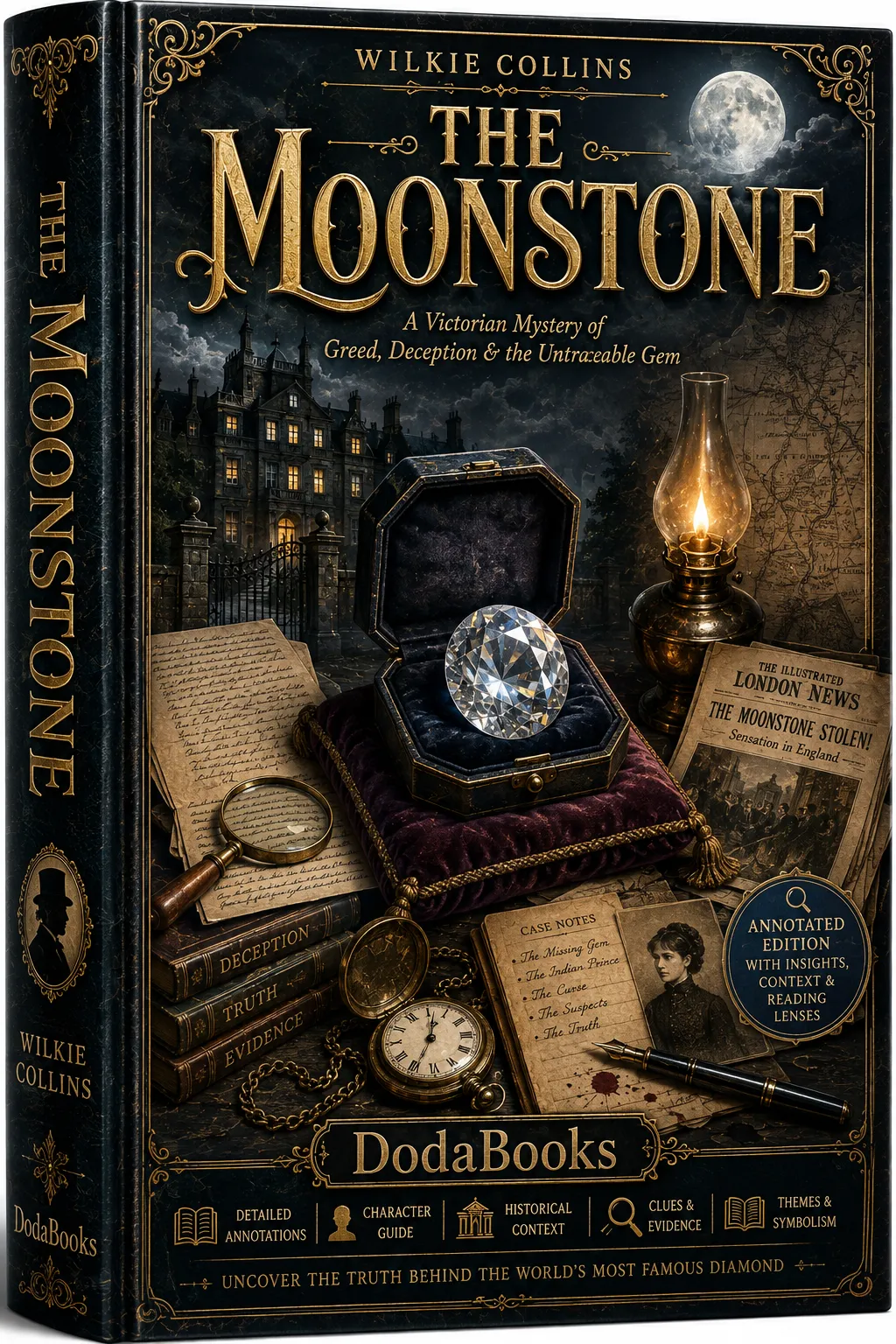
💎 Experience Collins’s Detective Masterpiece Fully Annotated
Read the novel that founded detective fiction in an authoritative, distraction-free edition:
- ✅ Complete, unabridged 1868 text across all fourteen narrators and testimonies
- ⚖️ Victorian medical & colonial context decoded — understand the opium science and Seringapatam theft
- 🗂️ Passage-specific annotation cards revealing character credibility and narrative clues
- 🔒 DRM-free EPUB format — readable on any Kindle, Kobo, iPad, or mobile device
- 📥 Instant digital download delivered directly after checkout