Is The Lady of the Lake Hard to Read? Reading Difficulty & Study Guide
For many contemporary readers who primarily read prose novels, opening a six-canto narrative poem written in rhyming verse can seem daunting. First-time readers often wonder: Is Sir Walter Scott’s The Lady of the Lake too archaic, slow-paced, or linguistically dense to enjoy today?
The surprising reality is that The Lady of the Lake is one of the most swift-moving, cinematic, and rhythmically intoxicating adventures in the English language. Unlike the complex, Latinate philosophical epics of John Milton (Paradise Lost) or the reflective introspection of William Wordsworth (The Prelude), Scott wrote for a broad, popular audience. His brisk iambic tetrameter lines gallop like a horse in full stride, carrying the reader through high-stakes stag hunts, clan ambushes, and mortal duels.
However, readers will encounter genuine linguistic and historical hurdles: Gaelic clan terminology, sixteenth-century Scottish political history, and nineteenth-century poetic diction. This comprehensive study guide analyzes the reading difficulty of The Lady of the Lake, providing an essential Scottish glossary, meter analysis, and an actionable 4-week reading schedule.
| Difficulty Metric | Level / Measurement | Comparative Context |
|---|---|---|
| Poetic Form & Meter | Iambic Tetrameter (Octosyllabic Couplets) | Fast, galloping 8-syllable lines (aabb rhyme scheme); Spenserian stanzas open and close each canto. |
| Total Length | 6 Cantos (~4,900 lines / ~36,000 words) | Equivalent in reading time to a short novella (~120–140 pages). |
| Reading Pace | Extremely Swift | The driving meter creates strong forward momentum; read aloud, it flows naturally. |
| Primary Hurdle | Gaelic & Scottish Highland Vocabulary | Terms like pibroch, snood, targe, coronach, heath, ben, and sassenach. |
| Historical Context | High (16th-Century Scotland) | Reign of James V, the banishment of the Douglases, and the clan system. |
| Recommended Pacing | 1.5 Cantos per week (4-week plan) | Allows close attention to incorporated songs, geography, and historical notes. |
🎼 The Music of the Meter: Understanding Scott’s Verse
The greatest secret to reading The Lady of the Lake with ease is understanding its rhythmic engine:
SCOTT'S DRIVING OCTOSYLLABIC METER (Iambic Tetrameter)
da-DUM  da-DUM  da-DUM  da-DUM
The STAG  at EVE  had DRUNK  his FILL,
Where DANCED  the MOON  on MON-  an's RILL...
1. Iambic Tetrameter (Octosyllabic Couplets)
Nearly 85% of the poem is composed in four-beat iambic verse (eight syllables per line), rhyming in immediate couplets (aabbccdd):
- This was the meter of medieval minstrel romances and Border ballads.
- Because the lines are short (four beats compared to Shakespeare’s or Milton’s five-beat pentameter), the action moves with breathless speed.
- It is designed to be read aloud or chanted to the rhythm of a galloping horse or marching clan.
2. Spenserian Stanzas (Preludes and Codas)
Each of the six cantos opens and closes with one or two majestic Spenserian stanzas (nine lines rhyming ababbcbcc, ending with a sweeping six-beat alexandrine line). In these stanzas, Scott steps back from the rapid action to invoke the “Harp of the North,” offering reflective, atmospheric landscape paintings of dawn, mist, and sunset over the Scottish mountains.
3. Incorporated Lyrical Songs
Throughout the poem, Scott breaks the octosyllabic meter with celebrated independent songs that mimic traditional Celtic musical forms:
- Lullaby: “Soldier, rest! thy warfare o’er” (Canto I)
- Clan Choral March: “Hail to the Chief who in triumph advances!” (Canto II)
- Funeral Dirge: “He is gone on the mountain, he is lost to the forest” (The Coronach) (Canto III)
- Highland Ballad: “Alice Brand” (Canto IV)
METRIC ARCHITECTURE OF EACH CANTO
┌────────────────────────────────────────────────────────┐
│ 1. Spenserian Prelude: Atmospheric landscape painting  │
│ 2. Octosyllabic Core: Fast-paced narrative action       │
│ 3. Embedded Lyrical Songs: Choral songs, laments, dirges│
│ 4. Spenserian Coda: Sunset, twilight, moral reflection │
└────────────────────────────────────────────────────────┘
🔍 The 3 Greatest Reading Challenges
1. Gaelic Highland Topography
Scott does not set his action in an imaginary fantasy land; he maps his narrative onto real Scottish geography with topographical precision. A reader unfamiliar with Scottish landscape terms will encounter lines such as:
“The stag at eve had drunk his fill,
Where danced the moon on Monan’s rill,
And deep his midnight lair had made
In lone Glen Artney’s hazel shade…”
Understanding basic landscape words (ben = mountain peak, loch = lake, glen = narrow valley, strath = broad river valley, brae = hillside, burn = small stream) instantly transforms confusing geographic names into vivid physical imagery.
2. The 16th-Century Political Landscape
Scott’s narrative presupposes that the reader understands the bitter historical conflict between:
- The Lowland Feudal Crown (Edinburgh/Stirling): English-speaking, centralized, governed by royal law courts and professional armies under King James V.
- The Gaelic Highlands (Clan Alpine): Gaelic-speaking, decentralized, organized around blood kinship, patriarchal loyalty, and traditional cattle-reiving.
- The Banished Border Aristocracy (The Douglases): Anglo-Scottish nobility caught in between royal favor and outlawry.
Without recognizing these three distinct factions, the shifting allegiances of characters like Malcolm Graeme and Lord James of Douglas can seem bewildering.
3. Scott’s Antique Poetic Diction
Like all Romantic poets, Scott occasionally employs archaic contractions (o’er, ere, oft, whilom, meed) and inverted syntax (placing verbs before subjects to satisfy rhyme schemes). Reading with attention to punctuation—pausing at commas and periods rather than automatically halting at the end of every poetic line—resolves almost all syntactic confusion.
📚 Essential Scottish & Clan Vocabulary
This glossary covers the most critical period terms used throughout The Lady of the Lake:
| Scottish / Celtic Term | Literal Meaning & Poetic Context |
|---|---|
| Ben | A mountain peak or high summit (e.g., Benvenue, Benledi). |
| Brae | A steep hillside, bank, or sloping slope covered in heather. |
| Cairn | A mound of rough stones built as a memorial or landmark on a mountain ridge. |
| Claymore | A massive, two-handed Highland broadsword used by Clan Alpine warriors. |
| Coronach | A Gaelic funeral dirge or lament sung by women over the body of a fallen chieftain. |
| Crann Tara (Fiery Cross) | A charred, blood-dipped wooden cross carried by couriers to summon the clan to war. |
| Dirk | A long, straight-bladed Highland dagger worn at the belt for close-quarters combat. |
| Glen | A deep, narrow mountain valley, usually carved by a river or stream (e.g., Glenfinlas). |
| Loch | A lake or narrow sea inlet (e.g., Loch Katrine, Loch Achray). |
| Pibroch | Classical martial or mournful pipe music played on the Great Highland Bagpipe. |
| Plaid | A long length of wool tartan fabric worn over the shoulder and belted around the waist. |
| Sassenach / Saxon | The Gaelic term for Lowland Scots or Englishmen; used by Roderick Dhu to denote outsiders. |
| Snood | A silk ribbon or fillet worn around the hair by unmarried Scottish maidens to signify maidenhood. |
| Target (Targe) | A round, leather-covered wooden shield studded with brass bosses and steel spikes. |
| Trossachs | The rugged, wooded gorge and wild valley between Loch Achray and Loch Katrine. |
| Taghairm | An ancient Celtic divination ritual where an ascetic slept in a bull’s hide to receive visions. |
🗓️ 4-Week Structured Reading Plan
Covering the 6 cantos over four weeks allows you to absorb Scott’s poetic meter and historical world without feeling rushed:
4-WEEK POETRY STUDY PLAN
Week 1 (Canto I):     The Chase & Arrival at Ellen's Isle (The Hunt & Lullaby)
Week 2 (Cantos II–III): The Flotilla, "Hail to the Chief", & The Fiery Cross
Week 3 (Cantos IV–V): The Prophecy, Goblin Cave, & Single Combat at Coilantogle
Week 4 (Canto VI):    The Stirling Guard-Room, Roderick's Death, & The Royal Reveal
Week 1: The Mountain Hunt & Ellen’s Isle (Canto I)
- Reading Goal: Canto First: The Chase (~800 lines).
- Core Action: The royal stag hunt; the death of the black horse; Fitz-James’s discovery of Loch Katrine; meeting Ellen; the rustic lodge and the song “Soldier, Rest!”
- Focus: Tuning your ear to the galloping rhythm of octosyllabic rhyming couplets.
- Reading Time: ~50 minutes.
Week 2: Chieftains, War Anthems & The Fiery Cross (Cantos II & III)
- Reading Goal: Canto Second: The Island and Canto Third: The Gathering (~1,700 lines).
- Core Action: Allan-bane’s harp songs; Clan Alpine’s arrival singing “Hail to the Chief”; Douglas’s refusal of Roderick’s marriage proposal; Brian the Hermit consecrating the Fiery Cross; the frantic courier run interrupting weddings and funerals.
- Focus: Contrasting peaceful domestic love with the terrifying speed of Celtic tribal mobilization.
- Reading Time: ~90 minutes.
Week 3: Prophecies, Ambush & Mortal Combat (Cantos IV & V)
- Reading Goal: Canto Fourth: The Prophecy and Canto Fifth: The Combat (~1,600 lines).
- Core Action: Brian’s bull-hide vision; Douglas slipping away to Stirling; Fitz-James giving Ellen the royal signet ring; the ambush at Coilantogle Ford (“I am Roderick Dhu!”); the ferocious rapier-versus-claymore duel; Douglas winning the royal games at Stirling.
- Focus: The clash of codes: Fitz-James’s Renaissance fencing versus Roderick Dhu’s Celtic warrior pride.
- Reading Time: ~85 minutes.
Week 4: The Castle Guard-Room & The Royal Crown (Canto VI)
- Reading Goal: Canto Sixth: The Guard-Room (~900 lines).
- Core Action: Ellen and Allan-bane arriving at Stirling Castle; Allan-bane singing the battle lay to dying Roderick Dhu; Ellen presenting the ring in the presence chamber; the reveal that Fitz-James is King James V; the royal pardon and union of Malcolm and Ellen.
- Focus: How Scott resolves clan warfare through sovereign mercy and national reconciliation.
- Reading Time: ~60 minutes.
💬 Discussion & Book Club Questions
- Poetry vs. Prose: How does reading a story in rhyming verse affect your emotional experience compared to reading a standard historical novel like Waverley or Ivanhoe?
- The Defense of the Gael: Reread Roderick Dhu’s speech to Fitz-James on the mountain trail in Canto V. Does Scott sympathize with the Highlanders whose lands were seized by the Lowland crown?
- The Role of the Minstrel: Why is Allan-bane such a central figure in the poem? How does music function as both an instrument of war (Hail to the Chief) and an instrument of peace and solace?
- The Morality of King James V: Is James V justified in suppressing Clan Alpine and arresting Douglas, or does he abuse his absolute power? How does his incognito persona (Fitz-James) balance his royal duty?
- The Cultural Impact: Why do you think this poem sparked such an intense tourism craze in the nineteenth century, causing thousands of readers to visit Loch Katrine?
❓ Frequently Asked Questions
Is The Lady of the Lake written in Old English or Middle English?
No. The Lady of the Lake is written in modern English (composed in 1810 by Sir Walter Scott). While it features Scottish dialect words and 16th-century terms, its grammatical structure and vocabulary are completely understandable to modern readers without specialized translation.
Is it better to read the poem silently or out loud?
Reading aloud (or listening to a dramatic reading) significantly enhances the experience. Because Scott wrote in four-beat iambic meter modeled after oral folk ballads, hearing the rhythm brings the sword fights, bagpipe songs, and stag hunts to life far more vividly than silent scanning.
How does The Lady of the Lake connect to King Arthur?
Despite the shared title, Scott's poem is not about the Arthurian "Lady of the Lake" (Nimue or Viviane). Scott deliberately borrowed the evocative phrase to describe Ellen Douglas living on her lake island in Scotland, creating an entirely original historical romance set in 16th-century Perthshire.
How long does it take to read the entire poem?
At approximately 36,000 words, reading the entire poem from start to finish takes about 3.5 to 4 hours. Following our 4-week study schedule requires roughly 50 to 80 minutes of reading per week.
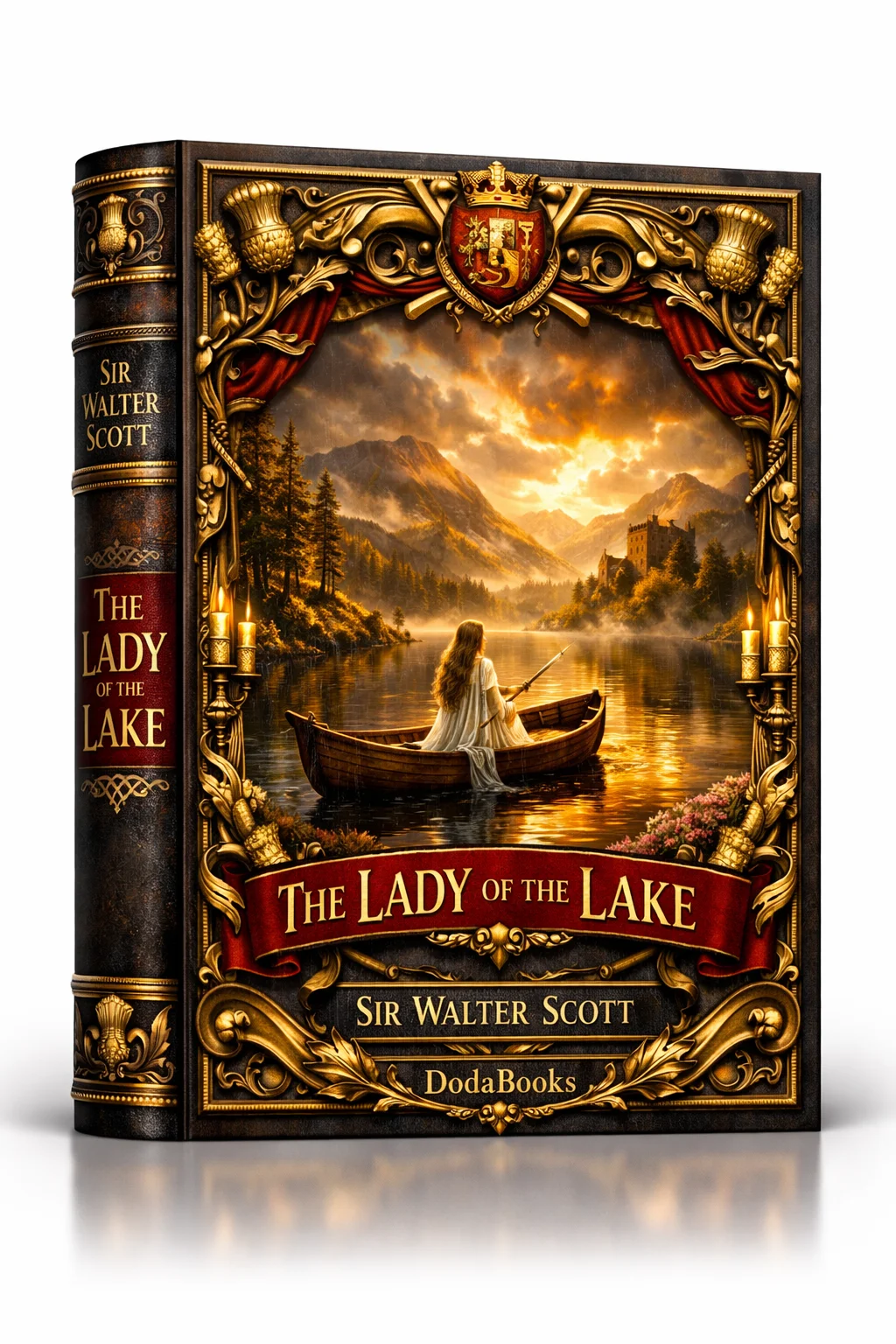
📖 Master Sir Walter Scott’s Epic in Verse
Experience The Lady of the Lake with the scholarly clarity, Highland notes, and poetic formatting it deserves:
- 🗡️ All 6 Cantos Complete & Unabridged — Featuring all songs, Spenserian preludes, and historical notes
- 💡 Exhaustive Footnotes on Clan Warfare & Celtic Lore — Understand the Fiery Cross, Taghairm, and James V
- 📱 Pristine Poetic Typography — Scrupulously formatted octosyllabic verse designed for mobile and e-ink displays
- 🔓 100% DRM-Free — Read anywhere on Kindle, Kobo, iPad, or Android with zero restrictions
👉 Get the Annotated Edition of The Lady of the Lake at DodaBooks →