Is The King in Yellow Hard to Read? Reading Order & Difficulty Guide
If you are planning to read Robert W. Chambers’s The King in Yellow (1895) for a literature seminar, an introduction to cosmic horror, or following a rewatch of HBO’s True Detective, you may be wondering what kind of challenge lies ahead. Is the 1895 prose dense and impenetrable? Do you have to read all ten stories, or should you only read the four famous horror tales? And why does the book suddenly switch from terrifying cosmic monsters to young American art students falling in love in Paris?
The short answer: The King in Yellow is remarkably modern, lyrical, and accessible in its sentence structure, earning a moderate difficulty rating of 6.0 / 10.
Unlike nineteenth-century novels that burden readers with massive fifty-page chapters of polite drawing-room gossip, Chambers wrote with the elegant, evocative, and rhythmic flair of the Decadent and Symbolist movements. His prose moves with eerie musical cadence, and his individual stories range from 15 to 45 pages in length.
However, modern readers frequently experience two unique challenges: navigating the deeply unreliable, brain-injured narrator of “The Repairer of Reputations”, and grappling with the dramatic tonal shift between the dark cosmic horror of the first four stories and the nostalgic bohemian romances of the final four tales.
This comprehensive guide breaks down the true reading level of The King in Yellow, solves the reading order debate, maps out the four specific hurdles to watch for, and provides a battle-tested 7-day reading schedule.
⚡ The King in Yellow Reading Difficulty: At a Glance
- Difficulty Rating: 6.0 / 10 (Moderate) — Far more readable and poetic than H.P. Lovecraft’s archaic Latinate prose, more propulsive than Frankenstein (6.5/10), but more structurally disorienting than The Hound of the Baskervilles (5.0/10).
- Length: Approximately 83,000 words across 10 stories and prose poems (around 250–290 pages in standard print editions).
- Estimated Reading Time: 5.5 to 6.5 hours for an average adult reader (at 250 words per minute).
- Recommended Reading Age: Ages 14+ (Grades 9–12, high school, university, and adult readers).
- The Primary Challenge: The abrupt structural shift from cosmic horror in Part I to bohemian Parisian romance in Part II, alongside the complex unreliable narrator of "The Repairer of Reputations".
🧭 The Great Reading Order Debate: 4 Stories or 10?
The most debated question among first-time readers of The King in Yellow is which stories should you actually read?
Because Chambers grouped ten diverse works together under a single title, modern readers generally choose between three distinct reading strategies:
+---------------------------------------------------------------------------------------+
|                    THE THREE READING STRATEGIES FOR THE KING IN YELLOW                |
+---------------------------+-----------------------------------------------------------+
| STRATEGY                  | HOW TO READ & WHO IT IS FOR                               |
+---------------------------+-----------------------------------------------------------+
| 1. The Cosmic Mythos      | Read only Stories 1–4 ("The Repairer of Reputations",     |
|    Purist (Stories 1–4)   | "The Mask", "In the Court of the Dragon", "The Yellow     |
|                           | Sign"). Best for True Detective and Lovecraft fans        |
|                           | looking strictly for weird fiction and Carcosa dread.     |
+---------------------------+-----------------------------------------------------------+
| 2. The Complete Aesthetic | Read all 10 stories in chronological order as Chambers    |
|    Experience (1–10)      | intended in 1895. Best for serious readers, literature    |
|    *(Recommended)*        | students, and those who appreciate 1890s Decadent art.    |
+---------------------------+-----------------------------------------------------------+
| 3. The Thematic Split     | Read the 4 cosmic tales first; read the Brittany time-slip|
|    (4 + 1 + 1 + 4)        | romance ("Demoiselle d'Ys"); then read the 4 Latin        |
|                           | Quarter tales as an independent bohemian novella cycle.   |
+---------------------------+-----------------------------------------------------------+
Why You Should Read All 10 Stories
While horror enthusiasts often skip the final six stories, doing so deprives you of Chambers’s true artistic genius:
- “The Demoiselle d’Ys” (Story 5) is one of the most sublime supernatural time-slip romances in American literature—a medieval fantasy that lingers in the heart long after reading.
- “The Street of the First Shell” (Story 8) offers a gripping, realistic eyewitness portrait of Paris under Prussian artillery fire during the 1870 Franco-Prussian War.
- The Parisian Contrast: In 1890s Symbolist art, beauty and horror were viewed as two sides of the same coin. The sunny, vibrant bohemian cafes of the Latin Quarter provide the vital emotional contrast that makes the shadows of Carcosa feel so terrifying.
🧗 The 4 Specific Hurdles for Modern Readers
1. The Deeply Unreliable Narrator of “The Repairer of Reputations”
The collection opens with what many consider its most challenging story. The narrator, Hildred Castaigne, suffered a severe head injury from a riding accident and spent four years in an insane asylum.
He speaks with supreme confidence, claiming that America in 1920 is an authoritarian empire with public suicide chambers, and that he is the rightful heir to the imperial throne of Carcosa.
First-time readers are often disoriented: Is this alternate history real within the story? Is Hildred truly a prince? Or is he a raving lunatic holding a toy crown?
How to conquer it: Embrace the ambiguity! Chambers pioneered the modern psychological unreliable narrator. Look for subtle clues where ordinary characters react to Hildred with pity, alarm, or disgust. Once you realize Hildred’s aristocratic composure masks lethal clinical paranoia, the story becomes a masterpiece of dark irony.
2. The Abrupt Tonal Shift
If you open the book expecting ten consecutive chapters of tentacled monsters and dark cults, you will experience severe whiplash when you reach Story 7, “The Street of the Four Winds”, and find an artist cuddling a white cat in a Parisian garret.
How to conquer it: Adjust your expectations from the start. Treat the book as a two-part exhibition by a brilliant nineteenth-century painter: the first half is painted in shadows, cosmic nightmares, and rotting corpses; the second half is painted in the warm, golden hues of Parisian cafes and bohemian romance.
3. Decadent & Symbolist Aesthetic Vocabulary
Robert W. Chambers was an art student at the Académie Julian in Paris and was heavily influenced by French Decadent writers like Joris-Karl Huysmans and Charles Baudelaire. He frequently uses specialized aesthetic, psychological, and religious terms:
+-------------------------------------------------------------------------------+
|                       KEY DECADENT VOCABULARY IN THE BOOK                     |
+-------------------+-----------------------------------------------------------+
| WORD              | MEANING & CONTEXT                                         |
+-------------------+-----------------------------------------------------------+
| Cataleptic        | A state of unresponsive physical rigidity and trance-like |
|                   | suspension (Geneviève's marble slumber in "The Mask").    |
+-------------------+-----------------------------------------------------------+
| Somnambulism      | Sleepwalking or behaving in a dreamlike, hypnotic trance  |
|                   | (the victims of the Yellow Sign).                         |
+-------------------+-----------------------------------------------------------+
| Diadem            | A jeweled royal crown or ornamental headband (Hildred's   |
|                   | brass crown of Carcosa).                                  |
+-------------------+-----------------------------------------------------------+
| Fin-de-Siècle     | "End of the century"; referring to the decadent, weary,  |
|                   | highly stylized artistic culture of the 1890s.            |
+-------------------+-----------------------------------------------------------+
| Chryselephantine  | Made of gold and ivory; exquisite decadent sculpture.     |
+-------------------+-----------------------------------------------------------+
| Vespers           | Evening prayers and liturgical hymns in church            |
|                   | (Saint-Sulpice in "In the Court of the Dragon").          |
+-------------------+-----------------------------------------------------------+
4. Late 19th-Century Parisian French References
In the four Latin Quarter stories, characters frequently utter French slang, student expressions (boulevardier, atelier, modiste), and references to real Parisian landmarks (the Bal Bullier, Montparnasse, the Luxembourg Gardens, the Rue de Rennes).
An annotated edition providing quick inline translations ensures that these atmospheric French flourishes never stall your reading flow.
🎭 The Decadent Style: How Chambers Blends Beauty and Dread
Unlike modern horror writers who rely heavily on sudden jump scares, graphic gore, or technical jargon, Robert W. Chambers belonged to the fin-de-siècle Decadent movement (beside figures like Oscar Wilde, Aubrey Beardsley, and Ernest Dowson).
Understanding this artistic ethos transforms how you read his sentences:
- Art for Art’s Sake (L’art pour l’art): Chambers is as passionate about describing the scent of turpentine, the light filtering through dusty studio skylights, and the curve of a sculpture as he is about describing rotting corpses. The horror derives its devastating impact precisely because it invades a world of refined aesthetic beauty.
- The Palette of Sensation: Notice how Chambers uses color symbolism. Yellow is not the color of sunshine; it is the sickly hue of decay, quarantine flags, sulfur, and unwholesome decadence. The “black stars” and “twin suns” overturn natural astronomical order to signal metaphysical madness.
- The Power of Suggestion: Chambers never explains what the play The King in Yellow actually says. He gives you only brief verses and the screams of those who read it. By withholding explicit description, Chambers forces your imagination to construct a cosmic terror far more personal and frightening than any words on a page.
📊 How Hard Is The King in Yellow Compared to Other Classics?
+---------------------------------------------------------------------------------------+
|                       CLASSIC WEIRD & GOTHIC FICTION BENCHMARK                        |
+-----------------------------+-------------+------------+------------------------------+
| BOOK & AUTHOR               | DIFFICULTY  | WORD COUNT | PRIMARY CHALLENGE            |
+-----------------------------+-------------+------------+------------------------------+
| The Hound of the Baskervilles| 5.0 / 10    | ~59,000    | Fast detective thriller;     |
| (Arthur Conan Doyle)        | (Accessible)|            | regional Dartmoor terms      |
+-----------------------------+-------------+------------+------------------------------+
| The Picture of Dorian Gray  | 5.5 / 10    | ~78,000    | Witty epigrams; Victorian    |
| (Oscar Wilde)               | (Accessible)|            | aesthetic philosophy         |
+-----------------------------+-------------+------------+------------------------------+
| The King in Yellow          | 6.0 / 10    | ~83,000    | Unreliable narrator; tonal   |
| (Robert W. Chambers)        | (Moderate)  |            | shift from horror to romance |
+-----------------------------+-------------+------------+------------------------------+
| The Call of Cthulhu & Tales | 6.5 / 10    | ~60,000    | Archaic Latinate syntax;     |
| (H.P. Lovecraft)            | (Challenging|            | dense scientific catalogs    |
+-----------------------------+-------------+------------+------------------------------+
| Frankenstein                | 6.5 / 10    | ~75,000    | High Romantic rhetoric;      |
| (Mary Shelley)              | (Challenging|            | complex nested narrators     |
+-----------------------------+-------------+------------+------------------------------+
As the comparison illustrates, The King in Yellow is noticeably more approachable and lyrical than H.P. Lovecraft’s notoriously dense, adjective-heavy prose, while offering more psychological nuance than conventional detective stories.
📅 The Proven 7-Day King in Yellow Reading Schedule
Reading The King in Yellow in one week requires reading approximately 1 to 2 stories per day (around 11,000 to 12,000 words, or roughly 45 to 55 minutes of reading):
+-------------------------------------------------------------------------------+
|                      THE 7-DAY KING IN YELLOW READING PLAN                    |
+-----+-----------------------+-------------------------------------------------+
| DAY | STORY                 | DRAMATIC HIGHLIGHTS                             |
+-----+-----------------------+-------------------------------------------------+
| 1   | The Repairer of       | Future 1920 America; The lethal chamber;        |
|     | Reputations           | Hildred's crown and Mr. Wilde's fatal cat.      |
+-----+-----------------------+-------------------------------------------------+
| 2   | The Mask & In the     | Boris's marble chemical pool; The blasphemous   |
|     | Court of the Dragon   | organ music; The terrifying skies of Carcosa.   |
+-----+-----------------------+-------------------------------------------------+
| 3   | The Yellow Sign       | Jack and Tessie; The rotting hearse driver;     |
|     |                       | The fatal onyx clasp and final damnation.       |
+-----+-----------------------+-------------------------------------------------+
| 4   | The Demoiselle d'Ys & | Brittany time-slip romance; Medieval falconer   |
|     | The Prophets' Paradise| maiden; Eight philosophical prose vignettes.    |
+-----+-----------------------+-------------------------------------------------+
| 5   | The Street of the     | Severin the woodcarver; The wandering white cat;|
|     | Four Winds            | The tragic deathbed discovery across the roofs. |
+-----+-----------------------+-------------------------------------------------+
| 6   | The Street of the     | The 1870 Prussian Siege of Paris; Artillery     |
|     | First Shell           | shells in Montparnasse; Heroic survival.        |
+-----+-----------------------+-------------------------------------------------+
| 7   | The Street of Our Lady| Hastings and Valentine in Luxembourg Gardens;   |
|     | & Rue Barrée          | Clifford's whimsical courtship in the Latin Qtr.|
+-----+-----------------------+-------------------------------------------------+
💡 4 Practical Tips for an Effortless Read
- Read Cassilda’s Song Aloud: Begin by reading the opening poem, “Cassilda’s Song”, out loud. Chambers’s rhythm sets the dreamlike, decadent mood for the entire book.
- Track the Recurring Motifs: Keep an eye out for recurring names and symbols across the first four stories: the color yellow, the black stars, the pallid mask, the lake of Hali, and the name Castaigne.
- Don’t Rush the Prose: Chambers wrote during the height of the Symbolist movement. His sentences are packed with sensory color, perfume, and delicate emotional textures. Savoring the atmosphere is far more rewarding than racing to the plot climax.
- Choose an Unabridged Annotated Copy: Ensure your edition contains all ten stories and provides built-in notes explaining the Ambrose Bierce connections and historical French context.
❓ Frequently Asked Questions (FAQ)
Is The King in Yellow harder to read than Lovecraft?
No, most readers find Chambers significantly easier to read than H.P. Lovecraft. Chambers was a commercially successful novelist and poet with a crisp, evocative, and rhythmic style. Lovecraft deliberately wrote in an intentionally archaic, eighteenth-century style packed with rare Latinate words (e.g., eldritch, rugose, squamous).
Why did Robert W. Chambers stop writing horror?
Following the publication of The King in Yellow and a few subsequent weird fiction collections (The Maker of Moons, The Mystery of Choice), Chambers realized that historical romances and high-society melodramas were far more commercially lucrative. He became one of the wealthiest and most successful romance novelists in America, earning vast royalties, but literary history remembers him almost exclusively for The King in Yellow.
At what age should you read The King in Yellow?
The collection is ideal for readers aged 14 and older (Grades 9 and up). While the stories deal with suicide, madness, and horrific decay (the rotting hearse driver), there is no graphic gore or profanity, making it appropriate for high school and university courses.
Do you need to know about True Detective to understand the book?
Not at all. In fact, reading Chambers’s original 1895 text first gives you a much deeper appreciation of True Detective. You will instantly recognize the references to Carcosa, the black stars, and the Yellow King that the series weaves into its gritty Louisiana murder mystery.
What is the easiest way to read the collection for beginners?
The easiest way is to read an annotated digital edition with inline notes and historical cards, such as the DodaBooks Annotated Ebook. Reading one story per evening following our 7-day plan ensures a deeply immersive and manageable reading experience.
📚 Related Articles & Guides
Looking for an overarching analysis of weird fiction and cosmic dread? Explore our master The King in Yellow Book Guide.
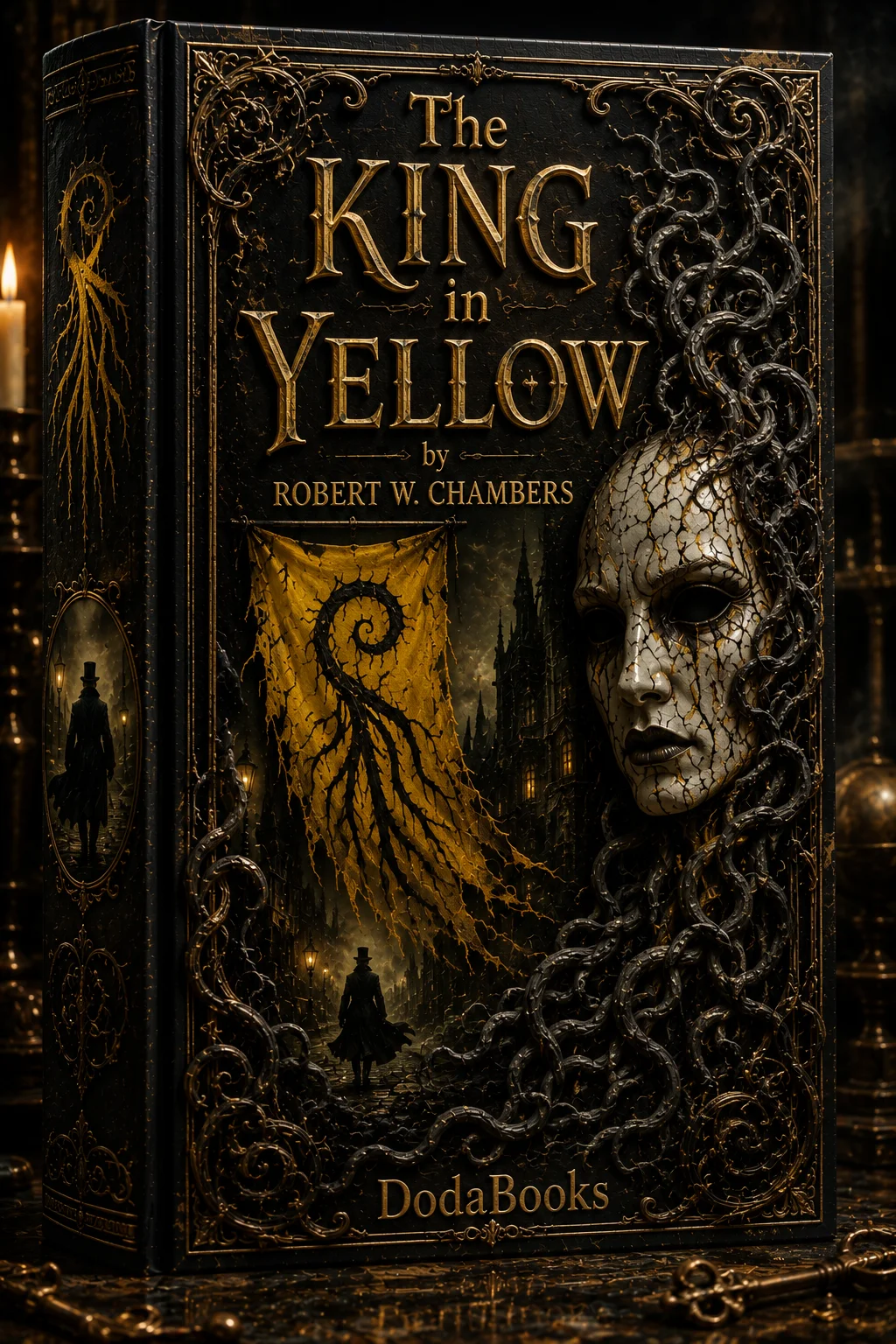
📖 Read the Definitive Annotated Edition of The King in Yellow
Experience Robert W. Chambers’s complete landmark weird fiction anthology with comprehensive cosmic horror commentary and historical notes:
- ✅ Complete Unabridged 10-Story Collection — Every word of the 1895 original first edition
- 👑 Cosmic Horror Mythology Cards — Decode Carcosa, the Lake of Hali, Cassilda’s Song, and the Pallid Mask
- 🎨 Paris Latin Quarter Historical Notes — Understand the 1870 Prussian Siege and Belle Époque artist life
- 📜 The True Detective & Lovecraft Lineage — Explore how Chambers shaped modern cosmic supernatural fiction
- 🔒 Universal DRM-Free Formats — Delivered instantly in EPUB, PDF, and AZW3/Kindle formats