Is The Dogaressas of Venice Hard to Read? Reading Difficulty & Study Guide
For history enthusiasts, students of the Italian Renaissance, and travelers fascinated by the floating city of Venice, John Edgcumbe Staley’s The Dogaressas of Venice (The Wives of the Doges) (1910) is a treasure trove of archival research, civic pageantry, and female biography. Covering a thousand years of political, cultural, and domestic life, Staley’s work is one of the most comprehensive chronicles of Venetian court society ever written in English.
However, readers approaching this monumental study for the first time will encounter significant academic and linguistic challenges. Staley writes in the elevated, ornate prose style characteristic of late Edwardian historiography, weaving untranslated Italian archival terms, complex Venetian constitutional titles, and intricate patrician genealogies into nearly every paragraph.
This comprehensive reading difficulty guide evaluates the Lexile level, vocabulary demands, and research methodology of The Dogaressas of Venice, providing an essential glossary of Venetian civic institutions and an actionable 4-week study roadmap for history majors, educators, and independent scholars.
| Difficulty Metric | Level / Measurement | Comparative Context |
|---|---|---|
| Lexile Measure | 1180L – 1250L | Advanced adult / collegiate academic readership; comparable to Jacob Burckhardt’s The Civilization of the Renaissance in Italy. |
| Total Word Count | ~125,000 words (~360–400 pages) | Substantial historical monograph covering 804 AD to 1797 across 18 thematic chapters. |
| Sentence Structure | Formal & Periodical | Dense Edwardian historical prose with extensive clauses, archival quotations, and Latin/Italian citations. |
| Primary Challenge | Venetian Constitutional & Civic Terms | Concepts like Promissione Ducale, Serrata, Bucintoro, Corno Ducale, and the Council of Ten. |
| Historical Scope | 1,000 Years of Complex History | Spans from early Byzantine influence and the Crusades to Renaissance triumphs and Napoleonic conquest. |
| Recommended Pacing | 4 to 5 chapters per week (4-week plan) | Allows careful absorption of dynastic family trees, sumptuary laws, and civic rituals. |
📊 Quantitative Difficulty & Historiographical Analysis
To understand the academic weight of The Dogaressas of Venice compared to other classic historical and biographical works, consider standard educational benchmarks:
HISTORICAL MONOGRAPH DIFFICULTY COMPARISON (LEXILE SCALE)
┌────────────────────────────────────────────────────────┐
│ Edward Gibbon: Decline and Fall of the Roman Empire (1350L)
├────────────────────────────────────────────────────────┤
│ Jacob Burckhardt: Civilization of the Renaissance (1260L)│
├────────────────────────────────────────────────────────┤
│ Edgcumbe Staley: The Dogaressas of Venice (1210L) ◄── ADVANCED
├────────────────────────────────────────────────────────┤
│ Thomas Carlyle: The French Revolution (1180L)          │
├────────────────────────────────────────────────────────┤
│ Lytton Strachey: Eminent Victorians (1120L)            │
└────────────────────────────────────────────────────────┘
At roughly 125,000 words, Staley’s work is a serious scholarly endeavor. Rather than offering superficial romanticized gossip, Staley drew heavily from primary archival documents preserved in the State Archives of Venice (Archivio di Stato di Venezia), the Marciana Library, and private patrician collections.
The prose reflects the golden age of Edwardian historical writing:
- Rich Descriptive Cadence: Staley excels at sensory descriptions of coronation pageants, detailing fabrics (gold damask, samite, Genoa velvet), jewels (Oriental pearls, emeralds), and floating architecture.
- Genealogical Density: Readers must track dozens of intertwined aristocratic family names—Morosini, Dandolo, Foscari, Contarini, Priuli, Grimani, Querini, Corner, and Loredan.
🔍 The 3 Greatest Reading Hurdles
1. Complex Venetian Constitutional Terminology
The Republic of Venice had the most intricate, checks-and-balances constitutional apparatus in human history. Staley frequently references government bodies and legal oaths without defining them anew in every chapter:
- The Doge was not an absolute king, but a sworn magistrate whose every action was monitored by the Signoria (his cabinet), the Collegio, the Senate, and the dreaded Council of Ten (Consiglio dei Dieci).
- The Dogaressa’s status was strictly governed by the Promissione Ducale—a legally binding charter drafted by the state before the Doge’s election, restricting gifts, foreign correspondence, and spending.
THE VENETIAN CIVIC ARCHITECTURE
┌────────────────────────────────────────────────────────┐
│ 1. THE GREAT COUNCIL (Maggior Consiglio): All Patricians│
│ 2. THE SENATE (Senato): Foreign policy & maritime trade│
│ 3. THE COUNCIL OF TEN (Consiglio dei Dieci): State spy/security │
│ 4. THE SIGNORIA: Doge + 6 Ducal Councillors + 3 Judges │
│ 5. THE DOGARESSA: Crowned Consort & Patron of Guilds   │
└────────────────────────────────────────────────────────┘
2. Italian, Latin, and Venetian Dialect Phrases
Staley frequently incorporates authentic Italian and Venetian dialect terms into his narrative:
- Venetian dress terms: Corno (the ducal horned crown), Chopines or Zoccoli (towering platform shoes), Bavara (a lace collar).
- Navigational and architectural terms: Molo (the stone quay), Piazzetta (the open plaza beside St. Mark’s), Pozzi (the dark lower dungeons of the Ducal Palace), Piombi (the lead-roofed upper cells).
Reading with an annotated edition like DodaBooks that provides instant pop-up definitions eliminates the need to constantly consult Italian-English historical lexicons.
3. Chronological vs. Thematic Structure
While the early chapters follow a chronological arc from the 9th to the 15th centuries, the middle and later chapters frequently organize material thematically:
- Chapter X focuses entirely on The Bucintoro and Water Pageantry.
- Chapter XI explores The Dogaressa and the Guilds.
- Chapter XIV examines The War on Fashion: Sumptuary Legislation.
Readers should approach the book not merely as a timeline of rulers, but as a cultural encyclopedia of Venetian civilization viewed through female agency.
📚 Essential Venetian Civic Glossary
Mastering these twenty historical terms will unlock the text completely:
| Term / Institution | Meaning & Context in Venetian History |
|---|---|
| Archivio di Stato | The Venetian State Archives, housing over a thousand years of official government registers, decrees, and wills. |
| Arsenale | The colossal state shipyard of Venice where galleys and the Bucintoro were built and manned by elite arsenallotti. |
| Bucintoro | The two-deck golden state galley rowed by 168 men, used for coronation pageants and the “Marriage of the Sea.” |
| Chopine (Zoccolo) | Towering wooden platform shoes, often 12 to 18 inches high, worn by Venetian noblewomen to display wealth and keep hems dry. |
| Corno Ducale | The unique horned bonnet of stiff brocade and gold worn by the Doge and Dogaressa as the official crown of state. |
| Council of Ten | The secret, dreaded judicial and state security council of Venice responsible for protecting the state against conspiracy. |
| Doge | The supreme elected magistrate and head of state of the Venetian Republic (derived from Latin Dux, leader). |
| Fondaco | A fortified trading house and warehouse assigned by the Republic to foreign merchants (e.g., Fondaco dei Tedeschi for Germans). |
| Golden Rose | A sacred golden ornament blessed by the Pope and presented to foreign monarchs; awarded to Dogaressa Morosina Morosini in 1597. |
| Libro d’Oro (Golden Book) | The official heraldic register of hereditary patrician families entitled to sit in the Great Council of Venice. |
| Maggior Consiglio | The Great Council; the sovereign general assembly comprising all male patrician citizens over age twenty-five. |
| Molo | The stone quay and waterfront promenade facing the Bacino di San Marco, where state barges landed. |
| Piombi | The “Leads”; the famous prison cells located directly beneath the lead sheet roof of the Ducal Palace. |
| Pozzi | The “Wells”; the dark, damp stone prison dungeons located at the water level beneath the Ducal Palace. |
| Promissione Ducale | The extensive written constitutional oath of office restricting the powers and privileges of the Doge and Dogaressa. |
| Punto in Aria | “Stitches in the air”; the famous, delicate needlepoint lace invented and crafted by the women of Burano island. |
| Ridotto | A private or state-licensed palace salon in 18th-century Venice used for gambling, masked socializing, and politics. |
| Scuole Grandi | The wealthy charitable lay fraternities and guild institutions that commissioned master Renaissance paintings and pageants. |
| Serrata (1297) | The “Closure” of the Great Council, which transformed the Venetian merchant elite into a permanent closed hereditary nobility. |
| Signoria | The supreme governing body of the Republic, consisting of the Doge, his six councillors, and the three heads of the Quarantia. |
🗓️ 4-Week Structured Study Plan
This four-week curriculum divides Staley’s eighteen chapters into logical historical eras:
4-WEEK STUDY ROADMAP
Week 1 (Ch. 1–5):   The Byzantine Dawn & Medieval Foundations (804–1250)
Week 2 (Ch. 6–9):   The Merchant Empire, Guilds & The Foscari Tragedy (1250–1450)
Week 3 (Ch. 10–14): High Renaissance Coronations, Burano Lace & Sumptuary Laws (1450–1650)
Week 4 (Ch. 15–18): Baroque Twilight, The Last Coronation, & Fall of the Republic (1650–1797)
Week 1: Byzantine Origins and the Dawn of Luxury (Chapters 1–5)
- Reading Goal: Chapters I through V (~30,000 words).
- Key Themes: Moving the capital to the Rialto; the early Duchesses; Theodora Ducas and the scandal of the golden fork; the rediscovery of Saint Mark’s relics under Felicia Malipiero; early sumptuary customs.
- Core Question: How did Byzantine luxury clash with early Venetian republican simplicity?
- Reading Time: ~120 minutes across the week.
Week 2: Merchant Kings, The Golden Book & Tragedy (Chapters 6–9)
- Reading Goal: Chapters VI through IX (~32,000 words).
- Key Themes: The Serrata of 1297; the invention of the Promissione Ducale; Alicia da Prata and Tommasina Morosini; the Black Death of 1348; the tragic reign and persecution of Marina Nani Foscari.
- Core Question: Why did the Venetian state systematically strip the Dogaressa of political voting power while expanding her ceremonial prestige?
- Reading Time: ~125 minutes across the week.
Week 3: High Renaissance Pageantry and Burano Lace (Chapters 10–14)
- Reading Goal: Chapters X through XIV (~33,000 words).
- Key Themes: The architecture of the Bucintoro; the coronation triumph of Zilia Dandolo Priuli (1557); Morosina Morosini’s 1597 triumph; the revival of Burano needlepoint lace; the Papal Golden Rose; the battle over platform chopines and silk trains.
- Core Question: How did Morosina Morosini use her private wealth to create a sustainable manufacturing industry for working-class women?
- Reading Time: ~130 minutes across the week.
Week 4: Baroque Twilight and Napoleonic Dissolution (Chapters 15–18)
- Reading Goal: Chapters XV through XVIII (~30,000 words).
- Key Themes: The magnificent 1694 coronation of Elisabetta Querini Valier; the Senate’s ban on future coronations; Elena Lucrezia Corner’s historic doctoral degree; eighteenth-century carnival and casino life; the final abdication of Doge Ludovico Manin before Napoleon in 1797.
- Core Question: What factors led to the decline of the Republic, and how did the Dogaressa’s role mirror this twilight?
- Reading Time: ~120 minutes across the week.
💬 Discussion & Book Club Questions
- Female Power in a Republic: How does the Dogaressa’s influence compare to that of contemporary feudal queens (such as Queen Elizabeth I of England or Catherine de’ Medici of France)? Which system granted women greater long-term cultural impact?
- The Politics of Pageantry: Why was public spectacle—such as the Bucintoro water regatta—so vital to the political survival of the Venetian merchant oligarchy?
- The Economics of Luxury: Discuss Morosina Morosini’s intervention in the Burano lace industry. How does this challenge the perception that noble consorts were merely passive consumers of wealth?
- The Foscari Downfall: How does Staley’s account of Marina Nani Foscari illustrate the ruthless cruelty of the Council of Ten? Why did the state view familial love as a threat to republican security?
- The Memory of Venice: In what ways did the artistic, sartorial, and culinary innovations championed by the Dogaressas permanently shape the modern image of Venice?
❓ Frequently Asked Questions
Is this book a novel or a work of history?
The Dogaressas of Venice is an authoritative work of narrative history and biography. Edgcumbe Staley was a prominent British art historian and fellow of the Royal Society of Arts who spent years researching original manuscripts, state decrees, and family diaries in the archives of Venice.
Do I need to speak Italian to read and understand the book?
No. While Staley includes authentic Italian titles, architectural terms, and period proverbs, the core narrative is written entirely in English. In the DodaBooks edition, all Italian, Latin, and Venetian dialect phrases are accompanied by immediate inline or pop-up translations.
How long does it take to read the entire book?
At approximately 125,000 words across eighteen chapters, reading the book from cover to cover takes roughly 8 to 10 hours. Following our recommended 4-week study plan requires about 2 hours of reading per week.
What illustrations were included in the original 1910 edition?
The original edition published by T. Werner Laurie featured over thirty black-and-white plates reproducing historic portraits, engravings, medals, and Renaissance paintings of the Dogaressas by master artists including Titian, Tintoretto, and Paolo Veronese.
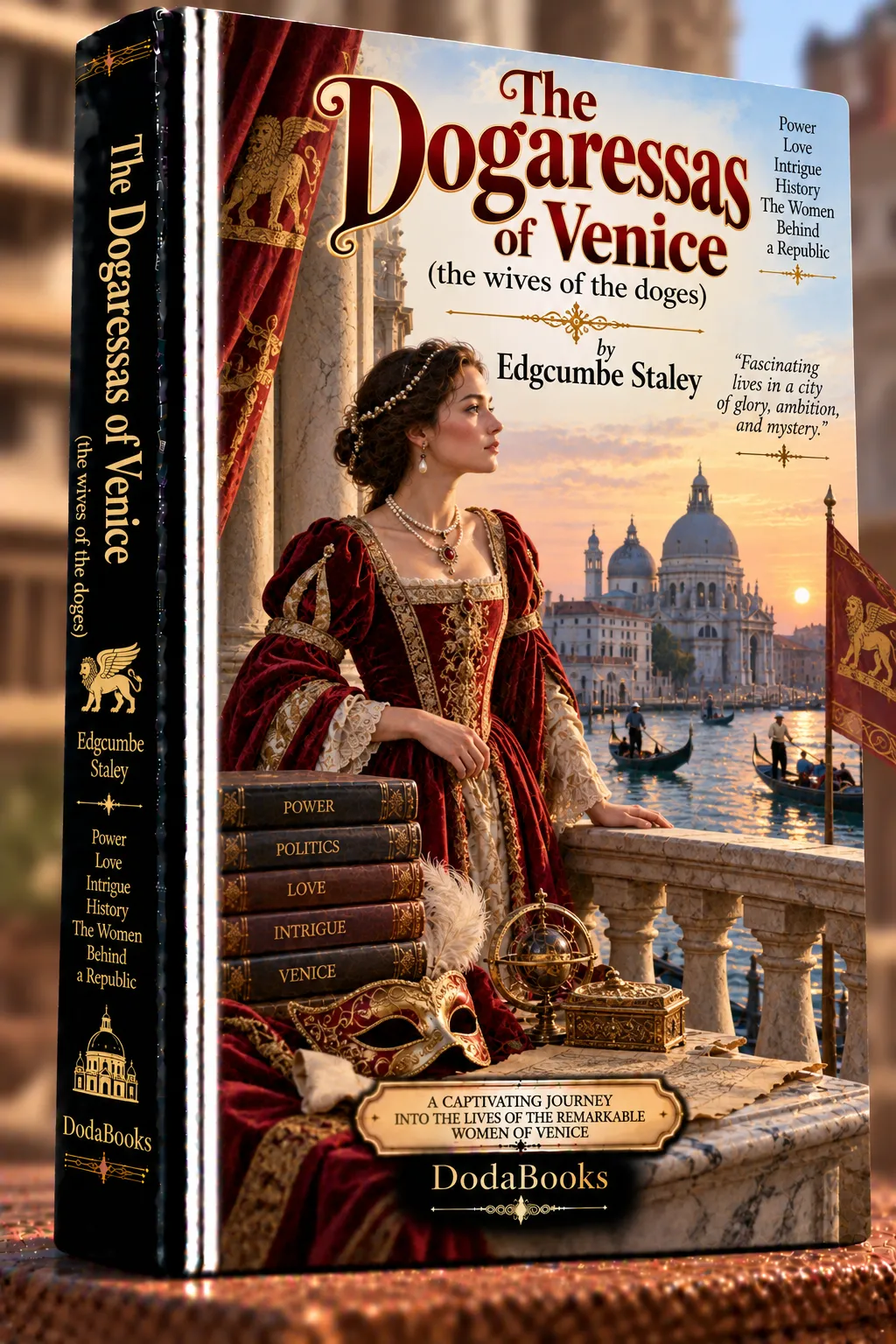
📖 Master the Secret History of Venetian Power
Deepen your understanding of Italian Renaissance sovereignty, pageantry, and female statecraft with the DodaBooks Annotated Edition of The Dogaressas of Venice:
- 👑 Complete 18-Chapter Historical Chronicle — From the 9th-century lagoons to the fall of the Republic in 1797
- 💡 Exhaustive Footnotes on Venetian Institutions — Translating dialect terms, legal oaths, and patrician lineages
- 📱 Engineered for Scholarly Study — Clean digital typography, linked references, and clear chapter navigation
- 🔓 100% DRM-Free — Read anywhere on Kindle, Kobo, iPad, or Android with complete freedom
👉 Get the Annotated Edition of The Dogaressas of Venice at DodaBooks →