Is The Call of Cthulhu Hard to Read? Reading Difficulty & Vocabulary Guide
If you are thinking about reading H.P. Lovecraft’s The Call of Cthulhu (1928) for high school, an AP Literature seminar, a college creative writing class, or simply to understand where modern horror and cosmic dread originated, you are likely wondering what level of challenge lies ahead. Is Lovecraft’s prose dry, dense, and archaic? Why does everyone complain about his obscure adjectives? And how hard is it to follow a story told through newspaper clippings and dying confessions?
The short answer: The Call of Cthulhu sits at a moderate-to-challenging reading level (6.5 / 10), but because of its compact length (~12,000 words), it is one of the most rewarding and accessible entries into Lovecraft’s universe.
Unlike sprawling Victorian novels that take thirty hours to finish, The Call of Cthulhu can easily be read in two to three hours. It is structured like a gripping forensic true-crime dossier where narrator Francis Wayland Thurston pieces together three chilling fragments: an artist’s clay tablet, a police raid on a swamp cult, and a sailor’s shipwreck diary.
However, modern readers frequently stumble over Lovecraft’s unique literary idiosyncrasies: dense, multi-clause periodic sentences, eighteenth-century British spellings (colour, vapour, splendour), and a massive vocabulary of rare Latinate words (such as eldritch, cyclopean, squamous, and non-Euclidean).
This comprehensive guide breaks down the true reading difficulty of The Call of Cthulhu, decodes the twenty most important Lovecraftian vocabulary words, compares it to other horror classics, and provides a proven 3-day reading plan.
⚡ The Call of Cthulhu Reading Difficulty: At a Glance
- Difficulty Rating: 6.5 / 10 (Challenging Vocabulary, Accessible Length) — Noticeably more dense than The Hound of the Baskervilles (5.0/10) or Dracula (5.5/10), but far shorter and more propulsive than Frankenstein (6.5/10) or Moby-Dick (9.5/10).
- Length: Approximately 12,000 words across 3 numbered chapters (around 35–45 pages in standard print editions).
- Estimated Reading Time: 2 to 3 hours for an average adult reader (at 250 words per minute).
- Recommended Reading Age: Ages 14+ (Grades 9–12, AP Literature, university students, and adult readers).
- Primary Stumbling Blocks: Archaic 18th-century Latinate vocabulary, complex nested periodic sentences, and scientific terminology (non-Euclidean geometry, geodesy, archaeology).
🧗 The 4 Specific Hurdles for Modern Readers
While The Call of Cthulhu delivers an electrifying mystery, first-time readers should prepare for four distinct stylistic hurdles:
1. Lovecraft’s Signature Archaic & Latinate Vocabulary
Lovecraft was an antiquarian who idolized eighteenth-century English essayists like Joseph Addison and Samuel Johnson. He deliberately avoided twentieth-century modern slang, choosing rare, polysyllabic words derived from Latin and Greek to create a solemn, academic atmosphere.
Here is the essential vocabulary key to decode his prose:
+-------------------------------------------------------------------------------+
|                       KEY LOVECRAFTIAN VOCABULARY DECODED                     |
+-------------------+-----------------------------------------------------------+
| WORD              | DEFINITION & CONTEXT IN THE CALL OF CTHULHU               |
+-------------------+-----------------------------------------------------------+
| Eldritch          | Weird, sinister, unearthly, or ghostly (the general aura  |
|                   | of the Cthulhu cult and R'lyeh).                          |
+-------------------+-----------------------------------------------------------+
| Cyclopean         | Denoting a type of ancient stonework built with massive,  |
|                   | irregular stone blocks fitted without mortar (R'lyeh).    |
+-------------------+-----------------------------------------------------------+
| Squamous          | Covered with or characterized by scales; scaly (the       |
|                   | rubbery skin of Cthulhu's torso).                         |
+-------------------+-----------------------------------------------------------+
| Non-Euclidean     | Geometry violating Euclid's classical axioms; impossible  |
|                   | curved angles where gravity and perspective warp.         |
+-------------------+-----------------------------------------------------------+
| Antediluvian      | Belonging to the time before the biblical Flood; ancient, |
|                   | prehistoric (the stone city of the Old Ones).             |
+-------------------+-----------------------------------------------------------+
| Fulsome           | Repulsive, disgusting, or sickeningly foul (the putrid    |
|                   | stench emanating from the R'lyeh portal).                 |
+-------------------+-----------------------------------------------------------+
| Bas-Relief        | A sculptural technique where figures project slightly     |
|                   | from a flat background (Wilcox's clay tablet).            |
+-------------------+-----------------------------------------------------------+
How to conquer it: Do not stop every two minutes to consult a dictionary! As long as you understand that words like eldritch, squamous, and antediluvian convey an atmosphere of ancient, scaly, repulsive cosmic decay, you can maintain your reading momentum without breaking your focus.
2. Multi-Layered Epistolary & Document Framing
Unlike modern thrillers that feature real-time dialogue and action scenes, The Call of Cthulhu is an investigative epistolary mosaic:
- You are reading Thurston’s manuscript…
- Who is reading Professor Angell’s notes…
- Who interviewed Henry Wilcox about his dreams…
- And who recorded Inspector Legrasse’s presentation…
- Who interrogated Old Castro about the cult…
- And Thurston reads Johansen’s maritime log.
Some readers find this “story-within-a-story-within-a-document” structure disorienting.
How to conquer it: Picture yourself as a modern detective or investigative journalist inspecting an unsolved criminal case file. Every chapter provides one piece of physical evidence (the clay relief, the swamp idol, the sailor’s log). Once you view Thurston as an archivist assembling a puzzle, the document format becomes deeply compelling.
3. Non-Euclidean Geometry & Impossible Perspective
In Chapter 3, when Gustaf Johansen and his sailors step onto the risen island of R’lyeh, Lovecraft writes:
“He said that the geometry of the dream-place he saw was abnormal, non-Euclidean, and loathsomely redolent of spheres and dimensions apart from ours… An angle which was acute, but behaved as if it were obtuse…”
First-time readers sometimes wonder: How can an angle be acute and obtuse at the same time?
How to conquer it: Lovecraft was incorporating Albert Einstein’s revolutionary theories of curved spacetime and fourth-dimensional physics. R’lyeh was built by extraterrestrial beings who perceive more than three spatial dimensions. What Johansen sees is an optical distortion: when a 3D creature looks at a multi-dimensional alien structure, our eyes cannot process the perspective, producing dizziness and psychological nausea.
4. 1920s Pulp Style vs. Modern Pacing
Because Lovecraft wrote for pulp magazines in the 1920s, he spends significant time establishing mood, atmosphere, and academic credentials before delivering physical action. The famous monster does not appear until the final six pages of Chapter 3.
How to conquer it: Enjoy the psychological slow-burn. The dread in The Call of Cthulhu accumulates through suggestion, telepathic dreams, and ancient chants. When the physical confrontation between Cthulhu and the steam yacht finally arrives, the payoff is monumental.
📊 How Hard Is The Call of Cthulhu Compared to Other Classics?
+---------------------------------------------------------------------------------------+
|                       CLASSIC HORROR & WEIRD FICTION BENCHMARK                        |
+-----------------------------+-------------+------------+------------------------------+
| BOOK & AUTHOR               | DIFFICULTY  | WORD COUNT | PRIMARY CHALLENGE            |
+-----------------------------+-------------+------------+------------------------------+
| The Hound of the Baskervilles| 5.0 / 10    | ~59,000    | Fast detective thriller;     |
| (Arthur Conan Doyle)        | (Accessible)|            | regional Dartmoor terms      |
+-----------------------------+-------------+------------+------------------------------+
| The Phantom of the Opera    | 5.5 / 10    | ~75,000    | Fast feuilleton pace;        |
| (Gaston Leroux)             | (Accessible)|            | French theatrical terms      |
+-----------------------------+-------------+------------+------------------------------+
| The King in Yellow          | 6.0 / 10    | ~83,000    | Unreliable narrator;         |
| (Robert W. Chambers)        | (Moderate)  |            | Decadent aesthetic prose     |
+-----------------------------+-------------+------------+------------------------------+
| The Call of Cthulhu         | 6.5 / 10    | ~12,000    | Heavy Latinate vocabulary;   |
| (H.P. Lovecraft)            | (Challenging|            | short, dense document format |
+-----------------------------+-------------+------------+------------------------------+
| Frankenstein                | 6.5 / 10    | ~75,000    | High Romantic rhetoric;      |
| (Mary Shelley)              | (Challenging|            | complex nested narrators     |
+-----------------------------+-------------+------------+------------------------------+
| Moby-Dick                   | 9.5 / 10    | ~206,000   | Cetological treatises; dense |
| (Herman Melville)           | (Formidable)|            | Shakespearean metaphysics    |
+-----------------------------+-------------+------------+------------------------------+
As the benchmark matrix reveals, The Call of Cthulhu features sentence complexity and vocabulary comparable to Mary Shelley’s Frankenstein, but its compact 12,000-word length makes it dramatically faster and easier to complete.
✍️ Deconstructing Lovecraft’s Sentence Architecture
Beyond individual archaic words, modern readers often find Lovecraft’s sentence construction uniquely dense. Like Edgar Allan Poe and Arthur Machen, Lovecraft was a devotee of the periodic sentence—a classical rhetorical structure where the central thought or subject is withheld until the very end of the sentence, preceded by an accumulation of atmospheric dependent clauses, historical parentheticals, and sensory adjectives.
Consider this famous sentence from Part III:
“There was a bursting as of an exploding bladder, a slushy nastiness as of a cloven sunfish, a stench as of a thousand opened graves, and a sound that the chronicler could not put on paper.”
Notice how Lovecraft structures the description:
- The Rule of Sensory Triads: Lovecraft rarely uses a single adjective; he stacks sensory impressions in rhythmic groups of three (bursting bladder, slushy sunfish, open graves).
- The Progression from Physical to Metaphysical: The sentence begins with physical similes (bladder, sunfish), escalates to human mortality (opened graves), and terminates in the ineffable (“a sound that the chronicler could not put on paper”).
- The Cadence of an Academic Report: Lovecraft frames horrific phenomena through the clinical detachment of a researcher recording field data, heightening the horror by making it feel like cold, incontrovertible fact.
How to Parse Lovecraft’s Long Sentences
When facing a 60-word Lovecraftian sentence:
- Read for Cadence, Not Speed: Lovecraft wrote with an ear for 18th-century prose music. If a sentence feels convoluted, read it with a deliberate, solemn rhythm.
- Isolate the Action: Identify the primary subject and verb first, then treat the adjectives as atmospheric color rather than essential plot details.
📅 The Proven 3-Day Call of Cthulhu Reading Schedule
Because the story is divided into three distinct, self-contained chapters, the most rewarding way to read The Call of Cthulhu is over three days, reading one chapter per day (roughly 4,000 words, or approximately 20 to 25 minutes of reading):
+-------------------------------------------------------------------------------+
|                      THE 3-DAY CALL OF CTHULHU READING PLAN                   |
+-----+-----------------------+-------------------------------------------------+
| DAY | CHAPTER               | DRAMATIC HIGHLIGHTS                             |
+-----+-----------------------+-------------------------------------------------+
| 1   | Chapter 1:            | The death of Professor Angell; Wilcox's clay    |
|     | The Horror in Clay    | bas-relief; The global epidemic of mad artists. |
+-----+-----------------------+-------------------------------------------------+
| 2   | Chapter 2:            | The 1908 St. Louis archaeological symposium;   |
|     | The Tale of           | Legrasse's Halloween raid on the swamp cult;    |
|     | Inspector Legrasse    | Old Castro translates the R'lyehan liturgy.     |
+-----+-----------------------+-------------------------------------------------+
| 3   | Chapter 3:            | Sydney Bulletin clipping; The rising of R'lyeh; |
|     | The Madness from      | Opening the citadel door; Ramming Cthulhu with  |
|     | the Sea & Conclusion  | the steam yacht Alert; Thurston's fate.         |
+-----+-----------------------+-------------------------------------------------+
💡 4 Practical Tips for an Effortless Read
- Read the Opening Paragraph Twice: Lovecraft’s famous opening (“The most merciful thing in the world…”) sets the intellectual premise for everything that follows. Savoring it helps you appreciate Thurston’s growing paranoia.
- Listen to an Audiobook Narration: Listening to a master narrator (such as Wayne June) while following along in the text is the ultimate way to conquer Lovecraft’s rhythmic periodic sentences and guttural alien phonetics.
- Map the Dates: Pay attention to the timeline: March 23 to April 2, 1925, connects the dreams of Wilcox in Providence directly to Johansen’s discovery of R’lyeh in the South Pacific.
- Choose an Annotated Edition: An edition with built-in notes decoding Lovecraft’s archaic terms and historical references transforms obscure passages into thrilling moments of discovery.
❓ Frequently Asked Questions (FAQ)
How long does it take to read The Call of Cthulhu?
At an average adult reading speed of 250 words per minute, it takes approximately 2 to 2.5 hours of total reading time to finish The Call of Cthulhu’s 12,000 words. Following our 3-day schedule of one chapter per day requires only 20 to 25 minutes per session.
Is The Call of Cthulhu suitable for high school students?
Yes! It is frequently taught in Grades 9–12 high school English, AP Literature, and college seminars. While the story deals with cosmic madness, murder, and alien monsters, there is zero graphic sexuality, gore, or profanity.
Why does Lovecraft use such complex words?
Lovecraft was deeply influenced by eighteenth-century literature and believed that formal, academic language enhanced the realism of his supernatural tales. By writing in the voice of sober, dignified professors and scientists, the eventual intrusion of impossible monsters feels far more shocking and authentic.
Do I need to read other Lovecraft stories first?
No. The Call of Cthulhu was written in 1926 as a standalone novella and serves as the original, definitive gateway into the entire Cthulhu Mythos. Everything you need to know about the Old Ones, R’lyeh, and the cult is explained directly within the text.
What is the easiest way to read the story for beginners?
The easiest way is to read an annotated digital edition with inline vocabulary definitions and geographical maps, such as the DodaBooks Annotated Ebook. Having definitions right beside the text ensures you never have to break your reading flow to search a dictionary.
📚 Related Articles & Mythos Guides
Looking for an overarching analysis of cosmic horror and Lovecraft’s life? Explore our master The Call of Cthulhu Guide.
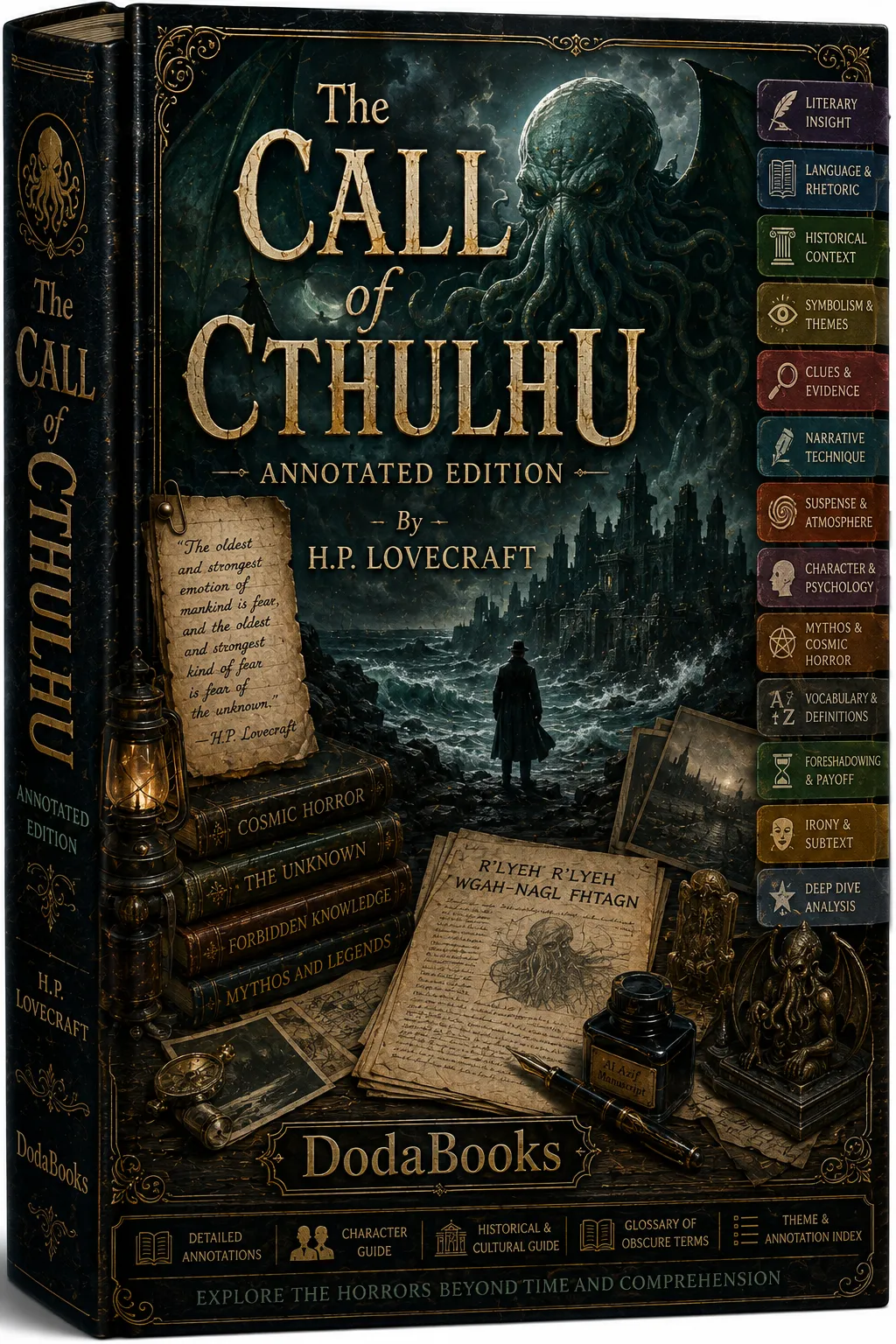
🐙 Read the Definitive Annotated Edition of The Call of Cthulhu
Experience the foundational masterpiece of cosmic horror with every archaic word, non-Euclidean concept, and historical document decoded:
- ✅ Complete Authoritative 1928 Text — Unabridged and uncut from the original Weird Tales publication
- 🗺️ R’lyeh Coordinates & Pacific Ocean Maps — Understand Point Nemo and the geography of the South Pacific
- 📜 Historical Context Cards — Learn about the 1908 St. Louis symposium and the 1907 New Orleans bayou raids
- 🌑 The Cthulhu Mythos Encyclopedia — Trace how Lovecraft built the pantheon of the Great Old Ones
- 🔒 Universal DRM-Free Formats — Delivered instantly in EPUB, PDF, and AZW3/Kindle formats