Is Romeo and Juliet Hard to Read? Reading Level, Lexile Score & Student Guide
For millions of high school freshmen, secondary school students, and literature lovers around the world, William Shakespeare’s Romeo and Juliet (c. 1595–1596) serves as the universal gateway into the world of Elizabethan drama. Yet opening Shakespeare’s text for the first time can feel like encountering a foreign language: sentences are inverted, archaic words like wherefore and anon abound, and dialogue shifts unpredictably between rhyming poetry and bawdy street slang.
Is Romeo and Juliet genuinely hard to read? Compared to Shakespeare’s deeply philosophical masterworks like Hamlet or King Lear, Romeo and Juliet is remarkably accessible. Its fast-paced, action-packed plot, passionate teenage romance, and high-stakes street violence make it one of Shakespeare’s most immediate and emotionally intuitive works. However, navigating four-hundred-year-old Early Modern English verse still requires specific reading strategies.
This comprehensive guide analyzes the reading level, Lexile score, linguistic hurdles, and structural dynamics of Romeo and Juliet, providing comparative difficulty ratings and an actionable 10-day reading schedule to make your study effortless.
| Metric | Score & Recommendation |
|---|---|
| Overall Difficulty Rating | 6.5 / 10 (Moderate Classic; Accessible Shakespeare) |
| Lexile Measure | 1040L (Approx. Grade 9 / Freshman High School Level) |
| Verse vs. Prose Ratio | Approximately 85% Poetic Verse, 15% Prose |
| Total Lines & Length | 3,007 lines (approx. 24,500 words across 24 scenes) |
| Recommended Reading Age | 13–18 years old (Grades 8–12 and adult general readers) |
| Estimated Reading Time | 3 to 4 hours (Stage performance runtime approx. 2 to 2.5 hours) |
| Recommended Edition | DodaBooks Fully Annotated & Illustrated Edition |
📊 Quantitative Reading Metrics: Understanding the 1040L Lexile Score
Standardized educational testing algorithms evaluate Romeo and Juliet with specific benchmarks:
- Lexile Measure (1040L): Places the play directly within the expected reading band for 9th- and 10th-grade high school students (ages 14–16). By comparison, Suzanne Collins’s The Hunger Games measures 810L, while Shakespeare’s Hamlet measures 1390L.
- Syntactic Rhythm: Unlike modern prose, roughly 85% of Romeo and Juliet is written in unrhymed iambic pentameter (blank verse). Sentences regularly invert standard English subject-verb-object order to preserve meter and rhyme (e.g., “My lips, two blushing pilgrims, ready stand”).
- Dramatic Momentum: With 24 relatively short scenes and a plot spanning less than five days, the play moves with blistering speed, preventing readers from getting bogged down in static exposition.
🔍 The 4 Key Obstacles That Challenge First-Time Readers
Understanding the specific mechanics of Shakespeare’s dramatic writing allows readers to overcome confusion quickly:
1. Poetic Forms: Blank Verse, Rhymed Couplets, and Sonnets
Shakespeare employs three distinct poetic registers throughout Romeo and Juliet:
- Blank Verse (Unrhymed Iambic Pentameter): The dominant medium of noble characters, consisting of ten syllables per line following an unstressed/stressed rhythm (da-DUM da-DUM da-DUM da-DUM da-DUM):
“But, soft! what light through yonder window breaks? / It is the east, and Juliet is the sun.”
- Rhymed Couplets: Often used to signal the conclusion of a scene, a moment of heightened romantic rapture, or a formal aphorism:
“For never was a story of more woe / Than this of Juliet and her Romeo.”
- The Shakespearean Sonnet: Shakespeare embeds full fourteen-line sonnets directly into the dramatic fabric:
- The opening Choral Prologue (“Two households, both alike in dignity…”)
- The Act II Choral Prologue (“Now old desire doth in his death-bed lie…”)
- Romeo and Juliet’s very first dialogue at the Capulet feast (Act I, Scene 5), where their shared lines form a flawless holy sonnet ending in their first kiss.
2. Renaissance Puns and “False Friends”
Elizabethan culture celebrated linguistic dexterity, and Shakespeare packed the play with puns, double entendres, and words whose meanings have shifted dramatically since 1595:
- “Wherefore”: Does NOT mean “where”; it means why (“O Romeo, Romeo! wherefore art thou Romeo?” means “Why must you be named Romeo Montague, the son of my family’s enemy?”).
- “Anon”: Means right away or coming immediately.
- “Nice”: Meant trivial or petty (“The letter was not nice, but full of charge”).
- “Bite my thumb”: An insulting Elizabethan gesture roughly equivalent to raising an obscene finger in modern culture.
- “Heavy”: Often meant sorrowful or depressed (“Why is my lord so heavy?”).
3. Tracking Factions and Social Hierarchies
A common source of confusion for beginners is keeping Verona’s sprawling cast sorted by family allegiance:
- House of Montague: Lord and Lady Montague, Romeo, Benvolio (Romeo’s peacemaking cousin), and servants Abram and Balthasar.
- House of Capulet: Lord and Lady Capulet, Juliet, Tybalt (Juliet’s hot-tempered cousin), the Nurse, and servants Sampson, Gregory, and Peter.
- Ruling / Neutral Figures: Prince Escalus (ruler of Verona), Count Paris (Juliet’s noble suitor and Prince’s kinsman), Mercutio (Romeo’s best friend and Prince’s kinsman), and Friar Laurence (Franciscan monk).
4. Compressed Temporal Velocity
Arthur Brooke’s 1562 narrative poem, Shakespeare’s primary source, stretched the story over nine months. Shakespeare radicalized the plot by compressing the entire action into four and a half days (Sunday morning to Friday dawn). This extreme velocity means characters fall in love, marry, kill, get exiled, and commit suicide almost instantaneously. Readers who expect modern, gradual psychological development must adjust to Shakespeare’s whirlwind dramatic momentum.
📚 Comparative Difficulty: How Romeo and Juliet Compares to Other Shakespeare Plays
| Shakespeare Play | Difficulty Rating (1–10) | Lexile Score | Key Reading Obstacle | Best Grade Level |
|---|---|---|---|---|
| A Midsummer Night’s Dream | 5.5 / 10 | 1020L | Whimsical rhyming verse, mythological references | Grades 7–9 |
| Romeo and Juliet | 6.5 / 10 | 1040L | Petrarchan poetry, fast street slang, sonnet forms | Grades 8–10 (Ages 13–16) |
| Julius Caesar | 7.0 / 10 | 1080L | Formal Roman rhetoric, political speeches | Grades 9–11 |
| Macbeth | 7.5 / 10 | 1090L | Dense poetic imagery, Scottish supernatural themes | Grades 10–12 |
| Hamlet | 8.5 / 10 | 1390L | Extended philosophical soliloquies, complex wordplay | Grades 11–College |
| King Lear | 9.0 / 10 | 1140L | Bleak cosmic despair, fragmented madness | College Level |
Because Romeo and Juliet combines lyrical romantic poetry with clear, high-stakes physical action, it serves as the ideal introduction to Shakespeare before students tackle the philosophical complexities of Macbeth or Hamlet.
🗓️ The 10-Day Romeo and Juliet Study Plan
Dividing the 24 scenes across ten daily reading sessions makes the play engaging and effortless:
Week 1: Ancient Feuds, Masked Feasts, and The Secret Marriage
Day 1:  Act I, Scenes 1–2 (Street Brawl; Prince's Decree; Romeo's Lovesickness for Rosaline)
Day 2:  Act I, Scenes 3–5 (Juliet & the Nurse; Queen Mab Speech; The Masked Feast & First Kiss)
Day 3:  Act II, Scenes 1–3 (The Balcony Scene: "What's in a Name?"; Friar Laurence's Cell)
Day 4:  Act II, Scenes 4–6 (Mercutio's Witty Duel; The Nurse's Errand; The Secret Wedding)
Day 5:  Act III, Scene 1   (The Fatal Duel: Mercutio & Tybalt Slain; Romeo Banished)

Week 2: Exile, Despair, The Tomb, and Reconciliation
Day 6:  Act III, Scenes 2–3 (Juliet's Wedding Night Grief; Romeo's Despair in Friar's Cell)
Day 7:  Act III, Scenes 4–5 (Capulet's Thursday Ultimatum; The Lark & Nightingale; Nurse's Betrayal)
Day 8:  Act IV, Scenes 1–3 (Friar's 42-Hour Potion Scheme; Juliet Drinks the Phial)
Day 9:  Act IV, Scenes 4–5 & Act V, Sc. 1–2 (Juliet Discovered "Dead"; Mantua Poison; Quarantined Letter)
Day 10: Act V, Scene 3     (The Capulet Tomb Duel; Double Suicide; "All Are Punish'd"; Golden Statues)
For comprehensive summaries, character motivations, and study questions for each day, consult our complete Romeo and Juliet Summary Act by Act.
💡 4 Essential Tips for Reading Romeo and Juliet with Confidence
- Read to the Punctuation, Not the Line End: Never pause at the end of a line of verse unless there is a comma, colon, semicolon, or period. Reading across line breaks according to natural grammar immediately makes Shakespeare’s sentences sound like natural human speech.
- Keep Track of the Verse-to-Prose Shifts: Notice when characters stop speaking in poetry and switch to prose. Servants speak in prose; Mercutio switches to prose when joking coarsely; nobility speak in blank verse for serious, elevated emotion.
- Use a Visual Character Guide: Keeping a family tree nearby clarifies why Tybalt hates Benvolio and why Paris is dining with Capulet. Check our complete breakdown in Romeo and Juliet Characters Explained.
- Choose an Edition with Vocabulary Cards: Having immediate definitions for Elizabethan words like wherefore, pilcher, and cockatrice eliminates 95% of reading obstacles. Explore our guide on the Best Editions of Romeo and Juliet.
❓ Frequently Asked Questions
Why is Romeo and Juliet taught in almost every high school?
Romeo and Juliet is the gold standard introductory Shakespeare text because its themes—passionate young love, generational conflict with parents, peer pressure, and impulsive decision-making—directly mirror the real-life developmental experiences of teenagers. Its dramatic momentum and accessible language make it ideal for high school curricula.
What does "star-cross'd lovers" mean?
In Elizabethan astrology, the stars and planetary alignments were believed to govern human destiny. "Star-cross'd" means thwarted or obstructed by malignant astrological forces, emphasizing that the lovers are doomed by cosmic fate and familial hatred from the very outset of the drama.
How long does it take an average reader to read the entire play?
At approximately 24,500 words, an average adult reading at 200 words per minute will complete the script in 3 to 4 hours. Following our 10-day study plan requires only 20 to 25 minutes of daily reading.
Is Romeo and Juliet harder to read than a modern novel?
Yes, due to its 16th-century vocabulary, poetic meter, and inverted sentence structure. However, once you become accustomed to the cadence of iambic pentameter after the first two acts, reading becomes remarkably fluid and natural.
Which edition is best for students who find the language confusing?
The DodaBooks Fully Annotated & Illustrated Edition is specifically engineered for student success, featuring 242 archaic vocabulary cards, 10 full-page historical illustrations, and scene-by-scene performance notes.
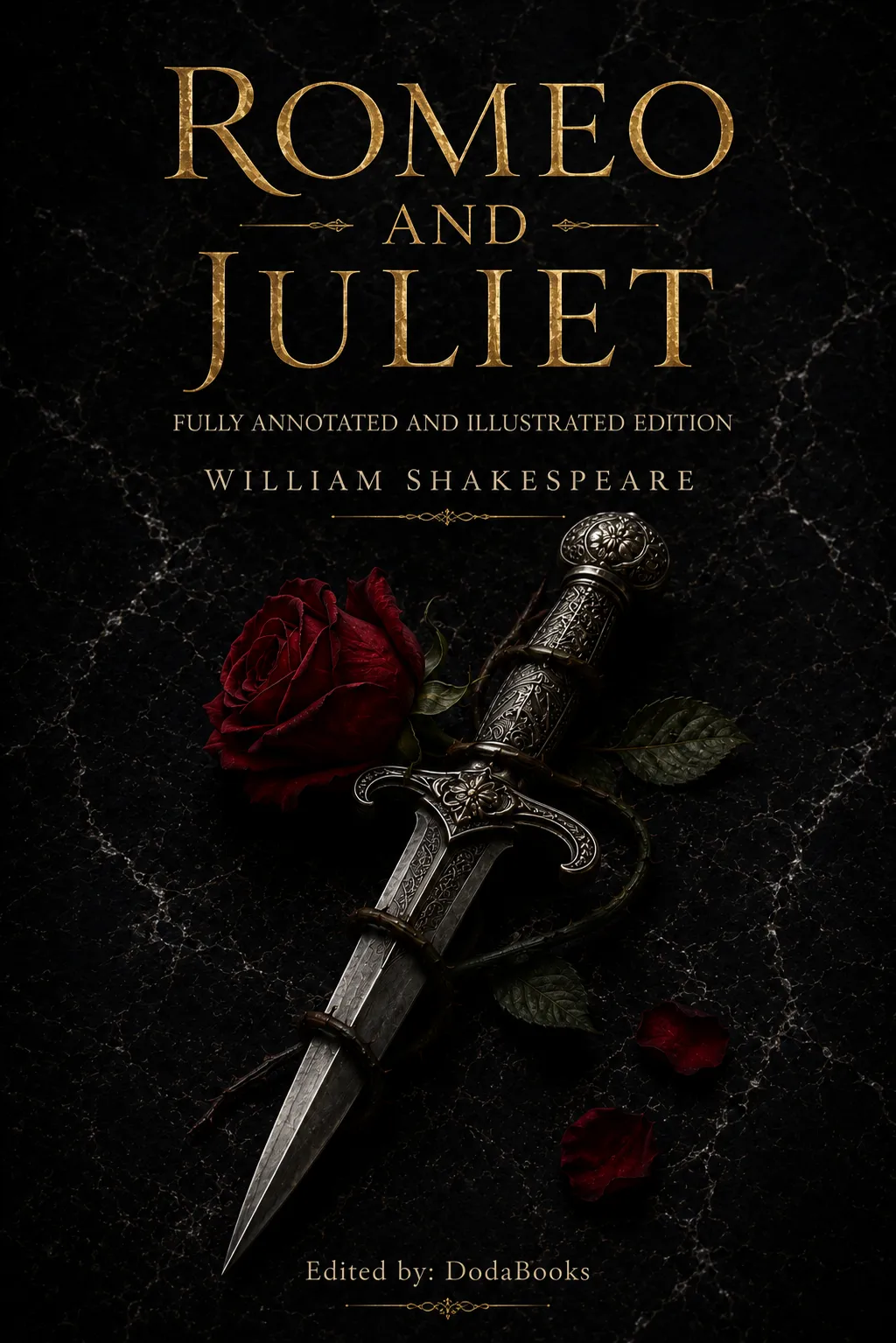
🎭 Master Romeo and Juliet with Ease and Enjoyment
Overcome archaic vocabulary, decipher Elizabethan wordplay, and experience Shakespeare’s lyrical tragedy with the DodaBooks Fully Annotated & Illustrated Edition.
- 🔍 242 Archaic Vocabulary Cards — Instant definitions for obscure idioms and puns
- 🎨 10 Full-Page Original Artworks — Visualizing iconic scenes from the ball to the tomb
- 📖 Complete Uncut Text — Beautifully typeset preserving authentic blank verse rhythm
- 🔒 100% DRM-Free Ownership — Yours forever on Kindle, Kobo, iPad, and desktop
- ⚡ Instant Download — High-resolution EPUB format available immediately upon checkout
Explore our master Romeo and Juliet Guide for complete analysis of setting, themes, and Verona’s historical context.