Frederick Douglass’s 1845 Narrative of the Life of Frederick Douglass, an American Slave is one of the most frequently assigned texts in high school American literature classes, AP English Language and Composition courses, and university history seminars. Yet prospective readers often approach it with apprehension: Is 19th-century prose too dense or archaic? Is the emotional weight of reading about slavery too overwhelming? How long does it take to finish?
The short answer is encouraging: linguistically and structurally, Douglass’s Narrative is one of the most direct, accessible, and fast-paced classics of 19th-century American literature. Unlike the dense, meandering prose of Herman Melville or the ornate Victorian syntax of Nathaniel Hawthorne, Douglass wrote with the rhythmic clarity, propulsive momentum, and unvarnished urgency of an orator fighting for human freedom.
However, the book presents distinct challenges—primarily its emotional intensity, historical terminology, and subtle rhetorical structures. This guide provides an honest, comprehensive evaluation of the book’s reading difficulty, alongside practical study tips to help you master the text.
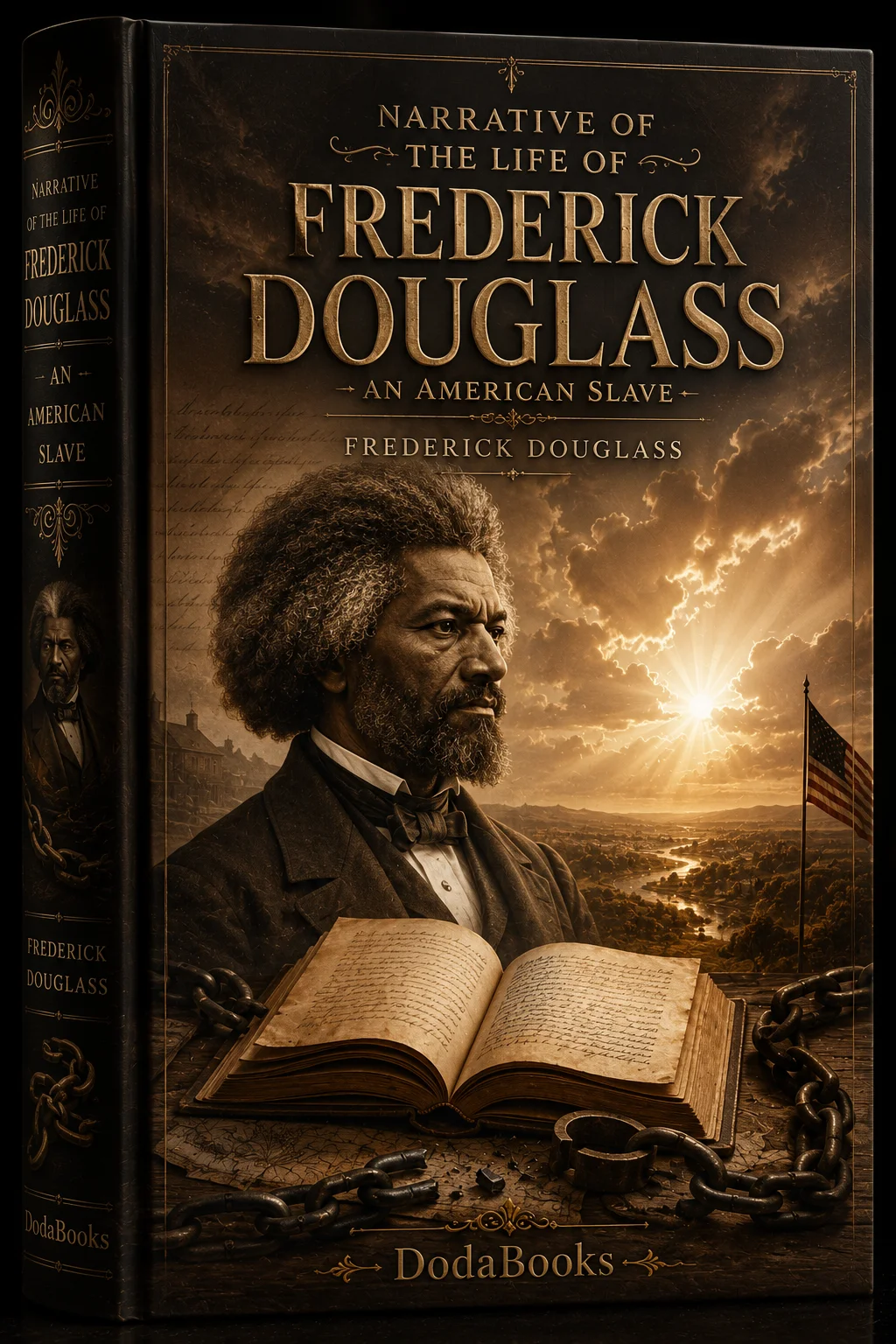
Frederick Douglass Reading Difficulty Guide
A practical study guide evaluating the linguistic readability, emotional weight, Lexile score, and rhetorical complexity of Frederick Douglass's 1845 masterwork.
📊 Reading Difficulty Metrics at a Glance
| Metric | Measurement | Reader Context |
|---|---|---|
| Word Count | ~38,500 words | Very concise; comparable to The Great Gatsby or Of Mice and Men |
| Page Count | ~120–140 pages | Short enough to finish across a weekend or single school week |
| Lexile Measure | 1040L–1080L | Standard high school reading level (Grades 9–12) |
| Flesch-Kincaid Grade | 9.2–9.8 | High readability for 19th-century literature |
| Pacing | Fast & episodic | Propulsive memoir structure with clear chapter milestones |
| Vocabulary Level | Moderate to Advanced | Formal 19th-century oratorical terms & maritime terminology |
| Emotional Intensity | Very High | Graphic descriptions of violence, psychological abuse, and injustice |
📖 Linguistic Readability: Why Douglass Is So Accessible
Many readers dread opening 19th-century books because authors like Charles Dickens or Henry James frequently write sentences that span an entire page with multiple dependent clauses. In stark contrast, Frederick Douglass wrote with astonishing economy and directness.
1. Plain Saxon Clarity
Douglass learned the power of words from the King James Bible and the populist speeches of The Columbian Orator. He consciously avoided unnecessary academic jargon. When describing horrors, he relies on concrete, physical verbs and nouns rather than vague abstractions:
“He was a cruel man, hardened by a long life of slaveholding… He would whip her to make her scream, and whip her to make her hush; and not until overcome by fatigue, would he cease to swing the blood-clotted cowskin.”
The prose is striking because it does not hide behind euphemisms. The cadence is muscular, direct, and unsparing.
2. Narrative Momentum
The book never bogs down in lengthy philosophical digressions. Each of the 11 chapters marks a distinct phase of Douglass’s life and geographic movement:
- From plantation childhood at Tuckahoe…
- To baronial life at Colonel Lloyd’s Great House Farm…
- To urban Baltimore and the discovery of the alphabet…
- To the rural horrors of Edward Covey’s slave-breaking farm…
- To the shipyards of Fell’s Point and the final escape to New Bedford.
Because the memoir follows a clear chronological progression with escalating tension, readers are pulled forward from chapter to chapter like a gripping suspense novel.
⚠️ The Four Real Challenges of Reading Douglass
While the sentence structure is generally straightforward, modern readers encounter four specific challenges:
                  ┌──────────────────────────────────────────────┐
                  │       The 4 Core Challenges in Douglass      │
                  ├──────────────────────────────────────────────┤
                  │  1. 19th-Century & Plantation Vocabulary     │
                  │  2. Sophisticated Rhetorical Figures         │
                  │  3. Extreme Emotional & Graphic Intensity    │
                  │  4. Subtle Religious & Theological Irony     │
                  └──────────────────────────────────────────────┘
1. Plantation and Maritime Vocabulary
The Narrative features specialized vocabulary drawn from 19th-century agricultural law, Southern customs, and coastal seafaring that can puzzle modern readers:
- Plantation Mechanics: Allowance (monthly food rations), driver (an enslaved person forced to supervise others in the field), overseer (a hired white manager), treading yard (a circular dirt pen where wheat was threshed by hooves of horses), buckboard (a horse-drawn open carriage).
- Maritime Caulking Terms: Sloop (a single-masted sailing boat), caulking (sealing ship seams with oakum and pitch), oakum (loose hemp fibers soaked in tar), larboard (port side), starboard (right side).
- Formal Oratorical Terms: Execrable (detestable), privation (lack of necessities), interposition (divine intervention), imbrued (stained or soaked), odiousness (hatefulness), chattel (personal moveable property).
2. Sophisticated Rhetorical Structures
For AP English Language students, Douglass is a premier text because he continually deploys classical rhetorical devices that require attentive reading:
- Chiasmus (Inverted Parallelism): “You have seen how a man was made a slave; you shall see how a slave was made a man.”
- Apostrophe: Addressing inanimate objects or absent concepts directly, as in his dramatic address to the white sailing ships on the Chesapeake Bay in Chapter 10.
- Antithesis: Juxtaposing stark opposites, such as the white slaveholder’s outward piety versus his inward brutality.
Understanding Douglass requires reading not just what happened, but how he constructs his arguments to persuade a skeptical white Northern readership.
3. Emotional and Graphic Intensity
The true difficulty of Douglass’s Narrative is not intellectual, but emotional. The book contains unvarnished eyewitness accounts of severe physical and psychological trauma:
- The vicious whipping of young Douglass’s Aunt Hester in Chapter 1.
- The cold-blooded shooting of Demby in the creek by overseer Austin Gore in Chapter 4.
- The murder of Douglass’s cousin by Mrs. Giles Hick for failing to hear a crying baby.
- The heartbreaking abandonment of Douglass’s elderly grandmother to die in an isolated woods cabin after decades of faithful service.
- The prolonged physical torture and psychological breakdown Douglass suffered under Edward Covey.
Readers should be prepared for the raw reality of chattel slavery; Douglass does not soften the truth to spare reader comfort.
4. Religious Satire and Irony
In Chapter 9 and the Appendix, Douglass writes scathingly about Southern religion:
“I have asserted that the religion of the south is a mere covering for the most horrid crimes,—a justifier of the most appalling barbarity,—a sanctifier of the most hateful frauds,—and a dark shelter under, which the darkest, foulest, grossest, and most infernal deeds of slaveholders find the strongest protection.”
Unprepared readers sometimes misinterpret Douglass as being anti-Christian. In reality, Douglass was a devout believer who was drawing a sharp theological distinction between the Christianity of Christ (peace, love, and liberation) and the Christianity of slaveholders (hypocrisy, cruelty, and white supremacy). Readers must read the Appendix carefully to appreciate this nuanced theological defense.
🎯 Practical Study Tips for Students & Book Clubs
If you are studying Douglass for school or discussing him in a book club, use these four proven strategies to maximize your comprehension:
1. Track the Geography of Bondage
Keep a simple map or timeline of Douglass’s physical locations. His geographical movements correspond directly to his intellectual stages:
- Tuckahoe / Eastern Shore (Ch. 1–4): The innocence and terror of rural plantation childhood.
- Baltimore City (Ch. 5–7): The awakening of the mind through urban freedom and literacy.
- St. Michael’s & Covey’s Farm (Ch. 8–10): The depths of despair, brokenness, and the rebirth of resistance.
- Shipyards of Fell’s Point (Ch. 10): Economic exploitation as a skilled caulker.
- New York & New Bedford (Ch. 11): Emancipation, marriage, self-naming, and oratorical leadership.
2. Highlight Every Turning Point of Education
Notice how Douglass acquires knowledge in creative, rebellious ways:
- Sophia Auld teaching the alphabet (Ch. 6).
- Trading bread for reading lessons with poor white boys in the streets (Ch. 7).
- Copying timber letters (L, S, LF, A) on shipyard fences (Ch. 7).
- Purchasing The Columbian Orator and learning how to debate liberty (Ch. 7).
- Teaching forty fellow slaves in his secret Sabbath school (Ch. 10).
3. Analyze the Covey Battle as a Rite of Passage
When reading Chapter 10, pay close attention to Douglass’s psychological state before and after the two-hour fight with Edward Covey. Notice that although his legal status does not change, his inner identity undergoes a complete revolution. Write down what Douglass means when he says: “He can only be subjected to slavery who consents to be a slave.”
❓ Frequently Asked Questions (FAQ)
Is Frederick Douglass's Narrative suitable for high school freshmen or middle schoolers?
Yes, but with parental or teacher guidance. The text is frequently introduced in 8th and 9th grades because of its accessible vocabulary and historic importance. However, teachers should prepare younger students for the graphic depictions of physical violence and racism.
How does this 1845 Narrative differ from Douglass's later autobiographies?
Douglass wrote three distinct autobiographies:
- Narrative of the Life of Frederick Douglass (1845): The shortest, fastest, and most electrifying account, written while still an escaped fugitive.
- My Bondage and My Freedom (1855): A much longer, more philosophical expansion published after his freedom was purchased.
- Life and Times of Frederick Douglass (1881, revised 1892): A comprehensive life retrospective covering the Civil War, Abraham Lincoln, and Reconstruction.
The 1845 Narrative remains the most popular and tightly crafted of the three.
Why did Douglass leave out the details of how he escaped?
At the time of publication in 1845, Douglass was still legally a fugitive subject to recapture under federal law. Revealing the train lines, false papers, or individuals who aided him would have endangered free Black conductors on the Underground Railroad and closed escape routes for others still in chains.
Can I finish this book in one weekend?
Easily. At approximately 38,500 words, an average reader reading at 250 words per minute will finish the entire book in about 2.5 to 3.5 hours. Most study schedules spread it across three to five days of reading.
📖 Enhance Your Reading with the DodaBooks Edition
To overcome unfamiliar historical vocabulary and immerse yourself in the authentic 1845 text, read the DodaBooks Annotated Edition of Narrative of the Life of Frederick Douglass. Featuring explanatory footnotes, clear chapter navigation, and clean modern typography, it provides the ideal reading companion for students and history lovers.