Is Jekyll and Hyde Hard to Read? Reading Difficulty & Beginner's Guide
If you are preparing to read Robert Louis Stevenson’s The Strange Case of Dr. Jekyll and Mr. Hyde for high school, university, or personal enjoyment, you might wonder what the actual reading experience is like. Is it an impenetrable, antique Victorian chore, or does it deliver the breathless suspense of a classic gothic mystery?
The short answer: Jekyll and Hyde is one of the easiest, shortest, and most accessible classics in English literature.
At only 25,000 words (about 70 to 85 pages), Stevenson’s novella is leaner and more concise than almost any other 19th-century masterpiece. It does not contain the multi-generational family genealogies of Wuthering Heights or the dense, philosophical monologues of Frankenstein. However, it does present a few distinct challenges for modern readers: archaic 1880s medical vocabulary, an indirect Victorian social restraint, and the supreme psychological challenge of reading a mystery when pop culture has already spoiled the twist ending.
This comprehensive guide analyzes the exact reading level of Jekyll and Hyde, maps out the hurdles to watch for, provides a practical 5-day reading schedule, and shares tips to unlock the novella’s deepest psychological layers.
⚡ Jekyll and Hyde Reading Difficulty: At a Glance
- Difficulty Rating: 4.5 / 10 (Very Accessible) — Considerably easier than Frankenstein (6.5/10), much faster than Dracula (5.5/10), and far simpler than Moby-Dick (9.5/10).
- Length: Approximately 25,500 words across 10 short chapters.
- Estimated Reading Time: 2 to 3 hours for an average adult reader (250 words per minute).
- Recommended Reading Age: Grades 8–10 (ages 13+) through adult readers.
- The Primary Reading Challenge: Experiencing the story as an authentic Victorian detective investigation despite already knowing that Jekyll and Hyde are the same person.
🧗 The 3 Main Hurdles for Modern Readers
While Jekyll and Hyde is short and fast-paced, modern readers typically encounter three distinct literary challenges:
1. The “Pop Culture Spoiler” Trap
In 1886, when Victorian readers bought the original “shilling shocker” at railway bookstalls, they had no idea that Dr. Jekyll and Mr. Hyde were the same person.
The book was written as a pure detective mystery. For the first eight chapters, readers follow lawyer Gabriel John Utterson as he tries to uncover why a respectable physician is being blackmailed by a monstrous street thug named Edward Hyde. The realization that they are the same man was a staggering, mind-bending plot twist that wasn’t revealed until Dr. Lanyon’s letter in Chapter 9!
Today, virtually every person on Earth knows the twist before turning page one.
How to overcome it: Shift your reading focus from plot outcome to psychological process. Instead of waiting for the reveal, marvel at how Stevenson plants subtle clues throughout the text: the strange clauses in Jekyll’s will, the shared handwriting discovered by Mr. Guest in Chapter 5, and the fact that Hyde’s door is actually the neglected rear laboratory entrance of Jekyll’s grand home.
2. Victorian Restraint and the “Conspiracy of Silence”
Modern thrillers thrive on aggressive interrogations and emotional confrontations. In contrast, the characters in Jekyll and Hyde are Victorian gentlemen bound by an unspoken code of absolute discretion and emotional privacy:
“I make it a rule of mine: the more it looks like Queer Street, the less I ask.”
When Utterson and Enfield see the sinister door, or when Utterson suspects Jekyll is being blackmailed, they do not scream, confront, or pry. They avoid gossip, speak in guarded, diplomatic euphemisms, and go out of their way to protect each other’s public reputations. To modern readers accustomed to directness, this intense social restraint can initially feel cold or evasive.
How to overcome it: Recognize that Victorian repression is the entire theme of the book. Dr. Jekyll is forced to create Edward Hyde precisely because Victorian society made it impossible for a respectable gentleman to openly acknowledge his human flaws without facing social ruin.
3. Archaic 1880s Vocabulary & Medical Terminology
While Stevenson’s prose is remarkably clear and rhythmic, he uses specialized 19th-century medical and Scottish terms:
- “Sawbones” — Victorian street slang for a surgeon or doctor.
- “Troglodytic” — Resembling a primitive, prehistoric cave-dweller (used to describe Hyde’s atavistic appearance).
- “Apothecary” — A pharmacist or chemist who formulated and sold medicines.
- “Farrago” — A confused, disorderly mixture or hodgepodge.
- “Balderdash” — Senseless talk or nonsense (used by Lanyon to scorn Jekyll’s experiments).
- “Volatile salt” — A chemical compound (such as ammonium carbonate) that readily vaporizes, used in Jekyll’s transformative potion.
- “Pedant” — A person who is excessively concerned with minor details, rules, or formal scientific dogmas.
⏱️ Recommended 5-Day Reading Plan
At only 25,000 words, The Strange Case of Dr. Jekyll and Mr. Hyde can easily be conquered in five short reading sessions of about 20 to 30 minutes each:
+--------------------------------------------------------------------------------+
|                    5-DAY JEKYLL AND HYDE READING PLAN                          |
+--------------------------------------------------------------------------------+
| DAY 1: Chapters 1–2 (Story of the Door, Enfield's Tale, Search for Mr. Hyde)   |
| DAY 2: Chapters 3–4 (Jekyll at Ease, The Carew Murder Case, Soho Lodgings)     |
| DAY 3: Chapters 5–6 (The Mysterious Letter, Mr. Guest's Analysis, Lanyon Dies) |
| DAY 4: Chapters 7–8 (Incident at the Window, Breaking into the Cabinet, Body)  |
| DAY 5: Chapters 9–10 (Dr. Lanyon's Witness Narrative & Jekyll's Full Confession)|
+--------------------------------------------------------------------------------+
📊 Classic Victorian Gothic Difficulty Compared
| Book Title | Author | Word Count | Difficulty (1–10) | Pacing & Key Hurdle |
|---|---|---|---|---|
| Dr. Jekyll and Mr. Hyde | R.L. Stevenson | ~25,500 | 4.5 / 10 | Very short; fast pacing; minor Victorian medical vocabulary. |
| The Adventures of Sherlock Holmes | Arthur Conan Doyle | ~105,000 | 4.5 / 10 | Episodic 12-story collection; snappy conversational dialogue. |
| The Picture of Dorian Gray | Oscar Wilde | ~78,000 | 5.5 / 10 | Theatrical epigrams; Chapter 11 aesthetic catalog slump. |
| Dracula | Bram Stoker | ~160,000 | 5.5 / 10 | Epistolary letters and diaries; fast modern horror pacing. |
| Frankenstein | Mary Shelley | ~75,000 | 6.5 / 10 | Formal Romantic prose; nested concentric narrative frames. |
💡 Top 5 Tips for First-Time Readers
- Pay Close Attention to Architecture: Stevenson carefully mirrors Jekyll’s mind in his house. The front of the house is an imposing, comfortable Victorian mansion in Cavendish Square (the respectable persona); the back is a neglected, windowless, sinister laboratory door opening onto a dingy alley (Hyde’s entrance).
- Notice the Hands: Keep track of the descriptions of hands in the book. Jekyll’s hand is large, white, smooth, and professional; Hyde’s hand is dark, lean, hairy, and ape-like. The moment Jekyll wakes up and sees Hyde’s hand on his bedsheet is one of the greatest moments in horror.
- Read the Last Two Chapters Carefully: Chapters 9 and 10 are completely different in tone from the rest of the book. While Chapters 1–8 are an objective detective story, Chapters 9 and 10 are raw, terrifying first-person confessions.
- Remember the Historical Context: In 1886, British society was terrified of Darwinian regression and urban crime. Understanding that readers genuinely feared devolving into violent primates makes Hyde’s animalistic descriptions terrifyingly real.
- Use an Annotated Edition: Reading with brief margin notes explaining the legal terms, London geography, and medical theories ensures you never lose momentum.
Experience the original Victorian mystery without friction. The DodaBooks Annotated Edition includes inline glossaries, London street maps, and psychological analysis for every chapter.
Get the Annotated Edition at DodaBooks❓ Frequently Asked Questions
Is Dr. Jekyll and Mr. Hyde suitable for high school students?
Yes! It is one of the most frequently taught classics in high school English curricula worldwide. Because it is short, suspenseful, and explores universal moral questions about conscience, temptation, and peer pressure, it is exceptionally engaging for young adult readers.
Why did Stevenson burn his first draft of the story?
Stevenson wrote the initial 30,000-word draft in a three-day burst of creative frenzy after waking from a nightmare. When his wife, Fanny, read it, she argued that he had treated a brilliant moral allegory about human duality as a cheap, sensational thriller. Recognizing the truth of her critique, Stevenson burned the manuscript in the fireplace and rewrote the entire philosophical masterpiece from scratch in another three to six days.
Is the book scary to read today?
While modern readers are accustomed to graphic cinematic gore, Stevenson’s horror is psychological, claustrophobic, and atmospheric. The horror comes not from jump scares, but from the sickening realization of watching a proud, intelligent man lose control of his own body and soul to an inner monster he created.
Why is Mr. Utterson the narrator for most of the book?
Utterson serves as the ultimate objective, reliable Victorian observer. Because he is a methodical, cautious lawyer who refuses to indulge in wild speculation, his gradual realization that something supernatural and monstrous is occurring carries immense weight and credibility with the reader.
What does the term "shilling shocker" mean?
In Victorian Britain, a "shilling shocker" (or penny dreadful) was an inexpensive, popular pocket-sized novella sold at railway stations and newsstands for one shilling. Stevenson wrote Jekyll and Hyde for this popular mass-market format, which is why the pacing is so tight, dramatic, and accessible compared to multi-volume Victorian domestic novels.
📚 Related Reading Guides
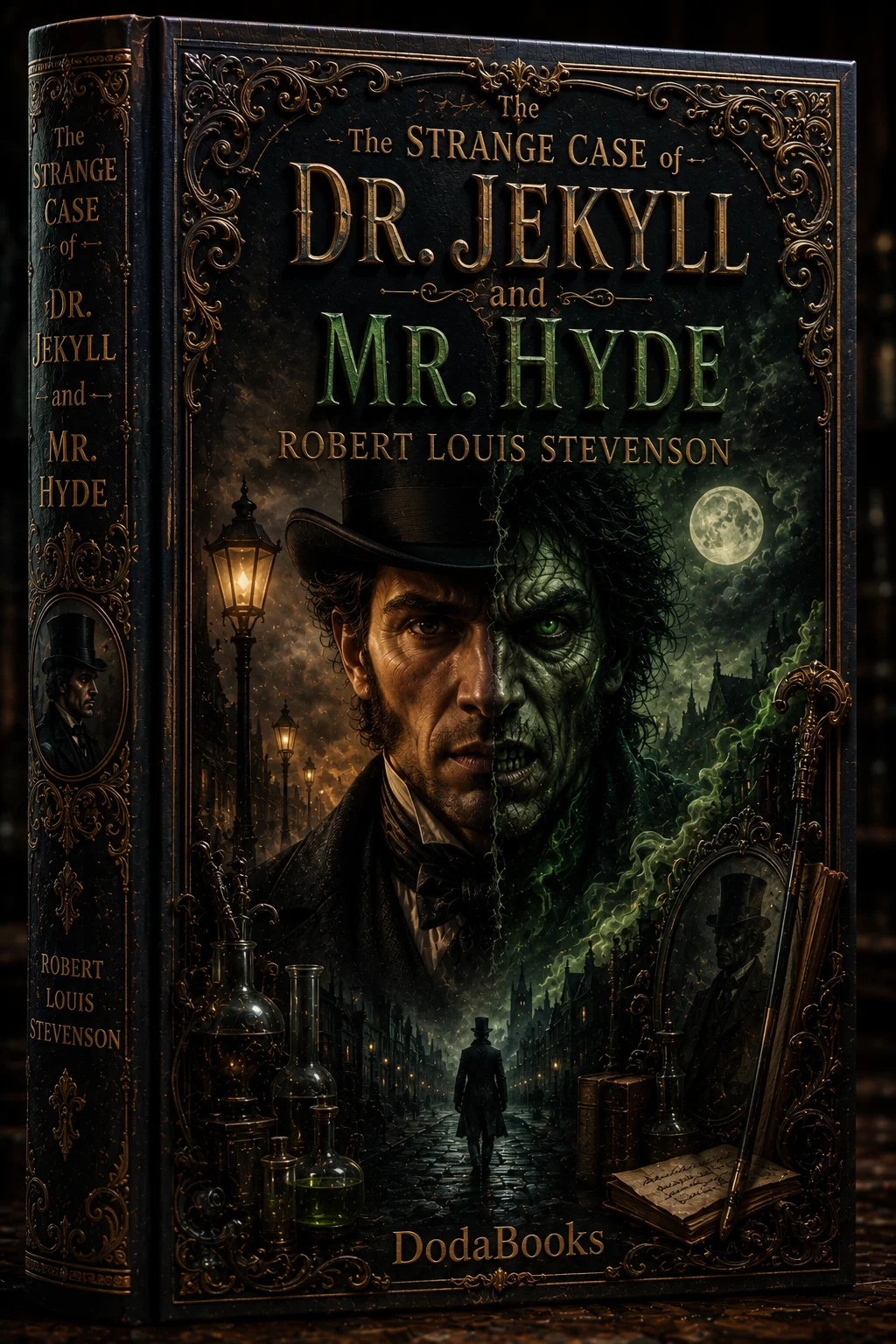
Read Jekyll and Hyde Without the Struggle
Enjoy Robert Louis Stevenson's masterpiece with confidence using the DodaBooks Annotated Edition:
- Complete, authoritative 1886 text of all 10 chapters
- Instant margin explanations for Victorian medical and legal terms
- Chapter reading notes and psychological duality profiles
- Distraction-free digital typography hand-formatted for Kindle, iPad, Kobo, and phone