Is Jane Eyre Hard to Read? Reading Difficulty & Schedule Guide
If you are thinking about reading Charlotte Brontë’s Jane Eyre (1847) for high school, an AP English Literature course, a university seminar, a book club, or simply your own personal reading list, you may be wondering what level of challenge lies ahead. Is the 1840s language stiff and archaic? Will you get bogged down in dense Victorian sermonizing? And why does everyone mention untranslated French dialogue?
The short answer: Jane Eyre is one of the most engaging, emotionally urgent, and gripping Victorian novels ever written, but it sits at a moderate difficulty level (6.0 / 10).
Unlike her sister Emily Brontë’s Wuthering Heights—which disorients first-time readers with thick, impenetrable Yorkshire dialect and a complex Russian-nesting-doll narrative structure—Charlotte Brontë writes in a direct, intense, first-person confessional voice. Jane speaks straight to “Reader” as an intimate confidant.
However, at approximately 185,000 words across 38 chapters, Jane Eyre is a substantial read. It features nineteenth-century periodic sentence structures, untranslated French conversations, Victorian class politics, and subtle biblical allusions that can trip up unprepared modern readers.
This comprehensive guide breaks down the true reading level of Jane Eyre, details the four specific hurdles you will encounter, compares its difficulty to other classics, and provides a battle-tested 14-day reading schedule to make your journey completely effortless.
⚡ Jane Eyre Reading Difficulty: At a Glance
- Difficulty Rating: 6.0 / 10 (Moderate) — Far more accessible than Moby-Dick (9.5/10) or Wuthering Heights (7.0/10), slightly more complex than Pride and Prejudice (5.5/10), and more emotionally intense than Frankenstein (6.5/10).
- Length: Approximately 185,000 words across 38 chapters (typically 480–560 pages in standard print editions).
- Estimated Reading Time: 12 to 15 hours for an average adult reader (at 250 words per minute).
- Recommended Reading Age: Ages 14+ (Grades 9–12, AP Literature, university, and adult readers).
- Primary Stumbling Blocks: Passages of untranslated French dialogue with Adèle Varens, formal 19th-century Latinate vocabulary, and shifting pacing across five distinct geographic settings.
🧗 The 4 Specific Hurdles for Modern Readers
While Jane Eyre reads with the emotional velocity of a psychological thriller, first-time readers should prepare for four distinct literary hurdles:
1. Untranslated French Dialogue
In Chapters 11 through 15, Jane arrives at Thornfield Hall to educate Rochester’s young French ward, Adèle Varens. Adèle speaks almost exclusively in French, and Rochester frequently shifts between English and rapid-fire Parisian French when bantering with her or questioning Jane.
In standard public domain editions, these sentences are left completely untranslated:
- “Ah! C’est comme cela pour les petites filles; mais pour les grandes personnes, c’est différent…”
- “Qu’avez-vous donc? Pourquoi pleurez-vous?”
- “Mademoiselle, vous êtes très calme…”
How to conquer it: If you do not speak French, don’t panic. Adèle’s French dialogue mostly consists of childish chatter about dresses, dolls, and Parisian bonbons. However, Rochester’s French remarks contain subtle psychological clues regarding his past affair with Céline Varens. Reading an annotated edition (such as the DodaBooks Annotated Ebook) provides instant inline translations so you never lose the narrative thread.
2. Victorian Vocabulary & Latinate Phrasing
Charlotte Brontë had a magnificent, sprawling vocabulary influenced by John Milton, the King James Bible, Sir Walter Scott, and Romantic poetry. She frequently employs formal nineteenth-century words that rarely appear in contemporary speech:
+-------------------------------------------------------------------------------+
|                       KEY VICTORIAN VOCABULARY IN JANE EYRE                   |
+-------------------+-----------------------------------------------------------+
| WORD              | VICTORIAN MEANING & CONTEXT                               |
+-------------------+-----------------------------------------------------------+
| Antipathy         | Deep-seated natural aversion or hostility (Mrs. Reed's    |
|                   | instinctive hatred toward young Jane).                   |
+-------------------+-----------------------------------------------------------+
| Ignominious       | Deserving or causing public disgrace or shame (Jane's    |
|                   | punishment in the Red-Room).                              |
+-------------------+-----------------------------------------------------------+
| Supercilious      | Behaving as though one is superior to others; arrogant    |
|                   | (the snobbish attitude of Blanche Ingram and her circle). |
+-------------------+-----------------------------------------------------------+
| Phrenology        | The 19th-century pseudo-science of reading character      |
|                   | traits from bumps on the skull (Rochester examines Jane). |
+-------------------+-----------------------------------------------------------+
| Meretricious      | Apparently attractive but having no real value or         |
|                   | integrity; flashy (Rochester's continental mistresses).   |
+-------------------+-----------------------------------------------------------+
| Indefatigable     | Persisting tirelessly without fatigue (St. John Rivers's  |
|                   | terrifying work ethic and religious devotion).            |
+-------------------+-----------------------------------------------------------+
How to conquer it: Do not stop every two minutes to look up obscure adjectives in a dictionary. As long as you grasp the emotional tone of the sentence, keep reading. Brontë’s context clues almost always make the emotional meaning transparent.
3. Victorian Social Hierarchies & Governess Economics
Much of the novel’s dramatic tension hinges on nineteenth-century class rigidities that can feel alien to modern twenty-first-century readers:
- The Governess Limbo: Jane is neither a servant nor a lady of leisure. She eats alone, sits quietly in drawing-room corners when aristocratic guests arrive, and is treated with contempt by aristocrats like Lady Ingram.
- The Financial Stakes: In the 1840s, a governess earned approximately £25 to £35 per year. When Jane inherits £20,000 from her uncle John Eyre in Madeira, she suddenly becomes one of the wealthiest unmarried women in the region—an enormous sum that gives her total life autonomy.
- The Horror of Bigamy: Modern readers sometimes ask: “Why didn’t Jane simply live with Rochester in France if she loved him so much?” In 1847, becoming an aristocrat’s kept mistress meant forfeiting all legal status, social respectability, moral autonomy, and spiritual standing. Jane would have been entirely at Rochester’s financial mercy.
4. Structural Pacing Shifts Across Five Distinct Settings
Jane Eyre is not set in a single location. It is an episodic Bildungsroman (coming-of-age story) structured across five distinct life settings:
- Gateshead Hall (Ch. 1–4): Gothic domestic abuse and childhood rage.
- Lowood School (Ch. 5–10): Institutional starvation, stoicism, and academic endurance.
- Thornfield Hall (Ch. 11–26): Gothic romance, psychological sparring, and mystery.
- Moor House / Morton (Ch. 27–35): Starvation, rural teaching, familial discovery, and spiritual coercion.
- Ferndean Manor (Ch. 36–38): Secluded pastoral reunion and moral reconciliation.
When the story transitions between these stages—especially when Jane flees Thornfield and spends several chapters teaching peasant children in the village of Morton—readers expecting continuous Gothic mystery can experience narrative whiplash.
How to conquer it: Treat each setting as an independent “act” or mini-book within Jane’s life. Recognizing that each location tests a different dimension of Jane’s character will keep you engaged through every transition.
📊 How Hard Is Jane Eyre Compared to Other Classics?
+---------------------------------------------------------------------------------------+
|                       CLASSIC LITERATURE DIFFICULTY BENCHMARK                         |
+-----------------------------+-------------+------------+------------------------------+
| BOOK & AUTHOR               | DIFFICULTY  | WORD COUNT | PRIMARY CHALLENGE            |
+-----------------------------+-------------+------------+------------------------------+
| The Hound of the Baskervilles| 5.0 / 10    | ~59,000    | Fast detective thriller;     |
| (Arthur Conan Doyle)        | (Accessible)|            | regional Dartmoor terms      |
+-----------------------------+-------------+------------+------------------------------+
| Pride and Prejudice         | 5.5 / 10    | ~122,000   | Regency conversational irony;|
| (Jane Austen)               | (Moderate)  |            | subtle social satire         |
+-----------------------------+-------------+------------+------------------------------+
| Jane Eyre                   | 6.0 / 10    | ~185,000   | 185k words; French dialogue; |
| (Charlotte Brontë)          | (Moderate)  |            | Victorian social context     |
+-----------------------------+-------------+------------+------------------------------+
| Frankenstein                | 6.5 / 10    | ~75,000    | Dense Romantic rhetoric;     |
| (Mary Shelley)              | (Challenging|            | philosophical monologues     |
+-----------------------------+-------------+------------+------------------------------+
| Wuthering Heights           | 7.0 / 10    | ~107,000   | Unforgiving Yorkshire dialect|
| (Emily Brontë)              | (Challenging|            | and complex nested narrators |
+-----------------------------+-------------+------------+------------------------------+
| Moby-Dick                   | 9.5 / 10    | ~206,000   | Cetological treatises; dense |
| (Herman Melville)           | (Formidable)|            | Shakespearean metaphysics    |
+-----------------------------+-------------+------------+------------------------------+
As the matrix shows, Jane Eyre is noticeably more accessible and propulsive than Emily Brontë’s Wuthering Heights or Herman Melville’s Moby-Dick. Its difficulty comes primarily from its expansive length and emotional density rather than linguistic obscurity.
✍️ Decoding Charlotte Brontë’s Sentence Architecture
One reason some readers perceive nineteenth-century prose as “difficult” is the architecture of the periodic sentence. In modern English writing, sentences are typically short and front-loaded with the main subject and action (e.g., “Jane ran down the stairs because she heard a terrible scream.”).
In 1847, Charlotte Brontë frequently employed classical periodic structures, where multiple descriptive dependent clauses, sensory metaphors, and parenthetical thoughts precede the final grammatical clause:
“The cold winter wind had brought with it clouds so sombre, and a rain so penetrating, that further outdoor exercise was now out of the question; and though I was glad of it, for I never liked long walks, especially on chilly afternoons, dreadful to me was the coming home in the raw twilight, with nipped fingers and toes, and a heart saddened by the chidings of Bessie, the nurse, and humbled by the consciousness of my physical inferiority to Eliza, John, and Georgiana Reed.”
How to Parse Brontë’s Long Sentences
When encountering a multi-clause sentence in Jane Eyre, use this three-step reading strategy:
- Locate the Anchoring Core: Identify the core subject and verb first (in the example above: “outdoor exercise was out of the question” and “dreadful was the coming home”).
- Embrace the Parenthetical Cadence: The phrases tucked between commas and semicolons are not filler—they are psychological snapshots of Jane’s inner emotional temperature.
- Trust the Punctuation: Brontë uses semicolons and em-dashes to mimic the natural pauses of an intimate spoken conversation. If a paragraph feels dense, pause slightly at each semicolon as if listening to someone speak across a hearth.
📅 The Proven 14-Day Jane Eyre Reading Schedule
Reading Jane Eyre in two weeks requires reading roughly 2 to 3 chapters per day (about 12,000 to 14,000 words, or approximately 45 to 60 minutes of reading). This schedule maps perfectly onto the novel’s natural dramatic arcs:
+-------------------------------------------------------------------------------+
|                        THE 14-DAY JANE EYRE READING PLAN                      |
+-----+-------------+---------------+-------------------------------------------+
| DAY | CHAPTERS    | SETTING       | MAJOR DRAMATIC HIGHLIGHTS                 |
+-----+-------------+---------------+-------------------------------------------+
| 1   | Ch. 1–4     | Gateshead     | Red-Room trauma, confrontation with aunt  |
+-----+-------------+---------------+-------------------------------------------+
| 2   | Ch. 5–7     | Lowood        | Arrival at Lowood, Brocklehurst's tyranny |
+-----+-------------+---------------+-------------------------------------------+
| 3   | Ch. 8–10    | Lowood        | Miss Temple's tea, death of Helen Burns   |
+-----+-------------+---------------+-------------------------------------------+
| 4   | Ch. 11–13   | Thornfield    | Arrival at Thornfield, meeting Rochester  |
+-----+-------------+---------------+-------------------------------------------+
| 5   | Ch. 14–16   | Thornfield    | Midnight bedside fire, Rochester's past   |
+-----+-------------+---------------+-------------------------------------------+
| 6   | Ch. 17–19   | Thornfield    | Aristocratic house party, gypsy visitor   |
+-----+-------------+---------------+-------------------------------------------+
| 7   | Ch. 20–22   | Thornfield/GH | Richard Mason's stabbing, Mrs. Reed dies  |
+-----+-------------+---------------+-------------------------------------------+
| 8   | Ch. 23–24   | Thornfield    | Chestnut tree proposal, wedding prep      |
+-----+-------------+---------------+-------------------------------------------+
| 9   | Ch. 25–26   | Thornfield    | The torn wedding veil, interrupted altar  |
+-----+-------------+---------------+-------------------------------------------+
| 10  | Ch. 27–28   | Flight / Moor | The temptation of France, flight on moors |
+-----+-------------+---------------+-------------------------------------------+
| 11  | Ch. 29–31   | Moor House    | Rescued by Rivers family, village school  |
+-----+-------------+---------------+-------------------------------------------+
| 12  | Ch. 32–34   | Moor House    | Inheriting £20,000, St. John's proposal   |
+-----+-------------+---------------+-------------------------------------------+
| 13  | Ch. 35–36   | Moor / Ruins  | The mysterious voice, Thornfield in ashes |
+-----+-------------+---------------+-------------------------------------------+
| 14  | Ch. 37–38   | Ferndean      | "Reader, I married him," Ferndean reunion |
+-----+-------------+---------------+-------------------------------------------+
💡 4 Practical Tips for an Effortless Read
- Read Jane’s Voice as Real Speech: Charlotte Brontë wrote Jane Eyre in an urgent, intimate conversational rhythm. If a complex sentence seems tangled, read it aloud in your mind. Jane’s punctuation mimics natural passionate speech with dashes, rhetorical questions, and exclamation points.
- Don’t Get Stalled in Morton: Many first-time readers feel the pace slows down in Chapters 28 to 32 after Jane leaves Thornfield. Recognize that Moor House is essential: it proves Jane can survive happily on her own terms as an independent schoolmistress before she ever inherits wealth or returns to Rochester.
- Appreciate the Gothic Symbolism: Watch for Brontë’s masterstrokes of foreshadowing—the great horse-chestnut tree struck by lightning in Chapter 23 right after Rochester’s marriage proposal, and the recurring dream of crying infant children that heralds catastrophe.
- Choose an Edition with French Translations: Avoid the frustration of stopping mid-paragraph to decipher Adèle’s French. An edition with built-in translations preserves the story’s dramatic momentum.
❓ Frequently Asked Questions (FAQ)
At what age should you read Jane Eyre?
Jane Eyre is ideal for readers aged 14 and older (Grades 9 through 12 in high school, AP English Literature, and adult readers). While mature younger readers (ages 12–13) can follow the plot, older teens and adults will appreciate the deep psychological complexity, Victorian social critique, and feminist themes.
Is Jane Eyre harder to read than Pride and Prejudice?
Yes, slightly. While Jane Austen’s Pride and Prejudice features subtle social irony and Regency manners, its vocabulary is lighter and its plot is a compact domestic comedy. Jane Eyre is about 60,000 words longer, contains extensive untranslated French dialogue, and deals with heavier Gothic elements, psychological trauma, and religious disputes.
How long does it take to read Jane Eyre?
At an average adult reading speed of 250 words per minute, it takes approximately 12 to 14 hours of total reading time to finish Jane Eyre’s 185,000 words. Following our 14-day schedule of roughly 45 to 60 minutes per day makes completing the novel easily manageable.
Why does Charlotte Brontë use so much French in the novel?
Charlotte Brontë spent two years (1842–1843) living in Brussels, Belgium, studying French literature and language at the Pensionnat Heger. She spoke fluent French and incorporated it naturally into Thornfield’s world to reflect Rochester’s worldly, continental lifestyle and Adèle’s Parisian upbringing.
What is the easiest way to read Jane Eyre for beginners?
The easiest way is to read an annotated digital edition with inline French translations and historical notes, such as the DodaBooks Annotated Ebook. Listening to an unabridged audiobook (such as the acclaimed narration by Thandiwe Newton) while following along in the text is also a fantastic method to conquer 19th-century sentence rhythms.
📚 Related Articles & Guides
Looking for an overarching analysis of themes, Gothic elements, and Victorian social context? Explore our master Jane Eyre Novel Guide.
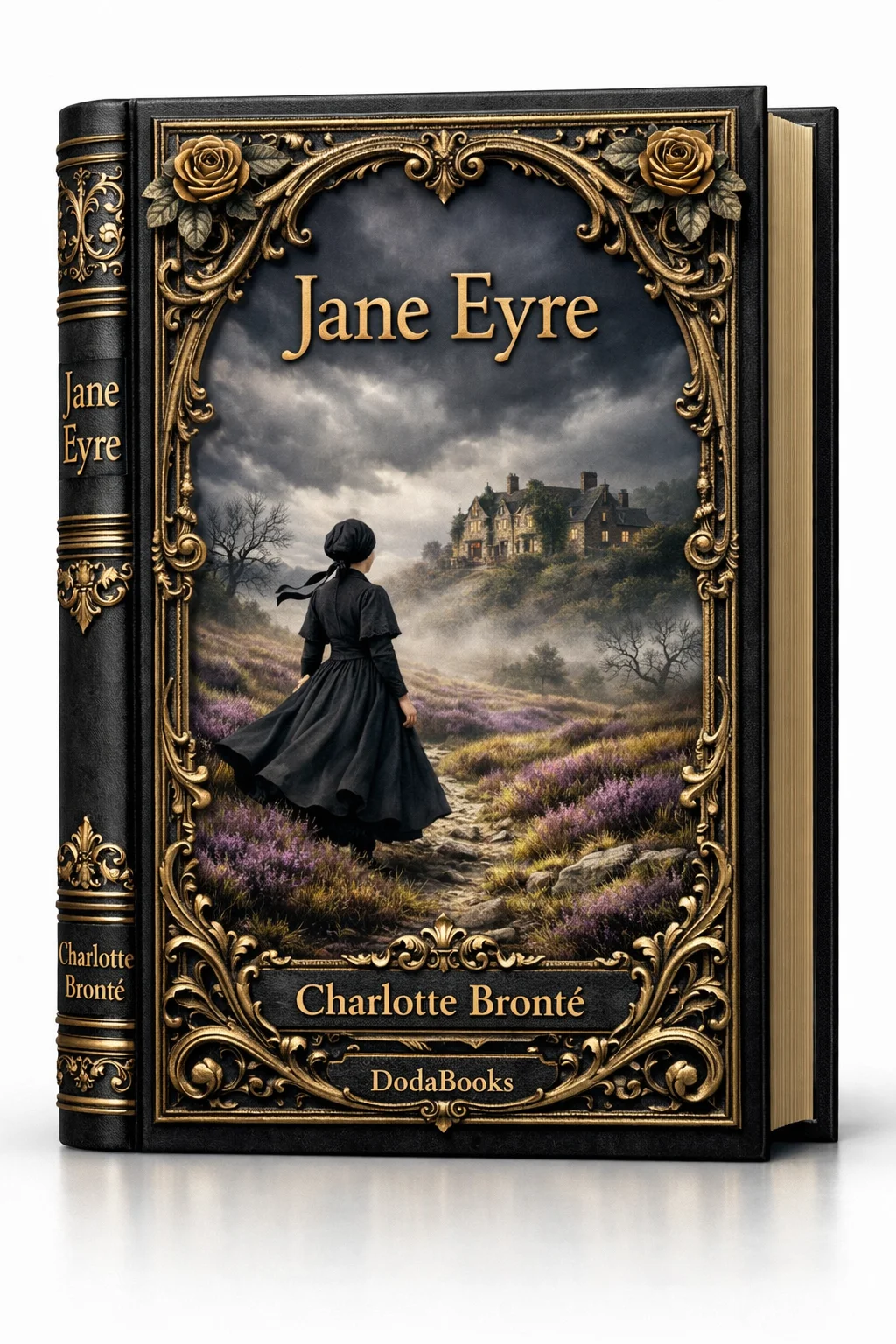
📖 Read the Definitive Annotated Edition of Jane Eyre
Experience Charlotte Brontë’s revolutionary masterpiece with complete historical context, French dialogue translations, and Victorian commentary:
- ✅ Complete 38-Chapter Authoritative Text — Unabridged 1847 edition with authentic punctuation and typography
- 🇫🇷 Inline French Translations — Instantly decode Adèle’s and Rochester’s fluent French conversations
- 🏛️ Victorian Social & Governess Notes — Understand Lowood’s historical basis (Cowan Bridge) and 19th-century class hierarchies
- 📜 Biblical & Literary Allusion Cards — Discover every reference to Milton, Bewick’s Birds, and the scriptures
- 🔒 Universal DRM-Free Formats — Delivered instantly in EPUB, PDF, and AZW3/Mobi for Kindle, Kobo, iPad, and Android