Is Hamlet Hard to Read? Reading Level, Lexile Score & Shakespeare Guide
For high school students, college undergraduates, and lifelong readers approaching William Shakespeare’s The Tragedy of Hamlet, Prince of Denmark (c. 1600–1601) for the first time, the play often presents an intimidating prospect. Widely recognized as the pinnacle of dramatic art in the English language, Hamlet is simultaneously famous for its thrilling ghost scenes and notorious for its linguistic density, complex syntax, and philosophical soliloquies.
Is Hamlet genuinely difficult to read? The short answer is yes: Hamlet is one of Shakespeare’s most intellectually demanding works. However, its difficulty stems not from obscure storytelling, but from the fact that it is a four-hundred-year-old theatrical script written in Early Modern English verse, designed to be heard and witnessed in living performance rather than deciphered as silent printed prose.
This comprehensive guide analyzes the quantitative reading metrics, linguistic hurdles, poetic structures, and thematic complexities of Hamlet, complete with comparative difficulty ratings and a structured 14-day reading plan to make your study effortless.
| Metric | Score & Recommendation |
|---|---|
| Overall Difficulty Rating | 8.5 / 10 (Challenging Masterpiece) |
| Lexile Measure | 1390L (College / Advanced High School Level) |
| Verse vs. Prose Ratio | Approximately 75% Blank Verse, 25% Prose |
| Total Lines & Length | 4,042 lines (Shakespeare’s longest play; approx. 30,550 words) |
| Recommended Reading Age | 15+ (Grades 10–12 and University) |
| Estimated Reading Time | 4 to 6 hours (Stage runtime approx. 3.5 to 4 hours) |
| Recommended Edition | DodaBooks Annotated Edition of Hamlet |
📊 Quantitative Metrics: Understanding the Lexile Score
Standardized reading algorithms place Hamlet at an exceptionally advanced reading level:
- Lexile Measure (1390L): Places the text well above standard high school prose (e.g., F. Scott Fitzgerald’s The Great Gatsby at 1010L or George Orwell’s 1984 at 1090L). A 1390L score reflects long, complex multi-clause sentences, high conceptual density, and an extensive vocabulary of archaic terms.
- Syntactic Complexity: Shakespeare frequently employs inverted syntax (hyperbaton) to maintain his poetic meter, placing verbs or objects before subjects (e.g., “Thus conscience does make cowards of us all” or “Neither a borrower nor a lender be”).
- Dense Soliloquy Length: With seven major soliloquies spanning dozens of continuous lines of blank verse, readers must track complex philosophical arguments across extended grammatical units.
🔍 The 4 Key Obstacles That Make Hamlet Challenging
Understanding why Hamlet feels difficult allows modern readers to dismantle the barriers systematically:
1. Early Modern English Vocabulary and “False Friends”
Shakespeare did not write in “Old English” (which is Anglo-Saxon, like Beowulf) or “Middle English” (like Chaucer’s Canterbury Tales). He wrote in Early Modern English, the immediate ancestor of our contemporary language.
While 90% of the words are identical to modern English, readers encounter two linguistic hurdles:
- Completely Archaic Terms: Words that have vanished from modern usage, such as hebenon (a lethal botanical poison), unhouseled (without receiving the Eucharist), fardels (burdens), quietus (discharge of debt or death), and bisson (blinding).
- False Friends: Familiar words that carried drastically different meanings in 1600:
- “Doubt” often meant suspect (“I doubt some foul play”).
- “Nerve” meant sinew or muscle.
- “Climatures” meant regions.
- “Nunnery” was Elizabethan slang both for a religious convent and a brothel.
2. Blank Verse vs. Prose Shifts
Shakespeare wrote Hamlet primarily in unrhymed iambic pentameter (blank verse)—lines composed of ten syllables following an unstressed/stressed rhythm (da-DUM da-DUM da-DUM da-DUM da-DUM):
“O that this too too solid flesh would melt, / Thaw, and resolve itself into a dew…”
Crucially, Shakespeare shifts deliberately between verse and prose to signal psychological states and social status:
- Nobility & High Philosophy: Rendered in elevated blank verse (e.g., Claudius’s state speeches, Hamlet’s soliloquies, Horatio’s stoic counsel).
- Feigned Madness & Satire: Whenever Hamlet speaks to Polonius, Rosencrantz, or Ophelia while assuming his “antic disposition,” he switches abruptly into rapid, jagged prose.
- Commoners: The gravediggers (clowns) in Act V, Scene 1 speak purely in colloquial prose.
3. Rapid Puns, Double Entendres, and Stichomythia
Elizabethan audiences loved wordplay, and Hamlet is the supreme punster in dramatic history. His very first line—answering Claudius’s greeting—is a triple-layered pun:
“A little more than kin, and less than kind.”
Hamlet plays on “kin” (related by marriage twice over), “kind” (affectionate), and “kind” (unnatural, outside human nature). Similarly, when Claudius asks why the clouds still hang on him, Hamlet retorts: “Not so, my lord; I am too much in the sun”—punning bitterly on the royal “sun” and his status as an unwanted “son.” Without annotations, these linguistic fireworks pass entirely unnoticed.
4. Theological and Philosophical Abstraction
Hamlet is not merely an action-packed murder mystery; it is a deep philosophical debate wrestling with Renaissance skepticism:
- Protestant vs. Catholic Eschatology: King Hamlet’s Ghost claims to arrive from Purgatory, a Catholic concept, yet Hamlet was educated at Wittenberg, the German cradle of the Protestant Reformation where Purgatory was rejected as a papal superstition. This theological tension feeds Hamlet’s terror that the ghost might be a demonic illusion.
- Existential Fatalism: The movement from suicidal despair in Act I to stoic acceptance of divine Providence in Act V requires tracking complex philosophical evolutions across four thousand lines.
📚 Comparative Difficulty: Shakespeare’s Major Plays
| Play | Difficulty (1–10) | Lexile Level | Key Reading Barrier | Recommended Audience |
|---|---|---|---|---|
| A Midsummer Night’s Dream | 5.5 / 10 | 1020L | Whimsical rhyming verse, mythological references | Middle school to adults |
| Romeo and Juliet | 6.5 / 10 | 1040L | Petrarchan love sonnets, fast-paced street slang | High school freshman (Grade 9) |
| Macbeth | 7.5 / 10 | 1090L | Dark poetic brevity, Scottish witchcraft imagery | High school sophomore / junior |
| Hamlet | 8.5 / 10 | 1390L | Dense philosophical soliloquies, extended wordplay | Advanced high school & college |
| King Lear | 9.0 / 10 | 1140L | Brutal existential despair, cosmic storm poetry | College & mature readers |
While Romeo and Juliet and Macbeth are more accessible due to their linear narrative momentum, Hamlet demands greater patience because the protagonist pauses the plot repeatedly to interrogate the cosmos.
🗓️ The 14-Day Hamlet Study Plan
Tackling Hamlet scene by scene over two weeks transforms a daunting 4,000-line play into an exciting, manageable journey:
Week 1: The Ghost, The Rot, and The Mousetrap
Day 1:  Act I, Scenes 1–2 (Midnight Ghost on Ramparts; Claudius's Court & 1st Soliloquy)
Day 2:  Act I, Scenes 3–5 (Polonius's Advice; The Ghost's Revelation & Sacred Vow)
Day 3:  Act II, Scene 1   (Polonius Spies; Ophelia Describes Hamlet's Madness)
Day 4:  Act II, Scene 2   (Rosencrantz & Guildenstern; The Players; "Rogue & Peasant Slave")
Day 5:  Act III, Scene 1  ("To Be or Not to Be"; The Brutal Nunnery Scene)
Day 6:  Act III, Scene 2  (The Mousetrap Play-Within-a-Play; Claudius Bolts)
Day 7:  Act III, Scenes 3–4 (Claudius at Prayer; The Closet Scene; Polonius Slain)

Week 2: Exile, Madness, Mortality, and Providence
Day 8:  Act IV, Scenes 1–3 (Polonius's Body Hidden; Hamlet Sent to England)
Day 9:  Act IV, Scene 4   (Fortinbras's Army Passes; "How All Occasions Do Inform Against Me")
Day 10: Act IV, Scene 5   (Ophelia's Flower Madness; Laertes's Rebellion)
Day 11: Act IV, Scenes 6–7 (Pirate Letter; The Poisoned Fencing Plot; Ophelia Drowns)
Day 12: Act V, Scene 1    (The Graveyard; Yorick's Skull; Ophelia's Burial Brawl)
Day 13: Act V, Scene 2a   (The Commission Swapped; "The Readiness Is All")
Day 14: Act V, Scene 2b   (The Poisoned Duel; The Four Deaths; Fortinbras Claims the Crown)
For detailed plot summaries and thematic notes for each reading day, refer to our complete Hamlet Summary Act by Act.
💡 4 Proven Strategies for Reading Hamlet with Ease
- Watch a Live Performance First: Shakespeare wrote for the stage, not the page. Watching an acclaimed film adaptation (such as Kenneth Branagh’s 1996 uncut version or Gregory Doran’s 2009 Royal Shakespeare Company production starring David Tennant) before reading gives you immediate visual context for every character and scene.
- Read the Soliloquies Aloud: Shakespeare’s verse was composed for the human breath. Reading Hamlet’s speeches out loud reveals the natural cadence of iambic pentameter and clarifies inverted sentence structures.
- Keep a Character Map Handy: Elsinore is full of shifting loyalties and spies. Consult our comprehensive guide on Hamlet Characters Explained to keep track of Claudius, Polonius, Horatio, and Laertes.
- Use a High-Quality Annotated Edition: Never read bare, unannotated text. Having immediate explanations for archaic words and Elizabethan staging conventions eliminates 90% of reading confusion. Review our guide on the Best Editions of Hamlet.
❓ Frequently Asked Questions
What grade level is Hamlet typically taught in?
In the United States and Canada, Hamlet is almost universally taught in Grade 11 or Grade 12 (Advanced Placement / International Baccalaureate English), as well as introductory college literature courses. Students aged 16 to 18 possess the cognitive maturity to engage with the play's themes of existential doubt, mortality, and political corruption.
Why is Hamlet considered harder to read than Romeo and Juliet?
While Romeo and Juliet focuses on an emotional, fast-moving teenage romance written in relatively straightforward lyrical verse, Hamlet is an intensely psychological drama dominated by long, abstract soliloquies, complex double entendres, theological debates, and deliberate ambiguities.
Do I need to understand iambic pentameter to enjoy Hamlet?
No formal training in poetic scansion is required to enjoy the play. However, understanding that Shakespeare uses regular 10-syllable rhythm for calm, rational thoughts and breaks the meter when characters experience intense emotional distress or feign madness makes the reading experience vastly richer.
How long does it take to read Hamlet?
The average adult reader can read the complete text of Hamlet in 4 to 6 hours. Following our 14-day study plan requires approximately 20 to 30 minutes of focused reading each day.
Which edition is recommended for someone struggling with the language?
The DodaBooks Annotated Edition features line-by-line modern definitions of difficult Elizabethan vocabulary, scene-by-scene summaries, and staging notes, making it the most accessible and comprehensive digital edition available.
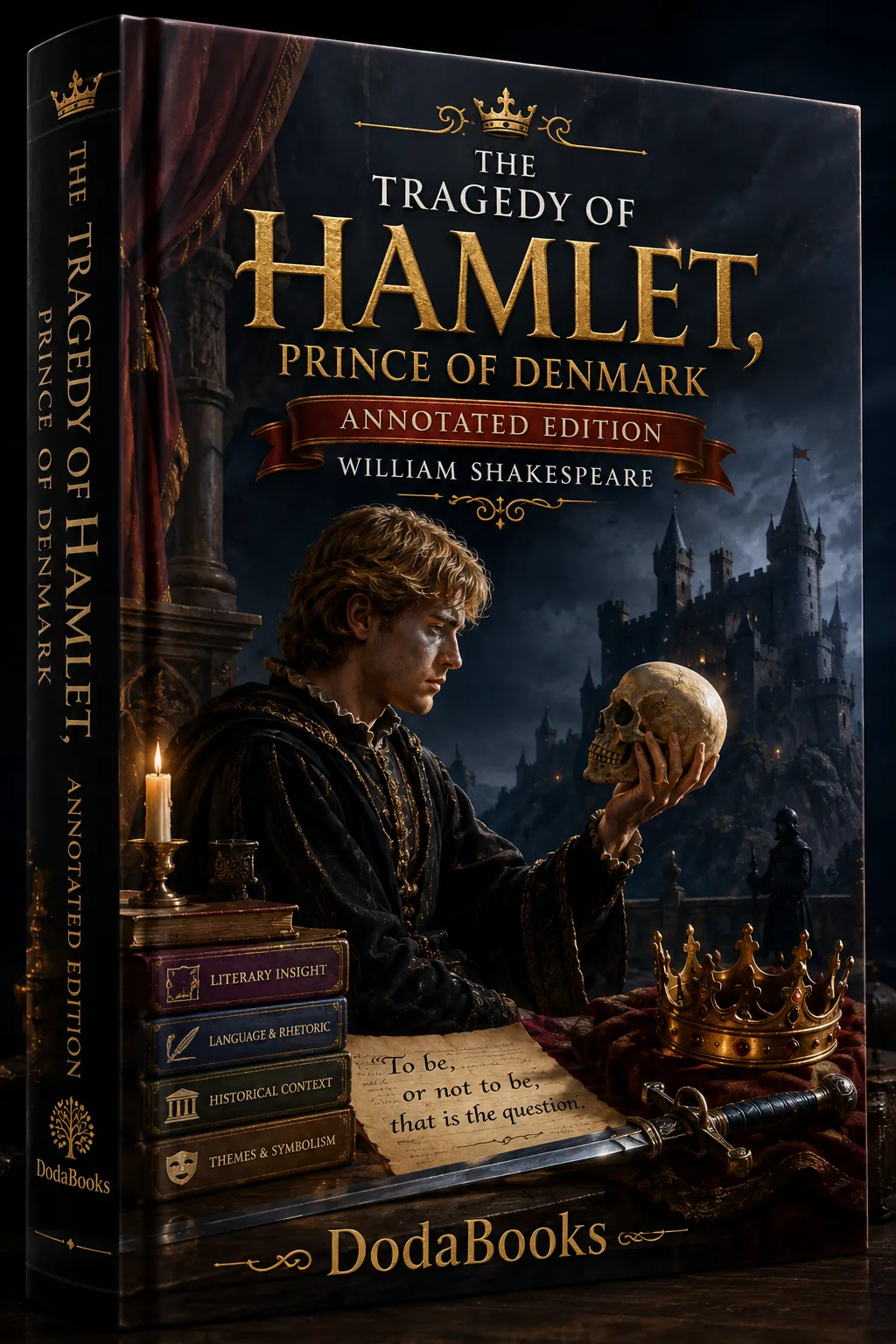
👑 Conquer Shakespeare’s Greatest Drama with Confidence
Eliminate archaic language barriers, decipher complex soliloquies, and experience the genius of Shakespeare with the DodaBooks Annotated Edition of Hamlet.
- 🔍 Over 1,200 Line-by-Line Glosses — Immediate definitions for obscure Elizabethan terms
- 📖 Complete Uncut Text — Beautifully typeset preserving authentic blank verse rhythm
- 🎭 Staging & Dramaturgical Context — Detailed notes on Globe Theatre performance conventions
- 🔒 100% DRM-Free Ownership — Compatible with Kindle, Kobo, iPad, and desktop
- ⚡ Instant Download — High-resolution EPUB delivered directly to your device
Explore our master Hamlet Guide for complete analysis of setting, themes, and Shakespeare’s enduring legacy.