Is Frankenstein Hard to Read? Reading Difficulty, Pacing & Beginner's Guide
If you are preparing to read Mary Shelley’s Frankenstein for school, book club, or personal curiosity, you might wonder what to expect. Is the 1818 prose impenetrable and dry? Does it read like an ancient philosophy textbook, or does it deliver the breathless suspense of a modern horror thriller?
The short answer: Frankenstein is moderately challenging, but far more readable than most early 19th-century classics. It does not contain the endless maritime encyclopedias of Moby-Dick or the intricate societal formalities of Jane Austen. However, it is an authentic Romantic-era text composed in high-register Regency English, complete with philosophical monologues and a nested narrative structure that can disorient unprepared readers.
This comprehensive guide analyzes the exact reading difficulty of Frankenstein, breaks down the four hurdles that trip up first-time readers, provides a tested 10-day reading schedule, and shares practical tips to conquer the novel with ease.
⚡ Frankenstein Reading Difficulty: At a Glance
- Difficulty Rating: 6.5 / 10 (Moderate) — Far easier than Moby-Dick (9/10), slightly more formal than Dracula (5.5/10).
- Length: Approximately 75,000 words (220–280 pages depending on typography and edition).
- Estimated Reading Time: 5 to 7 hours for an average adult reader (250 words per minute).
- Recommended Reading Age: High school (grades 9–12 / ages 14+) through adult.
- Biggest Stumbling Block: The "Russian Nesting Doll" narrative frame and the elevated, philosophical dialogue of the Creature.
🧗 The 4 Biggest Hurdles for Modern Readers
While Frankenstein is relatively short, modern readers typically encounter four distinct literary hurdles:
1. The “Russian Nesting Doll” Narrative Frame
Modern novels typically follow a single protagonist through a linear timeline. Frankenstein is constructed like a set of concentric Russian nesting dolls:
+-----------------------------------------------------------------------+
|  OUTER LAYER: Captain Robert Walton's Letters to his Sister           |
|  +-----------------------------------------------------------------+  |
|  |  MIDDLE LAYER: Victor Frankenstein's Oral Confession            |  |
|  |  +-----------------------------------------------------------+  |  |
|  |  |  INNER CORE: The Creature's Autobiography (Chapters 11-16)|  |  |
|  |  |  +-----------------------------------------------------+  |  |  |
|  |  |  |  SUB-CORE: Felix & Safie's History (Chapter 14)     |  |  |  |
|  |  |  +-----------------------------------------------------+  |  |  |
|  |  +-----------------------------------------------------------+  |  |
|  +-----------------------------------------------------------------+  |
+-----------------------------------------------------------------------+
First-time readers who open Chapter 1 expecting an immediate monster attack are often confused to find a sea captain writing letters about icebergs in the Arctic. It takes nearly twenty pages before Victor Frankenstein even begins his story.
How to overcome it: Understand that Walton’s frame is essential. Walton serves as a moral mirror for Victor. Once you realize that Victor is telling his life story to Walton as a cautionary warning, the concentric structure becomes one of the novel’s greatest intellectual pleasures.
2. Philosophical Monologues vs. Action
Pop culture has conditioned audiences to expect laboratory explosions, terrified mobs carrying torches and pitchforks, and a lumbering brute who grunts wordlessly. In the novel, the creation scene takes up only two paragraphs in Chapter 5. There are no hunchbacked assistants named Igor, no lightning rods in a castle tower, and no pitchfork mobs.
Instead, the novel is a philosophical drama of ideas. Characters do not talk like everyday people; they deliver extended, eloquent orations about justice, parental abandonment, the sublime beauty of nature, and the ethics of scientific discovery.
How to overcome it: Approach Frankenstein not as a creature feature, but as a Gothic psychological tragedy. Appreciate the Creature’s speeches in the ice cave (Chapters 10–16) for what they truly are: some of the most moving, heartbreaking arguments for empathy in Western literature.
3. Elevated Romantic & Regency Vocabulary
Written in 1816–1817 by an extraordinarily well-educated teenager, Frankenstein uses dense, elegant vocabulary that can slow down casual readers:
- “Chimeras” — Wild, impossible illusions or fantasies (often used by Victor’s professors).
- “Physiognomy” — The 18th-century pseudoscience of judging a person’s character from their facial features.
- “Panegyric” — An elaborate, formal public speech of praise.
- “Charnel-house” — A vault or building where dead human bones were piled.
- “Ennui” — A profound sense of spiritual weariness, boredom, and dissatisfaction.
- “Ignominious” — Deserving or causing public disgrace and shame.
How to overcome it: Reading with an annotated edition (such as the DodaBooks edition) provides instant, inline definitions so you never have to break your reading flow to search a dictionary.
4. Melodramatic Emotional Swings
Characters in early 19th-century Romantic literature experience extreme emotional states. Whenever Victor experiences guilt, grief, or stress, he does not merely feel sad—he suffers violent “brain fevers,” faints, weeps uncontrollably, or remains bedridden in convulsive delirium for months at a time. Modern readers can occasionally find this melodramatic.
How to overcome it: Remember that Romanticism celebrated raw, intense emotional sensibility as a virtue in contrast to the cold, calculating rationality of the Enlightenment. Victor’s physical collapses reflect his fractured soul.
⏱️ Recommended 10-Day Reading Schedule
At approximately 75,000 words, Frankenstein can comfortably be read in 10 days by reading about 7,500 words (20–25 pages) per day:
+--------------------------------------------------------------------------------+
|                    10-DAY FRANKENSTEIN READING PLAN                            |
+--------------------------------------------------------------------------------+
| DAY 1: Letters 1–4 (Walton's Arctic Voyage & Meeting the Stranger)             |
| DAY 2: Chapters 1–3 (Victor's Childhood, Agrippa's Alchemy, Ingolstadt Arrival)|
| DAY 3: Chapters 4–6 (Unlocking the Spark, Creation Scene, Nervous Breakdown)   |
| DAY 4: Chapters 7–8 (William's Murder & Justine's Tragic Execution)           |
| DAY 5: Chapters 9–10 (Chamounix Glacier Hike & Meeting the Creature)           |
| DAY 6: Chapters 11–13 (Creature's Awakening, De Lacey Hovel, Language Learning)|
| DAY 7: Chapters 14–16 (Safie's Story, Paradise Lost, Cottage Rejection, Fire)  |
| DAY 8: Chapters 17–19 (The Mate Ultimatum & Journey to the Desolate Orkneys)   |
| DAY 9: Chapters 20–22 (Destruction of the Mate, Clerval's Death, The Wedding)  |
| DAY 10: Chapters 23–24 (Elizabeth's Murder, Arctic Pursuit, Creature's Pyre)   |
+--------------------------------------------------------------------------------+
By sticking to this schedule, you can finish the entire classic in just an hour or less of reading per evening over a single week and a half.
📊 Classic Literature Difficulty Comparison
To put Frankenstein’s difficulty in perspective, here is how it compares to other famous 19th-century classics:
| Book Title | Author | Word Count | Difficulty (1–10) | Pacing & Key Hurdle |
|---|---|---|---|---|
| Dracula | Bram Stoker | ~160,000 | 5.5 / 10 | Fast, modern journalistic pacing; dialect hurdles in Whitby. |
| Frankenstein | Mary Shelley | ~75,000 | 6.5 / 10 | Elevated Romantic vocabulary; philosophical monologues. |
| Pride & Prejudice | Jane Austen | ~122,000 | 7.0 / 10 | Complex Regency social irony and syntactic indirectness. |
| Jane Eyre | Charlotte Brontë | ~185,000 | 7.5 / 10 | Long Victorian domestic sequences; intricate psychological introspection. |
| Moby-Dick | Herman Melville | ~206,000 | 9.5 / 10 | Massive encyclopedic cetology chapters; dense Shakespearean prose. |
🌧️ The “Year Without a Summer” and Gothic Atmosphere
To truly appreciate the mood and pacing of Frankenstein, modern readers should understand the bizarre weather phenomenon that birthed it. In April 1815, Mount Tambora in Indonesia erupted in the most powerful volcanic explosion in recorded human history. The colossal ash cloud circled the globe, blocking out sunlight and causing 1816 to become known worldwide as “The Year Without a Summer.”
In June 1816, eighteen-year-old Mary Wollstonecraft Godwin, Percy Bysshe Shelley, Lord Byron, and Byron’s physician John William Polidori rented villas on the shores of Lake Geneva in Switzerland. Instead of enjoying sunny alpine strolls, they were trapped indoors for weeks by relentless, freezing rain, unseasonable snow, and violent electrical storms over the lake:
- The Ghost Story Challenge: To pass the gloomy days, Lord Byron proposed that each member of the party write a supernatural ghost story. While Byron and Percy Shelley soon abandoned their attempts, Polidori wrote The Vampyre (the precursor to modern vampire literature), and Mary conceived the nightmare of Victor Frankenstein bending over his animated creature.
- Atmospheric Reflection in Prose: When you read Victor’s descriptions of “dreary nights of November,” dark rain drumming against windowpanes, and desolate icy glaciers, you are feeling the actual oppressive gloom of the 1816 Swiss summer. Once readers understand that the novel was written during an actual global ecological crisis, the dark, melancholic tone feels profoundly authentic rather than artificial.
💡 Top 5 Tips for First-Time Readers
- Clear Your Mind of Hollywood: Forget Bela Lugosi, Boris Karloff, green skin, and mute groans. The book’s Creature is athletic, agile, and speaks with the eloquence of an Oxford scholar.
- Read the Creature’s Speeches Aloud: The Creature’s monologue on the Mer de Glace (Chapters 10–16) is some of the finest rhythmic prose in English literature. Reading it aloud brings out its musical, tragic power.
- Choose the 1818 Original Text: Avoid modern reprints that silently use the watered-down 1831 revision. The 1818 text is sharper, bolder, and more intellectually honest.
- Pay Attention to the Books the Creature Reads: In Chapter 15, the Creature reads Milton’s Paradise Lost, Plutarch’s Lives, and Goethe’s Werther. Knowing that he models his self-image on Adam and Satan unlocks the novel’s deepest themes.
- Use an Annotated Digital Edition: An annotated edition eliminates the friction of historical vocabulary and archaic scientific terminology without breaking your immersion.
Overcome the 1818 vocabulary hurdles effortlessly. Read Mary Shelley's Frankenstein with clear inline definitions, historical context, and reading notes.
Get the Annotated Edition at DodaBooks❓ Frequently Asked Questions
Is Frankenstein suitable for beginners to classic literature?
Yes. Because the novel is relatively short (around 220–250 pages) and driven by intense dramatic stakes, it is one of the most accessible entry points into 19th-century Romantic and Gothic literature. The main requirement is patience with its elevated, formal dialogue.
Why does Victor Frankenstein faint and get sick so often?
In 19th-century Romantic literature, extreme physical illness—often called a "nervous fever" or "brain fever"—was a standard literary device to represent severe psychological trauma, acute guilt, and spiritual torment. Victor's body breaks down because his conscience cannot bear the moral horror of his actions.
At what age should someone read Frankenstein?
Frankenstein is generally ideal for readers aged 14 and older (grades 9 through adult). While it contains dark themes of murder, anatomical grave-robbing, and suicide, it contains no explicit graphic gore or inappropriate sexual content.
How does Frankenstein differ from modern science fiction?
Modern science fiction usually focuses on the mechanics of technological innovation and speculative world-building. Shelley focuses almost entirely on the moral and psychological consequences of invention—asking how society treats the marginalized creation rather than how the machine was built.
Which version is easier to read: 1818 or 1831?
The 1818 edition is generally easier and more rewarding to read because Shelley’s original prose was direct, vigorous, and passionate. Her 1831 revisions added denser, more conservative Victorian moralizing and lengthened several descriptive passages.
📚 Related Reading Guides
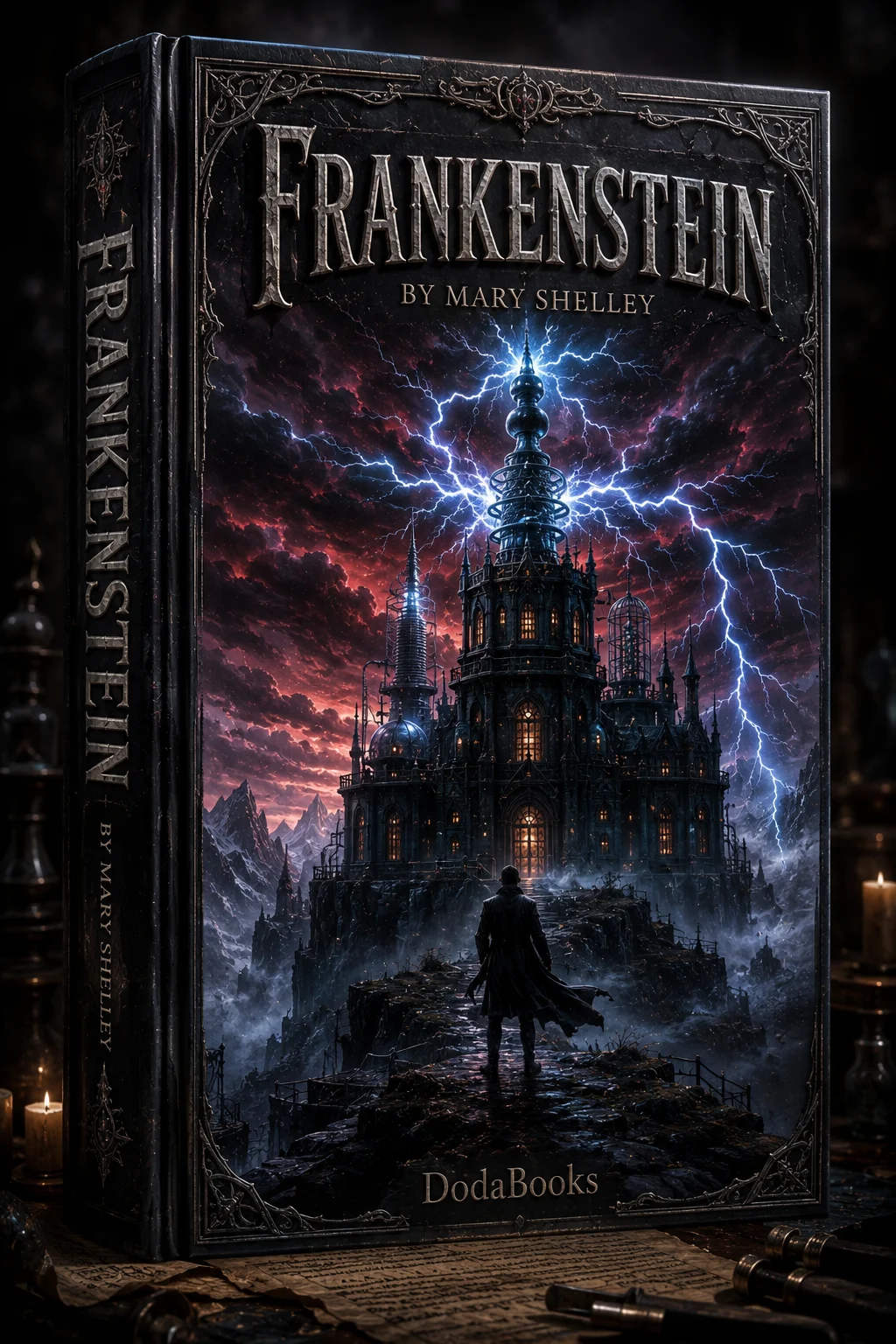
Read Frankenstein Without the Struggle
Enjoy Mary Shelley's masterpiece with confidence using the DodaBooks Annotated Edition:
- Complete, authentic 1818 original text
- Instant margin notes explaining early-1800s vocabulary and scientific allusions
- Built-in chapter summaries and character foil maps
- Pristine digital formatting designed for seamless reading on Kindle, iPad, and Kobo