Is Cranford Hard to Read? Reading Difficulty & Study Guide
For readers accustomed to the melodrama of Charles Dickens or the tempestuous romantic passions of Charlotte Brontë, opening Elizabeth Gaskell’s Cranford can feel like stepping into an entirely different literary universe. There are no gothic mansions, mysterious wills, or brooding aristocrats. Instead, Gaskell presents a quiet, domestic comedy of manners centered on a group of elderly spinsters who worry over sun-faded carpets, brew medicinal herb teas, and practice the delicate art of “elegant economy.”
In terms of raw vocabulary and sentence length, Cranford is one of the most accessible and charming classics in Victorian literature. Its prose is clean, lucid, and sparkling with affectionate humor. However, modern readers often encounter a unique kind of reading friction: not from difficult Latinate syntax, but from the novel’s loose episodic structure, its subtle reliance on unspoken 19th-century social etiquette, and the quiet understatement with which Gaskell depicts profound tragedies like lost love, sudden death, and financial ruin.
This comprehensive reading guide breaks down the quantitative readability scores of Cranford, decodes its most baffling Victorian social customs, explains its episodic structure, and provides a structured 5-day reading schedule to help you savor every nuance of Gaskell’s masterpiece.
| Readability Metric | Measured Score | What It Means for Readers |
|---|---|---|
| Lexile Measure | 940L – 1020L | Highly accessible for high schoolers, college students, and adult readers |
| Flesch Reading Ease | 68.2 (Standard / Fairly Easy) | Lighter and faster-flowing than Dickens, George Eliot, or the Brontës |
| Flesch-Kincaid Grade Level | Grade 7.6 | Can be enjoyed without specialized academic or historical training |
| Total Word Count | ~75,000 words | Approximately 220 pages in standard print across 16 charming chapters |
| Average Reading Time | 4 to 5 hours | Easily finished in a long weekend or 5 evenings of 50 minutes each |
| Primary Reading Obstacle | Victorian Etiquette Nuances | Unspoken social hierarchies, tea rituals, and 19th-century banking laws |
☕ Why Is Cranford Sometimes Misunderstood? (The 3 Core Obstacles)
1. The Episodic, Non-Linear Plot Structure
Modern readers conditioned on contemporary fiction often expect a continuous, three-act plot with a clear protagonist pursuing a single dramatic objective. Cranford does not follow this model:
- The book originated as a series of standalone sketches commissioned by Charles Dickens for his magazine Household Words.
- Major characters introduced with great fanfare—such as the lovable Captain Brown—can die suddenly in Chapter 2, leaving the narrative to pivot toward old rectory letters or traveling Italian conjurors.
- Rather than an escalating roller-coaster plot, Cranford functions like a Victorian social kaleidoscope: turning gently from one parlor tea party to the next, revealing the soul of a community rather than a single heroine’s adventure.
Once you adjust your expectations and approach Cranford as an intimate portrait of village life, its episodic rhythm becomes one of its greatest pleasures.
2. The Code of “Elegant Economy”
Much of the novel’s comedy and emotional depth hinges on genteel poverty. In Victorian England, women of gentle birth who lacked fortunes were trapped in a cruel social vise:
- They could not seek paid employment without losing their caste as “ladies.”
- They could not admit they were poor without committing an unpardonable social vulgarity.
- As a result, the Cranford spinsters invented the elaborate game of “elegant economy”—feigning that saving money was a moral choice rather than a desperate necessity.
When Miss Matty serves thin slices of bread and butter or insists on putting out candles the moment conversation starts, modern readers might mistake her for a stingy eccentric. In reality, she is performing a dignified, heroic balancing act to maintain her social self-respect on an annual income that barely covers tea and coal.
3. Victorian Domestic Understatement
Gaskell writes with supreme emotional restraint. The most devastating tragedies in the novel—such as Miss Matty’s mourning for Mr. Holbrook—are conveyed through tiny, domestic gestures rather than weeping melodrama:
- Miss Matty never speaks of her broken heart; she simply gives away her colorful ribbons and buys a lavender widow’s cap.
- To appreciate Cranford, readers must learn to pay attention to what characters do not say—the pauses over an open tea caddy, the glance at an old letter, or the quiet gift of five sovereigns to save an innocent stranger from financial ruin.
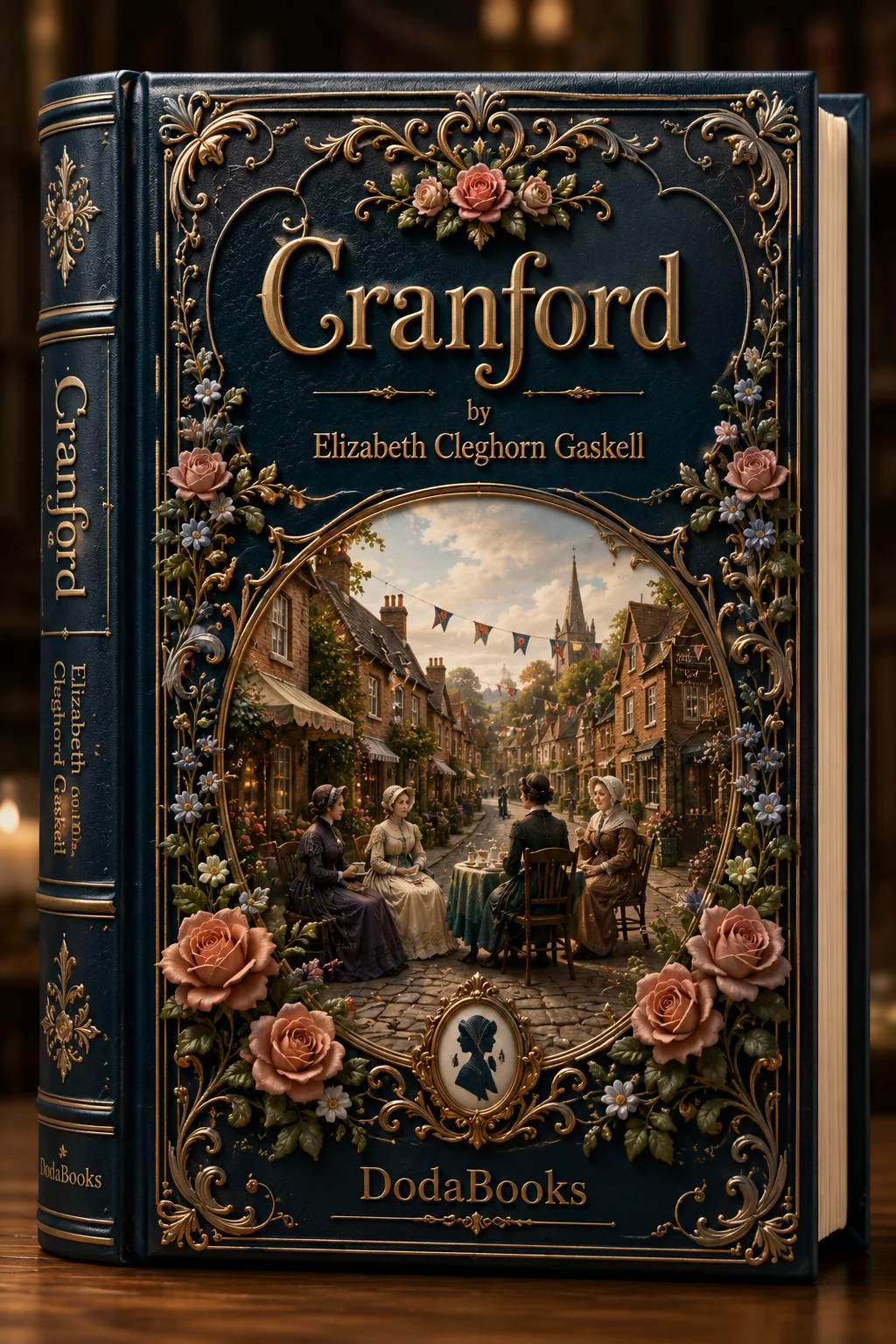
🏡 Read Elizabeth Gaskell with Seamless Digital Clarity
Eliminate reading friction with the DodaBooks Annotated Edition of Cranford. Crafted specifically for modern readers:
- ☕ Instant Victorian Etiquette Notes — Every social ritual, tea custom, and period term explained on-page
- 💡 Historical Context Cards — Contextualizing Victorian bank crashes, Dickens’s magazine, and Knutsford history
- 🗺️ Restored Village Maps — Follow Miss Matty’s walks through the real streets of historic Cheshire
- 📱 Universal DRM-Free EPUB — Read across Kindle, Apple Books, Kobo, and Android tablets
📜 The Cranford Parlor Lexicon: Essential Victorian Glossary
To help you navigate village social life without stumbling over obscure 19th-century domestic terms, here is an essential vocabulary guide:
+------------------------------------------------------------------------+
|                      THE CRANFORD PARLOR LEXICON                       |
|                                                                        |
|  Term                Victorian Meaning          Context in the Novel   |
|  --------------------------------------------------------------------  |
|  "Elegant Economy"   Social camouflage of       Practiced by all the   |
|                      genteel poverty            spinsters to save face |
|  Morning Call        Formal social visit        Strictly limited to 15 |
|                      between 12 and 3 p.m.      minutes by the clock   |
|  Calash              Enormous folding hood      Worn by ladies to      |
|                      resembling a carriage top  protect ornate caps    |
|  Pattens             Wooden overshoes raised    Kept shoes and skirts  |
|                      on iron rings              out of muddy streets   |
|  Preference          18th-century card game     The respectable card   |
|                      similar to whist           game of Cranford       |
|  Spatterdashes       Protective cloth or leather Worn over trousers by  |
|                      gaiters for boots          country gentlemen      |
|  Spinsters           Unmarried adult women      The ruling "Amazons"   |
|                      of gentle birth            of Cranford society    |
+------------------------------------------------------------------------+
Victorian Domestic Objects & Customs
- Widow’s Cap: A stiff, white muslin or lace headpiece worn by Victorian widows as a solemn symbol of perpetual mourning. Miss Matty adopts one in secret after Mr. Holbrook dies.
- Flannel Drawers: Woolen undergarments. Captain Brown humorously prescribes a set of red flannel waistcoats and drawers for Miss Betsy Barker’s scalded cow.
- Unlimited Liability Bank: A 19th-century banking institution where every shareholder was personally responsible for all debts of the bank down to their last shilling. This legal structure causes Miss Matty’s sudden bankruptcy.
- Chutnee: Spicy Indian mango or fruit pickle brought back by British colonial officers. Peter Jenkyns distributes jars of it to village ladies upon his return from India.
📅 The 5-Day Structured Reading Schedule
With only sixteen short chapters totaling around 75,000 words, Cranford is the perfect novel for a cozy, five-day reading plan (requiring roughly 45 to 55 minutes of reading per day):
          [ 5-DAY CRANFORD CHAPTER READING ROADMAP ]
+---------------------------------------------------------------+
| • Day 1: Chapters 1–3   | The Amazonian Society & The Browns  |
|   Focus: Rules of Cranford; Dickens vs. Dr. Johnson; Captain  |
|          Brown's heroism and tragic railway accident          |
+---------------------------------------------------------------+
| • Day 2: Chapters 4–6   | Lost Loves & The Ancient Rectory    |
|   Focus: Burning old family letters; the visit to Woodley;    |
|          Mr. Holbrook's romance; the vanishing of Peter       |
+---------------------------------------------------------------+
| • Day 3: Chapters 7–9   | Aristocratic Visits & Conjurors     |
|   Focus: Miss Barker's tea party; meeting Lady Glenmire;      |
|          Signor Brunoni's magic performance at Assembly Rooms |
+---------------------------------------------------------------+
| • Day 4: Chapters 10–13 | Panic, Sickness & The Surgeon Scandal|
|   Focus: The Cranford robbery panic; nursing Samuel Brown;     |
|          Lady Glenmire shocks town by marrying Mr. Hoggins    |
+---------------------------------------------------------------+
| • Day 5: Chapters 14–16 | Bank Crash, Tea Shop & The Great Aga|
|   Focus: Town & County Bank collapse; the spinsters' fund;    |
|          Miss Matty's tea shop; Peter Jenkyns returns from India|
+---------------------------------------------------------------+
Reading Tips for Book Clubs and Solo Readers:
- Compare Dickens and Dr. Johnson in Chapter 1: Gaskell uses this debate to poke gentle fun at conservative traditionalists who fear modern, democratic popular culture.
- Linger Over the Woodley Visit (Chapter 5): This is one of the most exquisitely written pastoral chapters in English literature—a masterclass in subtle, unexpressed yearning.
- Notice the Working-Class Loyalty in Chapter 14: Pay close attention to Martha and Jem Hearn; Gaskell deliberately highlights the moral nobility of servants in contrast to the irresponsible bankers of Drumble.
👥 Who Will Love Cranford?
Perfect For:
- Fans of Jane Austen (Pride and Prejudice, Emma): Features the same sparkling wit, keen observation of provincial social hierarchies, and delightful irony.
- Lovers of Cozy Victorian Classics: A warm, soothing, and deeply moral reading experience with zero cynicism or gratuitous despair.
- Readers Interested in Women’s Social History: An invaluable fictional chronicle of how 19th-century unmarried women built informal networks of mutual economic and emotional support.
Might Struggle If:
- You demand fast-paced, high-stakes thriller plotting. Cranford moves at the leisurely speed of a donkey cart through a Cheshire lane.
- You dislike domestic, character-driven storytelling. The drama here happens in tea parlors, churchyards, and small country shops.
❓ Frequently Asked Questions
Is Cranford considered a novel or a collection of short stories?
Cranford is generally classified as an episodic novel. While it began as a single magazine sketch in Charles Dickens's Household Words in December 1851, the overwhelming popular acclaim led Gaskell to compose eight additional installments over the next eighteen months, linking them together into a unified, character-driven narrative centered on Miss Matty Jenkyns.
How does Cranford compare to Elizabeth Gaskell's other novels?
Cranford is markedly lighter and more humorous than Gaskell's hard-hitting industrial novels, such as Mary Barton (1848) and North and South (1855), which confront grim labor riots, factory poverty, and class warfare in Manchester. However, Cranford shares the same profound moral empathy and commitment to social reconciliation found in her darker works.
Why did Charles Dickens publish Cranford in Household Words?
Dickens was an enthusiastic admirer of Elizabeth Gaskell's writing and actively solicited her contributions for his new family weekly magazine. Dickens loved the humor and gentle humanity of the Cranford sketches, though he famously objected to Gaskell's mention of his own book (The Pickwick Papers) in Chapter 1, prompting a playful editorial disagreement that was resolved with Dickens's typical charm.
Why does Miss Matty open a tea shop rather than taking a teaching position?
In Victorian England, opening a small, respectable trade in groceries—specifically high-grade imported China tea—was considered one of the few commercial pursuits that would not entirely compromise a clergyman's daughter's social status. Furthermore, Miss Matty lacked the formal educational credentials required for a governess or schoolmistress post, making the tea shop an ideal, dignified solution.
☕ Savor Every Page of Elizabeth Gaskell’s Masterpiece
Take the confusion out of 19th-century etiquette with the definitive DodaBooks Annotated Edition:
- 🏡 Complete 16-Chapter Text — Unabridged, beautifully typeset for digital reading
- 💡 Exhaustive On-Page Annotations — Explaining Victorian social customs, bank crashes, and tea etiquette
- 📜 Historical Context Cards — Learn about the real Knutsford figures who inspired Mrs. Gaskell
- 🔒 100% DRM-Free — Yours forever across Kindle, Kobo, iPad, and Android