Is Childe Harold's Pilgrimage Hard to Read? Reading Difficulty & Study Guide
For many readers exploring nineteenth-century British literature, Lord Byron’s Childe Harold’s Pilgrimage (1812–1818) represents one of the most intimidating yet rewarding summits of Romantic verse. Spanning four massive cantos composed in intricate, archaic Spenserian stanzas, the poem demands an attentive reader who can navigate classical mythology, the geopolitics of the Napoleonic Wars, and the stormy psychological landscape of the early nineteenth century.
However, once a reader understands the architecture of the Spenserian stanza and learns to decode Byron’s passionate, conversational voice, the poem transforms into an astonishingly vivid, exhilarating travelogue. Unlike the recondite mythological allegories of Percy Bysshe Shelley (Prometheus Unbound) or the dense philosophical meditation of William Wordsworth (The Prelude), Byron’s poetry is fueled by journalistic immediacy, fiery political indignation, and razor-sharp wit.
This comprehensive reading difficulty guide breaks down the structural mechanics, historical context, and vocabulary demands of Childe Harold’s Pilgrimage, providing an actionable 4-week reading schedule and essential discussion questions for students, educators, and poetry enthusiasts.
| Difficulty Metric | Level / Measurement | Comparative Context |
|---|---|---|
| Poetic Form & Meter | Spenserian Stanza (ababbcbcc) | 9-line stanzas: 8 lines of iambic pentameter followed by an expansive 12-syllable alexandrine line. |
| Total Length | 4 Cantos (~4,500 lines / ~38,000 words) | Equivalent in reading time to a medium-length Victorian novella (~140–160 pages). |
| Language & Diction | Elevated Romantic & Archaic | Cantos I–II use antique medievalisms (whilom, fain, sooth); Cantos III–IV transition to fluid, modern Romantic diction. |
| Primary Challenge | Classical & Historical Allusions | Peninsular War politics, Ottoman customs, Waterloo history, Roman imperial monuments, and Greek mythology. |
| Pacing & Flow | Expansive & Meditative | High emotional peaks (Waterloo, Ocean) balanced by reflective philosophical stanzas on ruins and mortality. |
| Recommended Pacing | 1 Canto per week (4-week plan) | Allows deep exploration of geographical landmarks, political background, and poetic imagery. |
🎼 The Mechanics of the Spenserian Stanza
The most critical step in reading Childe Harold with ease and pleasure is understanding how Byron uses the Spenserian stanza:
ANATOMY OF THE SPENSERIAN STANZA
Line 1:  da-DUM  da-DUM  da-DUM  da-DUM  da-DUM (10 syllables, Rhyme A)
Line 2:  da-DUM  da-DUM  da-DUM  da-DUM  da-DUM (10 syllables, Rhyme B)
Line 3:  da-DUM  da-DUM  da-DUM  da-DUM  da-DUM (10 syllables, Rhyme A)
Line 4:  da-DUM  da-DUM  da-DUM  da-DUM  da-DUM (10 syllables, Rhyme B)
Line 5:  da-DUM  da-DUM  da-DUM  da-DUM  da-DUM (10 syllables, Rhyme B)
Line 6:  da-DUM  da-DUM  da-DUM  da-DUM  da-DUM (10 syllables, Rhyme C)
Line 7:  da-DUM  da-DUM  da-DUM  da-DUM  da-DUM (10 syllables, Rhyme B)
Line 8:  da-DUM  da-DUM  da-DUM  da-DUM  da-DUM (10 syllables, Rhyme C)
Line 9:  da-DUM  da-DUM  da-DUM  da-DUM  da-DUM  da-DUM (12 syllables, Rhyme C ◄── THE ALEXANDRINE)
Invented by Edmund Spenser in 1590 for his epic The Faerie Queene, the Spenserian stanza requires nine lines with only three rhyming sounds across the entire stanza (a-b-a-b-b-c-b-c-c).
The Power of the Final Alexandrine
The secret to the stanza’s emotional resonance is the ninth line—an alexandrine containing six iambic feet (twelve syllables) instead of five. Byron uses this extra foot to create a majestic, lingering sonic wave at the close of every stanza:
“Roll on, thou deep and dark blue Ocean—roll! (A)
Ten thousand fleets sweep over thee in vain; (B)
Man marks the earth with ruin—his control (A)
Stops with the shore; upon the watery plain (B)
The wrecks are all thy deed, nor doth remain (B)
A shadow of man’s ravage, save his own, (C)
When, for a moment, like a drop of rain, (B)
He sinks into thy depths with bubbling groan, (C)
Without a grave, unknell’d, uncoffin’d, and unknown.” (C — 12 syllables)
Notice how the final line broadens out like a breaking wave, landing with immense philosophical weight.
🔍 The 3 Greatest Reading Challenges
1. Shift from Archaic Pastiche to Mature Modern Voice
A common trap for readers is starting Canto I and feeling alienated by Byron’s mock-medieval language (“whilom”, “yclept”, “ne”, “losel”, “sheen”).
- In Cantos I and II (1812), Byron was imitating Spenserian antique flavor to distance himself from Harold.
- By Canto III (1816) and Canto IV (1818), Byron completely dropped this artificial pastiche. His voice becomes natural, urgent, psychologically transparent, and intensely modern. If you find the early stanzas of Canto I stiff, keep reading—the verse opens up dramatically once Harold reaches Spain and Greece.
2. The Density of Classical and Historical Allusions
Byron wrote for an educated nineteenth-century audience that studied Latin and Greek from childhood and followed the Napoleonic Wars daily in the newspapers. The poem constantly references historical figures and battles:
- Military: Talavera, Albuera, Saragossa, Waterloo, Morat, Marathon, Cannae, Actium.
- Literary & Philosophical: Rousseau, Voltaire, Dante, Petrarch, Boccaccio, Tasso, Ariosto, Machiavelli.
- Classical Monuments: The Parthenon, the Colosseum, the Pantheon, the Tomb of Cecilia Metella, the Dying Gladiator, the Apollo Belvedere.
Reading with a well-annotated edition (such as DodaBooks or Oxford) is indispensable: pop-up footnotes eliminate the need to halt your reading to search external encyclopedias.
THE THREE TIERS OF BYRONIC ALLUSIONS
┌────────────────────────────────────────────────────────┐
│ 1. MODERN GEOPOLITICS: Waterloo, Napoleon, Elgin Marbles│
│ 2. CLASSICAL ANTIQUITY: Marathon, Colosseum, Gladiator │
│ 3. RENAISSANCE INTELLECT: Dante, Tasso, Machiavelli    │
└────────────────────────────────────────────────────────┘
3. Emotional Turbulence & Dramatic Shifting
Byron rarely maintains a single mood for more than three stanzas. He intentionally juxtaposes:
- Grand descriptions of nature’s beauty with cynical satirical jabs at British tourists.
- Deep, tragic grief over fallen empires with romantic confessions of personal guilt.
- High philosophical idealism with devastating existential disillusionment.
Readers should embrace these dramatic tonal shifts as the authentic expression of Byron’s tempestuous, complex mind.
📚 Essential Historical & Poetic Vocabulary
Familiarity with these twenty period terms will ensure a fluid, effortless reading experience:
| Term | Meaning & Context in the Poem |
|---|---|
| Albion | The ancient poetic name for Great Britain; Harold bids farewell to Albion in Canto I. |
| Alexandrine | A line of poetic meter consisting of six iambic feet (12 syllables); the ninth line of a Spenserian stanza. |
| Ali Pasha | The formidable, white-bearded Ottoman ruler of Epirus who hosted Byron at Tepelena in Canto II. |
| Cant | Hypocritical, insincere moral posturing; the societal convention Byron detested most in English life. |
| Childe | An archaic medieval English title given to a noble youth before he achieved knighthood. |
| Convention of Cintra | The controversial 1808 military treaty in Portugal that allowed defeated French forces to escape with plunder. |
| Dacian | An ancient inhabitant of the lower Danube region; the heritage of the Dying Gladiator in the Colosseum. |
| Elgin Marbles | The Parthenon sculptures removed from Athens by Lord Elgin; fiercely condemned by Byron in Canto II. |
| Ennui / Satiety | Deep spiritual boredom, moral exhaustion, and world-weariness resulting from excessive youthful pleasure. |
| Epirus | A historical region of the western Balkans (now northwestern Greece and southern Albania). |
| Hereditary Bondsmen | Byron’s famous phrase for enslaved peoples who wait for foreign saviors rather than striking for freedom themselves. |
| Lake Leman | Lake Geneva in Switzerland; the setting for Byron’s sublime meditation on nature, storms, and Rousseau in Canto III. |
| Maid of Saragossa | Agustina Zaragoza, the Spanish civilian heroine who fired the cannon against Napoleon’s forces in 1808. |
| Niobe of Nations | Byron’s famous mythological metaphor for Rome; mourning her dead imperial glory like Niobe weeping for her children. |
| Peninsular War | The brutal conflict (1807–1814) fought in Spain and Portugal against Napoleon’s invading armies. |
| Philhellenism | The international movement of intellectuals and artists who championed the liberation of Greece from the Ottoman Empire. |
| Rousseau | Jean-Jacques Rousseau (1712–1778), the philosopher of Romantic sensibility celebrated by Byron in Canto III. |
| Sintran Paradise | The mountain palaces of Sintra in Portugal, praised by Byron for their breathtaking natural beauty. |
| Spenserian Stanza | A nine-line stanza invented by Edmund Spenser, rhyming ababbcbcc, concluding with an alexandrine. |
| Tasso | Torquato Tasso (1544–1595), the brilliant Renaissance Italian poet imprisoned in a madhouse in Ferrara. |
🗓️ 4-Week Structured Reading Plan
Reading one canto per week provides the perfect pacing to absorb Byron’s poetry, geography, and historical arguments:
4-WEEK CHILDE HAROLD STUDY SCHEDULE
Week 1 (Canto I):   Flight from Albion & The Peninsular War (Portugal & Spain)
Week 2 (Canto II):  The Ottoman East & The Desecration of Athens (Elgin Marbles)
Week 3 (Canto III): Waterloo, Napoleon, & The Alpine Storms of Lake Leman
Week 4 (Canto IV):  Venice, Santa Croce, The Colosseum, & The Eternal Ocean
Week 1: Portugal, Spain, and Battlefield Carnage (Canto I)
- Reading Goal: Canto I (~93 stanzas / ~840 lines).
- Core Action: Childe Harold’s departure (“Good Night to my native Shore”); Sintra’s lush mountains; the Convention of Cintra; the blood of Talavera and Albuera; the Maid of Saragossa; the Cadiz bullfight; Harold’s confession to Ines.
- Key Reflection: How does Byron subvert patriotic military propaganda into an indictment of war’s cruel waste?
- Reading Time: ~75 minutes.
Week 2: Albania, Ali Pasha, and the Lament for Greece (Canto II)
- Reading Goal: Canto II (~98 stanzas / ~880 lines).
- Core Action: Sailing the Ionian Sea; traveling into Albania to the court of Ali Pasha; the martial dance of the Suliotes; the ruins of Athens; the furious attack on Lord Elgin; the call for Greek revolution (“Hereditary bondsmen!”).
- Key Reflection: Why does Byron view the loss of Greek liberty as the tragedy of the entire Western world?
- Reading Time: ~80 minutes.
Week 3: Waterloo, Napoleon, and Alpine Pantheism (Canto III)
- Reading Goal: Canto III (~118 stanzas / ~1,060 lines).
- Core Action: Farewell to infant daughter Ada; the Duchess of Richmond’s ball in Brussels; the carnage of Waterloo; the psychological dissection of Napoleon; castles on the Rhine; Lake Leman and Rousseau; the midnight thunderstorm over the Jura mountains.
- Key Reflection: How does communion with wild nature heal the psychic wounds of social exile?
- Reading Time: ~90 minutes.
Week 4: Venice, Roman Ruins, and the Sovereign Ocean (Canto IV)
- Reading Goal: Canto IV (~186 stanzas / ~1,670 lines).
- Core Action: The Bridge of Sighs in Venice; the tombs of Santa Croce in Florence; Rome as the “Niobe of nations”; the dying Dacian gladiator in the Colosseum; the immortal apostrophe to the Ocean (“Roll on, thou deep and dark blue Ocean—roll!”).
- Key Reflection: What does the eternal, untamable ocean represent in contrast to the ruins of human empires?
- Reading Time: ~110 minutes.
💬 Discussion & Book Club Questions
- The Architecture of Melancholia: What is the root cause of Childe Harold’s inner grief? Is it genuine philosophical despair or aristocratic self-indulgence? How does Byron’s own life reframe this question?
- The Ethics of Antiquity: Read Byron’s stanzas on Lord Elgin in Canto II. What are the ethical arguments surrounding the removal of cultural relics from their native landscapes to foreign museums?
- The Mirror of Napoleon: In Canto III, why does Byron find Napoleon both inspiring and tragic? In what ways is Napoleon’s hubris a warning to the poet himself?
- Art as Immortality: In Canto IV, Byron meditates on the fallen stones of Rome and Venice. How does he argue that artistic genius (poetry, painting, sculpture) outlives the military conquests of emperors?
- The Ocean’s Freedom: Reread the famous Ocean stanzas (178–184). Why is the ocean the ultimate symbol of liberty and divine power for the Romantic imagination?
❓ Frequently Asked Questions
How does Childe Harold's Pilgrimage compare to Don Juan?
Childe Harold's Pilgrimage (1812–1818) is serious, meditative, melancholic, and composed in Spenserian stanzas, capturing the dramatic Romantic spirit of Byron's youth. Don Juan (1819–1824) is a brilliant, comic, satirical epic composed in ottava rima, mocking romantic pretenses, European politics, and societal hypocrisy with biting humor.
Did Lord Byron actually travel the exact route described in the poem?
Yes! Cantos I and II follow Byron's actual Grand Tour of 1809–1811 through Portugal, Spain, Malta, Albania, Greece, and Constantinople. Canto III documents his actual 1816 journey through Waterloo, up the Rhine, and around Lake Geneva. Canto IV reflects his real travels through Venice, Florence, and Rome in 1817.
Can I read Canto III or IV without reading Cantos I and II?
Yes. While reading the poem sequentially reveals Byron's artistic maturation, Cantos III and IV stand as independent masterpieces of world poetry. Many university literature courses assign Canto III (Waterloo and Switzerland) or Canto IV (Rome and the Ocean) on their own.
How long does it take an average reader to finish the entire epic?
At approximately 38,000 words across four cantos, reading the complete poem takes about 4.5 to 5 hours. Following our 4-week study schedule requires roughly 75 to 110 minutes of reading per week.
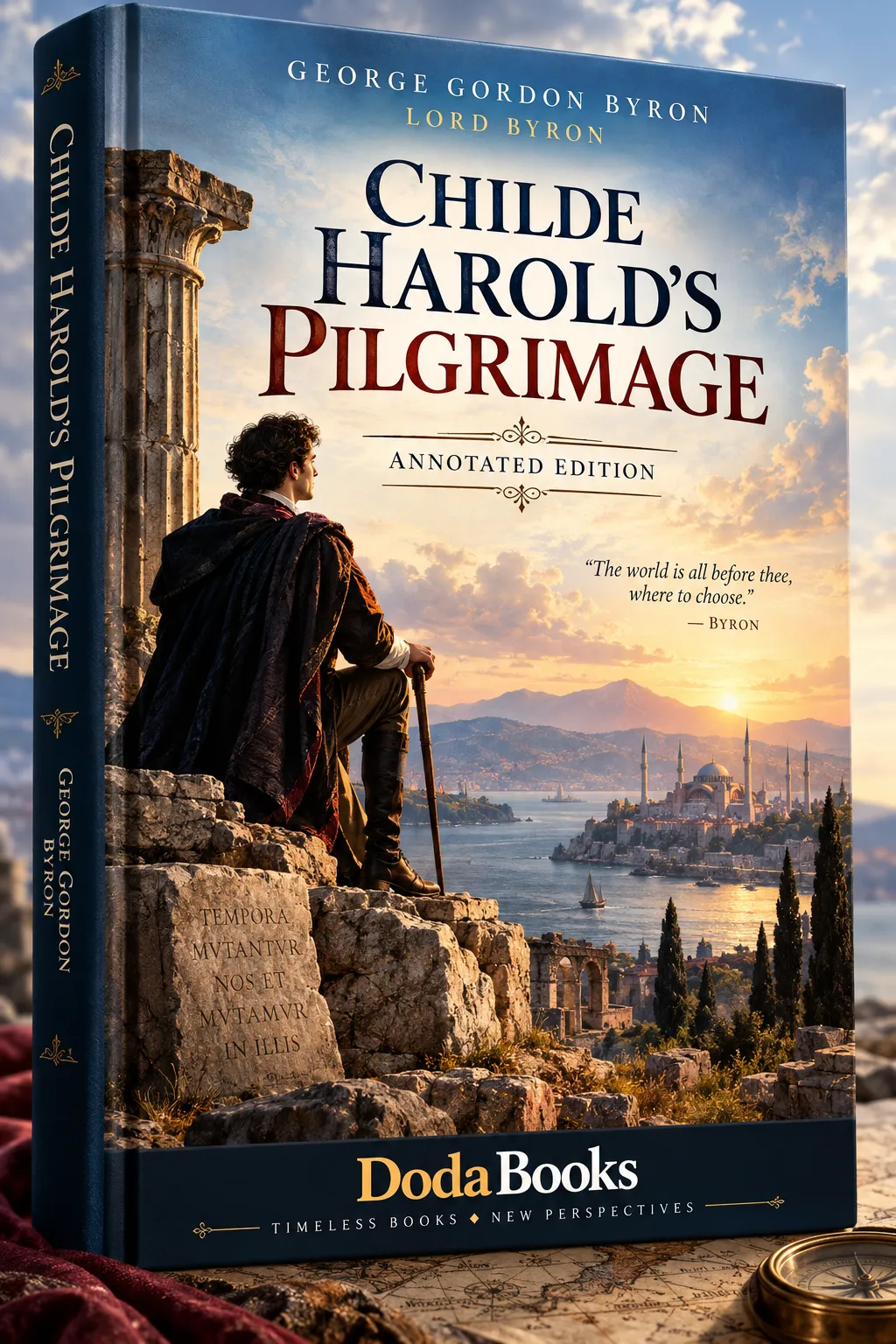
📖 Master Byron’s Grand Tour with Unrivaled Clarity
Experience Childe Harold’s Pilgrimage with complete historical, geographical, and classical commentary in the DodaBooks Annotated Edition:
- 🏛️ All 4 Cantos Complete & Uncut — Restored Spenserian verse with original prefaces and dedications
- 💡 Exhaustive Footnotes on European History & Mythology — Instant explanations for Napoleon, Waterloo, Elgin, and Rome
- 📱 Engineered for Verse Reading — Flawless line indentation and rhythm preservation across e-ink and mobile screens
- 🔓 100% DRM-Free — Yours to keep, read, and transfer across Kindle, Kobo, iPad, or Android
👉 Get the Annotated Edition of Childe Harold’s Pilgrimage at DodaBooks →