Is Black Beauty Hard to Read? Reading Difficulty & Study Guide
Because Anna Sewell’s Black Beauty is frequently displayed in the children’s section of bookstores and libraries, many prospective readers assume it is a simplistic story that can be skimmed in an afternoon. Others, intimidated by the label “19th-century Victorian literature,” fear dense, archaic sentences laden with impenetrable vocabulary.
The reality lies in a fascinating middle ground: Linguistically, Black Beauty is one of the most accessible classics ever written, but emotionally and historically, it is a deeply demanding, mature novel.
With a Lexile score of approximately 860L, Sewell’s prose is clean, lucid, and direct. However, the novel’s specialized 19th-century equine vocabulary, realistic depictions of animal suffering, and complex Victorian social structures require contextual guidance.
This comprehensive reading difficulty guide analyzes the book’s readability metrics, breaks down its core linguistic hurdles, and provides an actionable 10-day reading schedule for students, book clubs, and general readers.
| Readability Metric | Score / Level | Context & Explanation |
|---|---|---|
| Lexile Measure | 860L–900L | Typical for 5th–7th grade reading levels (accessible syntax) |
| Total Word Count | ~59,000 words | 49 Chapters across 4 Parts; ~200–220 printed pages |
| Flesch-Kincaid Grade Level | Grade 5.8 | Short sentences and natural speech rhythms make reading fast |
| Estimated Reading Time | 4–5 hours | Average reading pace of 200–250 words per minute across 10 days |
| Primary Challenge | Equine Terminology | Specialized 19th-century harness, carriage, and veterinary terms |
| Emotional Intensity | High | Realistic depictions of overwork, abuse, starvation, and animal death |
📖 The Deceptive Simplicity of Anna Sewell’s Prose
Anna Sewell crafted Black Beauty while confined to an invalid’s sofa in Norfolk, terminally ill with hepatitis. Because she was physically exhausted, she dictated chapters to her mother or wrote on small slips of paper. This physical constraint produced a literary miracle: concise, unpretentious, and rhythmically flawless English prose.
Unlike her contemporaries Charles Dickens or George Eliot—who favored complex, multi-clause periodic sentences and extensive authorial digressions—Sewell wrote with crystalline simplicity:
“The first place that I can well remember was a large pleasant meadow with a pond of clear water in it. Some shady trees leaned over it, and rushes and water-lilies grew at the deep end.”
Every sentence is active, concrete, and sensory. The chapters are remarkably short—averaging just 1,000 to 1,200 words (about 3 to 4 pages each). This modular structure makes the book exceptionally easy to read in brief, daily installments.
⚠️ The Real Hurdles: Equine Vocabulary & Emotional Weight
While the grammar is straightforward, readers face two distinct challenges:
1. Specialized Victorian Harness & Carriage Vocabulary
Sewell was writing a technical advocacy book for people who lived with horses daily. Consequently, she uses Victorian equine terms that are foreign to modern, automobile-centric readers:
┌─────────────────────────────────────────────────────────────┐
│  The Agonizing "Bearing Rein" (Checkrein)                   │
│  A strap running from the bit to the back harness, forcing  │
│  the horse's neck into an unnatural, suffocating arch.      │
├─────────────────────────────────────────────────────────────┤
│  The Cruel "Docked Tail"                                    │
│  The surgical amputation of the tailbone for high-society   │
│  fashion, leaving horses defenseless against biting flies.  │
├─────────────────────────────────────────────────────────────┤
│  "Blinkers" (Blinders)                                      │
│  Rigid leather flaps beside the eyes preventing peripheral  │
│  vision, often terrifying nervous horses.                   │
├─────────────────────────────────────────────────────────────┤
│  "Broken Knees" / "Scarred Knees"                           │
│  Scars from falling on stone roads; in Victorian England,    │
│  it permanently destroyed a gentleman's horse's value.       │
└─────────────────────────────────────────────────────────────┘
Other essential terms include:
- Curb Bit: A harsh levered bit that exerts intense pressure on a horse’s tongue and jaw, used to force submission.
- Job-Horse: A horse rented out on a commercial daily or weekly lease, notoriously subject to careless driving.
- Dray: A heavy, low-built cart used for hauling beer kegs, flour, and industrial freight.
- Knacker’s Yard: A slaughterhouse where old, injured, or diseased horses were butchered for dog food, glue, and leather.
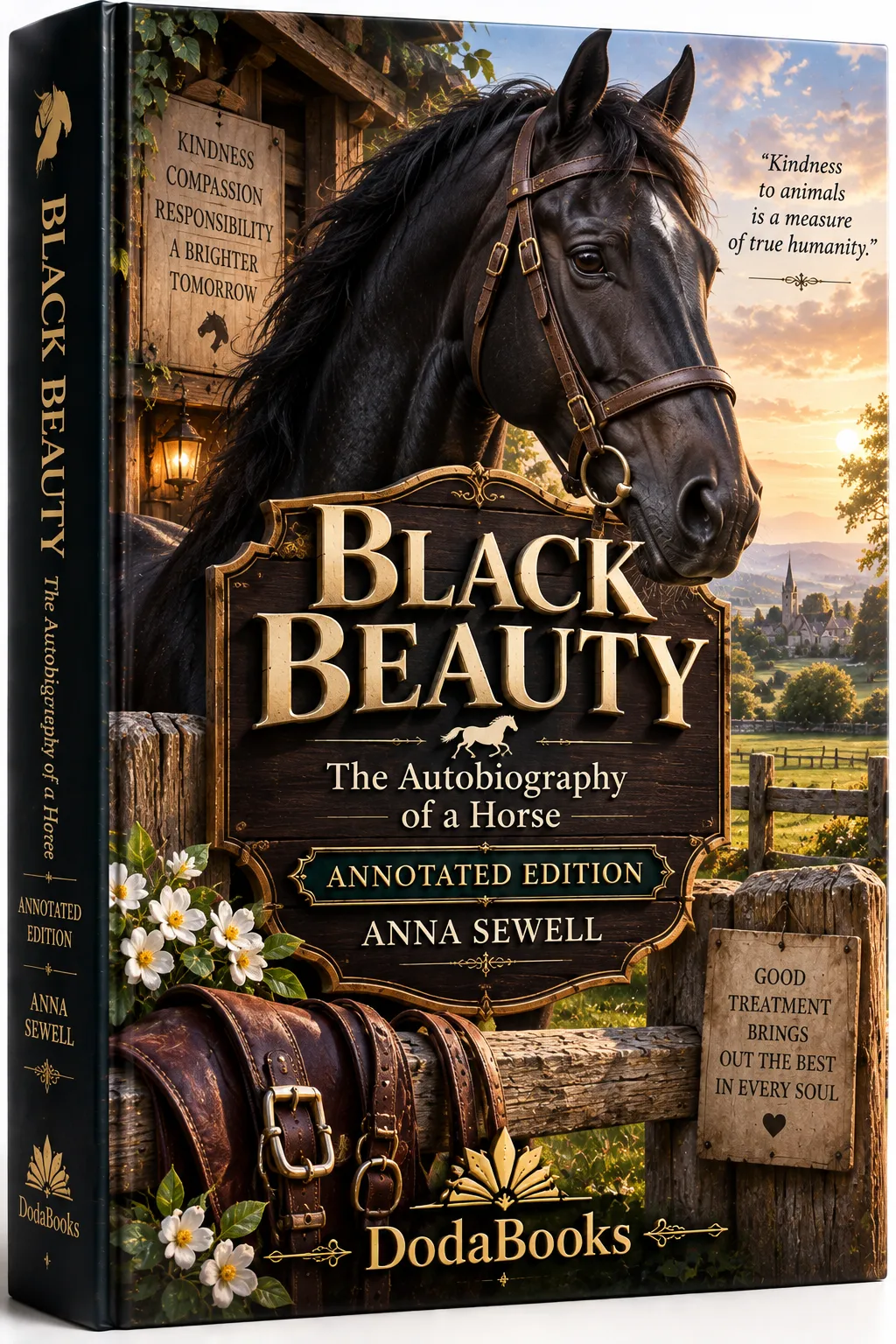
Solution: Read an edition with on-page historical footnotes—such as the DodaBooks Annotated Edition—which explains every piece of Victorian tack as it appears.
2. High Emotional Intensity & Mature Themes
The greatest challenge for modern readers, especially sensitive young readers, is not vocabulary, but emotional heartbreak.
Sewell pulls no punches. She depicts the harsh, unforgiving realities of 19th-century working-class life:
- Ginger’s Tragic Arc: Ginger does not experience a miraculous Hollywood rescue; she is broken by continuous beatings, exhausted by the London cab trade, and dies an emaciated wreck.
- Beauty’s Hemorrhage: In Chapter 47, overloaded with luggage on a steep hill, Beauty bursts a blood vessel in his lungs, collapsing onto the bloody stones under the driver’s whip.
- Human Consequences: Reuben Smith’s alcoholism leads to a graphic death on a flint road, plunging his wife and six children into the dreaded Victorian workhouse.
Master Victorian equine terminology and social history with our complete annotated guide.
📖 Get the Annotated Edition at DodaBooks →📅 The 10-Day Reading Plan (Master the Novel in Under Two Weeks)
Because the 49 chapters are short, reading Black Beauty across 10 days requires just 20 to 25 minutes (roughly 5 chapters) per session:
| Day | Chapters | Setting & Key Episodes | Reading Focus |
|---|---|---|---|
| Day 1 | Part I: Ch. 1–5 | The meadow; the hunt; breaking-in; arriving at Birtwick Park | Appreciate Duchess’s foundational moral advice |
| Day 2 | Part I: Ch. 6–11 | Liberty in the orchard; Ginger’s trauma; Merrylegs; Sir Oliver’s tail | Reflect on the cruelty of fashionable docking |
| Day 3 | Part I: Ch. 12–16 | The broken bridge storm; the brickmaker; the stable fire | Notice Beauty’s equine instinct and courage |
| Day 4 | Part I: Ch. 17–21 | Galloping for the doctor; Joe Green’s blunder; Birtwick stable broken up | Understand the difference between ignorance and malice |
| Day 5 | Part II: Ch. 22–26 | Earlshall Park; bearing rein strike; Reuben Smith’s fatal drunken ride | Witness the physical torture of the bearing rein |
| Day 6 | Part II: Ch. 27–31 | Ruined knees; livery job-horses; careless tourists; the oats thief | Observe Beauty’s descent into commercial hiring |
| Day 7 | Part III: Ch. 32–36 | London horse fair; Jerry Barker; War horse Captain’s Crimean story | Experience the noise and grit of 1870s London |
| Day 8 | Part III: Ch. 37–41 | Jerry’s Golden Rule; Sunday cab debate; poor Ginger’s death | Ponder the harsh economics of the London cab-stands |
| Day 9 | Part III: Ch. 42–45 | Election madness; helping a poor woman; Jerry’s New Year blizzard | Notice the high human cost of Victorian luxury |
| Day 10 | Part IV: Ch. 46–49 | Skinner’s cab hell; lung hemorrhage; Farmer Thoroughgood; reunion with Joe | Celebrate Beauty’s well-earned final sanctuary |
The 860L Reading Level
Understand why the short, crisp sentences make this novel readable for young students while challenging adult consciences.
Tack & Harness Glossary
A quick-reference visual guide defining curb bits, bearing reins, cruppers, martingales, and horse collars.
Preparing for Emotional Scenes
Guidance for parents and teachers on discussing Ginger's tragic death and Beauty's lung collapse with young readers.
Victorian Labor Economics
Explore the connection between overworked horses and exploited London cab drivers in Chapters 36 and 39.
Captain's Crimean War Lesson
How to approach Chapter 34 as an anti-war text detailing the animal casualties of the Charge of the Light Brigade.
Discussion Questions
Six provocative essay prompts exploring animal rights, Christian stewardship, and Victorian social reform.
❓ Frequently Asked Questions
Is Black Beauty suitable for a 9-year-old child?
Linguistically, yes. Most 4th and 5th graders can easily read the prose. However, parents should be aware that the novel contains distressing themes of animal abuse, starvation, physical injury, and death (especially Ginger's death and Reuben Smith's fatal accident). Reading together or providing emotional guidance is recommended.
Why are the chapters so short in Black Beauty?
Anna Sewell suffered from chronic, debilitating illness while writing the book and could only work in brief spurts. Her exhaustion created an episodic, punchy narrative structure where each 3-to-4 page chapter delivers a self-contained moral or narrative lesson.
How does Black Beauty compare in difficulty to Charlotte's Web?
*Charlotte's Web* (Lexile 680L) is written in simpler 20th-century American prose specifically for children. *Black Beauty* (Lexile 860L) uses 19th-century British sentence cadences, specialized equine terminology, and deals with complex adult social and economic issues like labor laws, animal anatomy, and alcoholism.
Do I need to know about horses to understand the novel?
Not at all! Anna Sewell wrote the book to educate people who knew little about proper horsemanship. While knowing basic terms like "reins" and "saddle" helps, reading an annotated edition that clarifies Victorian harness devices ensures complete comprehension.
How long does it take to read the entire novel?
At approximately 59,000 words, an average adult reading at 250 words per minute will complete *Black Beauty* in roughly 4 hours. Following our 10-day reading schedule takes just 20 to 25 minutes per day.
🐎 Master Anna Sewell’s Masterpiece with Ease
Read the definitive unabridged edition with full explanatory footnotes. The DodaBooks Annotated Edition of Black Beauty delivers:
- ✅ Complete Unabridged 1877 Text — All 49 chapters in their authentic Victorian form
- 📜 Over 250 Explanatory Footnotes — Decoded harness terms, London cab laws, and historical context
- ✒️ Clear Digital Typography — Formatted specifically for seamless reading on digital devices
- 🔒 100% DRM-Free Ownership — Read across Kindle, Kobo, iPad, and Android with complete freedom
- 📥 Instant EPUB Delivery — Download your digital copy immediately