Is Bacon's Essays Hard to Read? Reading Difficulty, Latin Glossary & Study Guide
When modern readers open Sir Francis Bacon’s The Essayes or Counsels, Civill and Morall, they are often struck by an immediate paradox. On the surface, the book appears remarkably accessible: individual essays are rarely longer than three or four pages, sentences are crisp and grammatically compact, and the subject matter—truth, death, ambition, friendship, and anger—deals with universal aspects of the human condition.
Yet within a paragraph or two, many readers find themselves stalling. Bacon’s prose, written in the late Elizabethan and early Jacobean periods between 1597 and 1625, demands a level of cognitive concentration that few modern texts require. It is not difficult because it is vague or overly poetic; rather, it is difficult because it is extraordinarily dense. Every sentence is an aphorism packed with Latin quotations, classical Roman history, legal metaphors, and archaic Renaissance English vocabulary that has shifted meaning over four centuries.
This comprehensive reading difficulty guide evaluates the quantitative readability metrics of Bacon’s essays, breaks down the four primary linguistic hurdles, provides a vital glossary of Elizabethan semantic shifts, and outlines a structured 14-day study plan to help you master Bacon’s timeless wisdom.
| Assessment Category | Measurement / Benchmark | Practical Reading Implication |
|---|---|---|
| Lexile Measure | 1190L–1280L | Comparable to John Milton’s prose, Shakespeare’s histories, and Alexander Hamilton’s Federalist Papers |
| Reading Age / Grade Level | Grades 11–College (Age 16+) | Requires mature analytical skills; best suited for advanced high school, university students, and adult readers |
| ATOS Book Level | 8.9 | Elevated syntactic and conceptual density; dense grammatical compression |
| Total Word Count | ~62,000 words (58 essays + 31 myth-essays) | Moderate overall length, but reading speed is roughly half that of a modern novel |
| Estimated Reading Time | 6 to 8 hours | Best consumed slowly—no more than 3 to 4 essays per sitting to avoid cognitive fatigue |
| Primary Obstacles | Untranslated Latin quotes, Renaissance semantic shifts, aphoristic compression | Requires an annotated edition with inline Latin translations and historical glosses |
📊 Readability Metrics: Understanding the Cognitive Load
Standard readability formulas evaluate sentence length and polysyllabic word counts. When applied to Bacon, these formulas produce scores that require careful interpretation:
                      [READABILITY PROFILE: BACON'S ESSAYS]
                                        │
        ┌───────────────────────────────┼───────────────────────────────┐
        ▼                               ▼                               ▼
[LEXILE: 1240L]                 [SENTENCE LENGTH: SHORT-MODERATE] [CONCEPTUAL DENSITY: EXTREME]
- Advanced syntactic complexity - Terse, balanced clauses       - Each sentence holds a complete
- Classical Latin borrowings    - No Victorian multi-page runs   philosophical thesis
1. The Deception of Short Sentences
Unlike Victorian authors like Thomas De Quincey or John Ruskin, who constructed sprawling sentences of eighty or ninety words connected by semi-colons, Bacon preferred the terse Tacitean style:
“He that hath wife and children hath given hostages to fortune.” “Reading maketh a full man; conference a ready man; and writing an exact man.”
Syntactically, these sentences are simple and balanced. However, the conceptual density is extreme. In a contemporary non-fiction book, an author will introduce a single concept and spend five pages illustrating it with anecdotes and statistics. Bacon states the concept in twelve words and immediately moves to the next principle. Attempting to speed-read Bacon as one would read a modern business book will result in immediate mental indigestion.
🚧 The Four Major Hurdles for Modern Readers
                  ┌─────────────────────────────────────────┐
                  │    THE FOUR HURDLES OF BACON'S PROSE    │
                  └────────────────────┬────────────────────┘
                                       │
         ┌─────────────────────────────┼─────────────────────────────┐
         ▼                             ▼                             ▼
┌───────────────────┐        ┌───────────────────┐         ┌───────────────────┐
│ Untranslated      │        │ Elizabethan       │         │ Classical Roman   │
│ Latin Quotations  │        │ Semantic Shifts   │         │ Historical Context│
│ Tacitus, Cicero,  │        │ Familiar words    │         │ Nero, Galba, Otho,│
│ Seneca, Livy      │        │ with dead meanings│         │ Augustus, Caesar  │
└───────────────────┘        └───────────────────┘         └───────────────────┘
1. The Latin Quotation Barrier
Bacon wrote for an educated Renaissance audience fluent in classical Latin. Throughout the 58 essays, he incorporates hundreds of untranslated Latin phrases, proverbs, and lines of Roman verse:
- In “Of Truth,” he quotes Lucretius: “Suave mari magno, turbantibus aequora ventis…” (“It is a pleasure to stand upon the shore, and to see ships tossed upon the sea…”)
- In “Of Death,” he cites the dying words of Emperor Augustus and Vespasian without naming them.
- In “Of Simulation and Dissimulation,” he invokes Tacitus’s critique of Livia.
In unannotated public-domain editions, these Latin passages break the reader’s comprehension. Unless you possess an annotated edition that translates these phrases inline, reading Bacon becomes an exercise in frustration.
2. Renaissance Semantic Shifts (“False Friends”)
Perhaps the most deceptive challenge is vocabulary. Bacon uses hundreds of English words that are still common today, but which carried completely different meanings in 1625. Encountering these “false friends” without a glossary leads modern readers to fundamentally misinterpret Bacon’s arguments.
📖 Glossary of Crucial Elizabethan Semantic Shifts in Bacon
| Renaissance Word | Meaning in Bacon’s Time (1625) | Modern Meaning (Do Not Confuse!) | Example from Bacon’s Essays |
|---|---|---|---|
| Curious | Meticulous, fastidious, excessively detailed | Inquisitive, strange, unusual | “Some books are to be read, but not curiously” (i.e., not requiring meticulous microscopic study) |
| Bravery | Ostentatious display, boasting, outward show | Courage, valor, fearlessness | “This is bravery of speech” (i.e., this is mere boastful rhetoric) |
| Indifferent | Impartial, neutral, unbiased | Uncaring, apathetic, mediocre | “Judges ought to be indifferent” (i.e., fair and unbiased) |
| Humour | Temperament, biological mood, bodily fluid | Wit, comicality, amusement | “The humour of a scholar” (i.e., the temperamental eccentricity of an academic) |
| Politique / Politic | Shrewd, cunning, worldly, Machiavellian | Relating to government policy | “Politic men contemn studies” (i.e., cunning, scheming men despise learning) |
| Officious | Attentive, dutiful, eager to serve | Meddlesome, bossy, overbearing | “An officious servant” (i.e., a loyal, diligent, and prompt servant) |
| Prevent | To anticipate, to come before, to precede | To stop something from happening | “He prevented the crisis” (i.e., he acted ahead of time to meet it) |
| Comfort | Encouragement, support, legal strengthening | Physical ease, relaxation | “To the comfort of his friends” (i.e., strengthening and encouraging his allies) |
| Sensible | Capable of feeling, sensitive, perceptive | Practical, reasonable, rational | “Sensible of the cold” (i.e., keenly feeling physical pain or cold) |
| Vain | Empty, foolish, lacking substance | Conceited, proud of appearance | “Vain opinions” (i.e., empty, groundless, and foolish beliefs) |
🏛️ 3. Classical Roman & Biblical Allusions
Bacon treats the entire history of the Roman Republic and Empire as an empirical laboratory of human behavior. He expects his readers to immediately understand references to:
- The Civil Wars of 69 AD (The Year of the Four Emperors: Galba, Otho, Vitellius).
- The legal administration of Julius Caesar and Emperor Augustus.
- The stoic philosophy of Seneca and the cynical historiography of Tacitus.
- Biblical figures, from Pontius Pilate to King Solomon’s proverbs.
When Bacon writes in “Of Great Place” that “Galba was omnium consensu capax imperii, nisi imperasset” (“by common consent capable of ruling, had he not ruled”), he assumes the reader knows that Emperor Galba was widely admired as a candidate for power, but proved utterly incompetent once crowned. Annotated editions explain these historical anecdotes so their modern relevance is immediately clear.
🧠 The Art of Reading Bacon: “Chewing and Digesting”
In his famous essay “Of Studies,” Bacon gave the ultimate prescription for reading his own work:
“Some books are to be tasted, others to be swallowed, and some few to be chewed and digested.”
Bacon’s Essays emphatically belong to the third category. To extract maximum value from the text, adopt the following four-step reading method:
[THE FOUR-STEP BACONIAN READING METHOD]
        │
        ├─► 1. THE AUDITORY PASS: Read one essay aloud to feel the Latinate rhythm
        │
        ├─► 2. THE ANNOTATION PASS: Consult inline translations and historical context
        │
        ├─► 3. THE APHORISTIC PAUSE: Identify the central antithesis or core maxim
        │
└─► 4. THE PRACTICAL TEST: Apply the insight to modern institutions or career- Read Aloud: Renaissance prose was written with oral cadence in mind. Reading an essay aloud reveals Bacon’s rhythmic balance, antithesis, and dramatic pauses.
- Translate the Latin: Never skip the Latin phrases. They are not decorative flourishes; they are the logical keystones around which Bacon builds his paragraphs.
- Isolate the Aphorism: In every essay, look for the master sentence that summarizes Bacon’s thesis. Write it down and reflect on how it challenges conventional wisdom.
- Test Against Reality: Bacon despised abstract theory divorced from practical utility. Ask yourself: Does this principle hold true in corporate boardrooms, modern political elections, or personal relationships today?
📅 The 14-Day Study Plan: Master Bacon’s Essays & Wisdom of the Ancients
This structured two-week reading schedule groups Bacon’s essays thematically rather than numerically, pairing his civil reflections with his allegorical interpretations from The Wisdom of the Ancients.
| Day | Theme / Category | Assigned Reading | Key Essays & Myth Allegories | Focus Questions & Learning Objectives |
|---|---|---|---|---|
| Day 1 | Truth & Human Delusion | ~6 pages | “Of Truth” (I), “Of Death” (II), “Of Unity in Religion” (III) | Why do people prefer comforting lies? How does Bacon strip death of its terror? |
| Day 2 | Passion & Moral Retribution | ~8 pages | “Of Revenge” (IV), “Of Adversity” (V), “Of Envy” (IX) | Why is revenge “wild justice”? How does adversity discover human virtue? |
| Day 3 | Dissimulation & Cunning | ~8 pages | “Of Simulation & Dissimulation” (VI), “Of Cunning” (XXII), “Of Wisdom for a Man’s Self” (XXIII) | When is secrecy morally justified? What is the difference between wisdom and low cunning? |
| Day 4 | Domestic Life & Society | ~7 pages | “Of Parents & Children” (VII), “Of Marriage & Single Life” (VIII), “Of Nobility” (XIV) | Why are children “hostages to fortune”? How do family ties alter public ambition? |
| Day 5 | The Summit of Power | ~8 pages | “Of Great Place” (XI), “Of Boldness” (XII), “Of Ambition” (XXXVI) | What is the “winding stair” of political rising? Why is boldness dangerous in directors of policy? |
| Day 6 | Statecraft & Insurrection | ~10 pages | “Of Seditions & Troubles” (XV), “Of Empire” (XIX), “Of Counsel” (XX) | What are the warning signs of civil rebellion? How should a sovereign manage counsel? |
| Day 7 | Practical Economics & Health | ~8 pages | “Of Expense” (XXVIII), “Of Regimen of Health” (XXX), “Of Riches” (XXXIV) | How should one balance spending and saving? What is Bacon’s empirical approach to health? |
| Day 8 | Friendship & Human Mind | ~9 pages | “Of Friendship” (XXVII), “Of Discourse” (XXXII), “Of Solitude” | Why is solitude dangerous to human psychology? How does friendship redouble joys and halve grief? |
| Day 9 | Habit, Nature & Learning | ~8 pages | “Of Nature in Men” (XXXVIII), “Of Custom & Education” (XXXIX), “Of Studies” (L) | Why do men act according to habit rather than belief? What are the true uses and abuses of reading? |
| Day 10 | Law, Justice & Public Honor | ~9 pages | “Of Judicature” (LVI), “Of Anger” (LVII), “Of Praise” (LIII), “Of Honor & Reputation” (LV) | What are the duties of an honest judge? How should anger be contained in governance? |
| Day 11 | Myth & Science: Part 1 | ~10 pages | Wisdom of the Ancients: Prometheus (Human Nature), Sphinx (Science) | How does Prometheus’s vulture represent human anxiety? What does the Sphinx teach about discovery? |
| Day 12 | Myth & Matter: Part 2 | ~10 pages | Wisdom of the Ancients: Pan (Universal Cosmos), Proteus (States of Matter) | Why does Pan have goat legs and sudden panics? How do scientists bind Proteus in chains? |
| Day 13 | Myth & Morality: Part 3 | ~10 pages | Wisdom of the Ancients: Narcissus (Self-Love), Daedalus (Mechanical Art), Icarus (Moderation) | Why is sterile self-love transformed into a flower? What are the moral hazards of mechanical invention? |
| Day 14 | Myth & Politics: Part 4 | ~10 pages | Wisdom of the Ancients: Styx (Treaties), Typhon (Rebellion), Metis (Secret Counsel) | Why is Styx the only oath gods honor? How does Jupiter absorb Metis into his own mind? |
❓ Frequently Asked Questions
Do I need to know Latin to read Bacon's Essays?
Not if you choose an annotated edition. While Bacon embeds dozens of Latin quotations into his text, modern annotated editions provide full, immediate translations directly within or alongside the prose, allowing you to follow his arguments without any Latin background.
Why are Bacon's essays so much shorter than modern essays?
In the Renaissance, the term "essay" retained its original French meaning (from Montaigne's essai): an attempt, a trial, or a concentrated assay of a subject. Bacon deliberately avoided sprawling, conversational filler, aiming to distill the absolute essence of a topic into a dense, aphoristic brief.
Is it better to read Bacon's Essays in chronological order?
No. While reading in numerical order (from Essay I "Of Truth" to Essay LVIII "Of the Vicissitude of Things") is fine, thematic reading—grouping moral essays together, statecraft essays together, and psychological essays together—provides a much clearer understanding of Bacon's systematic worldview. Following our 14-day study plan is strongly recommended.
How does Bacon's Essays compare in difficulty to Machiavelli's The Prince?
Bacon's essays are generally considered slightly more linguistically demanding than Machiavelli's The Prince because Bacon's prose is more heavily compressed, aphoristic, and laden with untranslated Latin quotations. However, in terms of conceptual clarity, both authors share the same brilliant, unblinking political realism.
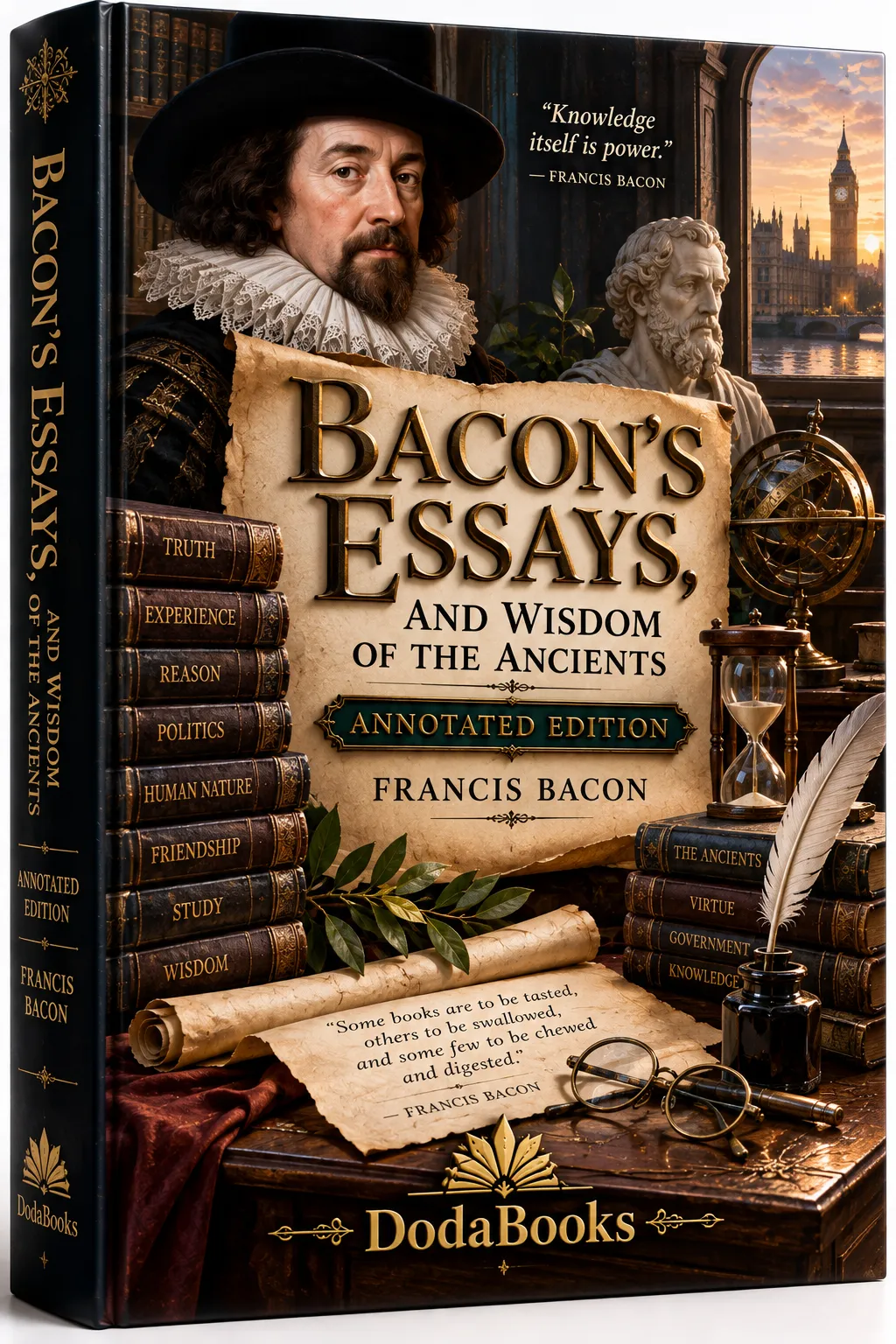
🏛️ Master Bacon’s Essays with Complete Reading Support
Never struggle with archaic vocabulary or untranslated Latin again. The DodaBooks Annotated Edition of Bacon’s Essays and Wisdom of the Ancients includes:
- ✅ Complete Authoritative Text — All 58 civil and moral essays plus all 31 mythological fables
- 📜 Complete In-Line Latin Translations — Every Roman quote translated in place
- ✒️ Renaissance Vocabulary Glosses — Explanations of archaic Elizabethan word shifts
- 🔒 100% DRM-Free Ownership — Read across Kindle, Kobo, iPad, and Android without limits
- 📥 Instant EPUB Delivery — Start your 14-day study journey immediately