For many modern readers—whether high school students preparing for AP U.S. History, university undergraduates encountering early American literature, or lifelong learners curious about America’s most charismatic Founding Father—picking up an 18th-century classic can feel intimidating. Images of powdered wigs, dense periodic sentences, and archaic Latinate legalisms often cause readers to wonder: Is Benjamin Franklin’s Autobiography hard to read?
The short answer is no—with a few manageable caveats. Compared to the dense, puritanical theological treatises of Cotton Mather or Jonathan Edwards, or the ornate philosophical treatises of Thomas Jefferson and Alexander Hamilton, Franklin’s prose is strikingly modern, breezy, humorous, and conversational. Franklin was, after all, a professional newspaper editor and popular almanac author who consciously cultivated what he called a “smooth, clear, and short” writing style designed for ordinary working tradesmen and farmers.
However, readers will encounter periodic 18th-century sentence structures, unfamiliar vocabulary, and specific political disputes in colonial Pennsylvania that require basic historical orientation. This comprehensive guide provides an honest assessment of Franklin’s reading difficulty, breaks down readability metrics and pacing, glosses key archaic terms, and provides actionable study strategies for classroom and independent reading.
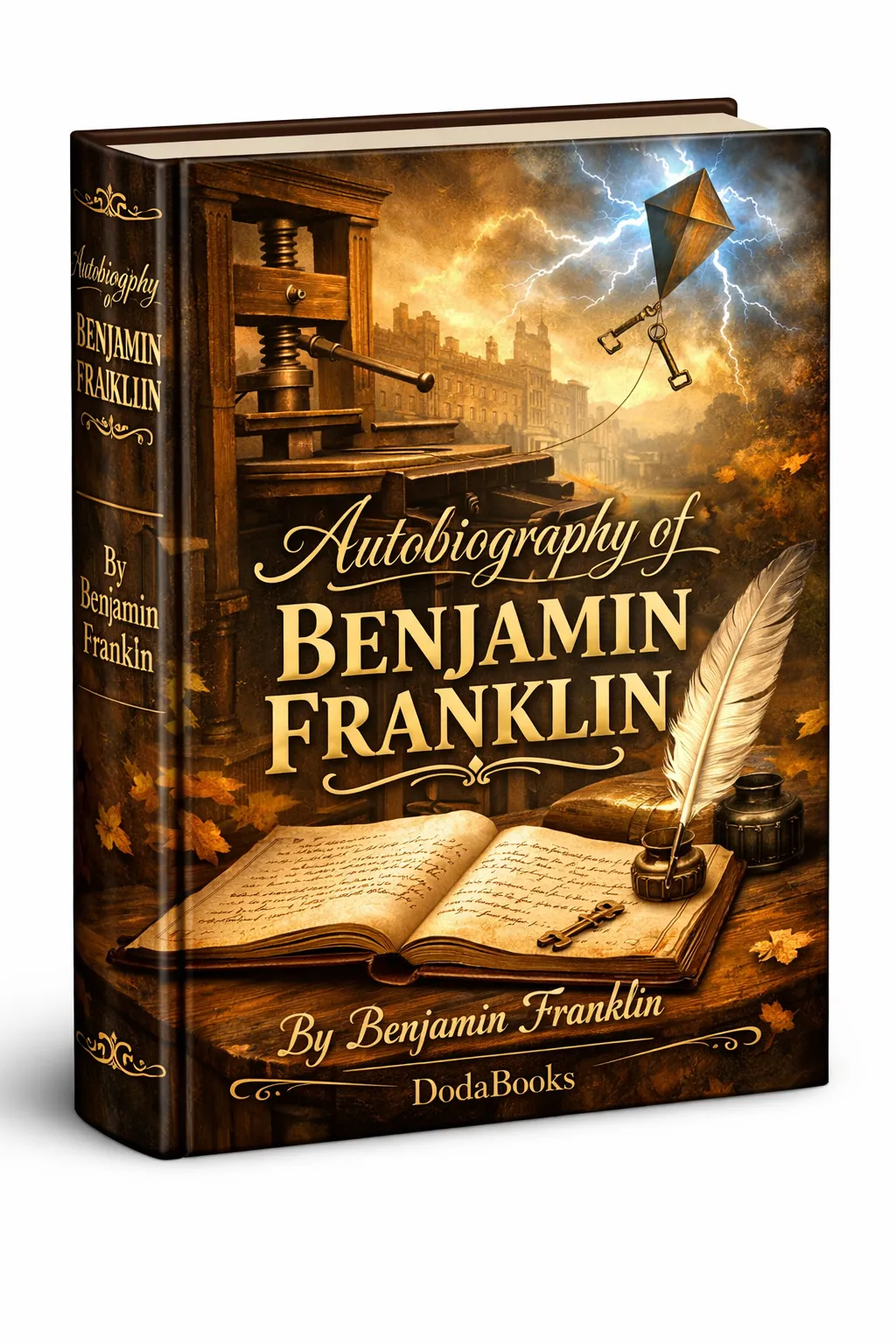
Franklin's Reading Difficulty & Guide
An objective analysis of Benjamin Franklin's Autobiography — examining readability scores, sentence architecture, vocabulary hurdles, reading time, and AP / college study questions.
📊 Reading Metrics at a Glance
| Metric | Score / Value | Context & Comparison |
|---|---|---|
| Lexile Measure | ~1000L – 1150L | Typical for 9th–11th grade literature; comparable to Frederick Douglass (~1040L) |
| Total Word Count | ~65,000 words | Moderate length; roughly the size of The Great Gatsby or Fahrenheit 451 |
| Estimated Reading Time | 6 to 8 hours | Read across 4 to 6 comfortable sittings at standard reading speed (200–250 wpm) |
| Tone & Style | Conversational, ironic, pragmatic | Intimate epistolary address with dry Enlightenment humor |
| Primary Difficulty | 18th-century punctuation & colonial politics | Parts 3 and 4 feature dense administrative and military logistics |
Why Franklin Is Far More Accessible Than His Contemporaries
Many readers lump Franklin into the same category as other 18th-century writers whose works can feel stiff and impenetrable. Yet Franklin wrote with a remarkably clean, unpretentious voice. There are three key historical reasons for this accessibility:
                  WHY FRANKLIN WRITES ACCESSIBLY
                                │
    ┌───────────────────────────┼───────────────────────────┐
    ▼                           ▼                           ▼
Journalistic Training       The Spectator Method        Egalitarian Philosophy
Decades running *The        Consciously modeled his     Believed prose should
Pennsylvania Gazette* and   voice on Addison & Steele:  instruct ordinary artisans
*Poor Richard's Almanac* clear, concise, and lively rather than flatter elites- The Practical Printer: Unlike British lords or university theologians who wrote to showcase classical Latin quotations, Franklin was a tradesman. He wrote for the Philadelphia shopkeeper, the blacksmith, and the farmer. If his prose wasn’t immediately understandable, his newspaper wouldn’t sell.
- The Spectator Method: As an adolescent apprentice, Franklin systematically trained himself by taking Joseph Addison’s essays from The Spectator, abstracting their arguments, and rewriting them in his own words to develop clarity, precision, and musical rhythm.
- Conversational Irony: Franklin writes not as an infallible deity lecturing from a mountaintop, but as a genial, grandfatherly friend sitting by a warm fireplace, recounting his youthful mistakes (“errata”) with self-deprecating wit.
Pacing Breakdown: Which Parts Are Easiest and Hardest?
Franklin’s Autobiography is composed of four distinct historical parts. Because each part was written at a different stage of his life for different audiences, the reading difficulty fluctuates significantly across the book:
                      READING DIFFICULTY BY PART
  Part 1 (Boston Youth & London Adventures)  ──► [  EASY & FUN  ]  ★★☆☆☆
  Part 2 (The 13 Virtues & Moral Perfection) ──► [ INTELLECTUAL ]  ★★☆☆☆
  Part 3 (Civic Projects, Science, Defense)   ──► [  MODERATE   ]  ★★★☆☆
  Part 4 (London Diplomatic Negotiations)    ──► [ DENSE/LEGAL  ]  ★★★★☆
1. Part One: Breezy, Picaresque, and Entertaining (Difficulty: 2/5)
Part One is universally considered the most engaging section of the book. Written in 1771 as a personal family letter to his son William, it moves rapidly through Franklin’s Boston boyhood, his vegetarian experiments, his rebellious flight from his brother’s print shop, his arrival in Philadelphia clutching three puffy bread rolls, and his wild, beer-soaked adventures in London print shops. It reads almost like an 18th-century coming-of-age novel.
2. Part Two: Highly Conceptual and Structured (Difficulty: 2/5)
Part Two introduces the famous “Bold and Arduous Project of Arriving at Moral Perfection.” It is philosophical rather than narrative, but its clean list format, operational maxims, and humorous parables (such as the customer with the speckled axe) make it completely accessible and immediately applicable to modern productivity and self-improvement enthusiasts.
3. Part Three: Dense Civic Logistics (Difficulty: 3/5)
In Part Three, Franklin turns from private life to public administration. While passages describing his electrical experiments, the invention of the lightning rod, and the legendary preaching of George Whitefield are thrilling, modern readers can occasionally bog down in the logistical minutiae of Pennsylvania colonial politics, military transport wagons for General Braddock, and the technical mechanics of Philadelphia street gutters.
4. Part Four: Legalistic and Abrupt (Difficulty: 4/5)
Part Four was composed while Franklin was eighty-three years old and dying of painful gout and kidney stones. It is heavily legalistic, detailing his diplomatic wrangling with the Penn family proprietors and the Privy Council over Pennsylvania assembly taxes. It ends mid-sentence without reaching the American Revolution.
18th-Century Linguistic Hurdles & Vocabulary Glossary
While Franklin’s vocabulary is largely recognizable, he uses several terms that carry different meanings in 18th-century prose. Below is a quick-reference glossary:
Common Historical Terms in Franklin's Autobiography:
├── Erratum / Errata:      Printer's term for typographical errors; Franklin's metaphor for moral mistakes.
├── Projector:             A promoter of civic schemes, business enterprises, or public institutions.
├── Journeyman:            A qualified tradesman who has finished apprenticeship but works for wages.
├── Indenture:             A legal binding contract obligating an apprentice or servant to a master.
├── Bagatelle:             A light, playful literary trifle or humorous short essay.
├── Proprietary:           Pertaining to the Penn family, the hereditary feudal landlords of Pennsylvania.
├── Junto:                 A private club or clique formed for mutual political and intellectual improvement.
├── Natural Philosophy:    The 18th-century term for physical science, particularly physics and chemistry.
├── Subscription:          A joint civic financial fund raised by pooling voluntary private contributions.
└── Venery:                Sexual intercourse or sexual activity (used in Virtue 12: Chastity).
Sentence Structure and Punctuation
Modern readers used to short, punchy digital sentences may occasionally stumble over Franklin’s periodic sentences—long clauses joined by semicolons, colons, and commas that hold the main verb until the end of the thought. The remedy is simple: read at an unhurried cadence, pausing naturally at semicolons as if Franklin were speaking aloud across a table.
5 Practical Tips for Mastering Franklin’s Autobiography
                         5 STRATEGIES FOR SUCCESS
                                    │
    ┌───────────────────┬───────────┴───────────┬───────────────────┐
    ▼                   ▼                       ▼                   ▼
Read Aloud at First Track the 4 Parts      Map the "Errata"    Focus on the Wit
Hear the natural    Recognize the shifting Note how he fixes   Enjoy the dry,
conversational      historical contexts    his mistakes in     ironic humor
rhythm of his voice from 1771 to 1790 later life proofs throughout Part 1- Read with an 18th-Century “Ear”: If a complex sentence seems tangled, whisper it aloud. Franklin’s prose was composed during an era of oral recitation; its clauses balance with natural rhetorical rhythm when vocalized.
- Treat the “Errata” as Narrative Anchors: Notice how Franklin catalogs his major errors: breaking his indenture with his brother James, printing his freethinking pamphlet in London, neglecting Deborah Read, and misusing Vernon’s money. Follow how his older self actively seeks to repair each error in subsequent chapters.
- Don’t Get Bogged Down in Part Four: Recognize in advance that Part Four is an unpolished fragment detailing a forgotten colonial tax dispute. Read it for Franklin’s sharp constitutional confrontation with Lord Granville, rather than expecting a grand narrative climax.
- Contrast Franklin’s Persona with Historical Reality: Franklin is not writing an unfiltered diary; he is constructing an idealized literary persona: the industrious, humble, self-made civic hero. Ask yourself where Franklin might be subtly polishing his own legend.
- Pair Your Reading with Clean Typography: Avoid blurry PDF scans or cluttered websites. Reading an 18th-century text is substantially easier when formatted with crisp margins, legible serif fonts, and properly rendered tables.
Discussion & Essay Questions for Students and Reading Groups
For AP U.S. History & American Studies:
- In what ways does Franklin’s Autobiography construct the archetypal myth of the “American Dream” and the “self-made man”? Where does his actual historical rise diverge from this myth?
- How do Franklin’s civic initiatives (the library, hospital, fire company, and militia) reflect Enlightenment political theory and the concept of the social contract?
- Analyze Franklin’s Albany Plan of Union (1754). Why did colonial assemblies and the British Crown both reject it, and how did it anticipate the U.S. Constitution?
For Literature & Philosophy Courses:
- How does Franklin’s concept of typographical “errata” secularize traditional Christian notions of sin, guilt, and redemption?
- Examine Franklin’s thirteenth virtue, Humility (“Imitate Jesus and Socrates”). Does Franklin achieve genuine humility, or does he master the art of displaying humility for rhetorical advantage?
- Analyze the parable of the Speckled Axe. What does this metaphor reveal about Franklin’s attitude toward psychological perfectionism and human fallibility?
Related Guides & Reading Pathways
- Autobiography of Benjamin Franklin: A Complete Guide — Complete overview of Franklin’s life, political career, and transatlantic legacy.
- Part-by-Part Summary & Chapter Breakdown — Detailed structural analysis of Parts 1, 2, 3, and 4.
- The 13 Virtues & Moral Philosophy Analysis — In-depth philosophical critique of Franklin’s moral accounting system and Enlightenment utilitarianism.
- Where to Buy Benjamin Franklin’s Autobiography: Best Editions — Critical evaluation of print and digital editions.
🖋️ Read Franklin with Effortless Clarity
Experience Benjamin Franklin’s immortal Autobiography in a digital edition engineered for pure readability. No archaic OCR glitches, no broken tables, and zero distractions:
- 📖 The Complete Unabridged Text — Restored from the authentic 4-part manuscript
- ✒️ Polished Typography — Flawless table formatting for the 13 Virtues and Daily Scheme
- 📱 Universal DRM-Free EPUB — Read comfortably on Kindle, Kobo, iPad, iPhone, and Android
- 🔒 Direct Instant Download — Keep your books forever on your own devices