Is Andersen's Fairy Tales Hard to Read? Reading Difficulty & Study Guide
For parents, teachers, and classic literature readers approaching Hans Christian Andersen’s Fairy Tales (Eventyr), a natural question arises: how difficult is it to read Hans Christian Andersen today? Are his stories strictly simple nursery tales suitable for young children, or do they possess the linguistic complexity and emotional gravity of serious adult nineteenth-century literature?
The short answer is that Andersen’s Fairy Tales are exceptionally accessible on the surface, earning an overall difficulty rating of 4.0 out of 10 (Accessible). Unlike dense Victorian prose or Early Modern verse, Andersen wrote in an intimate, conversational Danish style that translates into clear, lively English.
However, Andersen’s tales are famous for their dual reading levels: a child can enjoy the magical adventures of mermaids, snow queens, and ducklings, while an adult reader will encounter complex Christian existentialism, dark psychological melancholy, and biting satire of social class and vanity.
This comprehensive guide analyzes the Lexile reading measure, vocabulary hurdles, sentence structures, and philosophical dimensions of Andersen’s masterpieces, providing a practical 14-day reading schedule and actionable strategies for mastering the tales.
| Metric | Rating / Value | Analysis & Comparison |
|---|---|---|
| Overall Difficulty | 4.0 / 10 (Accessible) | Highly engaging; accessible to middle schoolers, deeply rewarding for adults |
| Lexile Reading Measure | 910L – 1020L | Equivalent to C.S. Lewis’s The Chronicles of Narnia (940L) |
| Average Reading Time | 5 to 7 Hours | Anthology of episodic tales (~50,000–60,000 words for core tales) |
| Primary Challenge | Emotional Melancholy & Christian Allegory | Navigating unrequited love, physical suffering, and spiritual redemption |
| Primary Strength | Lyrical, Conversational Storytelling | Vivid imagery, lively dialogue, and episodic story structure |
| Recommended Edition | Annotated Edition | Clarifies Danish folklore, 19th-century context, and biographical motifs |
📊 Reading Difficulty Breakdown by Category
To understand what makes Andersen’s fairy tales uniquely rewarding and where unassisted readers might encounter hurdles, we evaluate the text across four key dimensions:
1. Vocabulary and Syntax (Rating: 3.5 / 10)
Andersen was a pioneer in using everyday colloquial language in literature. In nineteenth-century Denmark, formal literature was written in stiff, Latinate prose. Andersen deliberately rejected this convention, writing as if he were speaking directly to a listener sitting beside his chair.
As a result, the vocabulary is clear and imaginative. Readers will rarely encounter obscure archaic words. The specialized terminology that does appear is related to nineteenth-century rural Scandinavian life and folklore:
- Domestic & Folkloric Terms: Burdock leaves, peat-moss, tinder-box, snuff-box, spindles, porridge, eiderdown, distaff.
- Geographical & Mythological Elements: Spitsbergen, Finmark, Lapland, trolls, nixies, Daughters of the Air.
Unlike the complex periodic sentences of Victor Hugo or Herman Melville, Andersen’s sentences are rhythmic, clear, and direct.
2. Dual Reading Levels: Children vs. Adults (Rating: 5.5 / 10)
The true complexity of Andersen lies not in his vocabulary, but in his thematic and philosophical subtext. Andersen famously explained:
“I seize on an idea for older people—and then tell the story to the little ones, remembering that father and mother are often listening, and one must give them something for their thought too.”
- The Child’s Reading Experience: Children engage with the vivid narrative surfaces—the colorful underwater palace of the mermaids, the talking crows and reindeer in The Snow Queen, the miraculous swan transformation in The Ugly Duckling, and the humorous naked emperor.
- The Adult’s Reading Experience: Adult readers perceive the harrowing psychological and spiritual undercurrents—the Little Mermaid’s excruciating physical agony as a metaphor for unrequited love; Kai’s frozen heart as an indictment of sterile intellectualism; and the Emperor’s new clothes as a chilling dissection of social conformity and political sycophancy.
3. Pacing and Narrative Variety (Rating: 2.5 / 10)
Pacing is one of the greatest pleasures of reading Andersen. Because each tale is an independent, self-contained narrative, readers never feel bogged down. Tales range from short, punchy satirical fables like The Princess and the Pea (around 400 words) and The Emperor’s New Clothes (around 1,500 words) to sprawling, epic pilgrimages like The Snow Queen (seven chapters totaling around 8,000 words).
This episodic structure makes Andersen ideal for daily reading, bedtime storytelling, or classroom study.
4. Emotional Melancholy and Darkness (Rating: 6.0 / 10)
The primary challenge for modern readers—especially those raised on sanitized cartoon adaptations—is the uncompromising emotional darkness of Andersen’s authentic texts.
Readers accustomed to tidy, cheerful endings may be surprised to find:
- The Little Mermaid does not marry the prince; she suffers constant physical agony and turns into sea foam before ascending to the Daughters of the Air.
- The Steadfast Tin Soldier and his paper ballerina are burned alive in a roaring stove, reduced to a melted tin heart and a charred spangle.
- The Little Match Girl freezes to death on New Year’s Eve in a dark, indifferent city alley.
These endings are not gratuitously cruel; they reflect Andersen’s profound Christian belief that earthly life is a temporary pilgrimage of trial and that true fulfillment is spiritual and eternal. Preparing readers for this melancholy beauty is essential for appreciating his genius.
📈 Andersen vs. Other Classic Storytellers
To see where Andersen fits within the landscape of classic fantasy and fairy literature, compare his reading difficulty with other classic works:
| Work | Author | Form / Era | Difficulty Rating | Typical Challenges |
|---|---|---|---|---|
| Grimms’ Fairy Tales | Brothers Grimm | Peasant Folklore (1812) | 3.5 / 10 | Violent peasant morality, repetitive plot structures |
| Andersen’s Fairy Tales | Hans Christian Andersen | Literary Fairy Tales (1835) | 4.0 / 10 | Emotional melancholy, Christian allegory, dual meaning |
| The Chronicles of Narnia | C.S. Lewis | Children’s Fantasy (1950) | 4.0 / 10 | Mid-century British idioms, overt religious allegory |
| The Hobbit | J.R.R. Tolkien | High Fantasy (1937) | 5.0 / 10 | World-building, invented geography, Nordic verse |
| Alice’s Adventures in Wonderland | Lewis Carroll | Victorian Nonsense (1865) | 5.5 / 10 | Victorian parodies, wordplay, mathematical logic |
| Gulliver’s Travels | Jonathan Swift | Enlightenment Satire (1726) | 7.5 / 10 | 18th-century political satire, complex archaic prose |
🗓️ The 14-Day Reading Plan: Exploring the Masterpieces
Because Andersen’s tales are episodic, this 14-day schedule allows readers to experience his greatest works comfortably in 15 to 25 minutes per day:
| Day | Tale / Section | Key Narrative Focus | Major Thematic Discussion |
|---|---|---|---|
| Day 1 | The Tinder-Box & The Princess and the Pea | Danish folklore roots, soldier cunning, sensitivity test | Social mobility and satirical humor |
| Day 2 | Thumbelina | Nature adventures, escaping forced marriage | Finding one’s true community among equals |
| Day 3 | The Little Mermaid (Part 1) | The underwater kingdom, longing for an immortal soul | The contrast between mortal souls and sea foam |
| Day 4 | The Little Mermaid (Part 2) | The Sea Witch’s knife bargain, the silent sacrifice | Unrequited love, martyrdom, Daughters of the Air |
| Day 5 | The Emperor’s New Clothes | The invisible weavers, courtiers’ fear, child’s truth | Social conformity, vanity, political sycophancy |
| Day 6 | The Steadfast Tin Soldier | One-legged soldier, paper ballerina, stove furnace | Stoic duty, unyielding fidelity in tragic fate |
| Day 7 | The Wild Swans (Part 1) | Eleven swan brothers, wicked stepmother, stinging nettles | Patient endurance and female self-sacrifice |
| Day 8 | The Wild Swans (Part 2) | Silent shirt-weaving, the witch stake, vindication | True innocence triumphing over false accusations |
| Day 9 | The Nightingale | Natural song vs. mechanical clockwork bird | Authentic artistry vs. synthetic royal flattery |
| Day 10 | The Ugly Duckling | Persecution in the barnyard, freezing winter, the swan | Personal resilience and spiritual transformation |
| Day 11 | The Snow Queen (Stories 1–3) | The devil’s looking-glass, Kai’s cold heart, flower garden | Cynical reductionism vs. innocent memory |
| Day 12 | The Snow Queen (Stories 4–5) | The royal court, forest robber girl, Lapland reindeer | The worldwide pilgrimage of childlike love |
| Day 13 | The Snow Queen (Stories 6–7) | The Finn woman, the ice palace of “Eternity”, the thaw | Faith melting frozen intellect; spiritual victory |
| Day 14 | The Little Match Girl & The Red Shoes | Striking matches in the snow, vanity of dancing shoes | Earthly poverty and celestial transcendence |
For a deeper dive into the characters and allegorical motifs, explore our Andersen’s Fairy Tales Characters & Themes Guide.
💡 5 Pro Strategies for Reading Andersen with Ease
- Read with an Open Heart for Melancholy: Do not expect conventional Hollywood endings. Embrace Andersen’s poetic sadness as an essential component of his spiritual art.
- Look for the Autobiographical Clues: Remember that The Ugly Duckling was Andersen’s own life story, that The Little Mermaid was written after his beloved friend Edvard Collin married someone else, and that The Nightingale celebrated singer Jenny Lind.
- Choose an Unexpurgated Annotated Edition: As detailed in our Where to Buy Guide, avoid censored Victorian editions that erased dark scenes and religious philosophy. An annotated edition provides crucial context on Danish folk beliefs.
- Read Key Tales Aloud: Andersen originally performed his tales orally for gatherings of friends and royal families before publishing them. Reading aloud reveals his comedic pauses, rhythmic phrasing, and playful narrator asides.
- Discuss the Dual Meanings: If reading with children, discuss the moral of each story together. Ask what the child in The Emperor’s New Clothes represents, or why Kai couldn’t solve the ice puzzle without Gerda’s tears.
❓ Frequently Asked Questions
At what age should children start reading Andersen's original tales?
Children aged 8 to 11 can comfortably enjoy tales like The Emperor's New Clothes, Thumbelina, and The Ugly Duckling. More complex and emotionally intense tales like The Little Mermaid, The Snow Queen, and The Little Match Girl are best appreciated by readers aged 11 and up, as well as adults.
Are Andersen's tales religious?
Yes. Hans Christian Andersen was a devout Christian, and Christian themes—immortal souls, prayer, divine grace, and resurrection—form the spiritual backbone of tales like The Little Mermaid, The Snow Queen, and The Little Match Girl. Victorian translations often distorted his open, poetic faith into rigid moral dogmatism, but his original texts celebrate a compassionate, all-embracing divine love.
Why did Kai have to spell the word "Eternity"?
The Snow Queen promised Kai his freedom if he could spell "Eternity" using slabs of ice. This represents the human intellect attempting to comprehend divine mystery through cold, sterile logic alone. Kai cannot do it because his heart is frozen. When Gerda’s loving tears thaw his heart, the ice slabs assemble themselves effortlessly, demonstrating that eternity is understood through love, not logic.
How does Andersen's writing style differ from English Victorian writers?
English Victorian writers (like Charles Dickens or William Makepeace Thackeray) often used elaborate, multi-clause sentences and formal rhetoric. Andersen used a revolutionary, intimate conversational style with short sentences, expressive interjections, and direct address to the reader, making his tales feel remarkably modern and immediate.
Which translation is best for young students and general readers?
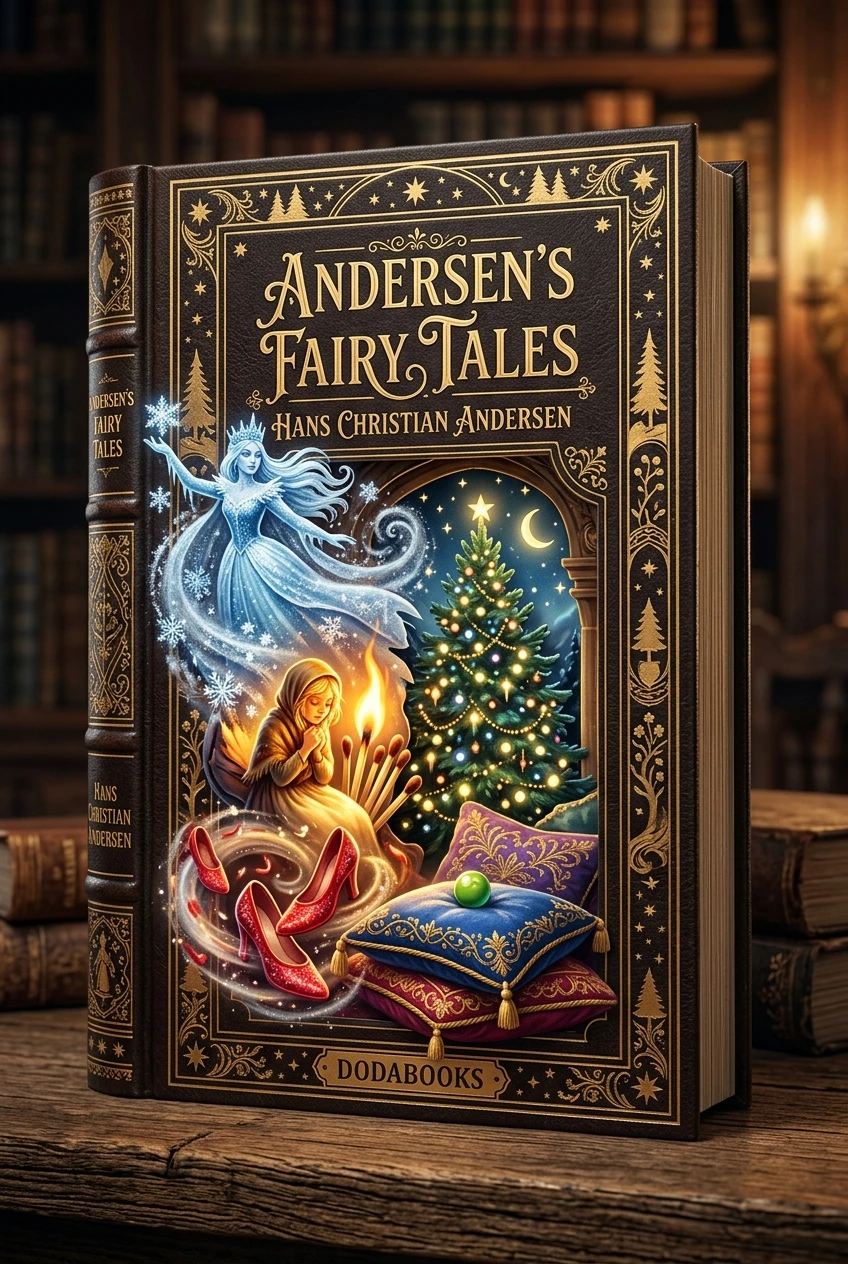
We recommend avoiding Victorian public-domain reprints. The DodaBooks Annotated Edition features the complete unabridged classic tales, rich annotations on folklore and biography, clean digital typography, and 100% DRM-free open EPUB ownership.
❄️ Master Hans Christian Andersen with Complete Ease
Rediscover the poetic majesty of world literature’s greatest storyteller. The DodaBooks Annotated Edition of Andersen’s Fairy Tales delivers:
- ✅ Complete Unabridged Classics — Unexpurgated texts capturing Andersen’s true literary voice
- 📜 Biographical & Folkloric Annotations — Explaining Odense history, Jenny Lind, and Christian allegory
- ✒️ Distraction-Free E-Reader Formatting — Formatted cleanly for effortless reading
- 🔒 100% DRM-Free Open Ownership — Keep your EPUB forever on Kindle, Kobo, and Apple Books
- 📥 Instant Direct Download — Start reading within seconds of ordering