Is Alice in Wonderland Hard to Read? Reading Difficulty & Level Guide
Because Alice’s Adventures in Wonderland (1865) is frequently classified as a children’s classic, many modern readers assume it will be an effortless, breezy walk in the park. Parents buying it for elementary schoolers, high schoolers encountering it on reading lists, and adults revisiting it often find themselves caught off guard. While the prose flows with charming speed, the text is densely saturated with Victorian puns, archaic nursery idioms, Oxford academic inside jokes, and intricate mathematical paradoxes.
Is Alice’s Adventures in Wonderland hard to read? The short answer: No, it has an accessible difficulty rating of 4.0 / 10.
At approximately 27,500 words across 12 chapters, it is shorter than a standard modern novella and can comfortably be read in two to three hours. However, readers often encounter three specific comprehension stumbling blocks:
- Satirical Nursery Parodies: Almost every poem Alice recites is a parody of a didactic 19th-century schoolroom poem that modern readers have never heard of.
- Linguistic Double Meanings & Wordplay: The dialogue frequently literalizes common English idioms (e.g., “murdering the time,” “taking care of the sense”).
- Dream Logic and Disorienting Shifts: The narrative operates under non-linear dream causality rather than traditional plot momentum.
This comprehensive guide breaks down the true reading level of Alice in Wonderland, maps out the specific hurdles to watch for, compares it to other classics, and provides a smooth 3-day reading plan.
⚡ Alice in Wonderland Reading Difficulty: At a Glance
- Difficulty Rating: 4.0 / 10 (Gentle & Engaging) — Considerably easier than Frankenstein (6.5/10) or The Call of Cthulhu (6.5/10), and more accessible than Pride and Prejudice (5.5/10).
- Length: Approximately 27,500 words across 12 chapters (about 120–150 pages in standard paperback print).
- Estimated Reading Time: 2 to 3 hours for an adult reader; 4 to 5 hours for an independent middle-grade reader.
- Lexile Measure & Grade Level: Lexile measure roughly 860L–950L (Grades 5–8 / Ages 10–13 for independent reading). Great as a read-aloud for younger children (Ages 6–9).
- Primary Stumbling Blocks: Obscure Victorian schoolroom parodies, linguistic puns and literalized idioms, and non-sequitur dialogue based on formal philosophical logic.
🧗 The 4 Specific Hurdles for Modern Readers
While Carroll’s prose is remarkably direct and devoid of the massive, convoluted periodic sentences found in Charles Dickens or George Eliot, first-time readers will appreciate context on four specific literary techniques:
1. Parodies of Forgotten Victorian Schoolroom Poems
In 1865, every British child was forced to memorize and recite pious, morally upright poems designed to instill industry, obedience, and fear of godliness. Carroll gleefully subverted these exact verses:
+-----------------------------------------------------------------------------------------------+
|                       CARROLL'S SUBVERSIVE SCHOOLROOM POETRY PARODIES                         |
+--------------------------+------------------------------+-------------------------------------+
| CHAPTER & CARROLL'S POEM | ORIGINAL VICTORIAN HYMN      | WHAT CARROLL'S PARODY REVEALS       |
+--------------------------+------------------------------+-------------------------------------+
| Ch. 2: "How doth the     | Isaac Watts, "Against        | Watts taught children to be busy and|
| little crocodile..."     | Idleness and Mischief" (1715)| moral like the bee; Carroll's croc  |
|                          | ("How doth the little busy   | smiles cheerfully while devouring   |
|                          | bee improve each shining hr")| unsuspecting little fish.           |
+--------------------------+------------------------------+-------------------------------------+
| Ch. 5: "You are old,     | Robert Southey, "The Old     | Southey praised piety and sobriety  |
| Father William..."       | Man's Comforts" (1799)       | in youth; Carroll's Father William  |
|                          |                              | somersaults over doors and chews    |
|                          |                              | whole geese with his jaw.           |
+--------------------------+------------------------------+-------------------------------------+
| Ch. 6: "Speak roughly to | David Bates, "Speak Gently"  | Bates preached calm, gentle speech; |
| your little boy..."      | (1848)                       | the Duchess violently shakes her    |
|                          |                              | sneezing infant and beats him.      |
+--------------------------+------------------------------+-------------------------------------+
| Ch. 7: "Twinkle, twinkle,| Jane Taylor, "The Star"      | Taylor wrote the classic bedtime gem|
| little bat..."           | (1806)                       | Carroll turns the star into a flying|
|                          |                              | tea-tray soaring through the sky.   |
+--------------------------+------------------------------+-------------------------------------+
| Ch. 10: "'Tis the voice  | Isaac Watts, "The Sluggard"  | Watts warned against sleeping late; |
| of the Lobster..."       | (1715)                       | Carroll transforms the sinner into  |
|                          |                              | a conceited lobster sugaring hair.  |
+--------------------------+------------------------------+-------------------------------------+
How to conquer it: You do not need to read Isaac Watts or Robert Southey beforehand. Simply realize that when Alice begins reciting poetry, she is trying to recite a serious, pious lesson, and Wonderland’s chaotic subconscious is actively warping the moral into hilarious, nonsensical rebellion.
2. Literalized Idioms and Semantic Traps
Carroll was an Oxford don who lectured in mathematics and formal logic at Christ Church. He was fascinated by the ways everyday conversational language breaks down when subjected to strict literal analysis:
- “Catching” a Cold: In Chapter 3, the birds are wet, and Alice worries about catching a cold. Characters treat “cold” as a physical quarry to be hunted.
- “Murdering” Time: The Hatter explains that he quarreled with Time because he was “murdering the time” while singing at the Queen’s concert. Time takes this as a personal assault and refuses to move, freezing the hour at 6:00 PM forever.
- “Take some more tea”: When the March Hare urges Alice to “take some more tea,” Alice responds that she hasn’t had any yet, so she cannot take more. The Hatter snidely corrects her: “You mean you can’t very well take LESS; it’s very easy to take MORE than nothing.”
How to conquer it: Enjoy the pedantry! Wonderland characters behave like strict legalistic philosophers who take every figure of speech with 100% literal precision.
3. Victorian Currency and Culinary Oddities
Several domestic references reflect everyday 1860s British household items that have disappeared from contemporary life:
- Treacle: Thick, golden syrup or black molasses (the three little sisters live at the bottom of a “treacle-well” in Chapter 7).
- Whiting: A small European marine fish closely related to the cod, traditionally served with its tail curled into its mouth (Chapter 10).
- Comfits: Sugar-coated seeds, dried fruits, or nuts, common as sweetmeats (Alice distributes these as prizes in the Caucus-Race in Chapter 3).
- Kid Gloves: Delicate gloves made from the skin of a young goat, essential attire for any Victorian gentleman attending a formal event (the White Rabbit drops his in Chapter 2).
4. Dream Logic and Non-Linear Pacing
Unlike standard adventure stories with clear villains, escalating stakes, and a quest objective, Alice’s Adventures in Wonderland is structured on episodic dream logic. Alice wanders from one surreal encounter to another. Conflicts do not resolve through combat or diplomacy; they simply dissolve as Alice changes size or walks into another part of the woods.
How to conquer it: Accept that the pleasure of the book lies in its dialogue, wordplay, and philosophical humor rather than an action-packed plot.
📊 How Hard Is Alice in Wonderland Compared to Other Classics?
+-----------------------------------------------------------------------------------------------+
|                            CLASSIC NOVELS DIFFICULTY BENCHMARK                                |
+-----------------------------+-------------+------------+--------------------------------------+
| BOOK & AUTHOR               | DIFFICULTY  | WORD COUNT | PRIMARY COMPREHENSION CHALLENGE      |
+-----------------------------+-------------+------------+--------------------------------------+
| Alice in Wonderland         | 4.0 / 10    | ~27,500    | Victorian parodies, wordplay,        |
| (Lewis Carroll)             | (Accessible)|            | mathematical logic puzzles           |
+-----------------------------+-------------+------------+--------------------------------------+
| Anne of Green Gables        | 4.5 / 10    | ~104,000   | Lyrical nature descriptions;         |
| (L.M. Montgomery)           | (Accessible)|            | longer domestic narrative arc        |
+-----------------------------+-------------+------------+--------------------------------------+
| Little Women                | 5.0 / 10    | ~185,000   | 185k words; 1860s domestic terms;    |
| (Louisa May Alcott)         | (Accessible)|            | John Bunyan allegorical references   |
+-----------------------------+-------------+------------+--------------------------------------+
| Pride and Prejudice         | 5.5 / 10    | ~122,000   | Regency conversational irony;        |
| (Jane Austen)               | (Moderate)  |            | formal syntactic sentence balance    |
+-----------------------------+-------------+------------+--------------------------------------+
| Frankenstein                | 6.5 / 10    | ~75,000    | High Romantic Latinate vocabulary;   |
| (Mary Shelley)              | (Challenging|            | nested epistolary framing            |
+-----------------------------+-------------+------------+--------------------------------------+
| The Call of Cthulhu         | 6.5 / 10    | ~12,000    | Dense eldritch vocabulary;           |
| (H.P. Lovecraft)            | (Challenging|            | non-Euclidean geometries             |
+-----------------------------+-------------+------------+--------------------------------------+
As the comparison reveals, Alice’s Adventures in Wonderland is one of the most accessible 19th-century classics available, ranking far below Gothic and Victorian adult novels in syntactic complexity.
📅 The Effortless 3-Day Alice Reading Schedule
At only 27,500 words, Alice in Wonderland can be read in three comfortable, 45-minute sessions. This schedule divides the book into its three natural dramatic movements:
+-----------------------------------------------------------------------------------------------+
|                              THE 3-DAY ALICE IN WONDERLAND PLAN                               |
+-----+-------------+------------------------------------+--------------------------------------+
| DAY | CHAPTERS    | THEMATIC FOCUS                     | READING TIME                         |
+-----+-------------+------------------------------------+--------------------------------------+
| 1   | Ch. 1–4     | The Descent & Identity Shifting:   | ~45 minutes (Chapters 1–4, ~8,500 w) |
|     |             | Rabbit-hole, tear pool, race       |                                      |
+-----+-------------+------------------------------------+--------------------------------------+
| 2   | Ch. 5–8     | The Eccentric Encounters:          | ~50 minutes (Chapters 5–8, ~10,000 w)|
|     |             | Caterpillar, pepper, mad tea-party |                                      |
+-----+-------------+------------------------------------+--------------------------------------+
| 3   | Ch. 9–12    | The Institutional Parodies:        | ~45 minutes (Chapters 9–12, ~9,000 w)|
|     |             | Mock turtle, quadrille, trial      |                                      |
+-----+-------------+------------------------------------+--------------------------------------+
Day 1: Chapters 1–4 (Falling, Shrinking & The Caucus-Race)
Follow Alice down the rabbit-hole, through the pool of tears, into the hilarious political bureaucracy of the Caucus-Race, and her entrapment as a giant in the White Rabbit’s cottage. Pay attention to how her inability to control her bodily scale symbolizes childhood vulnerability.
Day 2: Chapters 5–8 (The Caterpillar, The Kitchen & The Mad Tea-Party)
Witness the philosophical core of the book: the Caterpillar’s existential grilling, the Duchess’s chaotic pepper kitchen, the smiling Cheshire Cat, and the brilliant wordplay of the Mad Tea-Party. Notice how the Hatter and March Hare manipulate language to trap Alice in logical contradictions.
Day 3: Chapters 9–12 (The Mock Turtle, The Trial & Awakening)
Explore the satire of Oxford academics in the Mock Turtle’s school recollections, followed by the chaotic courtroom farce of the stolen tarts. Watch as Alice outgrows the courtroom, exposes the playing-card court as powerless paper, and awakens to the sunny riverbank.
💡 4 Tips for Maximum Comprehension & Enjoyment
- Read the Dialogue Aloud: Lewis Carroll wrote Alice as an oral tale told to the three Liddell sisters during a rowing trip up the Thames. Reading the dialogue aloud brings the rhythmic wordplay, accents, and puns to life.
- Don’t Try to Force Logic: If a scene feels completely irrational, that is the deliberate point. Alice is a child of the Age of Reason trying to apply Newtonian physics and social manners to a realm that rejects both.
- Compare the Parodied Verses: Taking a quick peek at the original hymns Carroll was spoofing (such as Isaac Watts’s bee hymn) turns an already funny poem into a stroke of satirical genius.
- Choose an Edition with Integrated Notes: Rather than flipping to the back of a textbook for dry academic footnotes, choose an edition with clean, inline color-coded cards that explain jokes right where they occur.
❓ Frequently Asked Questions
At what age should a child read Alice in Wonderland independently?
Children aged 10–12 (grades 5–7) can comfortably read Alice in Wonderland independently. Younger children (ages 6–9) enjoy it immensely when read aloud by an adult who can help explain Victorian idioms and voice the eccentric characters.
Is Alice in Wonderland confusing for modern readers?
The main plot is straightforward, but the humor can be confusing if you expect conventional logic. Once you understand that Wonderland operates on linguistic literalism and schoolroom parodies, the confusion disappears and becomes pure comedy.
How many pages is Alice's Adventures in Wonderland?
Standard print paperbacks range between 120 and 160 pages, depending on font size, margins, and whether Sir John Tenniel’s 42 illustrations are included. At 27,500 words, it is roughly one-fourth the length of Pride and Prejudice.
Do I need to read Through the Looking-Glass as well?
No. Alice’s Adventures in Wonderland is a self-contained, complete story that concludes with Alice waking on the riverbank. While Through the Looking-Glass (1871) is a wonderful sequel featuring the chess match, Tweedledum and Tweedledee, and Humpty Dumpty, Wonderland stands entirely on its own.
Where can I find an annotated edition with vocabulary notes?
The DodaBooks Annotated & Illustrated Edition provides child- and reader-friendly color-coded cards that clarify archaic words, puns, and historical parodies without interrupting the reading flow.
📚 Related Articles
Exploring more classic novels and difficulty guides? Read our Little Women Reading Difficulty Guide or our The Call of Cthulhu Reading Difficulty Guide.
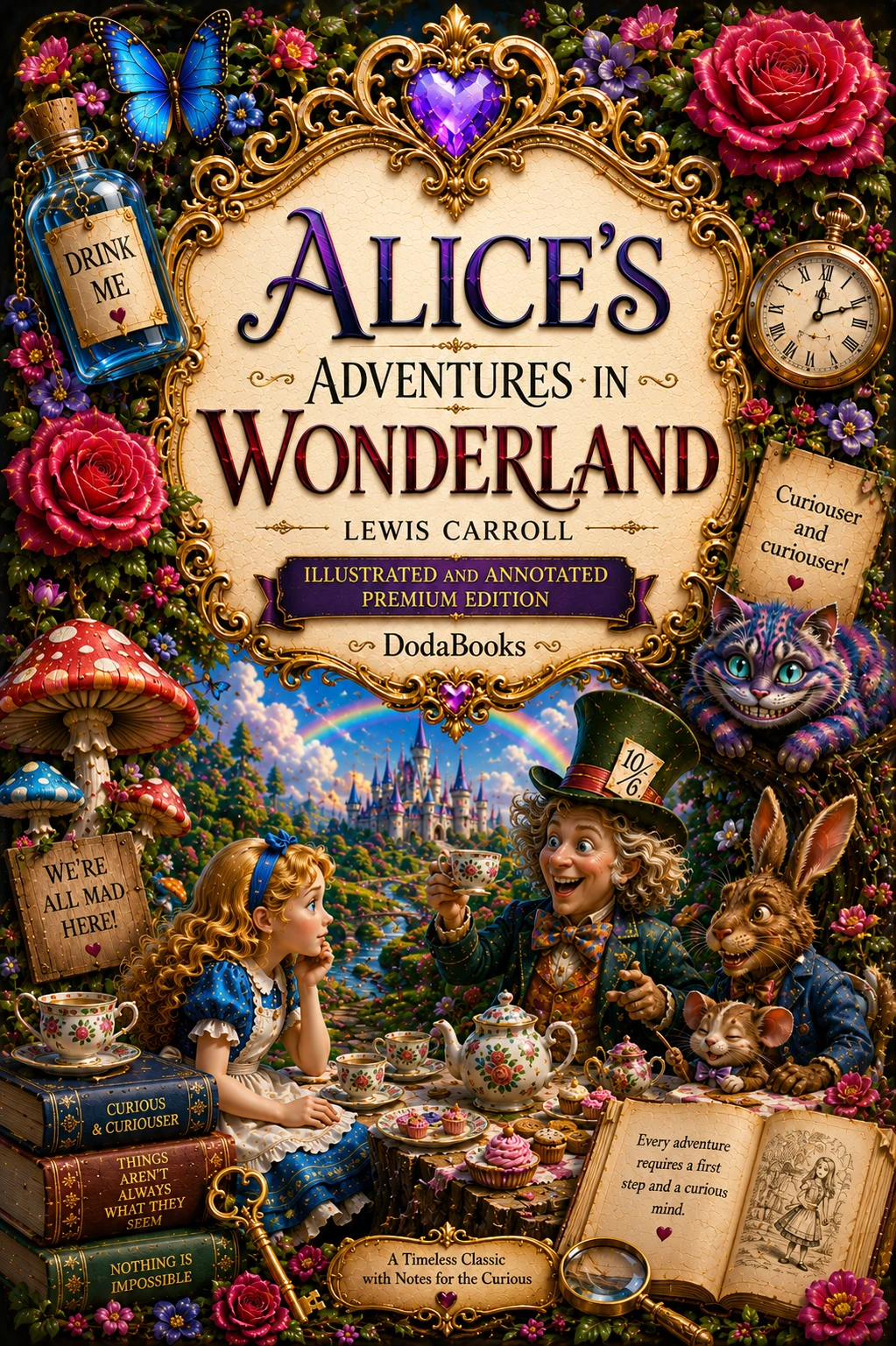
🐇 Read Wonderland With Every Mystery Decoded
Enjoy Carroll’s classic with seamless reading support built into every chapter:
- 🎨 20+ exclusive original illustrations that bring the tea-party and trial to life
- 🗂️ Integrated vocabulary & parody notes — understand every Victorian pun instantly
- 🗺️ Illustrated Wonderland Map — keep track of Alice’s subterranean journey
- 🔒 DRM-free EPUB — open and read on Kindle, Kobo, iPad, or any phone
- 📥 Instant digital download delivered directly after purchase